Mechanical Aptitude Test Questions: 12 Worked Examples by Concept
Mechanical aptitude test practice questions by concept: pulleys, gears, levers, fluids, springs and pressure. 12 worked examples with the reasoning shown.

Mechanical aptitude test practice questions are drawn from a small, stable set of physical principles: pulleys, gears, levers, fluids, springs and pressure. Most items you will see on a Bennett, Ramsay, Wiesen or apprenticeship paper are one of those six ideas dressed in a different picture. The fastest way to prepare is to learn the rule behind each concept once and then recognise it through any diagram, rather than grinding hundreds of random questions. Below are 12 worked examples, two per concept, each with the answer and the working that produces it.
Quick takeaways
- Six concepts cover most items: pulleys, gears, levers, fluids, springs, pressure. Some tests add extras such as simple circuits or tool identification.
- A movable pulley halves the force because two rope segments share the load. Counting supporting segments answers most pulley items.
- Meshed gears alternate direction, and speed is inversely proportional to tooth count.
- Levers are solved by moments: force times distance, equal on both sides.
- Pressure in a static liquid depends on depth, not on how wide the container is. This is the classic trap answer.
- The physics is the same across tests. The item count, the clock and the picture style are what change.
The six concepts, and what each one actually tests
Every item asks whether you can identify the principle before the clock runs out. Learn the rule, and the diagram stops mattering.
| Concept | The rule that solves it | The trap answer to avoid |
|---|---|---|
| Pulleys | Count the rope segments supporting the moving load. That number is the mechanical advantage. | Assuming a single fixed pulley makes the load lighter |
| Gears | Each mesh reverses direction. Fewer teeth means faster and weaker. | Picking the bigger gear as the faster one |
| Levers | Moments balance: force times distance equals force times distance. | Comparing the weights without multiplying by distance |
| Fluids | Pressure transmits equally (Pascal). Narrower pipe means faster flow. | Thinking water slows down where the pipe narrows |
| Springs | Extension is proportional to force. Parallel springs share load, series springs add travel. | Assuming two springs side by side stretch further |
| Pressure | Pressure equals force divided by area, and liquid pressure depends on depth. | Choosing the container that holds more liquid |
For more diagrams sorted by concept, see the mechanical reasoning question types page.
The 12 worked examples
Work each one by hand before reading the answer: cover the solution, sketch the setup on scrap paper, name the principle, then solve it without a calculator in about 30 seconds. That is close to the real pace on all three branded tests.
Once you can do all twelve cleanly, run the same skills at full test speed with a free Bennett mechanical practice simulation: 55 timed items in the current BMCT-II format.
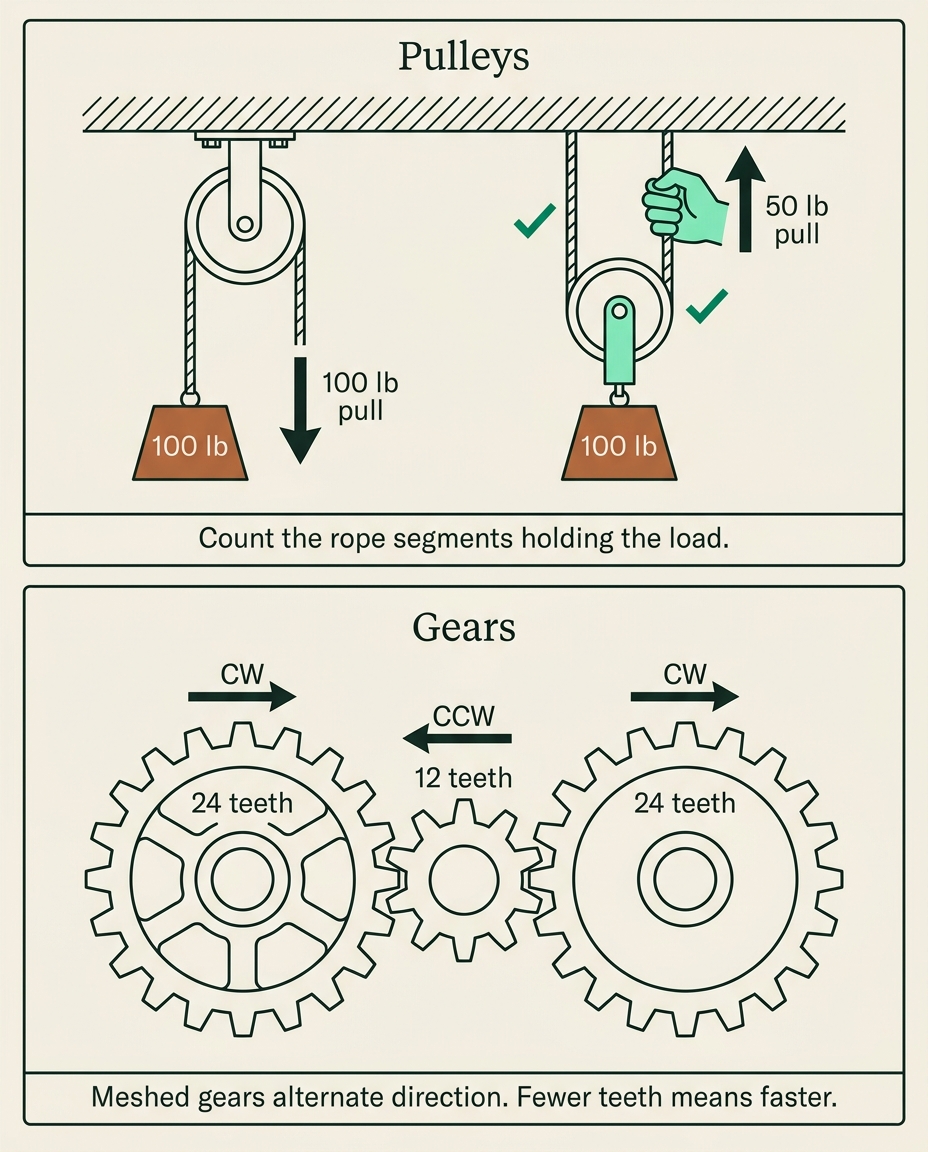
1. A fixed pulley (mechanical advantage 1)
A 100 lb crate hangs from a rope running over a single pulley bolted to a ceiling beam. You pull the free end down. How much force holds the crate steady?
Answer: 100 lb. A fixed pulley changes the direction of your effort, nothing else. Only one rope segment supports the crate, so the mechanical advantage is 1 and the force is 100 ÷ 1 = 100 lb. Pulling down is more comfortable, not lighter.
2. A movable pulley (mechanical advantage 2)
The same 100 lb crate now hangs from a movable pulley. The rope is anchored to the beam at one end, passes under the pulley, and you pull the other end upward. How much force do you need?
Answer: 50 lb. Two rope segments now run up from the pulley, one to the beam and one to your hand, so each carries half the load: 100 ÷ 2 = 50 lb. The trade-off is distance: to raise the crate one foot you pull two feet of rope.
3. Gear direction through a train
Three gears are meshed in a row. The left gear turns clockwise. Which way does the right gear turn?
Answer: Clockwise. Every mesh reverses direction, so the middle gear runs counter-clockwise and the third reverses back to clockwise. The shortcut: in a single row, an odd number of gears means the last one turns the same way as the driver, an even number means it turns the opposite way.
4. Gear speed ratio
A 24-tooth driver gear meshes with a 12-tooth gear and turns at 100 rpm. How fast does the 12-tooth gear turn?
Answer: 200 rpm. Teeth times speed is the same on both gears: 24 × 100 = 12 × N, so N = 2,400 ÷ 12 = 200 rpm. Half the teeth means twice the speed. It also delivers half the torque, which candidates forget when a question asks about force rather than speed.
5. Balancing a first-class lever
A plank pivots on a fulcrum. A 40 lb weight sits 3 ft to the left of the pivot. What weight, placed 2 ft to the right, balances it?
Answer: 60 lb. Moments must be equal: 40 × 3 = W × 2, so 120 = 2W and W = 60 lb. Every balance question is this one calculation.
6. Identifying the lever class
A wheelbarrow carries a load in its tray. Where is the fulcrum, and does the design multiply your force?
Answer: The fulcrum is the wheel, and yes it multiplies force. The load sits between the wheel and your hands, making it a second-class lever. Your hands are further from the wheel than the load is, so your effort arm is longer than the load arm and you lift less than the load weighs. Use the position test: fulcrum in the middle is first class, load in the middle is second class and multiplies force, effort in the middle is third class.
7. A hydraulic press (Pascal's principle)
A hydraulic system links a small piston with 2 square inches of area to a large piston with 10 square inches. You push the small piston with 50 lb. How much can the large piston lift?
Answer: 250 lb. Pressure is equal throughout the fluid. 50 lb ÷ 2 square inches = 25 psi, and 25 psi × 10 square inches = 250 lb. The trade-off is travel: the big piston moves one fifth as far.
8. Flow through a narrowing pipe
Water flows steadily along a pipe that narrows partway down its length. What happens to the water's speed in the narrow section?
Answer: It speeds up. The same volume must pass every second, so area times speed stays constant: halve the cross-section and the speed doubles. Pressure at that point drops accordingly, which is the usual follow-up question.
9. Springs in parallel and in series
Two identical springs support a load side by side. Compared with hanging that load on one spring alone, how far does it sink?
Answer: Half as far. In parallel, each spring carries half the load, so each stretches half as much. If one spring alone stretches 4 inches, two side by side stretch 2 inches. In series, the full load passes through both and total stretch doubles to 8 inches. Parallel stiffens, series softens.
10. Hooke's law in numbers
A spring stretches 2 inches under a 10 lb load. How far does it stretch under 25 lb?
Answer: 5 inches. Within the elastic limit, extension is proportional to force. 2 inches ÷ 10 lb = 0.2 inches per pound, and 0.2 × 25 = 5 inches. Past the elastic limit the proportion no longer holds.
11. Pressure versus force
Two blocks weigh exactly the same. One rests on a face of 4 square inches, the other on a face of 16 square inches. Which exerts more pressure on the floor?
Answer: The block on the 4 square inch face, by four times. Pressure equals force divided by area. Same force, one quarter the area (16 ÷ 4 = 4), so four times the pressure. The weight is identical in both cases, which is the distinction being tested.
12. Pressure at the bottom of a tank
Two open tanks are filled with water to the same depth. Tank A is tall and narrow, Tank B is short and wide. Which has greater water pressure at its base?
Answer: They are equal. Pressure in a static liquid depends on depth and density, not on the width of the container or the total volume it holds. Depth decides pressure, not volume. The wide tank is the trap: it holds more water, so it looks like it should press harder.
Which test you are sitting changes the drilling, not the physics
The six concepts above are constant. What varies is the item count, the clock and the presentation, and those decide how you should practise. Formats below are from each publisher's own test page.
| Test | Publisher | Format | Time per item |
|---|---|---|---|
| Bennett BMCT-II | Pearson TalentLens | 55 items, 25 minutes | About 27 seconds |
| Ramsay MAT-4 | Ramsay Corporation | 36 items, 20 minutes | About 33 seconds |
| Wiesen WTMA | Criteria Corp | 60 items, 30 minutes | 30 seconds |
None of the three publisher pages states a calculator policy, so check your invitation. The arithmetic in these items is simple enough to do by hand, so practise without one: practising with a calculator and then sitting without it is the worse surprise.
The IBEW aptitude test is a different case. It has no mechanical section at all: it is algebra and functions plus reading comprehension, as the Electrical Training Alliance sample page shows, and the full IBEW section breakdown covers it. For a side-by-side on the three branded mechanical tests, see how the Bennett, Ramsay and Wiesen compare.
The 48-hour drilling order
With two days left, concept order beats question volume. Work down this list and stop when time runs out.
- Pulleys and levers first. Both reduce to counting segments or one multiplication, so they are the fastest marks to lock in.
- Pressure second. The depth-versus-volume trap and the force-over-area distinction are easy marks that are easy to hand back.
- Gears third. Direction and ratio are quick to learn.
- Fluids and springs last. Hydraulics reuses the same ratio thinking as gears, and springs are one proportion.
- Then one full-length timed paper, to calibrate pace against the checkpoints below.
One habit is worth more than any of them: on every item, name the principle out loud before you calculate. The distractor is usually the correct answer to a different principle, so naming yours first is what stops you picking it.
Pace checkpoints for test day
Write these on your scrap paper (or memorise them) before the clock starts. If you are behind at a checkpoint, answer the item in front of you with your best pick and move on.
| Test | 25% of time gone | 50% of time gone | 75% of time gone | Finish |
|---|---|---|---|---|
| Bennett BMCT-II (55 items, 25 min) | Item 14 by 6:15 | Item 28 by 12:30 | Item 41 by 18:45 | Item 55 by 25:00 |
| Ramsay MAT-4 (36 items, 20 min) | Item 9 by 5:00 | Item 18 by 10:00 | Item 27 by 15:00 | Item 36 by 20:00 |
| Wiesen WTMA (60 items, 30 min) | Item 15 by 7:30 | Item 30 by 15:00 | Item 45 by 22:30 | Item 60 by 30:00 |
Times are elapsed minutes from the start. Criteria reports the WTMA raw score as the number of questions answered correctly, so a blank item earns nothing; check your own invitation for any guessing rules on the other tests.
FAQ
What questions are on a mechanical aptitude test?
Multiple-choice items built on basic applied physics, mostly drawn from six recurring areas: pulleys, gears, levers, fluids, springs and pressure. Most are diagram-based and ask which of several outcomes follows from the setup shown. Some tests add tool identification and simple circuits.
How to pass a mechanical aptitude test?
Learn the rule behind each of the six concepts rather than memorising individual questions, then practise at the real pace for your test. Name the principle before you calculate, and move past any item that stalls you beyond about 40 seconds, since a hard item usually counts no more than an easy one.
How hard is a mechanical aptitude test?
The physics sits at introductory secondary-school level, so the difficulty is mostly pace and unfamiliar diagrams. The Bennett BMCT-II gives you 25 minutes for 55 items, about 27 seconds each, which leaves little room to puzzle over a picture.
Can you provide some practice questions for aptitude tests?
The 12 worked examples above are exactly that, two for each of the six concepts, with the working shown rather than just an answer key. Work through them first, then repeat each concept against a timed set so you build recognition speed as well as understanding. Printable PDF sets circulate widely online, but many are unattributed and some carry wrong answers, so check any solution against the rule rather than trusting the sheet.
Can you use a calculator on a mechanical aptitude test?
The Bennett, Ramsay and Wiesen publisher pages do not state a calculator policy, so follow your invitation. If it does not say, prepare without one. The items above show the level of arithmetic involved: simple multiplication and division you can do on scrap paper.
Are free mechanical aptitude test questions good enough?
Free samples are genuinely useful for diagnosing which of the six concepts you are weak on, and you should start there. What they will not give you is repeated, timed, full-length practice in the right format, which is what builds pace. Use free questions to find the gaps, then drill them properly.
Related on PrepClubs
- Mechanical reasoning test: how the Bennett, Ramsay and Wiesen compare
- Bennett mechanical test: all versions explained
- Bennett Mechanical Comprehension Test format
- Bennett mechanical practice test, free, with walkthroughs
- IBEW aptitude test practice: the math and reading sections explained
Practise the concepts, not random questions
Twelve worked examples give you the rules. Pace takes repetition against full-length tests in the right format. Each PrepClubs mechanical track has 8 full-length timed tests, the first one free, so you can drill one weak concept at a time and then sit a complete paper:
- Bennett Mechanical (BMCT-II) practice: 440 questions across 8 tests of 55 items.
- Ramsay Mechanical (MAT-4) practice: 288 questions across 8 tests of 36 items.
- Wiesen (WTMA) practice: 480 questions across 8 tests of 60 items.
Every paid plan carries the 30-day Pass Guarantee: if you prepare with PrepClubs and don't pass your real test, we extend your access by 30 days at no extra cost. Current plans are on the pricing page. More than 3,700 students have practised with PrepClubs.
Last updated: October 2026.
PrepClubs is independent practice material and is not affiliated with, endorsed by or partnered with Pearson TalentLens, Ramsay Corporation, Criteria Corp or the Electrical Training Alliance.
Practise for this exam
Ramsay MAT practice tests
Timed practice tests in the real Ramsay MAT format, with a worked explanation for every question, so you learn the method as well as the answer.