
Bennett Mechanical Comprehension Test (BMCT-II): Format, Topics, Scoring and Practice
The Bennett Mechanical Comprehension Test (BMCT) is Pearson TalentLens's test of how well you understand physical and mechanical principles in everyday situations. The current version, BMCT-II, shows a picture and asks one question with three answer choices: 55 items in 25 minutes. PrepClubs runs full-length practice in the same format: 55 original picture questions per form, 25 minutes, the same number of items from each content area, and a worked explanation for every answer.
By PrepClubs Editorial Team, updated October 8, 2026
Official facts checked 8 Oct 2026
How long is the Bennett Mechanical Comprehension Test and how many questions does it have?
The Bennett Mechanical Comprehension Test (BMCT-II) has 55 items and a 25-minute time limit, according to Pearson TalentLens. That is about 27 seconds per question. The items are drawn at random from an item bank, so no two candidates get the same set. Pearson does not publish the full list of content areas or a calculator rule.
“Mechanical Reasoning Ability is required in a number of highly manual or technical roles, particularly in fields such as engineering, airlines, emergency services and skilled trades.”
“The online format and item-banked nature of the items allows for off-site, unproctored screening early in the hiring process with no two applicants receiving the same set of questions.”
Which Bennett practice tests are on PrepClubs, and how long is each one?
PrepClubs has 8 Bennett practice tests: 1 diagnostic and 7 full-length forms, 440 questions in all. Every one runs 55 questions on a 25-minute timer, 27.3 s per question.
The question count, time limit and question mix in each row are read from the question bank that runs the live tests, last on 8 Oct 2026, so each row matches what the test shows when you open it.
Showing 8 of 8 Bennett practice tests
- Pulleys and levers
- Forces and motion
- Hydraulics
- Miscellaneous
- Structures and slopes
- Gears and belts
- Gravity and velocity
- Acoustics and optics
- Center of gravity
- Electricity
- Heat
- Shape and volume
| Question mix | Calculator | Guide | |||||
|---|---|---|---|---|---|---|---|
| Bennett Mechanical Diagnostic Diagnostic | 55 | 25 min | 27.3 s | Pulleys and levers 7 · Forces and motion 6 · Hydraulics 6 9 more areasMiscellaneous 6 · Structures and slopes 6 · Gears and belts 5 · Gravity and velocity 4 · Acoustics and optics 3 · Center of gravity 3 · Electricity 3 · Heat 3 · Shape and volume 3 | Not allowed | Mechanical reasoning | |
| Bennett Mechanical Practice Test 1 Full-length | 55 | 25 min | 27.3 s | Pulleys and levers 7 · Forces and motion 6 · Hydraulics 6 9 more areasMiscellaneous 6 · Structures and slopes 6 · Gears and belts 5 · Gravity and velocity 4 · Acoustics and optics 3 · Center of gravity 3 · Electricity 3 · Heat 3 · Shape and volume 3 | Not allowed | Mechanical reasoning | |
| Bennett Mechanical Practice Test 2 Full-length | 55 | 25 min | 27.3 s | Pulleys and levers 7 · Forces and motion 6 · Hydraulics 6 9 more areasMiscellaneous 6 · Structures and slopes 6 · Gears and belts 5 · Gravity and velocity 4 · Acoustics and optics 3 · Center of gravity 3 · Electricity 3 · Heat 3 · Shape and volume 3 | Not allowed | Mechanical reasoning | |
| Bennett Mechanical Practice Test 3 Full-length | 55 | 25 min | 27.3 s | Pulleys and levers 7 · Forces and motion 6 · Hydraulics 6 9 more areasMiscellaneous 6 · Structures and slopes 6 · Gears and belts 5 · Gravity and velocity 4 · Acoustics and optics 3 · Center of gravity 3 · Electricity 3 · Heat 3 · Shape and volume 3 | Not allowed | Mechanical reasoning | |
| Bennett Mechanical Practice Test 4 Full-length | 55 | 25 min | 27.3 s | Pulleys and levers 7 · Forces and motion 6 · Hydraulics 6 9 more areasMiscellaneous 6 · Structures and slopes 6 · Gears and belts 5 · Gravity and velocity 4 · Acoustics and optics 3 · Center of gravity 3 · Electricity 3 · Heat 3 · Shape and volume 3 | Not allowed | Mechanical reasoning | |
| Bennett Mechanical Practice Test 5 Full-length | 55 | 25 min | 27.3 s | Pulleys and levers 7 · Forces and motion 6 · Hydraulics 6 9 more areasMiscellaneous 6 · Structures and slopes 6 · Gears and belts 5 · Gravity and velocity 4 · Acoustics and optics 3 · Center of gravity 3 · Electricity 3 · Heat 3 · Shape and volume 3 | Not allowed | Mechanical reasoning | |
| Bennett Mechanical Practice Test 6 Full-length | 55 | 25 min | 27.3 s | Pulleys and levers 7 · Forces and motion 6 · Hydraulics 6 9 more areasMiscellaneous 6 · Structures and slopes 6 · Gears and belts 5 · Gravity and velocity 4 · Acoustics and optics 3 · Center of gravity 3 · Electricity 3 · Heat 3 · Shape and volume 3 | Not allowed | Mechanical reasoning | |
| Bennett Mechanical Practice Test 7 Full-length | 55 | 25 min | 27.3 s | Pulleys and levers 7 · Forces and motion 6 · Hydraulics 6 9 more areasMiscellaneous 6 · Structures and slopes 6 · Gears and belts 5 · Gravity and velocity 4 · Acoustics and optics 3 · Center of gravity 3 · Electricity 3 · Heat 3 · Shape and volume 3 | Not allowed | Mechanical reasoning |
Sources
- Pearson TalentLens: Bennett Mechanical Comprehension Test (BMCT-II) (talentlens.com), checked 8 Oct 2026
- PrepClubs question bank, the files behind the live Bennett practice tests, read 8 Oct 2026
“Not published” means the publisher does not state that fact on any page we could find. We leave it blank instead of quoting a prep site.
What the Bennett Mechanical Comprehension Test is
Every BMCT item is a drawing of an everyday situation (gears, pulleys, a lever, a tank of water, a circuit, a moving vehicle) with a short question such as which gear turns faster, which rope carries more weight, or what happens when something is released. You answer A, B or C. Many items compare two things labelled A and B, and C means they are equal.
BMCT-II is the version Pearson sells today. It launched in the US in 2014, is taken online (Pearson recommends a desktop or laptop over a phone), and uses color artwork. Each candidate gets 55 items drawn at random from a bank of over 300, so no two people see the same set, but every sitting has the same number of items from each content area.
The older BMCT had two paper forms, S and T, with 68 items in 30 minutes. Pearson withdrew them from its catalog in January 2017, so if a page or book quotes 68 questions in 30 minutes, it is describing the old test.
The test needs no formulas and no calculator. The reading level is about sixth grade. What it rewards is a working feel for how things behave: leverage, gear ratios, pressure, balance, heat, light and sound.
The 12 content areas and how many items each gets
Pearson's BMCT-II Technical Manual fixes the number of items per area in every sitting. Our practice forms use exactly the same split.
Pulleys and Levers (7)
How many rope segments hold a load, how far a load rises, where a pivot gives the most help, and which side of a beam goes down.
Hydraulics (6)
Pressure at depth, connected tanks, pistons of different sizes, flow through narrow pipes, siphons and floating objects.
Resolution of Forces, Centrifugal Force and Inertia (6)
Rope tension at different angles, which way an object moves when pulled two ways, what happens when something spinning is let go, and what a load does when a vehicle brakes or turns.
Structures, Planes and Slopes (6)
Which support carries more, why a braced frame is rigid, which beam bends more, and which ramp or screw thread needs less effort.
Miscellaneous (6)
Everyday mechanisms: springs, friction, cranks and wheels, wrenches, cams, ratchets and screw threads.
Gears and Belt Drives (5)
Which way and how fast a gear turns, what an idler gear does, gears on one shaft, and open versus crossed belts.
Gravity and Velocity (4)
Falling objects, pendulums, ramps and the path of a ball rolling off an edge.
Acoustics and Optics (3)
Pitch, echoes and how fast sound travels; mirrors, shadows and how light bends in water or glass.
Center of Gravity (3)
Which object is harder to tip, whether a tilted object falls, and where an object balances.
Electricity (3)
Series and parallel bulbs, switches, batteries and electromagnets.
Heat (3)
Expansion, conduction, which surfaces absorb more heat, and where warm air goes.
Shape and Volume (3)
Which container holds more, how high the same amount of water fills different containers, and how a water surface sits in a tilted tank.
What a BMCT-style question looks like
Two items from our practice forms. Each is a drawing, one question and three choices, A, B or C.
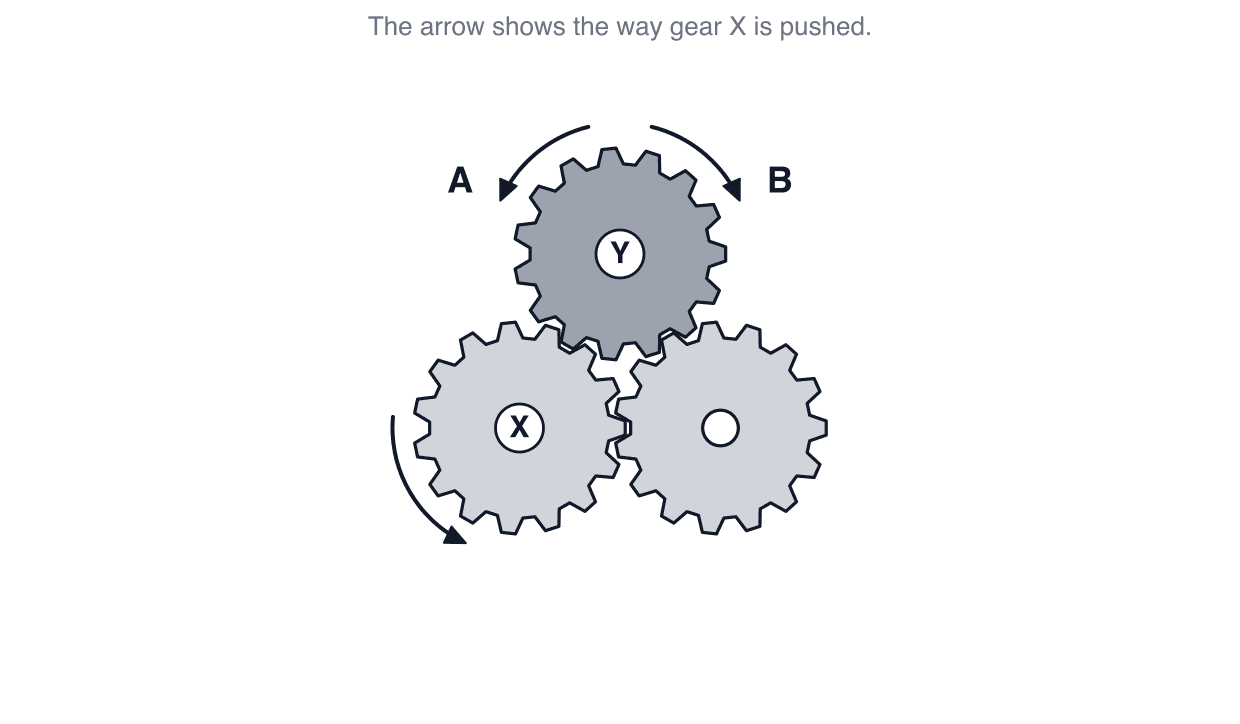
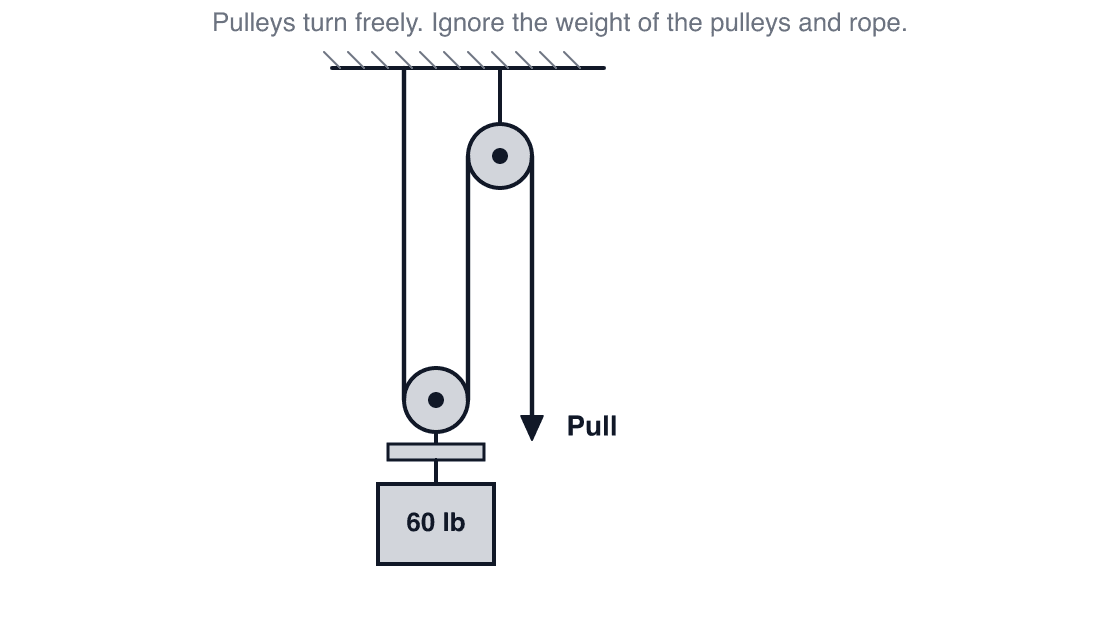
Original PrepClubs drawings, not Pearson items.
Build the rest of your prep stack
How the BMCT-II is scored
Pearson counts your correct answers, then adjusts for the difficulty of the particular items you received, because every candidate gets a different random set. That ability score is compared with a norm group the employer chooses, such as engineers, mechanics, skilled trades, installation, maintenance and repair, machine operators, or manufacturing and production. Reports show a percentile, plus the number correct, a T-score, a stanine and a sten.
Pearson publishes no pass mark. Each employer sets its own cut score for the job, and Pearson's own examples are illustrations, not rules. Specific cutoffs attributed to named companies online are not published by Pearson.
BMCT-II is a timed power test: 25 minutes is fixed, but you can skip items and come back, and review your answers before the end. A blank earns nothing, so answer every item before the clock runs out.
Pearson has not published average raw scores for BMCT-II. For the old 68-item Forms S and T, published norm averages ran from about 43 of 68 for manufacturing and production to about 53 of 68 for engineers, and Pearson notes those raw scores do not carry over to BMCT-II.
A two-week BMCT-II prep plan
Day 1: Take the diagnostic
Sit a full 55-question form in 25 minutes. The area split at the end shows where your points are going. Most people lose them in two or three areas, not evenly.
Days 2 to 5: Fix the rules you missed
Read the explanation for every wrong answer and write down the one rule behind it: count rope segments, the load is shared by distance, pressure depends on depth, crossed belts reverse direction. There are only a few dozen such rules.
Days 6 to 10: One timed form a day
Keep to 25 minutes. That is about 27 seconds per item, so do not spend a minute on one picture: answer, flag it and move on.
Days 11 to 13: Review by area
Group your misses by area. Several misses in one area is a gap to study, not bad luck. Hydraulics and forces are where most people have gaps.
Day 14: Final form and rest
One last timed form, then stop. On test day use a desktop or laptop and a quiet room, as Pearson recommends.
Common BMCT traps
Ignoring the C option
Many items have C as "equal" or "no difference". It is often right: two gears on one shaft turn at the same speed, water in connected tanks sits at one level, heavy and light objects fall together.
Judging by size instead of by the rule
A bigger container is not always the one that holds more, and a bigger gear is not the faster one. Apply the principle to what the picture actually shows.
Adding real-world complications
Unless the item says otherwise, ropes are light, pulleys turn freely and air resistance is ignored. Answer the idealized question the picture is asking.
Related reading
Bennett FAQs
A score tells you how you did. The coach tells you what to practice next.
After every test you get a short plan built from your own answers and seconds: which sections cost you points, which ones eat your clock, and the drill that fixes each.
Math: 11 of 12 right, at 31 s a question
Drill math against a 20 s clock. That frees about 2 minutes per test for the sections you miss more.
People who got the same questions right took 20 s.
Illustrative data
- Every section mapped on accuracy against speed, with one fix for each
- The questions that ate your time, and the clock checkpoints to hit next time
- Where rushing costs you, and the point to guess and move on
- A read that sharpens with every test you take
Your pacing report is free with your first test.
Practise the Bennett Mechanical test in the real format
55 three-choice picture questions in 25 minutes, the same topic split as BMCT-II, with a worked explanation for every answer.
Start prepping