IBEW Aptitude Test Study Guide: The 9 Skills It Actually Measures
An IBEW aptitude test study guide built on the 9 algebra skills actually tested, 69 questions in 97 minutes, no calculator, and the 1 to 9 score you need.

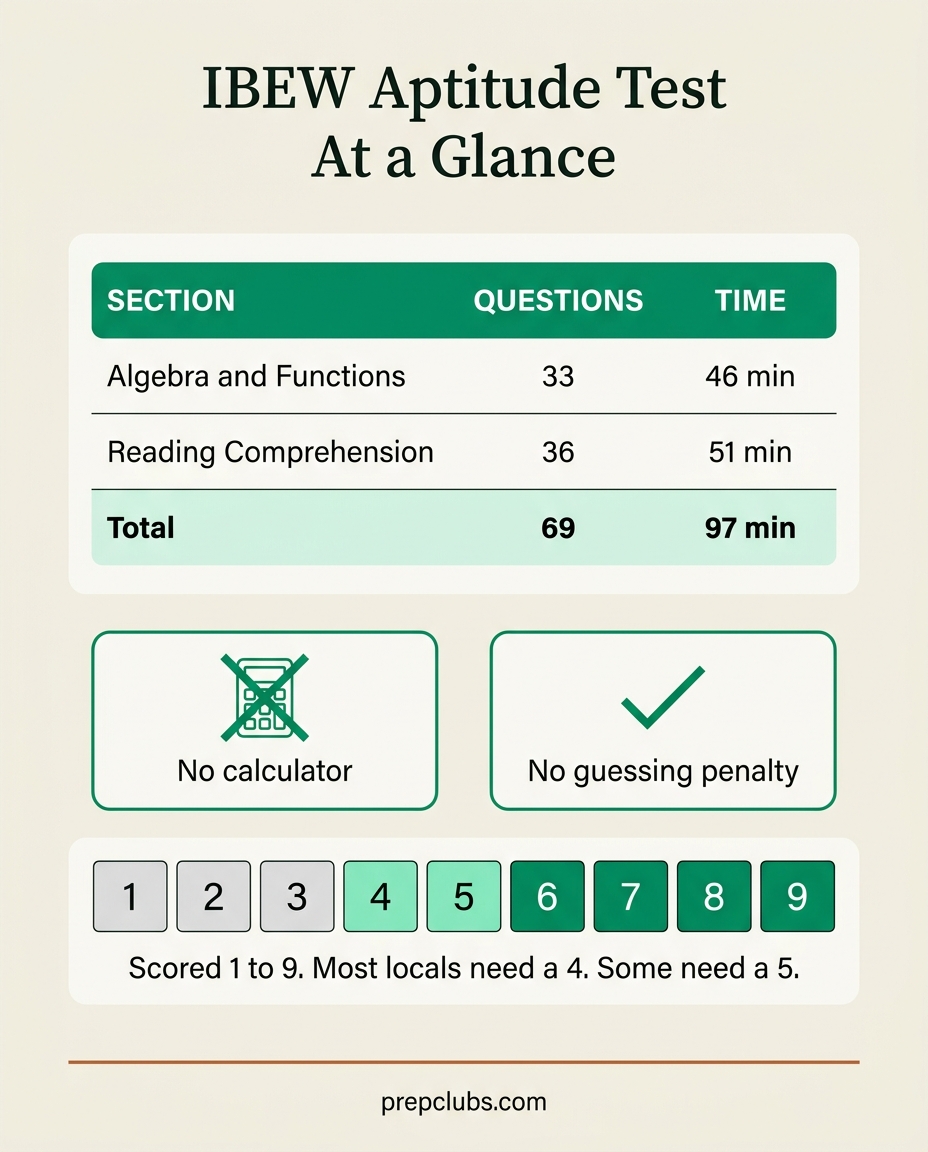
The IBEW aptitude test is 69 questions in 97 minutes, split into 33 algebra and functions items in 46 minutes and 36 reading comprehension items across four passages in 51 minutes. No calculator. No electrical knowledge. Locals that report a number use a 1 to 9 scale, and a 4 is the minimum most often cited for the interview, though your own JATC sets the bar. Any IBEW aptitude test study guide worth your time has to do two things: name the discrete skills the algebra half actually tests, and cite a primary source for the scoring rules. This one breaks the algebra section into 9 skills, shows what each looks like, and cites the electrical training ALLIANCE and named local JATCs throughout, because three of the most repeated "facts" about this test are wrong as stated.
Quick takeaways
- Two sections: Algebra and Functions, 33 questions in 46 minutes, and Reading Comprehension, 36 questions in 51 minutes. The item counts and times come from the electrical training ALLIANCE; the four-passage detail comes from the Local 48 JATC.
- You may not bring a calculator. Pencils and scrap paper are provided, and there is no penalty for guessing, so never leave an answer blank.
- There is no separate mechanical reasoning section on the standard battery. Local 99's prep sheet does warn that a few mechanical-style questions may appear alongside the math, so know the basics of pulleys and balanced loads.
- The passing score is not universal. Local 99's prep sheet says most apprenticeships require a 4, some JATCs require a 5, and at least one sets different cutoffs for different programs in the same building.
- The retake window is not universally six months. The ALLIANCE's current rule is 90 days from your most recent test, and Local 99's sheet says the wait applies at any JATC in the country, not just where you tested.
- The score is a gate, not a rank. Your place on the two-year eligibility list comes from the oral interview and a review of your qualifications.
- The content is high school algebra. The difficulty is the missing calculator: roughly 84 seconds per question, by hand. The ALLIANCE says most applicants have enough time to finish without rushing, so accuracy decides more than speed.
Last updated: October 2026.
What the IBEW aptitude test actually is
Most applicants to an inside wireman apprenticeship through a Joint Apprenticeship and Training Committee sit the same two-part battery (a few locals use a different test; see Day 1 of the plan below). It is often called the NJATC aptitude test after the organization that used to run it; the electrical training ALLIANCE runs it now. Same exam, which is why the two names get used interchangeably in every forum thread.
| Section | Questions | Time | Per question | What it measures |
|---|---|---|---|---|
| Algebra and Functions | 33 | 46 minutes | about 84 seconds | Solving problems using algebra, worked by hand |
| Reading Comprehension | 36 | 51 minutes | about 85 seconds | Getting information out of four written passages |
Two things surprise most first-time applicants. No electrical knowledge is tested: the ALLIANCE states that previous knowledge of electrical work is not required, and IBEW Local 48's JATC describes the sections as measuring algebra problem solving and getting information out of written passages. And plan for about three hours on site: the ALLIANCE puts the battery itself at about two and a half hours, including a short break between sections, and tells applicants to plan on roughly 3 hours at the test center.
The 9 skills any IBEW aptitude test study guide should cover
Almost nobody enumerates this. Competing pages repeat "algebra and functions" and move on. One clarification: these 9 skills are not weighted or reported separately. Every correct answer is one raw point, and the section converts into the single 1 to 9 number explained below. The list tells you what to study, not how the scoring splits. The list below comes from IBEW Local 99's official prep sheet, which publishes the exact study modules its applicants are pointed at, cross-checked against the ALLIANCE's published sample test instructions and questions. One caveat: no source publishes how many questions of each type appear, so anyone quoting a per-topic count invented it.
| # | Skill | What a question looks like |
|---|---|---|
| 1 | Order of operations and number types | A nested expression with a negative multiplier |
| 2 | Fractions and decimals by hand | Combine unlike fractions, express as a decimal |
| 3 | Linear equations | Solve for x with fractional coefficients |
| 4 | Systems of equations | Two unknowns, solved by substitution |
| 5 | Distributive property and FOIL | Expand two binomials, identify a coefficient |
| 6 | Factoring and quadratics | Factor a trinomial, or solve a clean quadratic |
| 7 | Exponents and roots | Simplify a negative or fractional exponent |
| 8 | Ratios, proportions, percentages | A scaling word problem, solved by cross-multiplication |
| 9 | Sequences, function notation, graphing | Find the next term, or evaluate f(3) |
1. Order of operations and number fundamentals
Whole numbers, signed integers, rational versus irrational, PEMDAS. A sign error here corrupts a question that was testing something else.
2. Fractions and decimals under time pressure
Multiplying and dividing decimals, common denominators, adding and subtracting fractions. This punishes calculator dependence hardest. Rebuild it first.
3. Solving linear equations
Balancing equations, inverse operations on both sides, anything shaped like ax + b = c. Local 99 lists this as three separate study modules, which tells you how central it is.
4. Systems of equations
Two equations, two unknowns, solved by substitution. These usually arrive dressed as word problems, so the first job is translation.
5. The distributive property, FOIL, and polynomial multiplication
Expanding brackets and multiplying factors. The classic item asks for one coefficient of the result, so you can often answer without expanding all of it.
6. Factoring and quadratics
Factoring polynomials and quadratics. These factor cleanly, so spotting the pair beats running the formula. Know the formula anyway.
7. Exponents and roots
Exponent rules, negative and fractional exponents, square roots. The quickest points on the section once the rules are automatic.
8. Ratios, proportions, and percentages
Equivalent ratios, missing numbers, proportional scaling. Local 99 puts it plainly: solving a proportion means you are missing one part of one fraction. Cross-multiply and solve.
9. Number sequences, function notation, and graphing
Next term in a series, function notation, plotting x and y. The trap is always the same: assuming one rule when the series runs on two. Worked example below.
Reading comprehension: 36 of the 69 questions, and the half people ignore
Half the test, and the half most study plans neglect. Four passages, 36 questions, 51 minutes, per the Local 48 JATC. Five sub-skills carry it:
- Main idea and author's purpose. What the passage argues, in one sentence.
- Supporting detail. Finding the fact stated outright, fast.
- Inference. What follows without being said.
- Tracing an argument. Following a claim through paragraphs of qualification.
- Vocabulary in context. What a word means here, not generally.
The passages are deliberately non-technical, closer to general-interest prose than a code book. Read the questions first, then the passage, and clear the literal retrievals before the inference items. The time saved there funds the two or three hard ones.
A worked reading comprehension item. This passage is written for this guide in the style of the ALLIANCE's sample; real passages are longer.
Before 1883, most American towns set their clocks by the sun, so noon in one city could arrive several minutes before noon in a city just to the west. Railroads, which ran trains through dozens of such towns, printed timetables that were hard to follow and easy to misread. On November 18, 1883, the major railroads adopted four standard time zones for their own operations. Many cities followed within weeks, but the zones did not become federal law until the Standard Time Act of 1918.
Which statement is best supported by the passage?
A) Railroads created time zones because a federal law required them. B) Before 1883, two towns a short distance apart could keep different local times. C) Every American city switched to standard time on November 18, 1883. D) The Standard Time Act of 1918 created the first time zones in the world.
Work it in three moves:
- Classify the stem. "Best supported by the passage" is an inference item: the right answer must follow from a specific sentence, and nothing outside the passage counts.
- Check each option against one sentence. A reverses the order of events: the railroads acted in 1883 and the law came in 1918. C is contradicted by "Many cities followed within weeks", which means not all of them switched that day. D claims more than the passage says: it never mentions the rest of the world, and the railroads already had zones 35 years before the law.
- Confirm the survivor. B follows directly from the first sentence: if noon arrives at different moments in neighboring cities and each sets its clocks by the sun, nearby towns keep different times. Answer: B.
The habit to build: for every option you keep, point at the sentence that proves it. If you cannot point at one, the option is out.
Two worked examples
An algebra and functions question. Solve for x: (x + 2)/4 + (x - 1)/5 = 3
A) -1/3 B) 6 C) 13 D) 7
Clear the fractions first. Multiply every term on both sides by 20, including the 3, which is the step people skip. That turns (x + 2)/4 into 5(x + 2), (x - 1)/5 into 4(x - 1), and 3 into 60.
So 5(x + 2) + 4(x - 1) = 60. Distribute: 5x + 10 + 4x - 4 = 60. Combine: 9x + 6 = 60. Subtract 6: 9x = 54. Divide by 9: x = 6, answer B. Check it: (6 + 2)/4 + (6 - 1)/5 = 2 + 1 = 3.
The wrong answers are built from real mistakes. C) 13 comes from adding the numerators over a combined denominator. A) -1/3 comes from multiplying the left side by 20 and forgetting the right.
A number series question. What comes next? 3, 6, 9, 18, 21, 42, 45, ___
A) 48 B) 90 C) 135 D) 47
The differences are 3, 3, 9, 3, 21, 3. The alternating 3s are the tell. Test for two rules: 3 to 6 is times 2, 6 to 9 is plus 3, 9 to 18 is times 2, 18 to 21 is plus 3, 21 to 42 is times 2, 42 to 45 is plus 3.
The last operation was plus 3, so the next is times 2. 45 times 2 is 90, answer B. A) 48 traps anyone who locked onto the most recent operation and applied plus 3 again.
Checking for two alternating rules before assuming one is worth more on this section than any other tip. Once you have worked these by hand, try a free IBEW practice simulation in the same two-section format under the real clock.
Three more from our newest IBEW practice test
The two examples above are written for this guide. These three are real items from IBEW Aptitude Test Practice 8, the latest form in our bank. Work them by hand, with no calculator, the way the real test requires.
Question 4 of 69. Two workers split a job in an 8 to 11 ratio. If the total pay is $76, how much does the first worker earn?
A) $44 B) $76 C) $40 D) $32 E) $24
Answer: D) $32. The ratio has 8 + 11 = 19 parts, so one part is $76 divided by 19, which is $4. The first worker gets 8 parts, which is $32. $44 is the second worker's share, the trap for anyone who reads the ratio backwards.
Question 8 of 69. If 2 electricians wire a building in 24 days, how many days would it take 8 electricians working at the same rate?
A) 5 days B) 9 days C) 7 days D) 6 days E) 8 days
Answer: D) 6 days. The job is 2 times 24, which is 48 electrician-days. Shared by 8 electricians, that is 48 divided by 8, or 6 days. Four times the crew means a quarter of the time.
Question 9 of 69. Simplify: 4(x + 18) - 11x
A) -7x - 72 B) -6x + 72 C) -8x + 72 D) -7x + 71 E) -7x + 72
Answer: E) -7x + 72. Distribute first: 4x + 72. Then 4x minus 11x is -7x, so the result is -7x + 72. A flips the sign on the constant, the most common slip on this item type.
What our practice data says about the IBEW test
Our PrepClubs Research series re-grades every scored practice attempt and publishes the figures with their caveats. The IBEW form behaves very differently from the fast cognitive screens most prep advice is written for.
- The clock rarely binds. At about 84 seconds a question, candidates left only 7.6% of the paper blank, against about 20% on the CCAT and Wonderlic (How much of a timed aptitude test is never answered).
- The paper is flat. Among 49 attempts that answered every item, accuracy was 86.4% on the first fifth of the paper and 86.5% on the last, with no ramp at all (Which aptitude tests are built as a difficulty ramp). There is no easy stretch to bank and no hard finale to fear, so steady accuracy is the whole game.
- Practising candidates score high. The median practice score was 87% correct, about 60 of 69, with the middle half between 71% and 92.8% (What candidates actually score on aptitude practice tests). These are raw scores on PrepClubs practice forms, not the ALLIANCE's 1 to 9 score, but they show that careless errors, not unfinished questions, are what pull a practice score down.
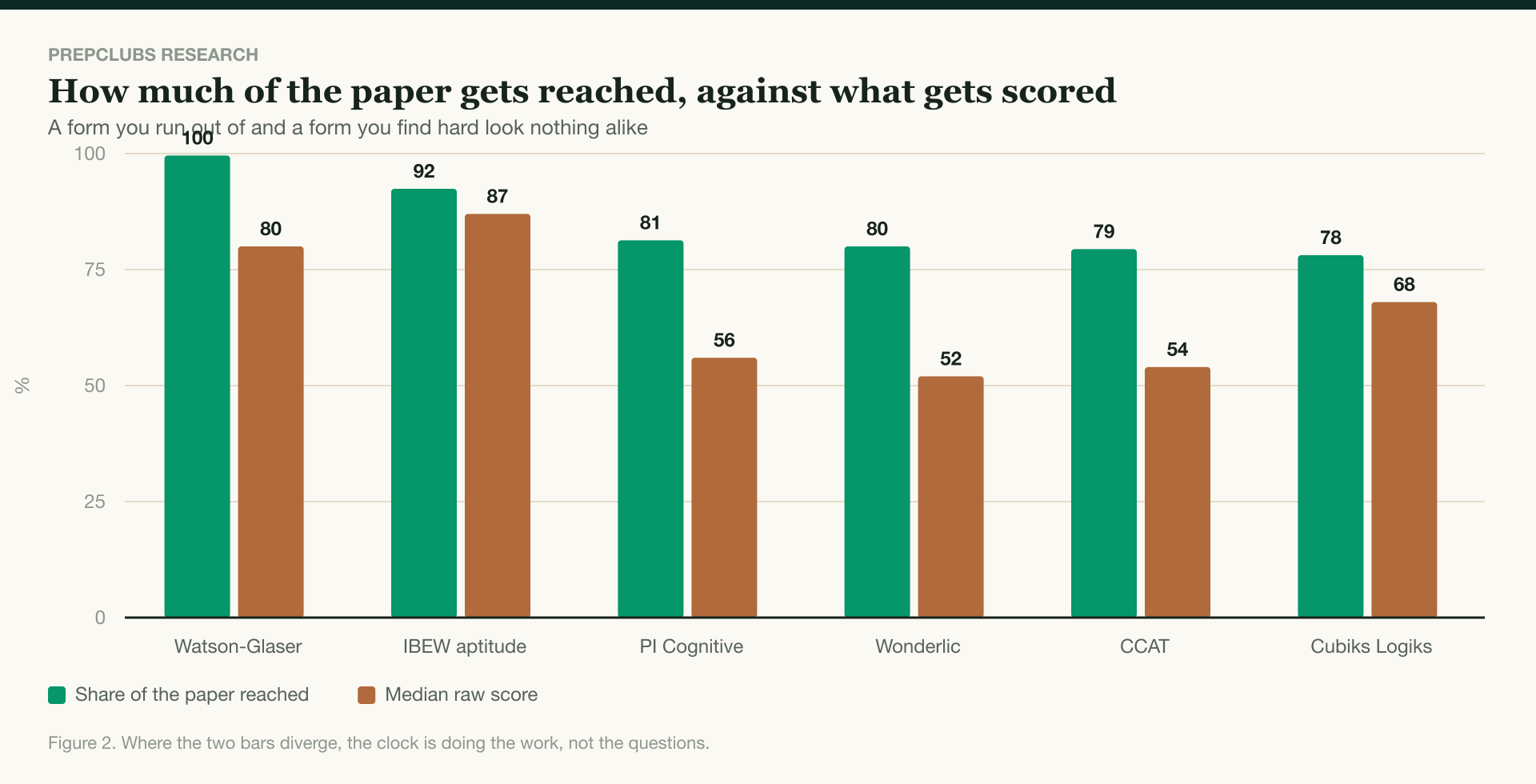
On forms like this, where the clock is generous, the raw score follows accuracy (correlation 0.77) more closely than coverage (0.59). The practical rule for IBEW prep: check every algebra answer by substituting it back, as the worked example above does, because that habit is worth more here than any speed drill. Full-length IBEW-format practice is on the IBEW aptitude test page.
How the 1 to 9 score works, and whether you need a 4 or a 5
Your raw score is the number of items answered correctly, converted to a single number from 1 to 9. Prep sites call that a stanine; no primary source uses the word, so treat it as convention. Reporting also varies: the ALLIANCE's own FAQ says you will be told whether you received a qualifying score and that exact scores are not provided, while locals such as Local 48 email applicants the 1 to 9 number. The cutoff is where the internet gets it wrong, because there is no single national one.
| Source | Minimum qualifying score |
|---|---|
| Local 48 JATC | 4 or higher |
| NorCal JATC | 4 or higher (Sound and Communication program) |
| IBEW Local 99 prep sheet | "Most apprenticeships require at least a 4" |
| North Texas ETC | 5 or higher |
| Southwest JATC | 5 for Inside, 4 for Low Voltage, no test for Residential |
Assume you need a 5, and confirm with your own JATC. That Southwest application also names the test's developer: the American Institutes for Research.
The retake rule is the other widely repeated error. The ALLIANCE states that a full 90 days must elapse before you retest, adds that "the six month rule remains in effect after each subsequent retake", and warns that willful attempts to violate the rule may result in permanent disqualification. Retest early and the score is not valid. Older local material, such as Local 99's sheet, still says six months and applies the wait at any JATC in the country, so confirm the current rule with your JATC before you book.
What happens after you pass: the interview is the ranking
Passing does not rank you. Per the ALLIANCE, a qualifying score gets you an oral interview with a committee representing NECA and the IBEW. After that interview and a review of your qualifications you receive an overall ranking, your name goes on an eligibility list for two years, and openings are filled in order of that ranking. The ALLIANCE says your local JATC receives test results roughly two to four weeks after you test.
The ALLIANCE's published process treats the test as the gate and the interview plus your qualifications as the ranking. Whether your local also weights the test score is a local decision, so ask. Any fixed "test percent versus interview percent" split you see quoted online is not part of the ALLIANCE's published process. That conversation deserves as much preparation as the algebra.
A 7-day study plan for the 9 skills
- Day 1. Call your JATC and ask two things: the current minimum qualifying score, and which battery they use. Some locals use a different battery: the Minneapolis Electrical JATC, for example, has applicants take the GAN Aptitude Test, which is a different exam from the two-section ALLIANCE battery. Ten minutes on the phone saves a week studying the wrong thing.
- Days 2 and 3. Skills 1, 2, 3. Pencil and paper only.
- Day 4. Skills 5, 6, 7. FOIL, factoring, exponents.
- Day 5. Skills 4, 8, 9. Systems, proportions, sequences.
- Day 6. One full-length timed run, both sections, one sitting. This is where you learn whether pacing or content is your problem.
- Day 7. Reading comprehension, plus the questions you missed on day 6.
With three days instead of seven, compress days 2 through 5 into one session on your four weakest skills and keep the timed run. That run is the only way to see whether your by-hand accuracy holds across 97 minutes, so it is the part you cannot skip.
FAQ
How hard is it to pass the IBEW aptitude test?
The content is high school algebra, so conceptually it is not hard. The difficulty is working without a calculator: roughly 84 seconds per algebra question, by hand. The ALLIANCE says most applicants have enough time to finish, and our own practice data agrees: only 7.6% of IBEW-format items go unanswered, so accuracy on each item decides more of the score than speed.
What is the best study guide for the IBEW aptitude test?
The free options are genuinely good. The ALLIANCE publishes sample questions, some locals publish free prep sheets like the Local 99 one above, and free algebra courses such as Khan Academy's cover every skill on the list. Paid guides add timed full-length simulation, which free resources rarely provide.
How do I prepare for the IBEW test?
Three steps, in order. Call your JATC and confirm the current minimum qualifying score and which battery they use, because both vary by local. Drill the 9 algebra skills above with pencil and paper, never a calculator. Then run at least one full-length timed test across both sections in a single sitting, because that shows whether your accuracy holds for 97 minutes. A week is enough time to do all three if you follow the day-by-day plan above.
What math should I study for the IBEW aptitude test?
The 9 above: order of operations, fractions and decimals, linear equations, systems of equations, distributive property and FOIL, factoring and quadratics, exponents and roots, ratios and proportions, and sequences with function notation. No trigonometry, no calculus, no electrical theory.
Can you use a calculator on the IBEW aptitude test?
No. The ALLIANCE states it flatly, and Local 99's prep sheet adds that pencils and scrap paper are provided. So practise without one from day one.
Is there a mechanical reasoning section on the IBEW aptitude test?
Not as a separate section. Every primary source lists exactly two sections, though Local 99's prep sheet warns that a few mechanical-style questions (pulleys, balanced loads) may turn up alongside the math. Full mechanical sections appear on the GAN battery used by some locals and on the separate Elevator Industry Aptitude Test, a different trade's exam. Prep sites conflate all three. For mechanical practice anyway, our Bennett, Ramsay, and Wiesen comparison covers what those measure.
What is a passing score on the IBEW aptitude test, 4 or 5?
Both, depending on where you apply. Local 48 sets the bar at 4, and Local 99's prep sheet says most apprenticeships require a 4. North Texas sets it at 5, and Southwest JATC sets 5 for inside wireman and 4 for low voltage, while its residential applicants take no test at all. Confirm with your own JATC.
How long do you have to wait to retake the IBEW aptitude test?
The ALLIANCE's current rule is 90 days from your most recent test, with its six month rule applying after each subsequent retake. Older local material, such as Local 99's sheet, says six months and applies the wait at any JATC in the country. Per the ALLIANCE, retesting early makes the score invalid.
Related on PrepClubs
- Free IBEW aptitude test practice: math and reading, timed
- NJATC aptitude test: how it differs from the general IBEW exam
- Electrician aptitude tests: which test each apprenticeship program uses
- Elevator Industry Aptitude Test (EIAT) explained
- What counts as a good aptitude test score
Ready to work all 9 skills under the real clock?
Reading a skill list is not the same as solving 33 problems in 46 minutes with no calculator. The PrepClubs IBEW aptitude test prep gives you 552 practice items across 7 full-length mocks, each timed to the real 97 minutes, with 30 days of access. Current pricing is on the pricing page. Start with the free simulation: it tells you which of the 9 skills is costing you points before you spend a week on the wrong ones.
PrepClubs prep is backed by our 30-day Pass Guarantee: if you do not pass your real test, we extend your access by 30 days at no extra cost.
Practise for this exam
IBEW practice tests
Timed practice tests in the real IBEW format, with a worked explanation for every question, so you learn the method as well as the answer.