What Is a Good Aptitude Test Score? A Cross-Test Benchmark Guide
A good aptitude test score depends on the test and the job. See average and target scores for the CCAT, Wonderlic, PI, SHL, Watson-Glaser, and Bennett, plus percentile framing by role.

There is no single number that counts as a good aptitude test score, because "good" is set by two things you do not control: which test the employer chose and where they draw the line for the job. A raw 24 out of 50 on the CCAT sits at the 50th percentile, while the same 24 out of 50 on the Predictive Index scales to roughly 250, the exact average. Different tests, different scales, same idea. This guide gives you the real average and target scores for the six cognitive tests you are most likely to face, a comparison table you can read at a glance, and the role-by-role framing employers actually use, all sourced to the test publishers where the publishers report it.
Quick takeaways
- A "good" score is a percentile, not a raw number. Most aptitude tests report how you did against a comparison group, and employers set a target against the job, not a universal pass line.
- Aim for the top quartile for competitive roles. Across tests, the 75th percentile and up is the practical bar for analyst, engineering, consulting, and senior roles; the 50th percentile is often enough for entry-level jobs.
- CCAT: average is 24 of 50 (about the 50th percentile), per Criteria Corp. A frequently cited good score is around 30 to 31 (top ~20 to 25%).
- PI Cognitive: raw scores scale to a 100 to 450 range with a mean of 250, per Predictive Index. Your target is set per role via the PI job assessment, not a fixed cutoff.
- SHL and the two Pearson tests (Watson-Glaser, Bennett) are scored purely by percentile against a norm group, so read your percentile, not your raw count.
- Wonderlic's classic 0 to 50 score is now legacy. The current product reports a job-fit score, so treat the old "20 is average" numbers as historical.
Why there is no universal passing score
Every cognitive aptitude test gives you two numbers: a raw score (how many you got right) and a percentile (how you did against everyone else in a comparison group). The percentile is the one that matters, because it is what the employer compares across candidates. A percentile of 50 means you performed better than half the comparison group. SHL states this plainly in its own reports: the percentile shows how the person scored against the specific comparison group, and a 50 means they beat 50% of that group.
Two things follow. First, the same raw score can be excellent against the general population and merely average against a group of graduate engineers, because the norm group changes the verdict. Second, employers set the cutoff, not the publisher. Predictive Index, for example, does not recommend a universal passing score and instead has each hiring team set a per-role target. So the honest answer to "what is a good aptitude test score" is: high enough to clear the target your specific employer set for your specific role, which usually means above average and, for competitive jobs, in the top quartile.
Good aptitude test scores by test
Here is the piece most pages skip: the scales are not comparable, so you need each test on its own terms. The average and format figures below come from the publishers where they publish them. The "good score" thresholds and raw-to-percentile mappings are compiled from public reporting and test-prep sources, not official publisher cutoffs, because most publishers do not release role-by-role pass marks. Treat them as directional.
| Test | Scale | Average / typical | A "good" score (directional) | How it is reported |
|---|---|---|---|---|
| CCAT (Criteria) | 0 to 50 correct, 50 Q in 15 min | 24 of 50 (~50th pct) | ~30 to 31 (~top 20 to 25%) | Raw score plus percentile |
| PI Cognitive (Predictive Index) | 0 to 50 raw, scales to 100 to 450 | Scaled mean 250 (raw ~20) | At or above the role's target (baselined at 250) | Scaled score plus per-role match |
| Wonderlic (classic) | 0 to 50, 50 Q in 12 min | ~20 (legacy figure) | 21+ above average, 30+ for demanding roles | Historical; current product reports job-fit |
| SHL (Verify general ability) | Percentile vs comparison group | 50th percentile = average | 60th to 80th+ pct for competitive roles | Percentile, sten (1 to 10), T-score |
| Watson-Glaser (critical thinking) | 40 items, ~30 to 40 min | 50th percentile = average | ~75th to 80th pct for law and senior roles | Percentile, T-score, stanine, sten |
| Bennett Mechanical (BMCT-II) | 55 items, 25 min | Norm-referenced | 60th pct and up is strong | Percentile, T-score, stanine, sten |
A few notes so you read this correctly. On the CCAT, Criteria Corp confirms the average is 24 of 50 and that fewer than 1% of candidates finish all 50 questions, so an average score is genuinely average. On the PI Cognitive Assessment, Predictive Index reports that raw scores translate onto a 100 to 450 scaled range with a mean of 250, and the average test taker gets about 20 of 50 raw. For SHL, Watson-Glaser, and Bennett, the raw count barely matters on its own: all three are norm-referenced and the publishers tell employers to read the percentile or a standardized score, not the number correct.
Wonderlic deserves a flag. The famous 0 to 50 scale, where a 20 was described as average, comes from the classic Wonderlic Personnel Test. Wonderlic has since moved to a product that reports a job-fit score rather than a single cognitive number, so the old "20 is average, 30 is strong" figures are best treated as historical context, not a live target.
A cross-test benchmark from our own practice data
The table above mixes publisher norms and public reporting. Here is a second view that uses one method across every test: raw percentage correct on our own practice forms, re-graded and published in the PrepClubs Research series (What candidates actually score on aptitude practice tests).
| Practice form | Attempts | Median | 90th percentile | Share of paper reached |
|---|---|---|---|---|
| Wonderlic format | 53 | 52% | 74% | 80% |
| CCAT format | 189 | 54% | 82% | 79% |
| PI Cognitive format | 215 | 56% | 74% | 81% |
| Cubiks Logiks format | 76 | 68% | 92% | 78% |
| Watson-Glaser format | 41 | 80% | 92.5% | 99.6% |
| IBEW aptitude format | 61 | 87% | 95.7% | 92% |
These are PrepClubs practice forms written to each test's published format, not official publisher scores, and they are not mapped to any employer's cut score. What the table does show is why "good" cannot mean one number. On the three 50-question speeded tests, the median practising candidate gets just over half right. On the Watson-Glaser and IBEW papers, where the clock is generous, the median is 80% or higher.
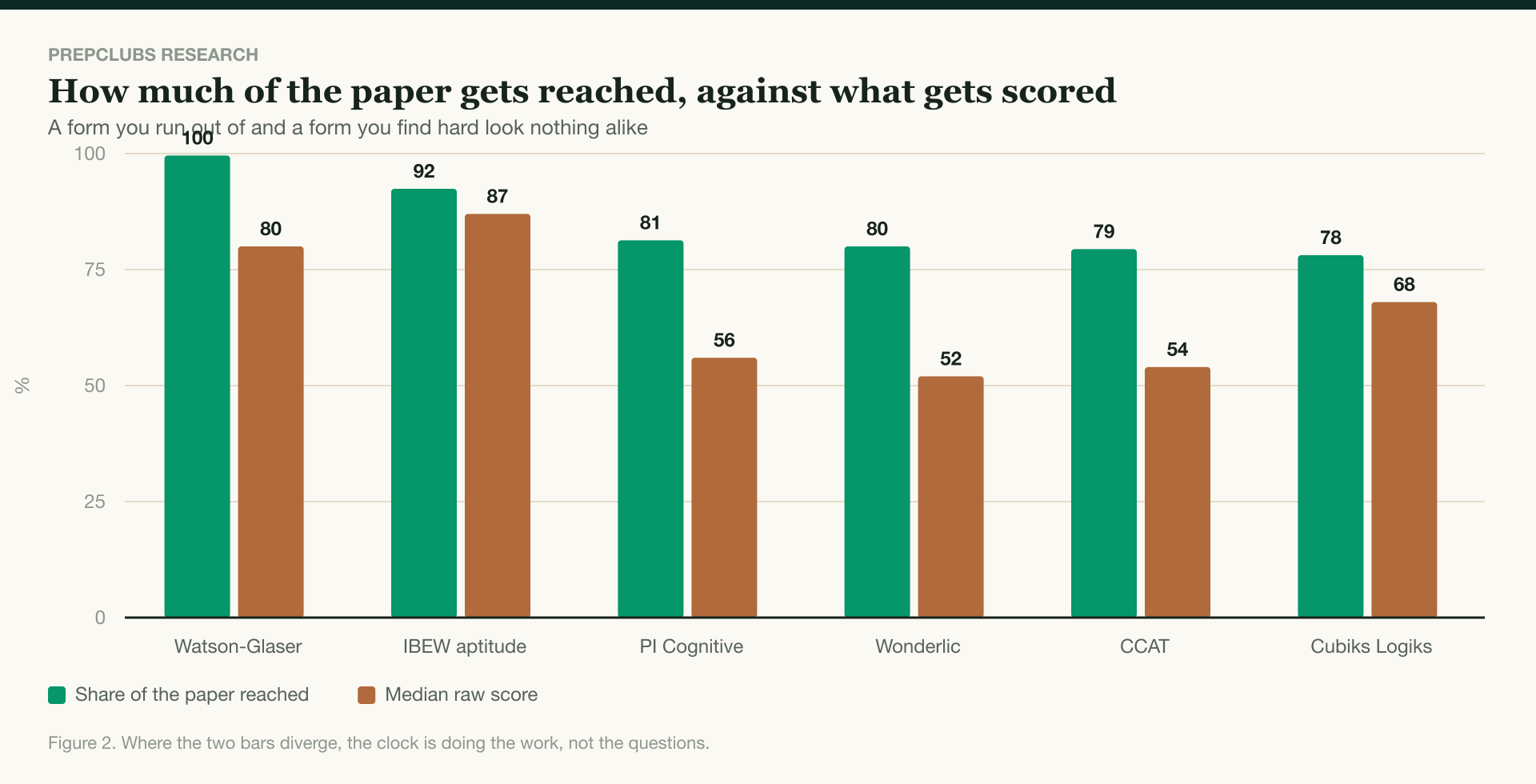
The gap between the two bars is the clock at work. On a speeded test, a good score is mostly a question of reach: getting to more of the paper, and guessing what you cannot reach, because none of these forms deducts marks for a wrong answer.
Check yourself on three real questions
One each from the newest CCAT, PI Cognitive and Watson-Glaser forms in our bank. Each is the kind of item that separates a median score from a good one.
CCAT Practice Test 15, question 32. A shop owner buys 60 items at $5 each and sells them at $8 each. If 10 remain unsold, what is the profit?
A) $80 B) $100 C) $110 D) $120 E) $140
Answer: B) $100. Cost is 60 times $5, which is $300. Only 50 sell, so revenue is 50 times $8, which is $400. Profit is $100. Using 60 sales gives $180, which is not offered, and the $3 margin times 50 gives $150, also not offered: the unsold stock still had to be paid for.
PI Cognitive Practice Test 8, question 24. Which is lowest? A) 0.72 B) 0.65 C) 7/10 D) 3/4 E) 0.68
Answer: B) 0.65. Convert the fractions first: 7/10 is 0.70 and 3/4 is 0.75. Then the smallest decimal is 0.65, with 0.68 the near miss.
Watson-Glaser Practice Test 8, question 21. Premises: No download link in the portal is public. This link is public. Conclusion: This link is not a download link in the portal.
Answer: The conclusion follows. If every portal download link is non-public, anything public cannot be one of them. This is the contrapositive, and it is always valid.
For full practice on the test you are actually facing, start from the PrepClubs test library.
A good aptitude test score by job role
The pattern that holds across every test is simple: the more a job leans on fast reasoning and learning, the higher the target. Employers do not use one line for all roles. They set the bar against the cognitive demand of the specific job. The percentile bands below are a directional read compiled from public benchmarks and test-prep reporting, not official publisher cutoffs, and they translate across tests because they are expressed as percentiles.
| Role family | Typical target percentile band | What that means in practice |
|---|---|---|
| Customer service, administrative | ~25th to 50th | At or near average is usually fine |
| Sales, recruitment, bookkeeping | ~40th to 70th | Above average helps you stand out |
| Project manager, operations | ~50th to 80th | Solidly above average expected |
| Analyst, finance, accounting | ~60th to 90th | Top quartile is the working bar |
| Software engineer, developer | ~55th to 90th | High for tech-heavy and high-growth firms |
| Senior manager, VP, executive | ~70th to 95th | Near the top of the norm group |
Read these as ranges, because two companies hiring the same title can set very different bars. A high-growth software firm hiring an engineer may target the high end of that band, while a mid-market employer may accept the middle for the same title. The takeaway across tests is consistent: clear the average to stay in the running for many roles, and reach the top quartile if you are chasing an analytical, technical, or senior position.
Two worked examples
Example one: CCAT for an analyst role. Say your practice tests land you at a raw 28 on the CCAT. That maps to roughly the 68th percentile, so you beat about two-thirds of takers. Against the analyst band of the 60th to 90th percentile, a 28 clears the floor but sits in the lower half. It will not get you screened out, but at a firm targeting the top of that range you would want a stronger number or a strong interview to carry the rest. Push toward 30 to 31 and you move into the top quartile, which is the more comfortable place to be for an analyst screen.
Example two: PI Cognitive for a project manager. Suppose your PI scaled score is 250, exactly the mean. Whether that is good depends entirely on the target the hiring team set in the PI job assessment. If they baselined the role at 250, you are right on target and your match score is strong. If they set the target higher for a reasoning-heavy PM role, a 250 sits below it and you lose ground to candidates who scored above the target. Same scaled score, different verdict, entirely because of the role's target. This is exactly why a cross-test, role-first view beats a single magic number.
When you want test-specific depth
This guide is deliberately cross-test, because a good score means different things on the CCAT than it does on the PI or SHL. If you know which test you are facing and you want the deep version, the raw-to-percentile table, the section breakdown, and the timed practice, go straight to the test's own page:
- For the CCAT, our CCAT test hub has the full percentile detail and timed mocks, and SHL vs CCAT shows how the two scoring systems differ if you are unsure which you will take.
- For the Wonderlic, Predictive Index, SHL, and Watson-Glaser, each hub covers that test's scoring model and question types in depth.
FAQ
What is a good score on an aptitude test?
There is no single good score, because each test uses a different scale and each employer sets its own target. As a rule of thumb, aim above average and, for competitive roles like analyst, engineering, consulting, or senior management, aim for the top quartile, roughly the 75th percentile or higher, against the relevant comparison group. On the CCAT that is around 30 to 31 of 50; on percentile-scored tests like SHL, Watson-Glaser, and Bennett, it is the percentile itself.
What is the average aptitude test score?
It depends on the test. On the CCAT the average is 24 correct out of 50, per Criteria Corp, which is about the 50th percentile. On the PI Cognitive Assessment the scaled scores center on a mean of 250 (out of a 100 to 450 range), per Predictive Index, which corresponds to roughly 20 correct out of 50 raw. On percentile-based tests, the 50th percentile is average by definition.
What percentile is a good aptitude test score?
The 50th percentile is average, and clearing it keeps you competitive for many entry-level and general roles. For competitive positions, the practical bar is the top quartile, the 75th percentile and up. For the most cognitively demanding roles and top-tier employers, expectations can reach the 80th to 90th percentile. Because percentiles are comparable across tests, this framing works whether you are taking the CCAT, SHL, Watson-Glaser, or another test.
Is there a universal passing score for aptitude tests?
No. Publishers generally do not set a universal pass mark. Predictive Index explicitly does not recommend a cutoff and has each employer set a per-role target instead, and SHL reports scores as percentiles against a comparison group rather than against a fixed line. Employers set the cutoff based on the role, and they usually weigh your score alongside interviews rather than as a hard gate.
Does a good score on one aptitude test mean I will score well on another?
Usually you will land in a similar percentile band, because these tests all measure related reasoning skills, but the raw numbers are not interchangeable. A 30 on the CCAT and a 30 on the classic Wonderlic are not the same thing, and neither compares directly to a PI scaled score of 300. Always convert to the percentile against the correct comparison group before you judge whether a score is good.
Should I guess if I am running out of time?
On most of these tests there is no penalty for a wrong answer, so a blank and a wrong guess cost the same. The CCAT, for example, applies no penalty, and Criteria Corp advises guessing rather than leaving anything blank. Confirm the rule for your specific test, but when there is no penalty, always put an answer down rather than skip.
Related on PrepClubs
- The CCAT test hub and timed practice
- The Wonderlic test format and scoring
- The Predictive Index cognitive assessment explained
- SHL vs CCAT: how the two scoring systems differ
Ready to hit your target score?
The way to move from an average percentile to a top-quartile one is timed practice against the real test you are facing. PrepClubs covers around 21 cognitive and aptitude tests, with full-length mocks plus topical drills for each, so you can find your weak section and close it before test day. Whatever test your employer uses, you can drill to its target rather than guess at one universal number. It is backed by our Money-back Guarantee. Join 3,700+ students preparing this way. Get PrepClubs access.
FAQ