How to Study for CISA: An Auditor-Mindset Plan Around the Five Domains
Study for CISA by budgeting hours to the five domain weightings and learning to think like an auditor, not an engineer. A domain-weighted study plan for CISA.

The efficient way to study for CISA is to budget your hours to the five domain weightings and to train yourself to answer as an auditor rather than as an engineer. The exam has 150 questions over four hours, split across five job-practice domains, and two of them, IS Operations and Business Resilience (26 percent) and Protection of Information Assets (26 percent), carry more than half the exam between them, per ISACA. CISA rarely asks you to fix a system. It asks you what an auditor should recommend, report, or verify. Study for the mindset and the weightings together, and the plan writes itself.
Most CISA study advice tells you to read the review manual front to back. That treats every domain as equal and every question as a knowledge recall. The real exam is weighted, and the hardest questions test judgment, not memory.
Allocate hours by domain weight, and answer as the auditor, not the engineer
Quick takeaways
- CISA has five domains; Domain 4 and Domain 5 are 26 percent each, so together they carry more than half the exam, per ISACA.
- The exam is 150 questions in four hours, scored on a scale of 200 to 800, with 450 to pass, per ISACA.
- Budget your study hours in proportion to the domain weights, not evenly.
- The recurring skill is judgment: pick the answer an auditor would recommend, not the most technical fix.
- A realistic plan is about 10 to 12 weeks at six to eight hours a week, adjusted to your background.
- Use practice questions to find your weak domains and to rehearse the auditor mindset. The PrepClubs CISA pack is one-time, 30-day access, with a 30-day Pass Guarantee.
The five domains and their weights
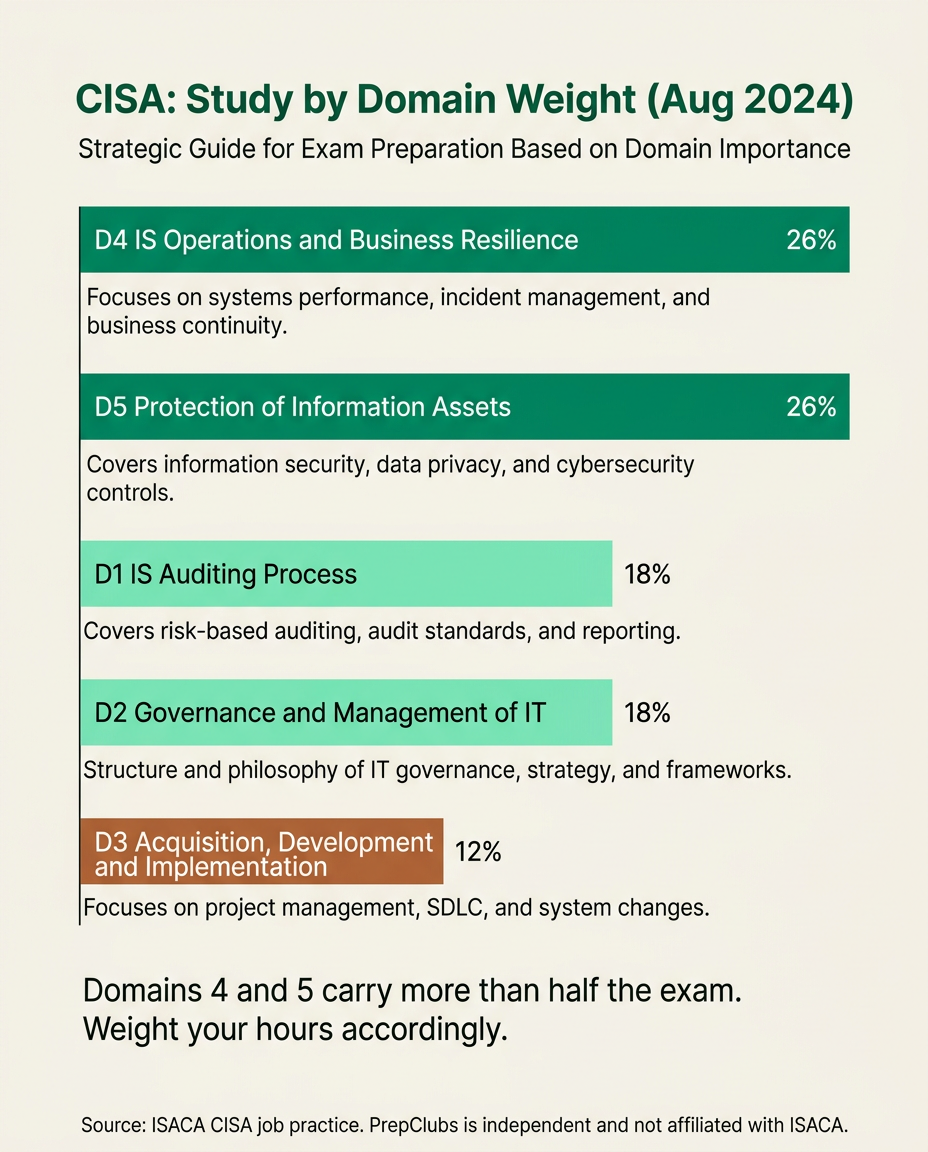
Before you plan a single study session, look at where the questions actually are. ISACA updated the CISA job practice effective August 1, 2024, and publishes the exact weight of each domain, per ISACA:
| CISA domain | Exam weight |
|---|---|
| 1. Information Systems Auditing Process | 18 percent |
| 2. Governance and Management of IT | 18 percent |
| 3. IS Acquisition, Development and Implementation | 12 percent |
| 4. IS Operations and Business Resilience | 26 percent |
| 5. Protection of Information Assets | 26 percent |
Domains 4 and 5 dominate. Domain 3 is the lightest at 12 percent. If you study every domain for the same number of hours, you spend the same effort on the 12 percent domain as on the 26 percent domains, which is the wrong trade. Weight your hours the way the exam weights its questions.
Convert the weights into a study-hour budget
The step that turns a blueprint into a plan is arithmetic. Take your total available study hours and split them by the domain percentages. Say you have 70 hours across ten weeks:
| Domain | Weight | Hours out of 70 |
|---|---|---|
| 1. Auditing Process | 18 percent | about 13 |
| 2. Governance and Management of IT | 18 percent | about 13 |
| 3. Acquisition, Development, Implementation | 12 percent | about 8 |
| 4. Operations and Business Resilience | 26 percent | about 18 |
| 5. Protection of Information Assets | 26 percent | about 18 |
Domain 5 and Domain 4 each get more than double the time you give Domain 3. That is not neglect of Domain 3; it is a decision to spend your scarce hours where they earn the most points.
The auditor mindset: the skill the weightings do not show
Here is the part most study guides underplay. CISA questions are written from the perspective of an information systems auditor, and the "correct" answer is usually the one an auditor would recommend, not the one an engineer would implement. When a question describes a control weakness, the tempting answer is to fix it. The auditor answer is often to report it, assess the risk, or verify that management addresses it.
Train this deliberately. As you work practice questions, before you look at the options, ask yourself: what would an auditor do here, observe and report, or take action? The exam consistently rewards the observe-assess-report posture over the hands-on fix. Candidates who fail often know the material but keep answering like practitioners instead of auditors.
A ten to twelve week plan
Here is a domain-weighted plan for a candidate studying part time. Adjust the length to your background; someone already working in audit can compress it, and someone new to the field should extend it.
- Weeks 1 to 2: Domain 1, the auditing process. This is the foundation. Learn the audit lifecycle, evidence, sampling, and risk-based audit planning. Everything else assumes this vocabulary.
- Weeks 3 to 4: Domain 2, governance and management of IT. IT strategy, policies, organizational structure, and the relationship between governance and audit.
- Week 5: Domain 3, acquisition, development, and implementation. The lightest domain. Cover project management, controls in the development lifecycle, and post-implementation review, then move on.
- Weeks 6 to 8: Domain 4, operations and business resilience. The first of the two heavyweights. IT operations, incident management, backup, disaster recovery, and business continuity. Spend real time here.
- Weeks 9 to 10: Domain 5, protection of information assets. The second heavyweight. Access controls, network security, encryption, and physical security, all framed as what an auditor evaluates.
- Weeks 11 to 12: full-length practice and correction. Take timed practice exams, score them by domain, and re-spend your last hours on whichever heavy domain is weakest.
Let practice questions steer the second half
The blueprint gives you a starting allocation. Your practice-question results give you the correction. When you take a full-length CISA practice exam and break the score down by domain, you get an honest map of where the remaining hours belong. This matters most for the two 26 percent domains, because a weak score there costs you the most.
On PrepClubs, the CISA practice pack pairs full-length mocks with domain-level drills, so you can rehearse the auditor mindset on realistic questions and see exactly which domain is dragging your total. It is a one-time payment, not a subscription, with 30 days of access and a 30-day Pass Guarantee: prepare with it and if you do not pass, we extend your access at no extra cost. For a professional-level exam like CISA, that guarantee takes the pressure off the first attempt without softening your preparation for it.
Real example: the same fact, two different answers
A practice question describes an organization that discovers a former employee's account is still active weeks after they left. The engineer's instinct is to disable the account, and one of the options will say exactly that. The auditor's answer, and usually the credited one, is to determine why the account was not disabled by reviewing the deprovisioning process, because the exam is testing whether you understand that fixing one account does not fix the control that failed. Both answers "solve" the immediate problem. Only one demonstrates audit thinking. Getting this distinction into your reflexes, through repeated practice, is what carries you across the 450 line.
Related on PrepClubs
- The five CISA domains and their weightings, explained
- CISA full-length practice exams and domain drills
- CISA pack pricing and the 30-day Pass Guarantee
FAQ
How long does it take to study for CISA?
A realistic part-time plan is about 10 to 12 weeks at six to eight hours a week, roughly 60 to 90 hours total. Candidates already working in audit can compress this; those new to information systems auditing should extend it. What matters most is weighting your hours to the domain percentages, per ISACA.
What are the CISA domains and their weights?
Information Systems Auditing Process (18 percent), Governance and Management of IT (18 percent), IS Acquisition, Development and Implementation (12 percent), IS Operations and Business Resilience (26 percent), and Protection of Information Assets (26 percent), effective August 1, 2024, per ISACA. Domains 4 and 5 carry more than half the exam.
What score do I need to pass CISA?
CISA is scored on a scale of 200 to 800, and you need a 450 to pass, per ISACA. It is a scaled score, so it does not map directly to a raw percentage of questions correct.
Why do people fail CISA even when they know the material?
The most common reason is answering like an engineer instead of an auditor. CISA rewards the recommend, report, and verify posture over the hands-on fix. Candidates who know the technology but keep choosing the "fix it" option miss questions they otherwise understand.
Which CISA domain is the hardest?
Difficulty is individual, but Domains 4 and 5 carry the most weight at 26 percent each, so weakness there costs the most points. Many candidates also find Domain 5, protection of information assets, the most technical. Budget the most hours to these two.
Is the CISA review manual enough on its own?
The manual covers the knowledge, but it does not rehearse the auditor mindset or simulate the timed 150-question exam. Pair reading with a large bank of practice questions, and use your per-domain practice scores to redirect your remaining study time to the heavy domains where you are weakest.
Note: PrepClubs is an independent practice-test provider and is not affiliated with, endorsed by, or sponsored by ISACA. CISA is a trademark of ISACA. All domain weightings, question counts, and scoring details are set by ISACA and cited to ISACA's official job-practice outline; confirm current details with ISACA.
FAQ