Best Entry-Level IT and Cybersecurity Certifications for Beginners in 2026
The best entry-level IT and cybersecurity certifications for beginners in 2026: CompTIA A+, Network+, Security+, Google IT Support, and ISC2 CC, ranked by goal.

The best entry-level IT certifications for beginners in 2026 are CompTIA A+ for general IT support, CompTIA Network+ for networking, CompTIA Security+ for a first security role, Google IT Support for a low-cost start with no prerequisites, and the ISC2 Certified in Cybersecurity (CC) for a recognized security credential with no experience requirement. The right one for you is not the "best" one in the abstract; it is the one that matches the job you want. This guide ranks them by goal, gives you the current cost and maintenance for each, and tells you which to earn first so you do not waste money certifying in the wrong direction.
One time-sensitive note up front, because it affects the cheapest option: ISC2's long-running free-exam offer for its CC certification is closing, so if a 2025 article told you CC is free, check the current terms before you count on it, per ISC2.
Pick the cert that matches the job you want, then earn it before the next one
Quick takeaways
- CompTIA A+ is the standard first certification for general IT support and help desk roles.
- CompTIA Network+ is the best next step and the foundation for security work.
- CompTIA Security+ is the most-requested first security certification, per CompTIA.
- Google IT Support is a low-cost, no-prerequisite entry point that pairs well with A+.
- ISC2 Certified in Cybersecurity (CC) needs no work experience, but its free-exam program is ending, so verify current pricing, per ISC2.
- A certification opens the door; practice and hands-on labs get you through it. PrepClubs packs are one-time, 30-day access, with a 30-day Pass Guarantee.
How to choose your first certification
Before the list, the decision rule. Beginners waste money by certifying in a direction that does not match their target job. Do this instead: name the role you want first, then pick the certification that role asks for. A help desk or desktop support job asks for A+. A junior network or systems role builds on Network+. A security analyst role asks for Security+ or CC. Certifying "because it is popular" without a target role is how people end up with a credential no local employer requests.
The second rule: earn them in order. Each of these certifications assumes the knowledge below it. Security+ is far easier if you already understand networking from Network+, which is easier if you already understand hardware and operating systems from A+.
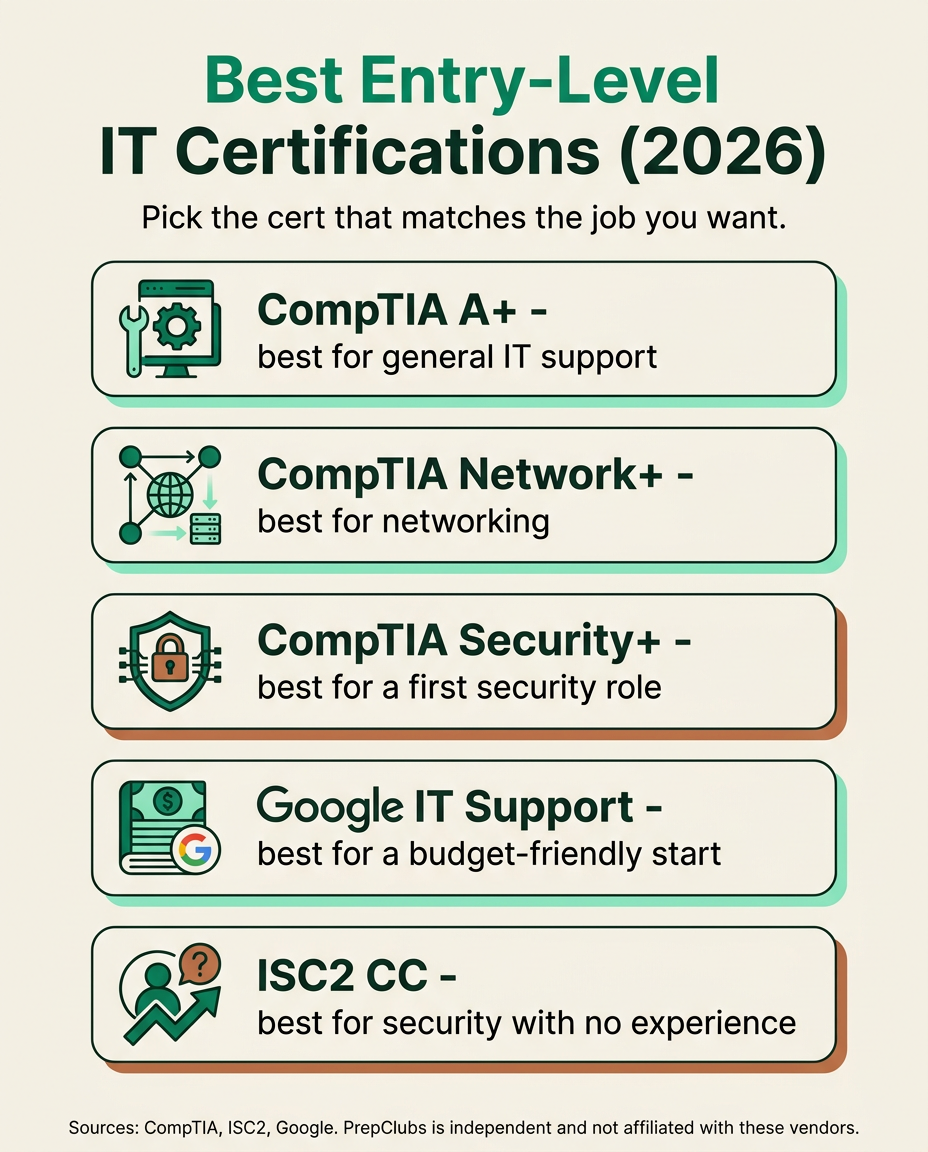
The five best entry-level certifications, by goal
1. CompTIA A+, the general IT starting point
A+ is the default first certification for anyone entering IT support. It covers hardware, operating systems, troubleshooting, and basic security across two exams (Core 1 and Core 2), and you must pass both to earn it, per CompTIA. It is the credential most help desk and desktop support job postings name. If you do not have a specific security or networking goal yet, start here, because A+ keeps every path open.
Best for: help desk, desktop support, general IT roles. Maintenance: valid three years, renewable through continuing education.
2. CompTIA Network+, the networking foundation
Network+ (N10-009) proves you can configure, manage, and troubleshoot networks. It matters for beginners well beyond networking jobs, because security is largely network security, so Network+ makes Security+ substantially easier. It is a single exam, and you pass at 720 out of 900, per CompTIA. Take it after A+ if your path runs toward networking or security.
Best for: junior network and systems roles, and as a bridge to security. Maintenance: valid three years.
3. CompTIA Security+, the first security credential
Security+ (SY0-701) is the most widely requested entry-level security certification. It covers threats, cryptography, identity, and risk at a foundational level, and it appears in a large share of junior security analyst postings. CompTIA recommends pairing it with Network+ and about two years of security or systems administration experience, but there is no formal experience requirement to sit or earn it, per CompTIA. For most people, Security+ is the destination of the CompTIA beginner path.
Best for: security analyst, SOC, and other first security roles. Maintenance: valid three years.
4. Google IT Support, the low-cost no-prerequisite start
The Google IT Support certificate, delivered through Coursera, is a strong option for a complete beginner who wants a low-cost, structured start with no prerequisites. It is not a substitute for A+ in the eyes of every employer, but it teaches the same foundational ground and is often used alongside A+ preparation. It suits career changers who want to test whether IT is for them before committing to exam vouchers.
Best for: complete beginners and career changers on a budget. Maintenance: no renewal exam; it is a course certificate, not a vendor exam certification.
5. ISC2 Certified in Cybersecurity (CC), security with no experience gate
The ISC2 CC is an entry-level security certification explicitly designed for people with no work experience, per ISC2. It has been popular partly because ISC2 ran a free-exam program. That program is winding down, so the current cost and any deadlines should be verified directly with ISC2 before you plan around "free." CC is a credible way to signal foundational security knowledge from a respected body while you build toward Security+ or work experience.
Best for: aspiring security professionals with no experience. Maintenance: annual maintenance fee, per ISC2. Verify current pricing.
Compare them side by side
| Certification | Best for | Prerequisite | Renewal |
|---|---|---|---|
| CompTIA A+ | General IT support | None | 3 years, continuing education |
| CompTIA Network+ | Networking, bridge to security | A+ recommended | 3 years |
| CompTIA Security+ | First security role | Network+ recommended | 3 years |
| Google IT Support | Budget-friendly beginner start | None | Course certificate, no exam renewal |
| ISC2 CC | Security, no experience needed | None | Annual maintenance fee |
Use this as a menu, not a ranking. The "best" row is the one whose "best for" column matches your target job.
The order that saves you money
If your goal is general IT, A+ is enough to start applying, and you can add Network+ later. If your goal is security, the efficient sequence is A+, then Network+, then Security+, with CC as an optional early confidence-builder along the way. Earning them out of order (attempting Security+ with no networking background, for example) usually means a harder exam and a higher chance of paying for a retake. The order is not tradition for its own sake; it is the cheapest route to a pass.
A certification is a door, not the room
One honest caveat that beginner cert lists often skip: a certification gets your resume past a filter, but it does not by itself make you job-ready. Employers also want to see that you can actually do the work, which means hands-on practice, a home lab, and small projects you can talk about in an interview. Treat each certification as the entry ticket, and pair it with real practice so you can back up the credential when someone asks you a technical question.
Real example: two beginners, two shortest paths
Consider two people starting from zero. The first wants a help desk job in three months. Her shortest path is A+ alone, because that is what local help desk postings ask for, and adding Network+ now would delay her without helping her land that specific role. The second wants to be a security analyst within a year. His shortest path is A+, then Network+, then Security+, in that order, because Security+ is what security postings request and the two certs beneath it make the Security+ exam far more passable. Same starting point, two different "best" certifications, because their target jobs are different.
Related on PrepClubs
- CompTIA A+ practice tests and drills
- CompTIA Network+ practice tests and drills
- CompTIA Security+ practice tests and drills
FAQ
What is the best IT certification for beginners with no experience?
CompTIA A+ for general IT support, and ISC2 Certified in Cybersecurity (CC) if your goal is specifically security, since CC requires no work experience, per ISC2. The best choice is the one that matches the job you want, not the most popular one in the abstract.
Which IT certification should I get first?
CompTIA A+ for a general IT path, because it keeps networking and security options open. If you already know your goal is security, you can still start with A+, then move to Network+ and Security+, since each builds on the one before it.
Is the ISC2 CC certification still free?
ISC2's free-exam program for CC is being phased out, so do not assume it is free based on older articles. Check the current pricing and any deadlines directly with ISC2 before you plan around it, per ISC2.
Are IT certifications worth it for beginners in 2026?
Yes, when matched to a target role. Entry-level certifications like A+, Network+, Security+, and CC are widely requested and help a resume clear automated filters. They are most valuable when paired with hands-on practice and a small project portfolio.
How much do entry-level IT certifications cost?
Costs vary by vendor and change over time. CompTIA exam vouchers run into the hundreds of dollars each, Google IT Support is a subscription-based course, and ISC2 CC pricing is changing as its free program ends. Always confirm current figures with the certifying body, since students and some programs qualify for discounts.
Do I need Network+ before Security+?
It is not formally required, but it is strongly recommended, per CompTIA. Security is largely network security, so understanding networking first makes the Security+ exam meaningfully easier and reduces your chance of a costly retake.
Note: PrepClubs is an independent practice-test provider and is not affiliated with, endorsed by, or sponsored by CompTIA, ISC2, or Google. All certification names are trademarks of their respective owners. Certification requirements, formats, and pricing are set by the certifying bodies and cited to their official pages; confirm current details before you purchase.
FAQ