CompTIA vs CISSP: Why They Are Not Actually Competing Certs
CompTIA vs CISSP is a false comparison. CompTIA is a family of entry to intermediate certs; CISSP is one advanced cert needing 5 years experience. Here is how they fit.

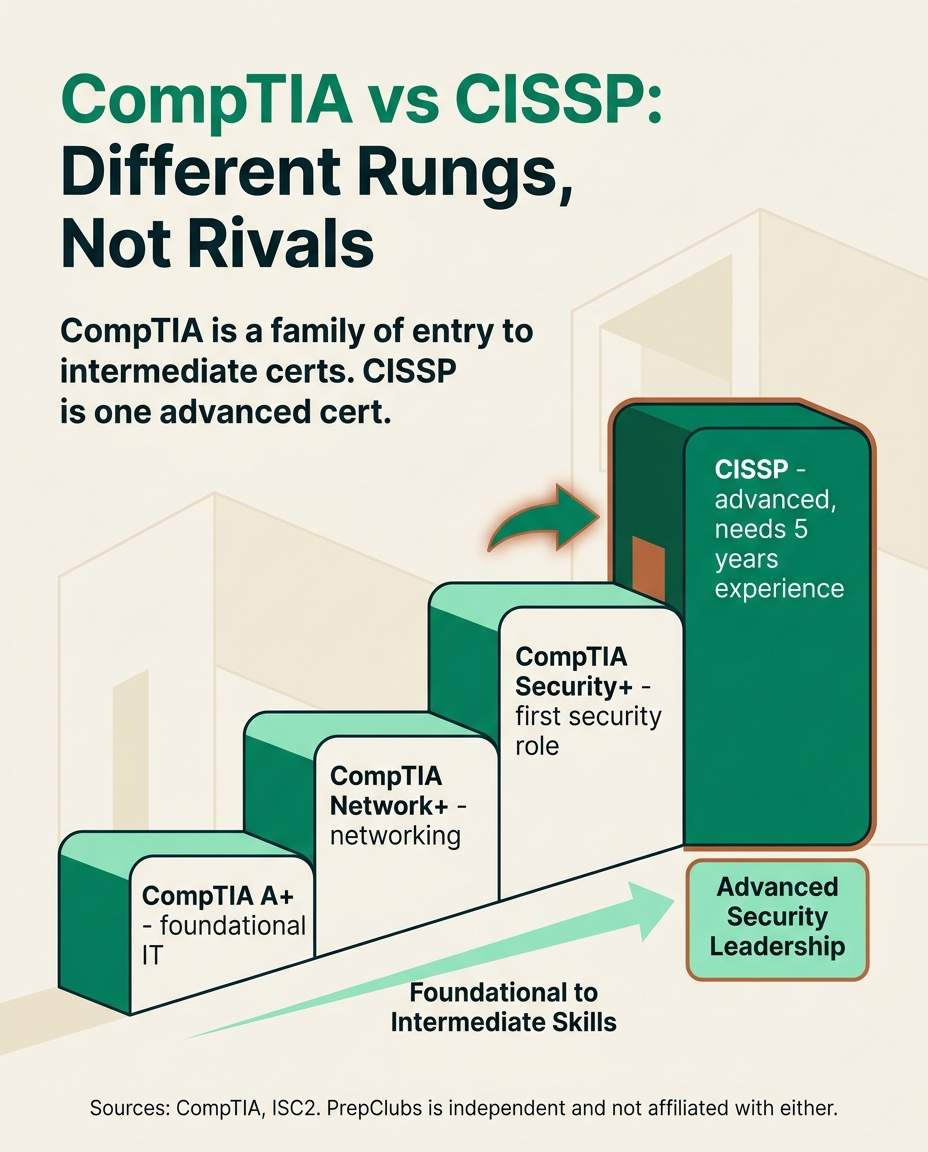
CompTIA and CISSP are not competing certifications, and comparing them head to head is like comparing a driving school to an airline transport pilot license. CompTIA is a family of certifications, A+, Network+, Security+, and more, that take you from entry level to intermediate. CISSP is a single advanced certification from ISC2 that requires five years of paid security work experience to fully earn, per ISC2. They sit at different rungs of the same ladder. For almost everyone the honest answer to "CompTIA or CISSP" is "CompTIA first, CISSP years later," not "pick one."
If you are early in your career and trying to choose between them, that framing alone saves you a wrong turn. You do not choose between a beginner cert and an expert cert. You earn the beginner one now and the expert one when you have the experience it requires.
CompTIA is a family of certs; CISSP is one advanced cert. They are rungs, not rivals
Quick takeaways
- CompTIA is a certification family (A+, Network+, Security+); CISSP is one advanced ISC2 certification. Comparing "CompTIA" to "CISSP" compares a category to a single item.
- CISSP requires five years of cumulative, paid, full-time security experience in two or more of its eight domains to fully certify, per ISC2.
- Security+ is the CompTIA cert people usually mean when they say "CompTIA vs CISSP," and it is an early-career security cert, not a rival to CISSP.
- You can pass the CISSP exam without the experience and become an Associate of ISC2, then earn the full cert once you have the years, per ISC2.
- The normal path is A+ or Network+, then Security+, then years of work, then CISSP.
- Whichever exam you are prepping, PrepClubs has practice packs: one-time payment, 30-day access, 30-day Pass Guarantee.
The category error at the heart of the question
"CompTIA vs CISSP" mixes two different kinds of things. CompTIA is a vendor that publishes many certifications at different levels. CISSP is one specific certification from a different organization, ISC2. So the real comparison people are reaching for is almost always "CompTIA Security+ vs CISSP," because Security+ is CompTIA's flagship security certification.
Once you make that swap, the mismatch becomes obvious. Security+ is designed as an early-career security certification with no formal experience requirement. CISSP is designed for experienced practitioners, managers, and executives, and it carries a five-year experience requirement, per ISC2. One is where you start in security. The other is where you arrive after several years.
Where each certification sits
| CompTIA (Security+) | CISSP (ISC2) | |
|---|---|---|
| Level | Early career | Advanced |
| Experience required | None to sit or earn | 5 years paid security work to fully certify |
| Focus | Hands-on foundational security skills | Security management, governance, and design |
| Exam | SY0-701, single form | Adaptive, 100 to 150 questions, 8 domains |
| Typical audience | New security analysts, help desk moving up | Managers, architects, senior practitioners |
| Position in a career | A first or second security cert | A cert you earn after years in the field |
The table makes the point better than any argument: these are not two options for the same slot. They are two different slots on the same career path.
The CISSP experience requirement changes everything
The single fact that reframes this whole comparison is the CISSP experience requirement. To be fully certified as a CISSP, you need a minimum of five years of cumulative, paid, full-time work experience in two or more of the eight CISSP domains, per ISC2. A relevant four-year degree or an approved credential can waive one year, bringing it to four. This is not a suggestion. It is a hard requirement for the credential itself.
That is why a new graduate cannot simply "choose CISSP instead of Security+." They can sit and pass the CISSP exam, but until they have the experience, they hold the title of Associate of ISC2, with up to six years to earn the required experience and convert it to the full CISSP, per ISC2. Security+, by contrast, is fully yours the moment you pass, with no experience gate. For someone at the start of their career, that difference is decisive.
The path most people actually take
For almost everyone entering security, the sequence looks like this, and each step builds on the last:
- A+ or Network+. Foundational IT and networking knowledge. Network+ is especially useful because so much of security is network security.
- Security+. Your first dedicated security certification. It proves baseline security skills and is widely requested for entry-level security roles. CompTIA recommends it be paired with Network+ and about two years of security or systems administration experience, per CompTIA.
- Work. Several years in security roles, accumulating the experience CISSP will later require.
- CISSP. Once you have the years, CISSP validates the management, governance, and design maturity you have built. This is where you pursue it, not before.
Notice that CompTIA and CISSP appear at opposite ends of the same path. You do not pick between step two and step four. You walk from one to the other over several years.
When the comparison does have a real answer
There is one situation where "CompTIA or CISSP" is a genuine either-or: an experienced security professional with five or more years in the field, deciding what to certify next. For that person, Security+ may be beneath their current level, and CISSP is the credential that matches their seniority and opens management-track roles. If you already have the experience and a strong foundation, going straight for CISSP can make sense, because you are not skipping a rung, you are standing on the one below it already. For everyone earlier than that, the sequencing answer holds.
Real example: two readers, two right answers
Take two people asking the same question. The first is a help desk technician with one year of experience wondering whether to study CompTIA or CISSP. For her, the answer is Security+, because CISSP's experience requirement means the credential is years away no matter how well she studies, and Security+ is the cert that gets her the next job now. The second is a security engineer with seven years of experience whose employer wants a security lead. For him, Security+ would be a step down, and CISSP is the right target, because he already meets the experience requirement and needs the management-level credential. Same question, opposite answers, and the deciding factor in both cases is experience, not which cert is "better."
Related on PrepClubs
- Security+ vs CISSP, compared in detail
- Security+ practice tests and drills
- CISSP practice tests and drills
FAQ
Is CISSP better than CompTIA?
Neither is "better"; they sit at different levels. CompTIA certifications like Security+ are entry to intermediate and need no experience, while CISSP is advanced and requires five years of paid security work to fully earn, per ISC2. The right one depends entirely on where you are in your career.
Should I get Security+ or CISSP first?
Security+ first, for almost everyone. It has no experience requirement and is fully yours when you pass, while CISSP requires five years of security experience to certify, per ISC2. Earn Security+ now, gain experience, and pursue CISSP once you meet the requirement.
Can I take CISSP without experience?
You can sit and pass the CISSP exam without the experience, which makes you an Associate of ISC2. You then have up to six years to earn the required five years of experience and convert it to the full CISSP, per ISC2.
Does CompTIA lead to CISSP?
Indirectly, yes. The common path is A+ or Network+, then Security+, then several years of security work, then CISSP. CompTIA builds the foundation and the early-career credentials; CISSP validates the senior-level experience you accumulate afterward.
What is the CISSP experience requirement?
A minimum of five years of cumulative, paid, full-time work experience in two or more of the eight CISSP domains, per ISC2. A relevant four-year degree or an approved credential can waive one year, reducing it to four.
Is Security+ enough without CISSP?
For many entry-level and intermediate security roles, yes. Security+ is widely accepted as a baseline security certification. CISSP becomes relevant later, when you have the experience for senior, management, or architecture roles that specifically ask for it.
Note: PrepClubs is an independent practice-test provider and is not affiliated with, endorsed by, or sponsored by CompTIA or ISC2. CompTIA, Security+, Network+, A+, CISSP, and related marks belong to their respective owners. All experience requirements, exam formats, and positioning statements are set by CompTIA and ISC2 and cited to their official pages; confirm current details with the vendors.
FAQ