Aptitude Test Examples: 10 Real Question Types With Worked Solutions
Ten aptitude test examples with the reasoning worked out: numerical, verbal, logical, mechanical and spatial questions, plus the real test each one comes from.

An aptitude test example is a practice question of the kind employers use to sift candidates, and the useful ones show the reasoning, not just the letter of the right answer. This guide works through ten across the five families you are most likely to meet: numerical, verbal, logical, mechanical and spatial. Each names the reasoning step, the shortcut that saves time, and the branded test the style belongs to. Nothing here is gated. After the ten come 12 picture-based spatial questions, all original and drawn in the same style as the real tests. Work them all and you will know which family is your weak one, the only thing worth knowing the day before a real assessment.
Quick takeaways
- Five families cover almost everything: numerical, verbal, logical, mechanical and spatial. Branded tests are mixes of those five.
- The reasoning matters more than the answer, because the same working recurs across dozens of questions.
- Speed is the real test. On the fastest formats you get under 20 seconds a question, so the shortcut beats the calculation.
- The family you get tells you which test you are taking. Gears and pulleys mean a trades battery; true, false and cannot say means a critical thinking test.
- Free first. Try one free diagnostic in the relevant test catalog before you pay for anything.
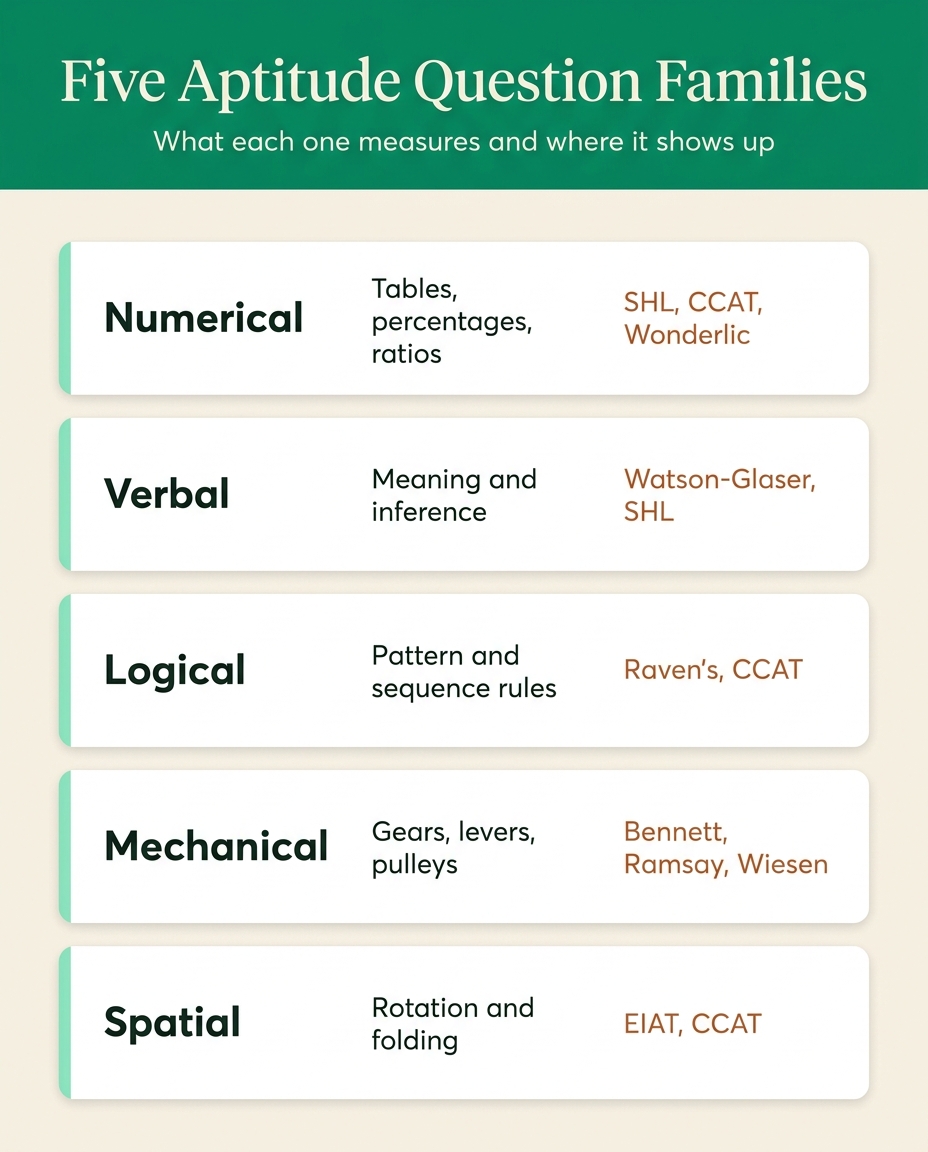
The five families at a glance
Find the family your invitation hints at, then jump to those two examples. An invitation can also carry abstract reasoning, situational judgement, error checking, or a personality questionnaire, which has no right answer.
| Family | What it measures | A typical question | Tests it turns up in |
|---|---|---|---|
| Numerical | Reading data fast, under a clock | Percentage change from a table | SHL, CCAT, Wonderlic, Talent Q |
| Verbal | Precision with meaning and inference | True, false or cannot say | Watson-Glaser, SHL verbal |
| Logical | Finding the rule behind a pattern | Number series, syllogisms | Raven's, CCAT, Aon cut-e |
| Mechanical | Physical principles nobody taught you | Gear direction, lever balance | Bennett, Ramsay, Wiesen |
| Spatial | Rotating a shape in your head | Folding a net into a cube | EIAT, CCAT, Raven's-style |
Numerical reasoning examples
Numerical reasoning is arithmetic with a stopwatch. The difficulty is pulling the right two numbers from a table and picking the right operation first time. The maths itself is school level.
Example 1: Percentage change
A support team handled 480 tickets in March and 552 tickets in April. What was the percentage increase?
A. 12 percent B. 15 percent C. 18 percent D. 20 percent
Answer: B, 15 percent.
The reasoning. Percentage change divides by the starting number, never the ending one. The change is 72, and 72 divided by 480 is 0.15, so 15 percent.
The shortcut. Skip the division. 10 percent of 480 is 48, and half of that, 24, is 5 percent. Together they make 72, exactly the change. Building percentages from 10 and 5 percent chunks is the highest-value habit on any numerical section.
The trap. Dividing 72 by 552 gives 13 percent, close enough to feel plausible. Percentage change always divides by the original value.
Example 2: Rates and proportion
A crew of 4 electricians installs 18 fixtures in 6 hours. Working at the same rate, how many fixtures would a crew of 6 install in 4 hours?
A. 12 B. 16 C. 18 D. 24
Answer: C, 18.
The reasoning. Convert to person-hours. The first crew supplies 4 times 6, or 24 person-hours, for 18 fixtures. The second supplies 6 times 4, also 24. Same labour, same output.
The shortcut. Spot that 4 times 6 and 6 times 4 match before calculating. Many of these are built on a swap that cancels out. If numerical is your weak family, work the timed set in the numerical reasoning practice guide first.
Verbal reasoning examples
Verbal reasoning rewards nothing but staying strictly inside the text you were given.
Example 3: True, false or cannot say
Passage: All of the company's field technicians completed the new safety course in January. Some of the office staff completed it in February. The course must be repeated every year.
Statement: Every employee at the company has completed the safety course.
A. True B. False C. Cannot say
Answer: C, cannot say.
The reasoning. The passage covers all field technicians and some office staff, and says nothing about the rest. The statement may be true in reality, but the passage neither establishes nor contradicts it, which is what cannot say means.
The shortcut. Circle the quantifiers: all, some, none, only, every. Nearly every cannot say answer turns on a some in the passage against an all in the statement. This style anchors critical thinking assessments, covered in the SHL verbal reasoning format guide.
Example 4: Word relationships
THERMOMETER is to TEMPERATURE as ODOMETER is to:
A. speed B. distance C. fuel D. time
Answer: B, distance.
The reasoning. Say the relationship as a sentence first: "a thermometer measures temperature." Substitute: "an odometer measures distance." It holds. Speed belongs to a speedometer, the near-miss the question is built around.
The shortcut. Build the bridging sentence first, then test each option against it. If two fit, your sentence was too vague.
Logical reasoning examples
Logical reasoning splits in two: inductive finds a hidden rule, deductive follows a stated one.
Example 5: Number series (inductive)
What comes next? 3, 6, 11, 18, 27, ?
A. 34 B. 36 C. 38 D. 40
Answer: C, 38.
The reasoning. When a series is not a simple multiple, write the gaps underneath. They are 3, 5, 7, 9: consecutive odd numbers, so the next gap is 11, and 27 plus 11 is 38.
The shortcut. Take first differences before trying anything clever, and if those are not obvious, take the differences of the differences. Those two passes crack most number series in fifteen seconds.
Example 6: Deduction (syllogism)
All inspectors carry a meter. Nobody who carries a meter works the night shift. Priya works the night shift.
Which must be true?
A. Priya carries a meter B. Priya is not an inspector C. Priya is an inspector D. Some inspectors work nights
Answer: B, Priya is not an inspector.
The reasoning. Chain them: inspector leads to carries a meter, which leads to does not work nights. Priya works nights, so she cannot be an inspector. That contrapositive is the only inference the statements support.
The shortcut. Rewrite each sentence as an arrow before reading the options. Deduction questions are almost always a two-link chain plus one fact running backwards along it.
Mechanical reasoning examples
Mechanical reasoning is the family candidates walk into cold, because nobody teaches it and it feels like it should be intuitive. It is not. It is a small set of rules you can learn in an evening.
Example 7: Gear direction
Three gears sit in a row, each meshing with the next. Gear A is turned clockwise. Which way does Gear C turn?
A. Clockwise B. Counterclockwise C. It does not turn D. It depends on the gear sizes
Answer: A, clockwise.
The reasoning. Meshed gears turn opposite ways, so A clockwise makes B counterclockwise and B makes C clockwise. Gear size changes speed, never direction, which is why D is wrong.
The shortcut. Count instead of tracing. In a straight gear train, odd-numbered gears turn with the driver and even-numbered ones against it. Gear C is third, so it matches Gear A.
Example 8: Levers
A lever has its fulcrum 1 foot from a 200 pound load and 4 feet from where you push. Ignoring friction, how much force do you need to balance the load?
A. 25 pounds B. 50 pounds C. 100 pounds D. 200 pounds
Answer: B, 50 pounds.
The reasoning. A lever balances when load times load distance equals effort times effort distance: 200 times 1 equals effort times 4, so the effort is 50 pounds.
The shortcut. Compare arm lengths and skip the algebra: yours is 4 times longer, so you need a quarter of the force. The same ratio covers pulleys, where each supporting rope divides the force again. The Bennett, Ramsay and Wiesen comparison explains which of the three you are likely sitting.
Spatial reasoning examples
Spatial questions are drawn rather than written, but their rules are verbal and learnable.
Example 9: Folding a net
A flat cross-shaped net folds into a cube. A circle is printed on the centre square, and a triangle on the square immediately to its left. On the finished cube, are the circle face and the triangle face opposite each other?
A. Yes B. No, they are adjacent C. Only if the net is folded inward D. Not enough information
Answer: B, they are adjacent.
The reasoning. Two squares sharing an edge on the net share an edge on the cube, making them adjacent. Opposite faces come from squares sitting two apart along a straight line of the net.
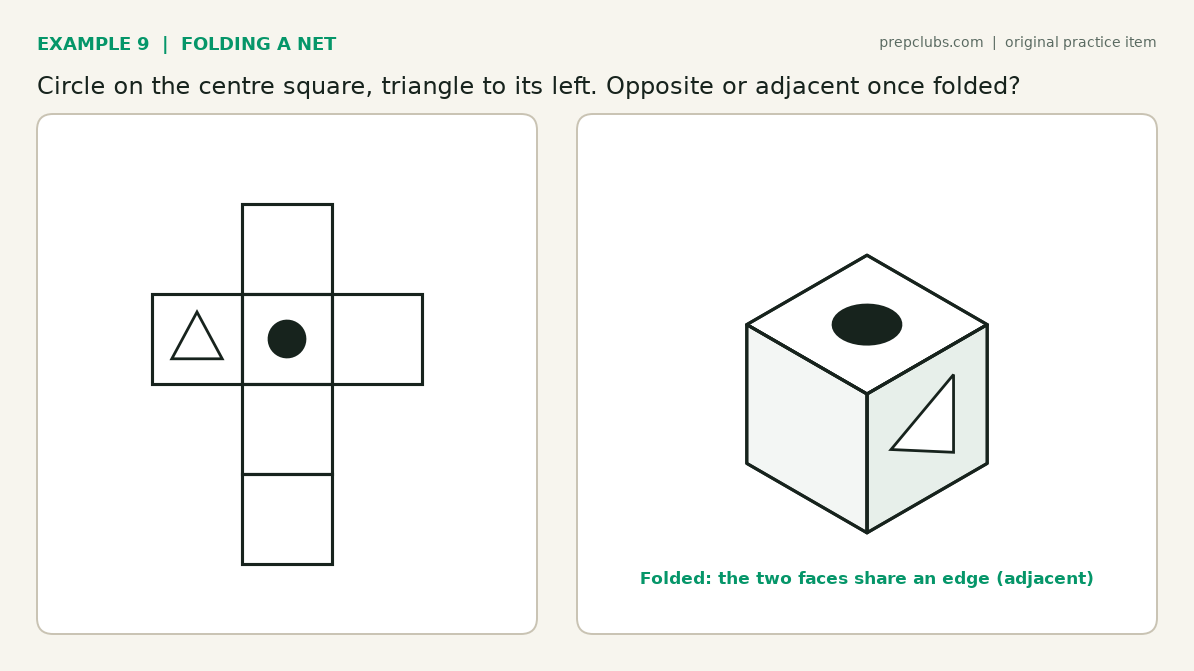
The shortcut. Stop visualising and learn the rule: touching on the net means touching on the cube, two apart in a row means opposite.
Example 10: Rotation
An L-shaped block stands with its tall arm pointing up and its short foot pointing right. Rotate the whole block 90 degrees clockwise. Where do the two parts point now?
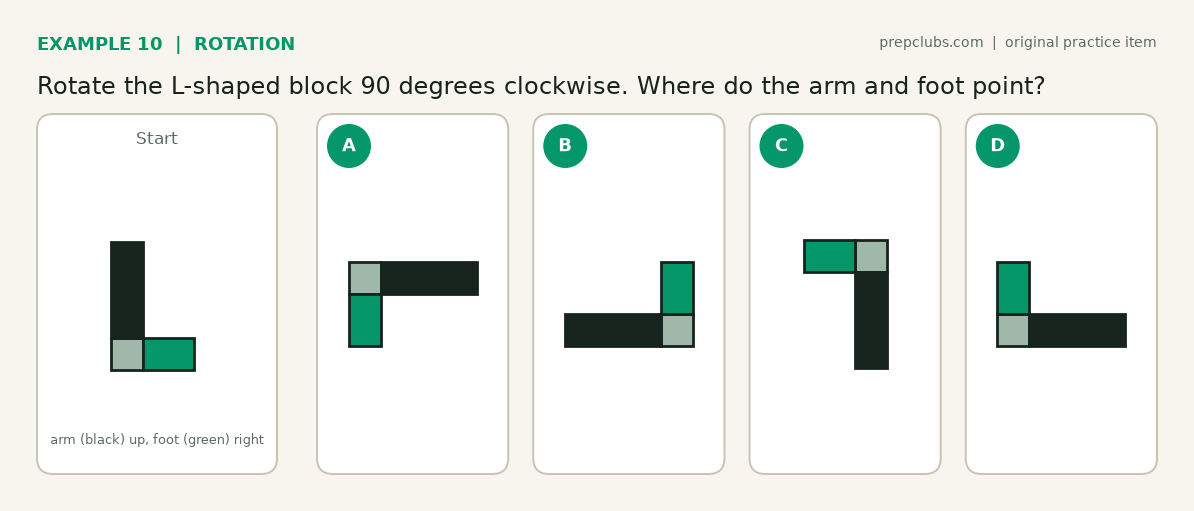
A. Arm right, foot down B. Arm left, foot up C. Arm down, foot left D. Arm right, foot up
Answer: A, arm right and foot down.
The reasoning. A 90 degree clockwise turn sends up to right, right to down, down to left and left to up. The arm was up, so it goes right; the foot was right, so it goes down.
The shortcut. Track one feature, not the whole shape. Rotate the most distinctive part, then eliminate every option that puts it elsewhere.
Spatial reasoning practice: 12 picture questions
Spatial reasoning is the one family you cannot practise from text, so here are 12 drawn questions. They are original items built by PrepClubs to match the look and logic of the rotation, mirror, cube-net, matrix and perspective questions on the CCAT, Thomas GIA, Criteria and SHL-style batteries; real vendor items are copyrighted and never published. Give yourself about 20 seconds each, note your letter, then check the answer under the picture.
Questions 1 to 4: rotation and mirror images
Question 1. Which option is the figure turned, not flipped?
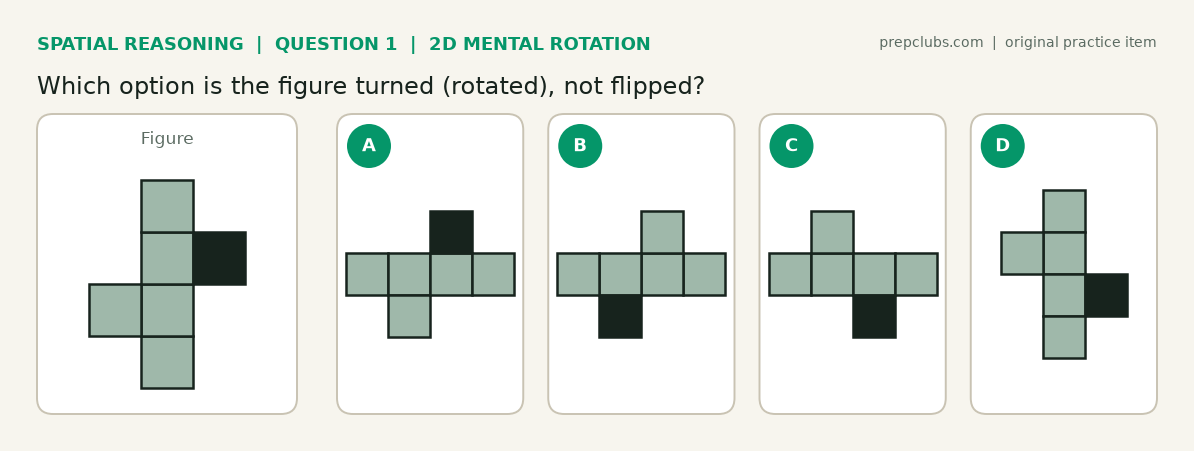
Answer: C. Turn the figure 90 degrees clockwise: the column lies flat, the dark square drops below the third cell and the single bump sits above the second. A, B and D are mirror images, which no rotation can produce.
Question 2. Which option is the reflection in the dashed mirror line?
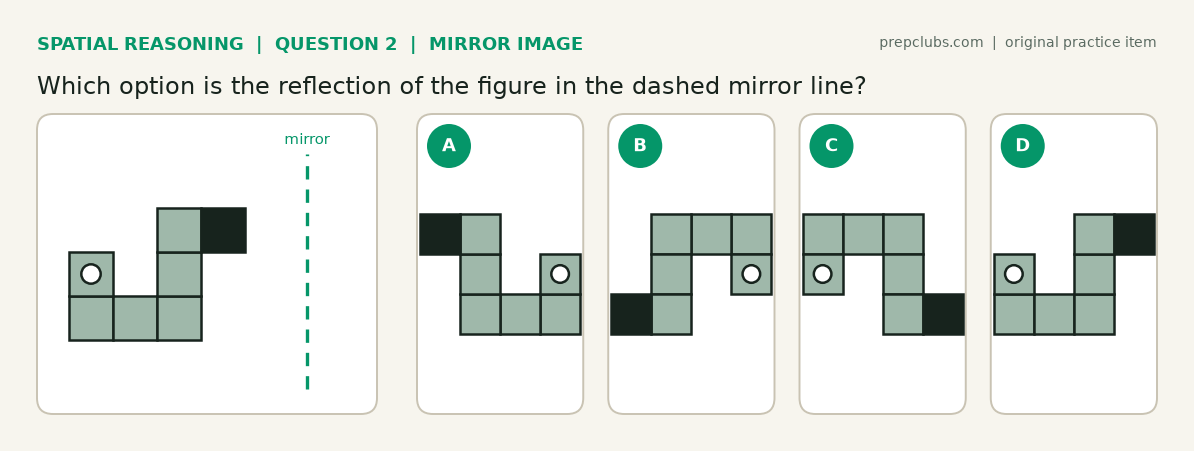
Answer: A. A vertical mirror swaps left and right and nothing else, so the dark square moves to the far left and the dot to the far right at the same heights. D is the untouched original, B is a half turn and C is a top-to-bottom flip.
Question 3. Three options are the cube figure rotated in space. Which one can not be?
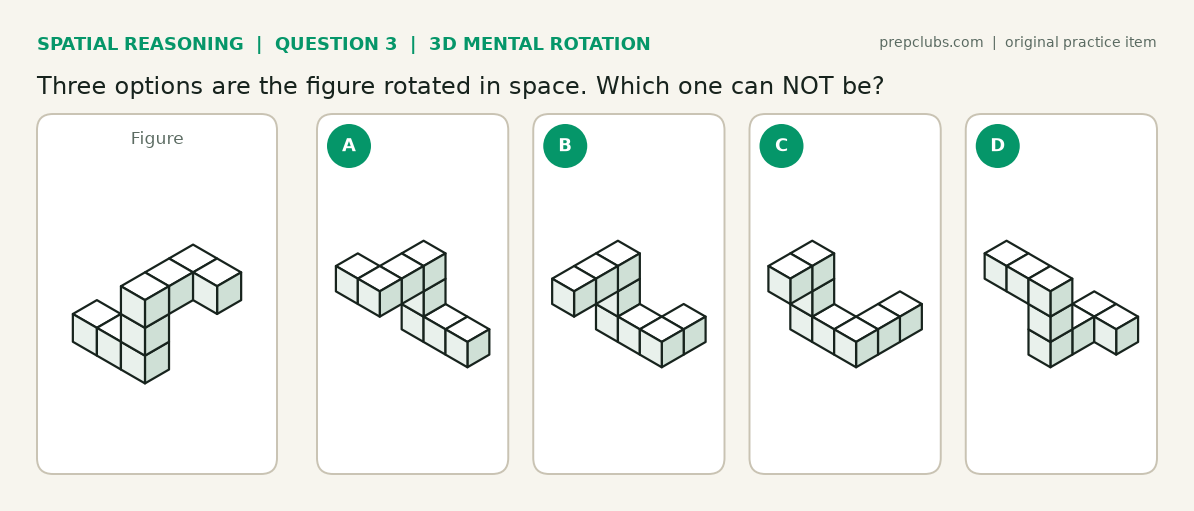
Answer: D. Point the three-cube arm away from you with the column rising from its far end. In the figure and in A, B and C, the top arm then runs off to the left; in D it runs to the right. That is a change of handedness, which only a mirror can make.
Question 4. Four figures are the same shape turned. Which is the odd one out?
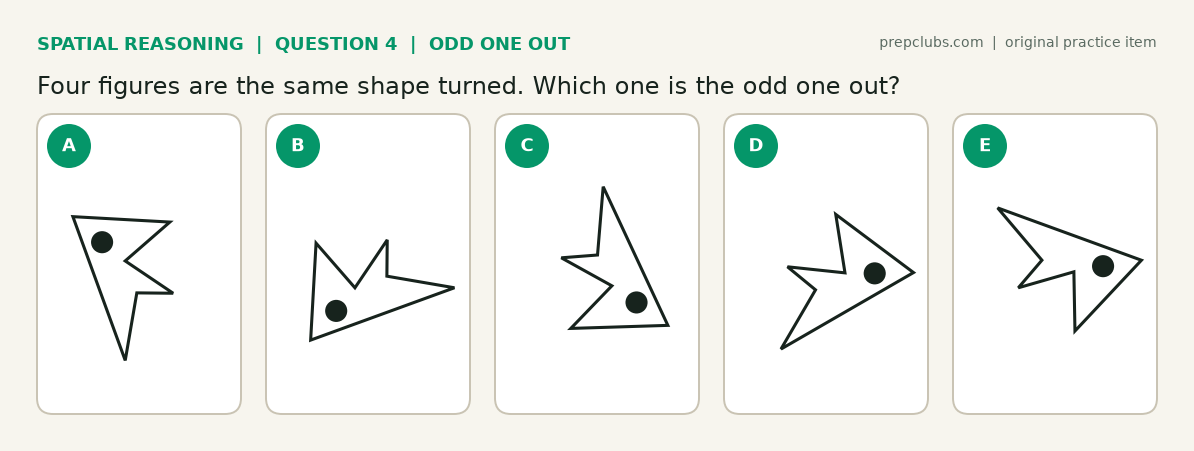
Answer: D. Stand each figure on its long straight edge with the dot at the top: in A, B, C and E the body of the shape sits to the right of that edge, in D it sits to the left, so D is flipped.
Questions 5 to 8: cube nets, matrices and series
Question 5. The net is folded into a cube. Which cube could it make?
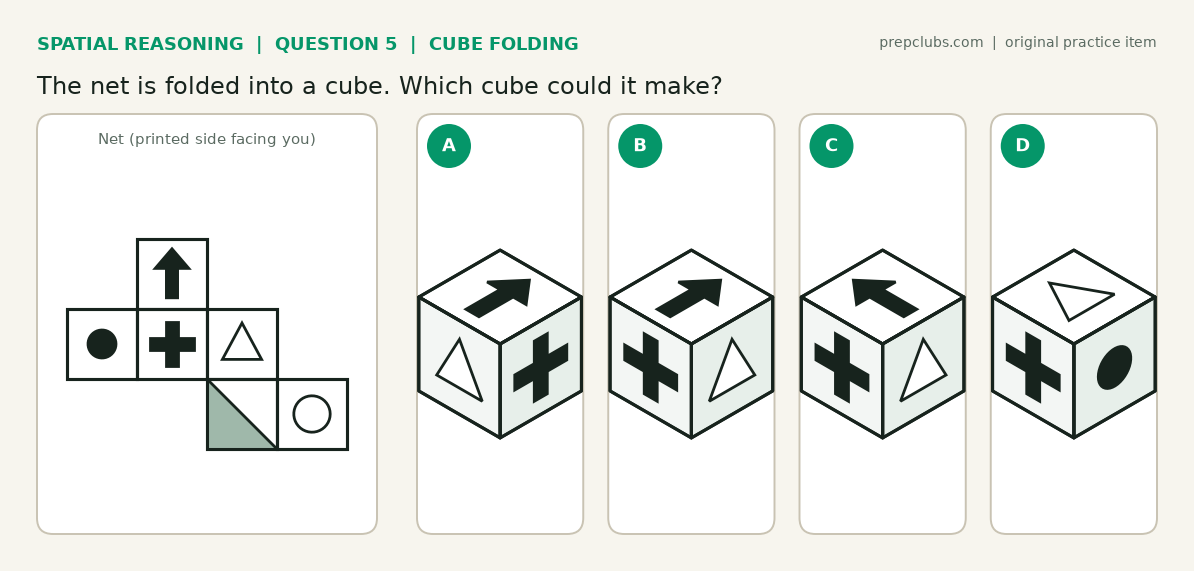
Answer: B. Fold around the cross: the arrow folds over the top pointing away from you and the triangle takes the right-hand side. The circle and triangle sit either side of the cross, so they are opposite and can never be seen together, which rules out D; A swaps the cross and triangle, and C turns the arrow sideways.
Question 6. Which flat pattern can not be folded into a cube?
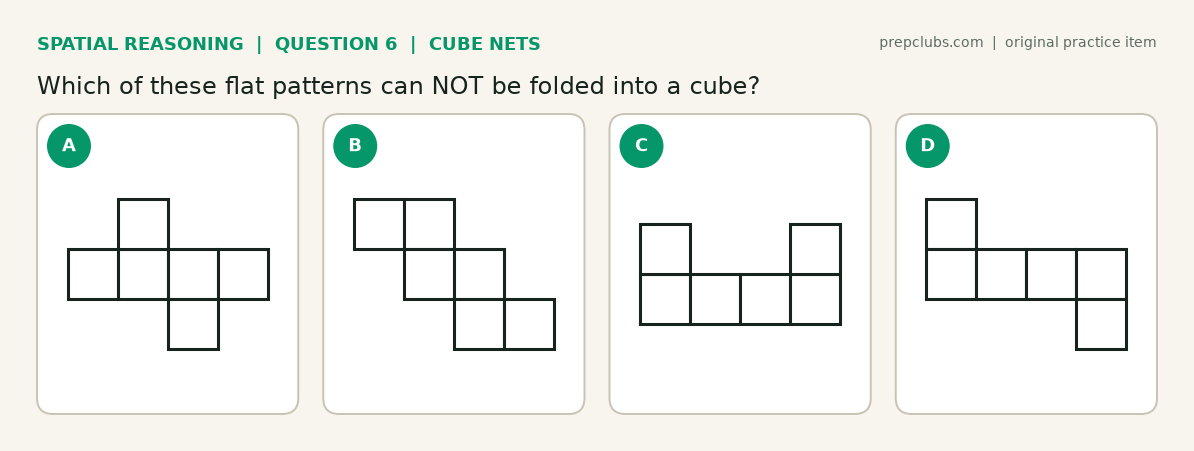
Answer: C. A row of four wraps round the sides of the cube, so its two end squares become neighbours, and the flaps above both ends would fold onto the same top face. A, B and D are three of the 11 valid cube nets.
Question 7. Which option completes the grid?
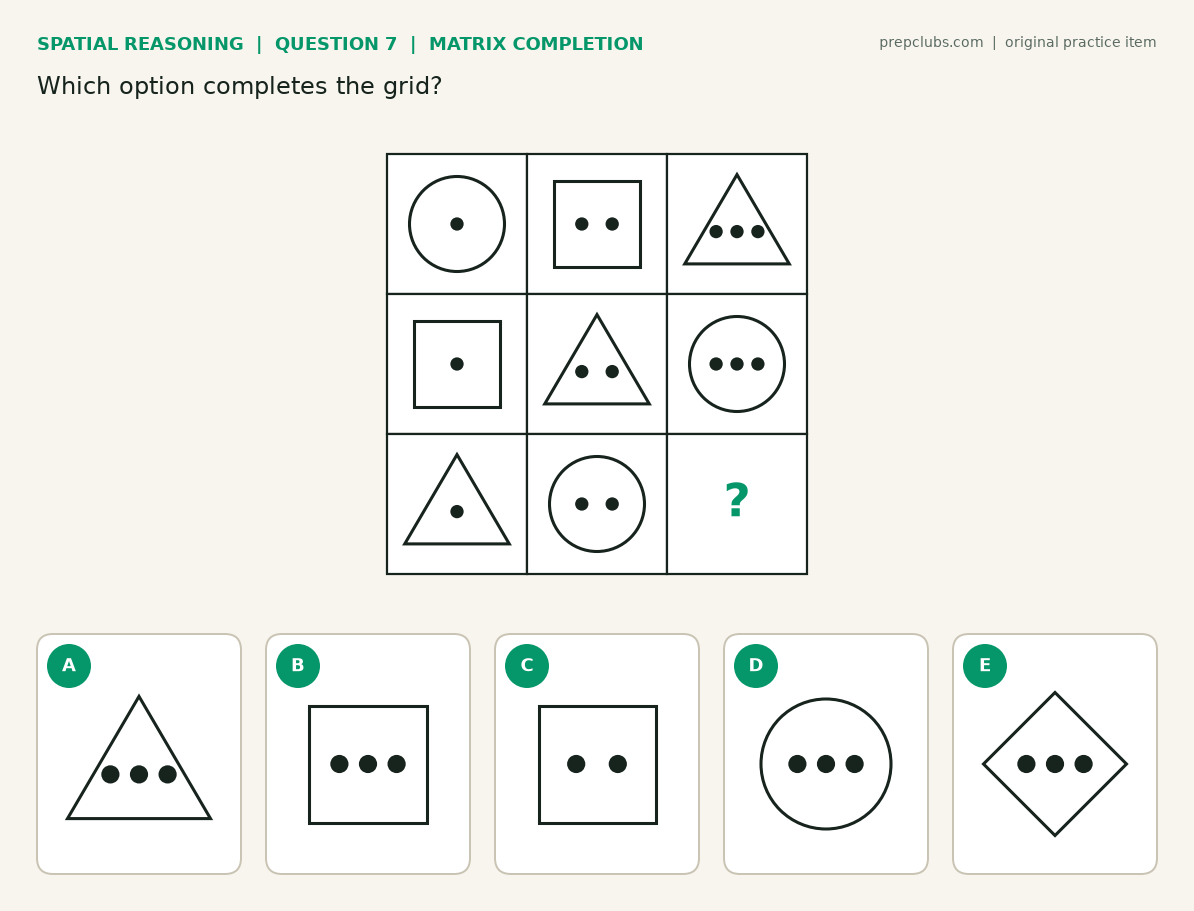
Answer: B. Each row holds a circle, a square and a triangle once, and the dot count rises 1, 2, 3 from left to right. The bottom row already has a triangle and a circle, so the gap is a square with three dots; E is a diamond, not a square.
Question 8. Which option comes next in the series?
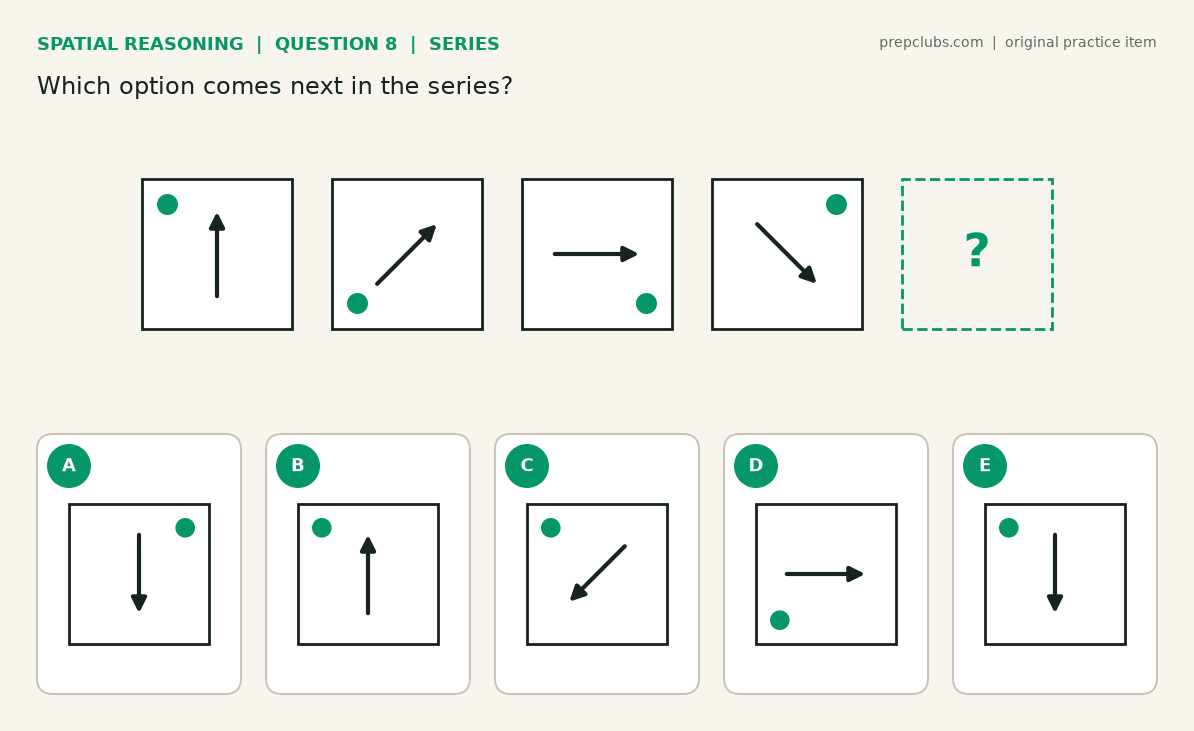
Answer: E. Track the two parts separately. The arrow turns 45 degrees clockwise each step (up, up-right, right, down-right), so next it points down; the dot moves anticlockwise round the corners and returns to the top left.
Questions 9 to 12: paper folding, views, analogies and counting
Question 9. A square sheet is folded twice and punched once. What does it look like unfolded?
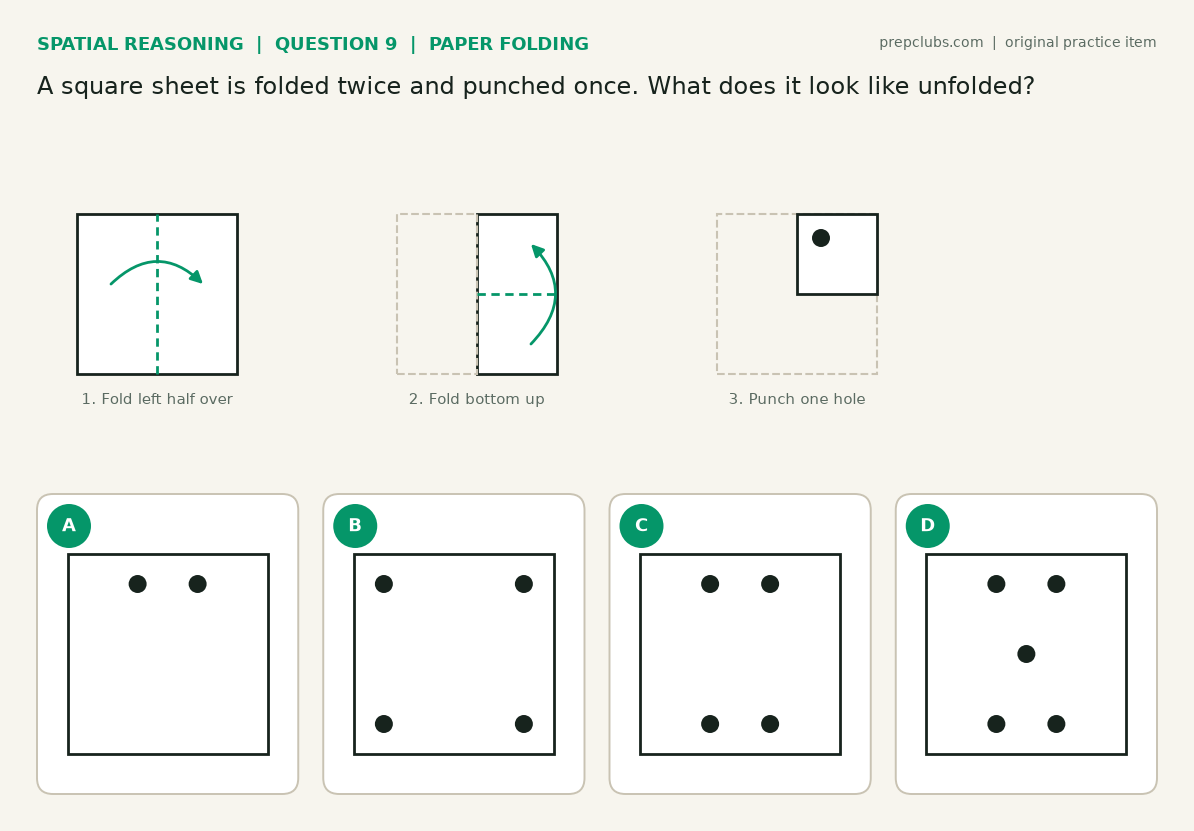
Answer: C. The punch goes through four layers, so there are four holes, mirrored across both fold lines: a pair near the top and a pair near the bottom, each close to the vertical centre line. B would need the hole punched at the outer corner of the folded square.
Question 10. Which option shows the stack seen from the front, in the direction of the arrow?
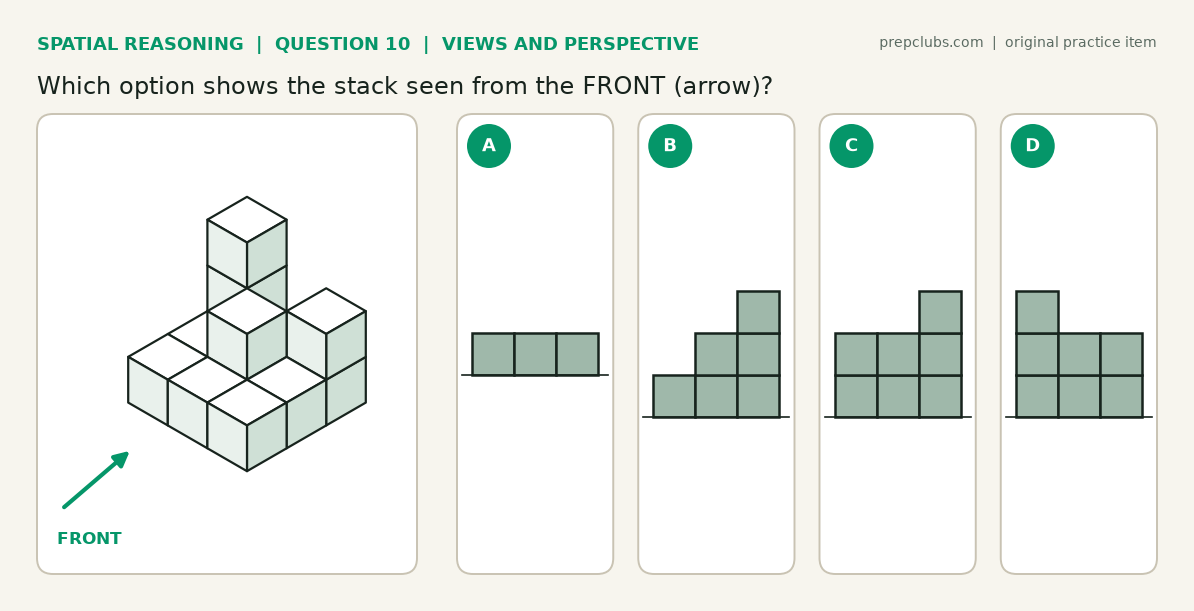
Answer: D. From the front you see the tallest cube in each column from left to right: 3, 2 and 2, with the tall column on the left. C is the view from behind, B is the view from the right-hand side and A shows only the front row.
Question 11. The first pair follows a rule. Which option completes the second pair?
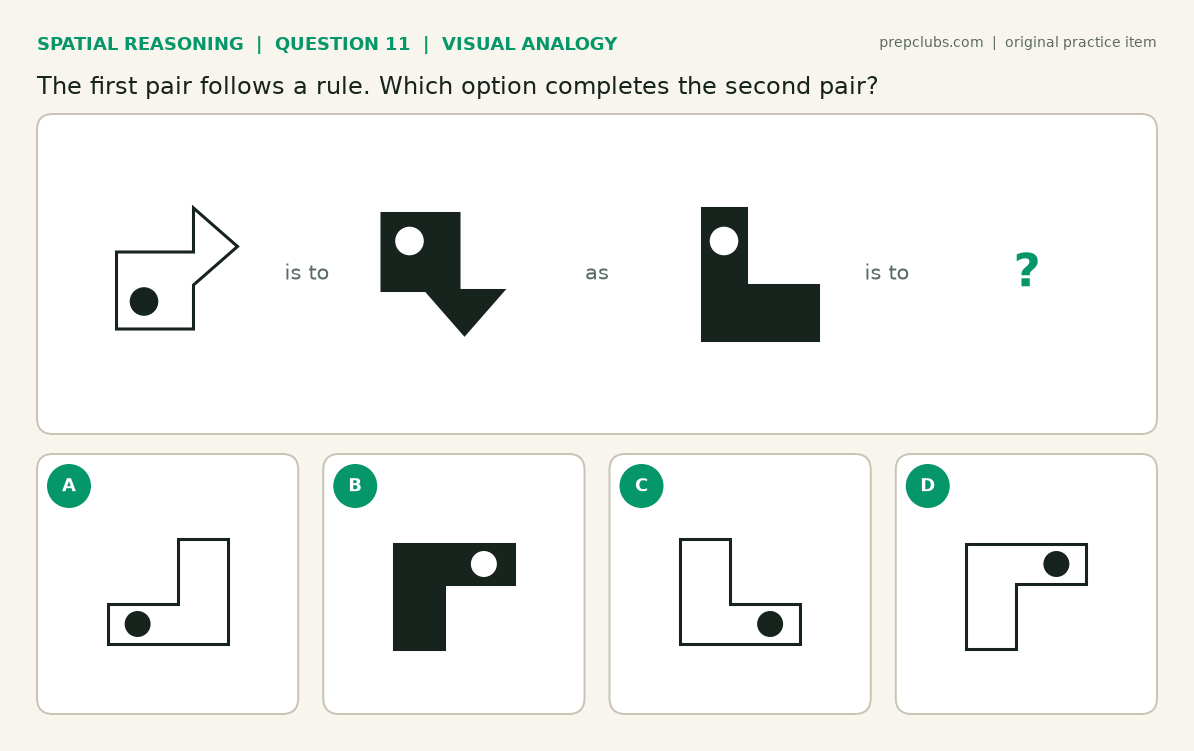
Answer: D. The rule is: turn 90 degrees clockwise and swap black for white. The black boot turned clockwise lays its tall part along the top with the dot at the right end, and turns white. A turns the wrong way, B keeps the colour and C is a mirror image.
Question 12. How many cubes are in the stack? Every cube rests on the table or on another cube.
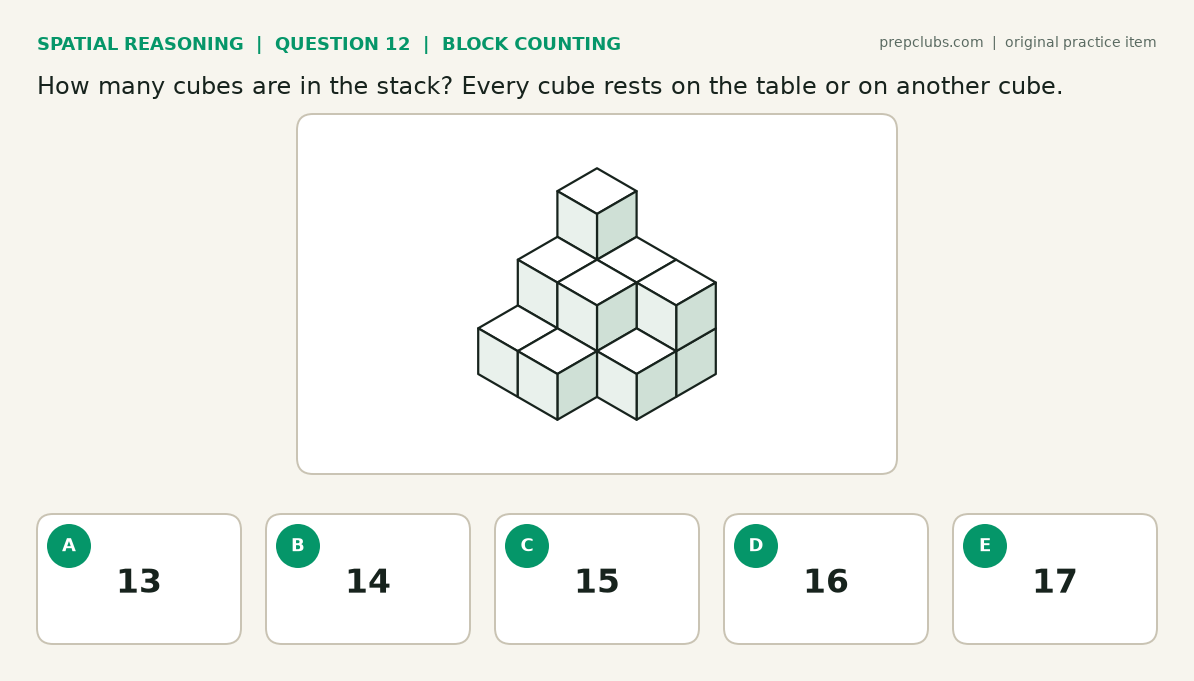
Answer: B, 14. Count column by column: 3, 2 and 2 along the back, 2, 2 and 1 in the middle, 1 and 1 at the front. Because every cube needs support, each visible top face tells you the full height of its column.
Missed more than three? That is the family to drill first. The spatial reasoning question guide breaks it into its four sub-skills with a 12-day plan.
How much time you actually get
Shortcuts matter because these formats are speeded by design, and the pace varies enormously by family. Counts below come from the publishers: Criteria Corp, Wonderlic, TalentLens for Bennett and Watson-Glaser, and the NEIEP study guide for the EIAT. PrepClubs is independent prep material, not affiliated with any of them.
| Test | Family it leans on | Questions | Time | Per question |
|---|---|---|---|---|
| Wonderlic (classic cognitive) | Mixed, speeded | 50 | 12 minutes | 14 seconds |
| CCAT (Criteria) | Mixed, speeded | 50 | 15 minutes | 18 seconds |
| Bennett Mechanical BMCT-II | Mechanical | 55 | 25 minutes | 27 seconds |
| Watson-Glaser III | Verbal and logical | 40 | about 30 minutes | 45 seconds |
| EIAT (elevator industry) | Mechanical and spatial | 100 | about 90 minutes | 54 seconds |
Almost nobody finishes the fastest of these, and that is intentional. A question you cannot start within five seconds should be guessed and abandoned, because a wrong answer and a blank cost the same where there is no penalty. Confirm the rule for your test, and build the habit before test day.
What those budgets do to real candidates
The table shows the budget. Our PrepClubs Research series shows what happens inside it, from re-graded practice attempts on our own forms written to each test's format.
- Under 20 seconds a question, a fifth of the paper goes blank. On the CCAT, Wonderlic, PI Cognitive and Cubiks Logiks formats, candidates left 18.7% to 21.9% of all items unanswered. At 45 seconds or more (Watson-Glaser, IBEW, EIAT) it drops to between 0.4% and 7.6% (How much of a timed aptitude test is never answered).
- Going too fast has a cost too. On speeded forms, answers given in under 5 seconds were right only 63.5% of the time, against 82.4% for answers given in 5 to 10 seconds. Past 30 seconds, accuracy settles around 62% to 65%, and most of that apparent penalty is because slow answers land on hard items (What an extra thirty seconds on a question actually buys).
- The real cost of a long dwell is elsewhere. The median attempt spent 102 seconds beyond a 30-second-per-item cap, which is about 7 questions it never reached.
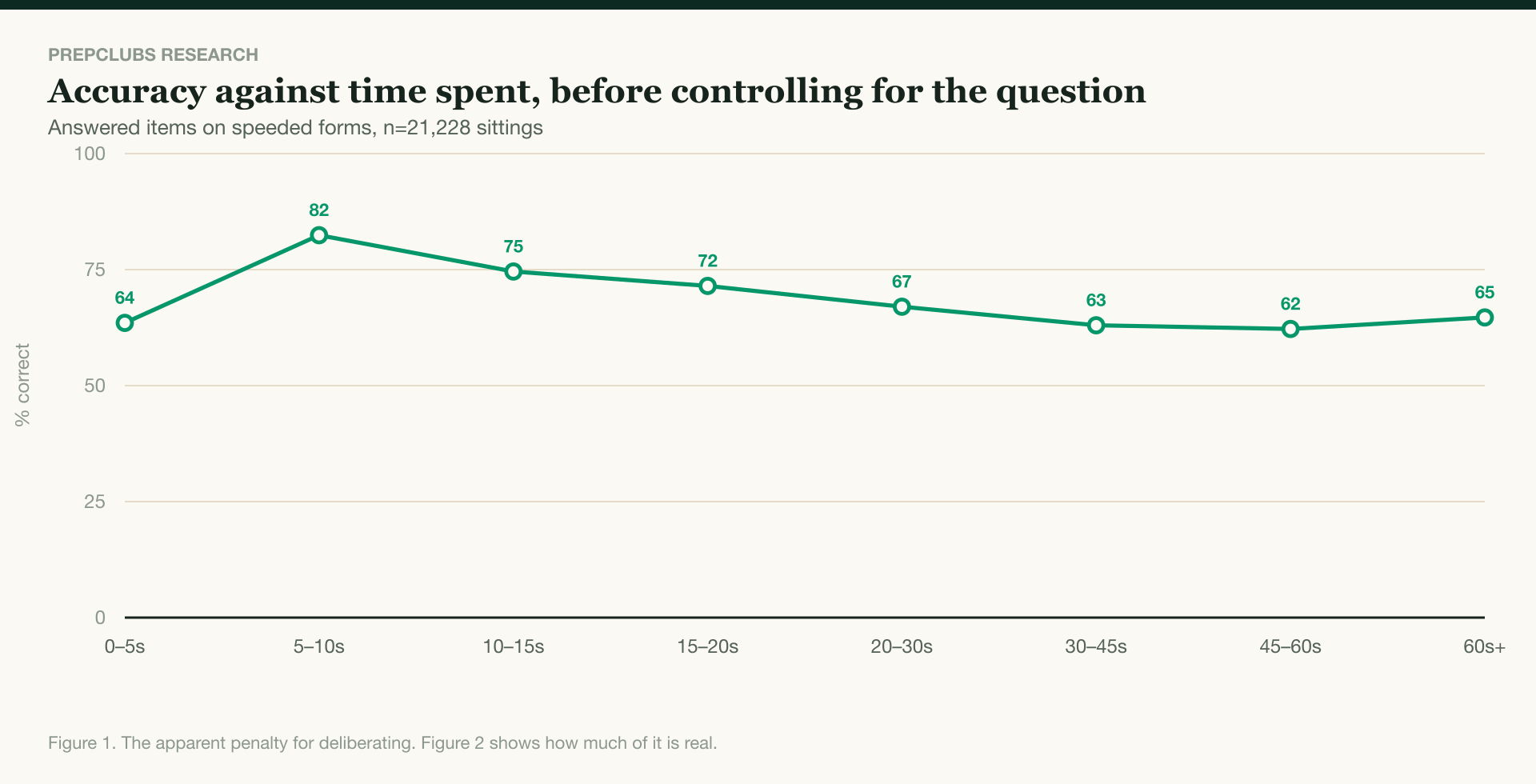
So the worked shortcuts above are not just tidiness. They are what keeps you in the 5-to-15-second band on the easy items, so the hard ones get the time they need.
Three more examples from our latest practice tests
The examples above are written to teach each family. These three are real items from the newest forms in our bank, one each from the numerical, verbal and mechanical families.
Numerical: CCAT Practice Test 15, question 21. What comes next: 3, 8, 15, 24, 35, ?
A) 44 B) 46 C) 48 D) 50 E) 52
Answer: C) 48. The gaps are 5, 7, 9 and 11, growing by 2, so the next gap is 13 and 35 plus 13 is 48. The terms are also each one less than a square (4, 9, 16, 25, 36, 49), which gets you there even faster.
Verbal: Wonderlic Practice Test 8, question 17. CONCEAL is to HIDE as DISCLOSE is to:
A) Cover B) Whisper C) Forget D) Lock E) Reveal
Answer: E) Reveal. Check the first pair before anything else. Conceal and hide mean the same thing, so this analogy runs on synonyms, not opposites. The synonym of disclose is reveal. Cover and Lock are there for anyone who assumed the pairs were opposites.
Mechanical: Ramsay Mechanical Practice Test 8, question 1. A string on a guitar plays a higher note when it is:
A) longer, looser and thicker B) shorter, tighter and thinner C) made of softer metal D) heavier and looser E) plucked with more force
Answer: B) shorter, tighter and thinner. Pitch rises with tension and falls with length and mass. Plucking harder makes the note louder, not higher, which is the trap in E.
For timed practice on the specific test you face, start from the PrepClubs test library.
Watch and practice: five free videos
Worked examples on a page teach the rule. Watching someone solve at speed teaches the pace, which is what the clock actually tests. These five are free on YouTube, come from established channels, and each maps to a family above. None is affiliated with PrepClubs.
7 Numerical Reasoning Test Tips, Tricks & Questions! (CareerVidz, about 15 minutes). Percentage, ratio and table questions worked with quick-calculation habits, the same moves as Examples 1 and 2.

Number Series Reasoning Tricks, The Easy Way (The Organic Chemistry Tutor, about 15 minutes). Step-by-step pattern spotting across many worked series, the fastest way to make the first-differences habit from Example 5 automatic.

Pattern folding strategy: Cube nets and folding cubes (Erudition, about 21 minutes). Clear graphics and a repeatable way to eliminate wrong nets. It was made for the dental admission test, but the method is exactly what picture questions 5 and 6 need.

How to ace the CCAT (Criteria Cognitive Aptitude Test) (Bahroz Abbas, about 20 minutes). Pacing and skipping strategy for 50 questions in 15 minutes, from an independent educator rather than a prep company.

How Levers, Pulleys and Gears Work (The Efficient Engineer, about 16 minutes). Animated mechanical advantage and gear ratios, the physics behind Examples 7 and 8 in a quarter of an hour.

Watch one, then do the matching examples above against a timer. Passive watching feels productive; timed attempts are what move a score.
FAQ
What is an example of an aptitude test?
A short, timed assessment measuring reasoning rather than knowledge: the CCAT, the Wonderlic, an SHL battery, the Watson-Glaser critical thinking appraisal, or the Bennett mechanical comprehension test. A single example: a team handled 480 tickets in March and 552 in April, what was the percentage increase? 15 percent, because 72 divided by 480 is 0.15.
What is the most common aptitude test?
In United States office and graduate hiring, short speeded cognitive tests are the ones candidates meet most, with SHL batteries common at larger employers. In skilled trades hiring, mechanical comprehension tests such as Bennett and Ramsay dominate instead. It depends on your industry, not a national ranking.
Can you give me some examples of aptitude questions?
The ten above are exactly that: two numerical, two verbal, two logical, two mechanical and two spatial, each with the reasoning and the shortcut spelled out. The 12 picture questions after them add rotation, mirror image, cube net, paper folding, matrix, series, analogy and block counting items, each with its answer.
How do I pass an aptitude test?
Find your weakest family, then drill it under a timer. Most candidates lose more marks to one weak section and to the clock than to hard questions. With 24 hours: a full-length timed mock tonight to find the weak family, one topical drill set in it, then a short second mock in the morning. With 3 days: the same three stages, one per day, the middle day all drills.
What is the trick to solve aptitude questions?
There is one per family, all above: build percentages from 10 and 5 percent chunks, circle the quantifiers, take first differences on a series, count gears rather than trace them, compare lever arms as a ratio, track one feature through a rotation.
Are online examples the real questions, and do I need to be good at maths?
No to both. Real items are copyrighted, so any site claiming to publish them is not one to trust; good practice replicates format, style, difficulty and timing. And the maths rarely passes percentages, ratios, averages and simple algebra. The difficulty is speed under pressure, not the maths.
Related on PrepClubs
- What a cognitive aptitude test measures and why companies use it
- What counts as a good aptitude test score, by test and role
- Worked situational judgement examples and how they are scored
Ready to try these under the clock?
Ten examples tell you which family is weak. Fixing it takes timed repetition against the real format. PrepClubs covers around 21 cognitive and aptitude tests, each cluster pairing full-length mocks with topical drills and opening with a free diagnostic. Single clusters such as CCAT, Wonderlic, Watson-Glaser, Ramsay Mechanical, Wiesen, IBEW and EIAT run for 30 days, with the current price on the pricing page. The All-Access bundle covers 162 tests and 11,205 questions across every cluster, the sensible pick when you do not yet know which test the employer uses. It is backed by our Money-back Guarantee. Join the 3,700+ students preparing this way. Get All-Access.