
Pipefitter and Plumber Apprenticeship Aptitude Test (UA): What Your Local Uses and How to Prepare
If you are applying to a United Association (UA) apprenticeship for plumbing, pipefitting, steamfitting or HVAC service, you will probably sit an aptitude test, but not the same one as an applicant in the next city. Each local's Joint Apprenticeship Training Committee picks its own test. What nearly all of them share is math without a calculator: fractions, decimals, percent, feet and inches, formulas and simple equations. PrepClubs runs full-length practice built on what locals actually use: a free 60-question diagnostic in the style of the multi-section batteries, plus paid forms in both the battery style and the style of the math tests locals write themselves.
By PrepClubs Editorial Team, updated October 8, 2026
Official facts checked 8 Oct 2026
How long is the UA pipefitter aptitude test and how many questions does it have?
There is no single UA pipefitter aptitude test, so there is no national time limit or question count. The United Association says only that the application process may include an aptitude test, and each local union sets its own. Of four locals that describe their test online, none publishes a question count. UA Local 447 in Sacramento says its math exam takes about three hours and allows no calculators.
What four UA locals publish about their own test
“The application process may include an interview, aptitude test and physical requirements.”
“This test takes approximately three (3) hours and covers mathematics up through 1st year Algebra. The applicant must pass this test with a minimum score of 65% to qualify.”
Which Pipe Trades (UA) practice tests are on PrepClubs, and how long is each one?
PrepClubs has 8 Pipe Trades (UA) practice tests: 1 diagnostic and 7 full-length forms, 420 questions in all. 5 run 60 questions in 55 minutes, 3 run 40 questions in 60 minutes.
The question count, time limit and question mix in each row are read from the question bank that runs the live tests, last on 8 Oct 2026, so each row matches what the test shows when you open it. No UA local publishes a question count, so the lengths below are practice settings: 60 questions in 55 minutes on the battery-style forms and 40 questions in 60 minutes on the local-math-style forms.
Showing 8 of 8 Pipe Trades (UA) practice tests
- Reading
- Mechanical
- Spatial
- Fractions and decimals
- Measurement
- Percent and ratio
- Algebra and formulas
- Arithmetic
- Geometry
| Question mix | Calculator | Guide | |||||
|---|---|---|---|---|---|---|---|
| Pipe Trades Apprenticeship Diagnostic (Aptitude Battery Style) DiagnosticAptitude battery style | 60 | 55 min | 55 s | Reading 15 · Mechanical 10 · Spatial 9 6 more areasFractions and decimals 8 · Measurement 6 · Percent and ratio 4 · Algebra and formulas 3 · Arithmetic 3 · Geometry 2 | Not allowed | Mental math | |
| Pipe Trades Apprenticeship Practice Test 1 (Aptitude Battery Style) Full-lengthAptitude battery style | 60 | 55 min | 55 s | Reading 15 · Mechanical 10 · Spatial 9 6 more areasFractions and decimals 8 · Measurement 6 · Percent and ratio 4 · Algebra and formulas 3 · Arithmetic 3 · Geometry 2 | Not allowed | Mental math | |
| Pipe Trades Apprenticeship Practice Test 2 (Aptitude Battery Style) Full-lengthAptitude battery style | 60 | 55 min | 55 s | Reading 15 · Mechanical 10 · Spatial 9 6 more areasFractions and decimals 8 · Measurement 6 · Percent and ratio 4 · Algebra and formulas 3 · Arithmetic 3 · Geometry 2 | Not allowed | Mental math | |
| Pipe Trades Apprenticeship Practice Test 3 (Aptitude Battery Style) Full-lengthAptitude battery style | 60 | 55 min | 55 s | Reading 15 · Mechanical 10 · Spatial 9 6 more areasFractions and decimals 8 · Measurement 6 · Percent and ratio 4 · Algebra and formulas 3 · Arithmetic 3 · Geometry 2 | Not allowed | Mental math | |
| Pipe Trades Apprenticeship Practice Test 4 (Aptitude Battery Style) Full-lengthAptitude battery style | 60 | 55 min | 55 s | Reading 15 · Mechanical 10 · Spatial 9 6 more areasFractions and decimals 8 · Measurement 6 · Percent and ratio 4 · Algebra and formulas 3 · Arithmetic 3 · Geometry 2 | Not allowed | Mental math | |
| Pipe Trades Apprenticeship Practice Test 5 (Local Math Test Style) Full-lengthLocal math test style | 40 | 60 min | 90 s | Fractions and decimals 10 · Measurement 8 · Percent and ratio 7 3 more areasArithmetic 6 · Algebra and formulas 5 · Geometry 4 | Not allowed | Mental math | |
| Pipe Trades Apprenticeship Practice Test 6 (Local Math Test Style) Full-lengthLocal math test style | 40 | 60 min | 90 s | Fractions and decimals 10 · Measurement 8 · Percent and ratio 7 3 more areasArithmetic 6 · Algebra and formulas 5 · Geometry 4 | Not allowed | Mental math | |
| Pipe Trades Apprenticeship Practice Test 7 (Local Math Test Style) Full-lengthLocal math test style | 40 | 60 min | 90 s | Fractions and decimals 10 · Measurement 8 · Percent and ratio 7 3 more areasArithmetic 6 · Algebra and formulas 5 · Geometry 4 | Not allowed | Mental math |
Sources
- United Association: Apprentice career path (ua.org), checked 8 Oct 2026
- Pipe Fitters Training Fund Local 597: Testing (pftf597.org), checked 8 Oct 2026
- Pipefitters Local 211: Apprenticeship FAQ (pipefitterslocal211.com), checked 8 Oct 2026
- UA Local 447: Training (ualocal447.org), checked 8 Oct 2026
- UA Local 447: sample examination questions (PDF) (ualocal447.org), checked 8 Oct 2026
- UA Local 22: Apprenticeship (ualocal22.com), checked 8 Oct 2026
- PrepClubs question bank, the files behind the live Pipe Trades (UA) practice tests, read 8 Oct 2026
“Not published” means the publisher does not state that fact on any page we could find. We leave it blank instead of quoting a prep site.
There is no single UA aptitude test
The UA's own apprenticeship page says the application process "may include an interview, aptitude test and physical requirements". It does not name a test, because the choice belongs to each local. So when a website describes "the UA test" with a fixed number of questions and a national 70 percent pass mark, it is describing one local's test, or guessing.
What locals publish shows four common routes. Some use a third-party battery such as the GAN Aptitude Battery, which GAN Human Resources says covers basic math, reading and spatial skills and is used by more than 50 apprenticeship programs, plumbers and pipe fitters included. Pipe Fitters Local 597 in Chicago lists five GAN sections: reading, numerical comprehension, numerical reasoning, Bennett mechanical, and 3D spatial.
Others use ACT WorkKeys (Applied Math, Workplace Documents and Graphic Literacy): Local 22 in Buffalo asks for level 4 of 7 in each, and Local 33 in Des Moines asks for a National Career Readiness Certificate at Silver or higher. Plumbers Local 1 in New York uses the TABE. Many locals write their own math test instead: Local 211 in Houston gives one hour with no calculator, and Local 447 in Sacramento tests math through first-year algebra.
A few locals test something else entirely. Steamfitters Local 638 in New York has used the Wiesen Test of Mechanical Aptitude, Local 168 in Marietta, Ohio uses the Differential Aptitude Test, and some locals, such as Local 344 in Oklahoma City, rank applicants on the interview alone. Read your local's application packet first: it names the test, and sometimes links a sample.
What the tests cover
Across the locals' own documents and sample tests, the same content comes up again and again. Our forms are built from this list.
Math without a calculator
Whole numbers, order of operations, fractions and mixed numbers in all four operations, decimals, and converting between fractions, decimals and percent. This is the core of every local math test and of the numerical sections of the batteries.
Measurement and shop math
Feet and inches, reading a tape or rule to the sixteenth, missing dimensions on a pipe run, pipe grade (fall per foot), yards, gallons and quarts, and simple metric conversions.
Word problems and formulas
Rates, averages, overtime pay, percent and reverse percent, ratios and scale drawings, plus formulas you are given: temperature conversion, water pressure per foot of height, BTU, and one- or two-step equations.
Geometry
Area and circumference of circles, area of rectangles and L-shapes, volume of tanks, and right triangles. Locals such as 447 and 602 include these in their samples.
Reading
Short passages and workplace documents: a procedure, a memo, a safety notice. Batteries like GAN include a reading section, and WorkKeys has Workplace Documents.
Mechanical reasoning and spatial
Gears, pulleys, levers and fluids in picture questions, plus pattern folding and 3D visualization. Local 597's GAN battery has a Bennett-style mechanical section and a 3D spatial section.
Try a few pipe trades math questions
No-calculator questions of the kinds locals' own math tests use. Click to reveal the answer and walkthrough.
- A.14 1/2
- B.15 5/8
- C.14 1/3
- D.14 5/8
- A.8 3/16
- B.8 13/16
- C.6 13/16
- D.7 13/16
- A.0.125
- B.0.225
- C.0.1
- D.1.25
- A.0.015
- B.0.15
- C.1.5
- D.2.56
What our pipe trades practice questions look like
Two items drawn for PrepClubs. Every drawing is generated from the same numbers as its answer and explanation.
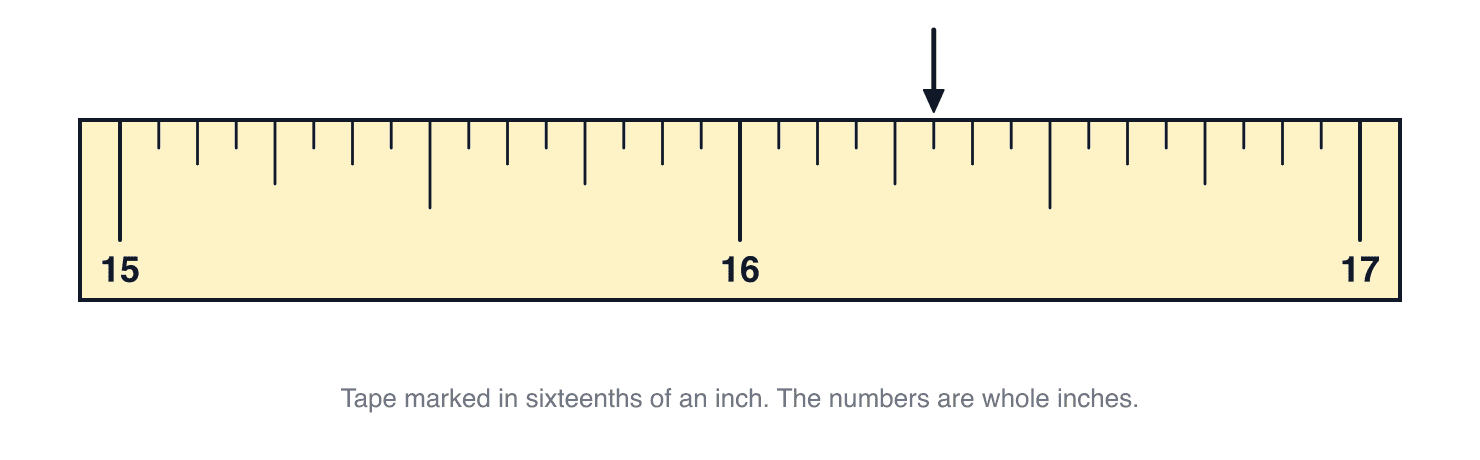
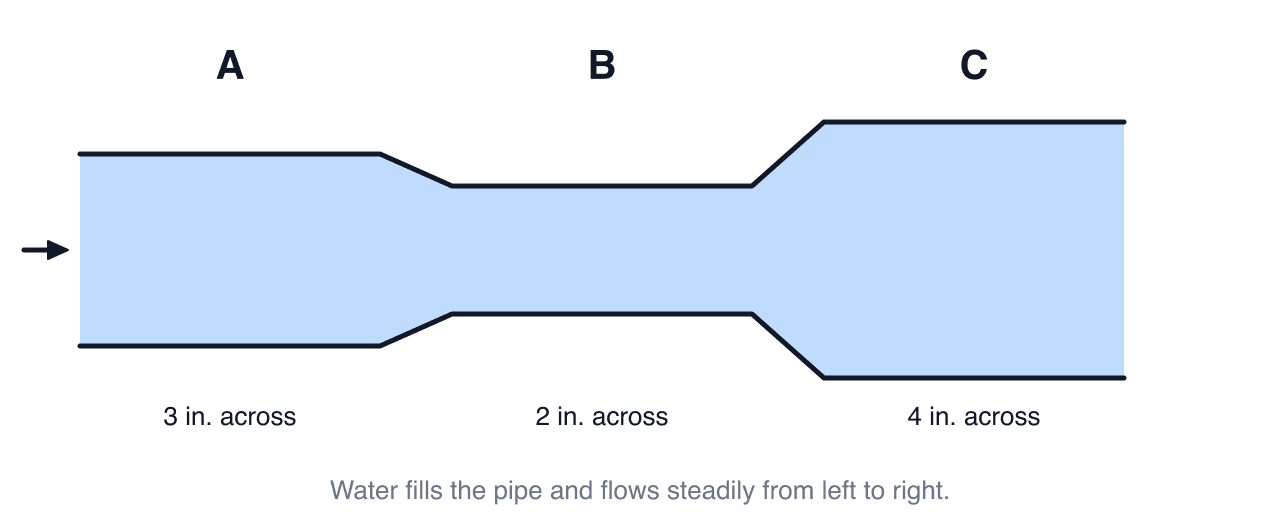
Original PrepClubs drawings, not items from any local, GAN, ACT or DRC.
Build the rest of your prep stack
Pass marks: only trust the ones your local publishes
Because every local picks its own test, there is no national pass mark. The published ones we found: Local 447 in Sacramento sets 65 percent on its math test, Local 211 in Houston sets 72 percent, Local 22 in Buffalo asks for WorkKeys level 4 on each test, and Local 33 in Des Moines asks for a National Career Readiness Certificate at Silver or higher (level 4 or better on all three WorkKeys tests).
The "70 percent" you see on many prep sites is not published by the UA or by GAN. Treat it as a rumor unless your local's packet says it.
Passing is usually only the first gate. Most locals rank applicants on a mix of test score, interview, and sometimes education or work history, then place apprentices from that ranked list as openings come up. A higher score can move you up the list, so aim well above the minimum.
A four-week plan for the pipe trades aptitude test
Week 1, day 1: Find out which test your local uses
Read the application packet or call the training center. A GAN-style battery, WorkKeys, TABE and a local math test all reward the same math, but reading, mechanical and spatial sections only matter if your local has them.
Week 1, day 2: Take the diagnostic
Sit the free 60-question battery-style diagnostic in 55 minutes with no calculator. The breakdown by area shows where your points went.
Weeks 1 and 2: Fix the math first
Fractions and mixed numbers, feet and inches, decimals and percent. Work 20 to 30 problems a day by hand. If your fractions are rusty, this is where most applicants gain the most.
Week 3: Timed forms in your local's style
Battery-style forms if your local uses GAN or a similar battery; math-test-style forms (40 questions, 60 minutes) if it writes its own math test. Review every miss.
Week 4: Reading, mechanical and spatial, then rest
If your test has them, drill the sections you scored lowest on. Do a last timed form two days out, then rest.
Common pipe trades test mistakes
Preparing for "the UA test"
There is no such single test. An applicant who crams one prep site's format can walk into a different test entirely. Your local's packet is the only reliable source.
Relying on a calculator
Most local math tests and batteries are taken without one. Do all your practice by hand, including long division and mixed-number fractions.
Losing the extra foot
Adding 7 in. and 9 1/4 in. gives 16 1/4 in., which is 1 ft 4 1/4 in. Forgetting to carry the foot is the most common feet-and-inches error.
Related reading
Pipe Trades (UA) FAQs
A score tells you how you did. The coach tells you what to practice next.
After every test you get a short plan built from your own answers and seconds: which sections cost you points, which ones eat your clock, and the drill that fixes each.
Math: 11 of 12 right, at 31 s a question
Drill math against a 20 s clock. That frees about 2 minutes per test for the sections you miss more.
People who got the same questions right took 20 s.
Illustrative data
- Every section mapped on accuracy against speed, with one fix for each
- The questions that ate your time, and the clock checkpoints to hit next time
- Where rushing costs you, and the point to guess and move on
- A read that sharpens with every test you take
Your pacing report is free with your first test.
Practise the pipe trades aptitude test without a calculator
A free 60-question diagnostic in the battery style, then battery and local-math-test forms with a worked explanation for every answer.
Start prepping