
How much of a timed aptitude test is never answered
Candidates on a speeded aptitude test do not ration their time across the paper. They answer the opening almost completely, then abandon the end, on tests where a wrong answer costs nothing at all. This report measures how much is abandoned, where, and what it is worth.
Sample 727 re-graded practice attempts from 575 distinct candidates, across nine forms: 533 attempts on speeded forms and 184 on forms with a generous clock.
1Finding
of the final fifth of a speeded aptitude test is left unanswered
Against 12.1% on forms with a generous clock. 61.2% among the 488 attempts that ran the clock down to 90% or more.
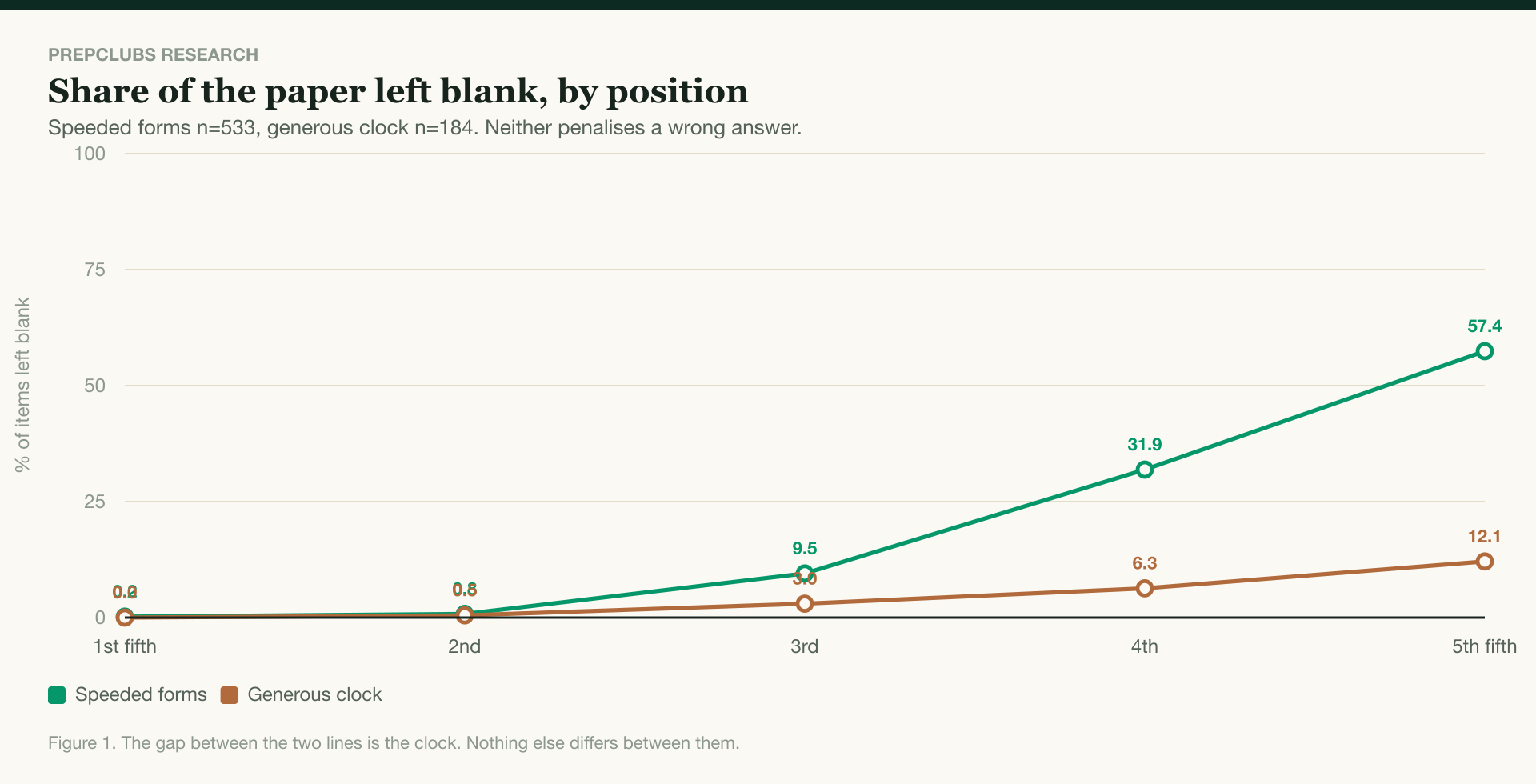
The shortfall is not spread across the paper. In the opening fifth, 0.2% of items go unanswered. By the fourth fifth it is 31.9%, and in the closing fifth it is 57.4%. The curve is not a decline, it is a cliff, and it arrives in the same place on every speeded form measured.
None of these tests penalises a wrong answer. That is what makes the number a finding rather than a description. An unanswered question is the only response on the paper that is guaranteed to score nothing. Every other response, including one chosen at random with two seconds left, has positive expected value.
2Where the paper is abandoned
Each attempt is divided into fifths by item position and the share of items left blank is counted in each. The two lines in Figure 1 differ in one respect only: how many seconds the form allows per question.
| Group | Attempts | 1st | 2nd | 3rd | 4th | 5th |
|---|---|---|---|---|---|---|
| Speeded forms | 533 | 0.2% | 0.8% | 9.5% | 31.9% | 57.4% |
| Generous clock | 184 | 0% | 0.5% | 3% | 6.3% | 12.1% |
| PI Cognitive | 215 | 0.3% | 0.7% | 7.9% | 29% | 55.8% |
| CCAT | 189 | 0% | 0.2% | 7.8% | 34.1% | 60.6% |
| Cubiks Logiks | 76 | 0.3% | 2.4% | 16.4% | 35.1% | 55.3% |
| Wonderlic | 53 | 0% | 1.3% | 11.5% | 30.8% | 56.2% |
Speeded forms allow under 30 seconds a question. Generous-clock forms allow 33 seconds or more.
3Which tests, and why the clock is the variable
Subject matter barely moves this number. Verbal, numerical, abstract and mechanical forms all appear on both sides of the divide. Seconds allowed per question moves it.
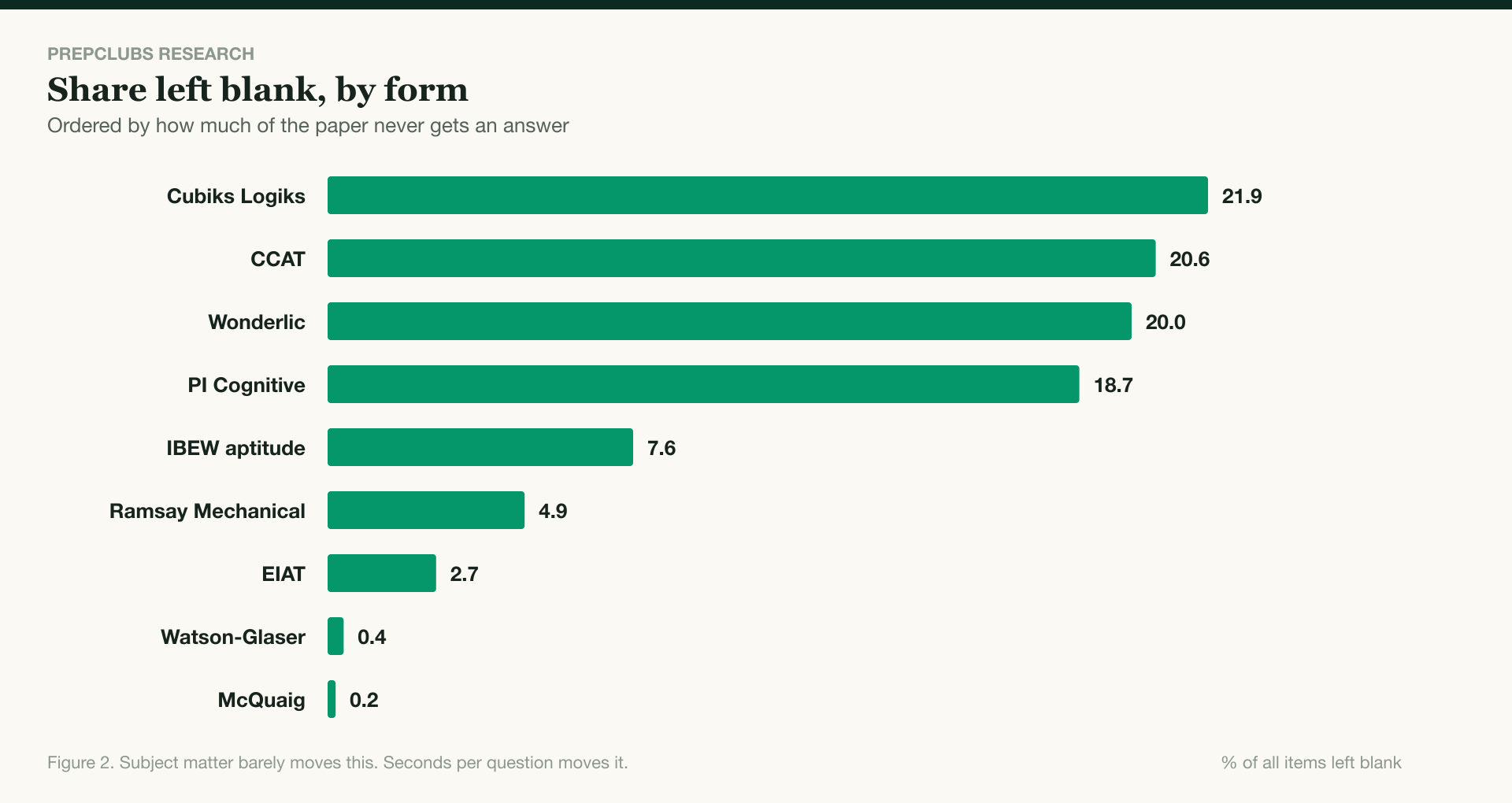
McQuaig is the case worth sitting with. It allows 18 seconds a question, the same as the CCAT, and runs at 0.2% blank against the CCAT’s 20.6%. The difference is not the clock in the abstract but the clock relative to the work each item demands: McQuaig items are quick word and number association, CCAT items are multi-step reasoning. What binds is seconds per unit of work, and most candidates never establish which kind of paper they are sitting until it is too late to change how they pace it.
| Form | Attempts | Items | Seconds each | Left blank |
|---|---|---|---|---|
| Cubiks Logiks | 76 | 50 | 14 | 21.9% |
| CCAT | 189 | 50 | 18 | 20.6% |
| Wonderlic | 53 | 50 | 14 | 20% |
| PI Cognitive | 215 | 50 | 14 | 18.7% |
| IBEW aptitude | 61 | 69 | 84 | 7.6% |
| Ramsay Mechanical | 17 | 36 | 33 | 4.9% |
| EIAT | 29 | 90 | 60 | 2.7% |
| Watson-Glaser | 41 | 40 | 45 | 0.4% |
| McQuaig | 25 | 50 | 18 | 0.2% |
4What an unanswered question is worth
A guess on a four-option item is worth a quarter of a mark and a guess on a five-option item a fifth. Our forms mix both, so the value of one blank is measured rather than assumed: across the speeded forms it averages 0.2 of a mark.
| Form | Mean score | Marks forfeited | As a share of score |
|---|---|---|---|
| Cubiks Logiks | 32.2 | 2.7 | 8% |
| CCAT | 28 | 2.1 | 7% |
| Wonderlic | 27.2 | 2 | 7% |
| PI Cognitive | 28.3 | 1.9 | 7% |
Marks forfeited is the expected value of the blanks actually left, not a theoretical maximum.
The practical instruction that follows is narrow and easy to execute: stop working with about thirty seconds left and put an answer on everything you have not reached. On a fifty-question form that is worth roughly two marks, which is 8% of a typical Cubiks score and 7% of a typical CCAT score, for no additional preparation and no risk.
Appendix tool
Enter the number of items you left blank on your own attempt to see what it was worth at the measured per-item value for that form.
What were your blanks worth?
Guessing them was worth about 1.8 marks, or 6% on a typical 28.3 score for this test.
At the measured average of 0.2 marks per blank on our PI Cognitive set, where items carry four or five options. None of these tests penalise a wrong answer.
5What this does not show
- It is not causal. The speeded and generous groups are different tests sat by different people. The clock is the obvious difference and the only one we can point to, but it is not a randomised comparison.
- It does not price a guess against an employer’s cut score. Marks forfeited are raw marks on our own forms. Whether two marks changes an outcome depends on a scaled score and a threshold neither we nor the candidate can see.
- It does not apply to negatively marked tests. Every form here scores a wrong answer as zero rather than as a deduction. A test with a penalty inverts the advice entirely.
- These are practice attempts. They were sat on PrepClubs forms written to each test’s published format, not on the publishers’ own instruments, and sat with the stakes of practice rather than of a job application.
6Sample, filters and discards
Every discard is published. The large one is the re-grade: banks were edited after launch, so an attempt whose stored score no longer matches the form on disk cannot be scored honestly and is dropped.
| Attempts on record | 1,473 |
| Discarded: re-grade disagreed with the stored score | 556 |
| Discarded: no answers recorded | 26 |
| Discarded: used under half the allowed clock | 164 |
| Analysed | 727 |
| Distinct candidates behind those attempts | 575 |
Candidates who failed to finish were not excluded. Not finishing is the measurement. Filtering on it would be selecting on the outcome being reported, which is the error this report exists to avoid.
The clock filter is half, not ninety percent. A 90% threshold selects for time pressure, so it would thin the generous-clock comparison group of exactly the people who found the paper easy and handed in early. At half the clock the comparison is fair and the result still holds: 57.4% against 12.1%. As a robustness check, among the 488 attempts that ran the clock down to 90% or more the final fifth runs at 61.2%.
| Edition | Date | Analysed | Final fifth | What changed |
|---|---|---|---|---|
| 1 | 2026-09-20 | 858 | 59% | Before the half-clock filter, and with a control group the filter had biased. |
| 2 | 2026-09-21 | 697 | 58.4% | Half-clock filter added, control group rebuilt, 90% demoted to a robustness check. |
| 3 | 2026-09-23 | 727 | 57.4% | Rebuilt on the shared corpus module with two further weeks of attempts. |
7The forms this report is computed from
Each form is a PrepClubs practice paper written to that test's published format and item mix. The pages below cover the format itself, and each carries a free practice paper.
- Cubiks Logiks
14 seconds a question. 21.9% of items left blank across 76 analysed attempts.
- CCAT
18 seconds a question. 20.6% of items left blank across 189 analysed attempts.
- Wonderlic
14 seconds a question. 20% of items left blank across 53 analysed attempts.
- PI Cognitive Assessment
14 seconds a question. 18.7% of items left blank across 215 analysed attempts.
- IBEW aptitude test
84 seconds a question. 7.6% of items left blank across 61 analysed attempts.
- Ramsay Mechanical
33 seconds a question. 4.9% of items left blank across 17 analysed attempts.
- EIAT
60 seconds a question. 2.7% of items left blank across 29 analysed attempts.
- Watson-Glaser
45 seconds a question. 0.4% of items left blank across 41 analysed attempts.
- McQuaig Mental Agility
18 seconds a question. 0.2% of items left blank across 25 analysed attempts.
8Common questions
- Should you guess on an aptitude test?
- On every form measured here, yes. None of the CCAT, Wonderlic, PI Cognitive, Cubiks Logiks, Watson-Glaser, IBEW, EIAT, McQuaig or Ramsay forms deducts marks for a wrong answer, so an unanswered question scores zero with certainty while a guess scores about a fifth of a mark on average. Where a test does apply a negative marking scheme, and a small number of public-sector and professional exams still do, this finding does not transfer.
- How many questions do people actually finish on the CCAT?
- Across 189 analysed CCAT attempts, 20.6% of all items were left blank, and in the final fifth of the paper that rises to 60.6%. Candidates are not spreading the shortfall across the paper. They answer the opening almost completely and then stop.
- When in the test should you start guessing?
- The abandonment curve turns sharply in the fourth fifth, so the practical cut is with roughly thirty seconds left, before the fifth begins to run away. Filling ten blanks at the measured average value adds about two marks on a fifty-question form, which is around 7% of a typical score.
- Does this mean people run out of time because the questions get harder?
- Partly, and that is measured separately in Report 2026-03. Three of the six forms with enough attempts do escalate in difficulty. But difficulty cannot be the whole story here, because the generous-clock forms leave only 12.1% of the final fifth blank while covering the same kinds of reasoning. The clock is the variable that moves this number.
Suggested citation
“On speeded aptitude tests, 57.4% of the questions in the final fifth of the paper are never answered, against 12.1% on tests with a generous clock. None of these tests penalises a wrong answer. PrepClubs Research, Report 2026-01, edition 3, n=533.”
Download the figures as CSVMethod and standardsAsk us to check a figure
Reproduce any figure or table with attribution to PrepClubs Research and a link to this page. The underlying per-question records are not published: joined to an attempt they are re-identifiable at this sample size.
Other reports in this series
- PCR-2026: The State of Timed Assessment 2026
Every finding of the year in one document.
- 2026-02: What an extra thirty seconds on a question actually buys
The return on deliberation, measured inside the same question.
- 2026-03: Which aptitude tests are built as a difficulty ramp
Accuracy by position, with selection controlled out.
- 2026-04: What candidates actually score on aptitude practice tests
Percentile bands per form, and what a raw score is made of.