
What an extra thirty seconds on a question actually buys
Every prep guide tells candidates not to dwell on a hard question. The usual justification, that deliberating makes you wrong, is not what the data says. The real argument is arithmetic, and it is stronger.
Sample 533 analysed attempts on speeded forms carrying per-item timing, drawn from a corpus of 575 distinct candidates. 17,825 individual item sittings in the controlled comparison.
1Finding
is all that separates fast and slow answers to the same question
72.5% against 69.4%, across 190 items sat at least 20 times each. Compared without holding the question constant, the same comparison appears to be worth 20.2 points.
Spending longer on a question does not meaningfully damage your chance of getting that question right. The apparent penalty is almost entirely an artefact: long answers land on hard items, and hard items are answered wrong more often whoever is answering them.
The cost is somewhere else, and it is large. The median attempt on a speeded form spends 102 seconds beyond a thirty-second-per-item cap. At the median item time of 14 seconds, that surplus would have covered 7.3 further questions. Report 2026-01 measures what happens to those questions: on a speeded form they are simply never answered.
2The gradient that looks like a penalty
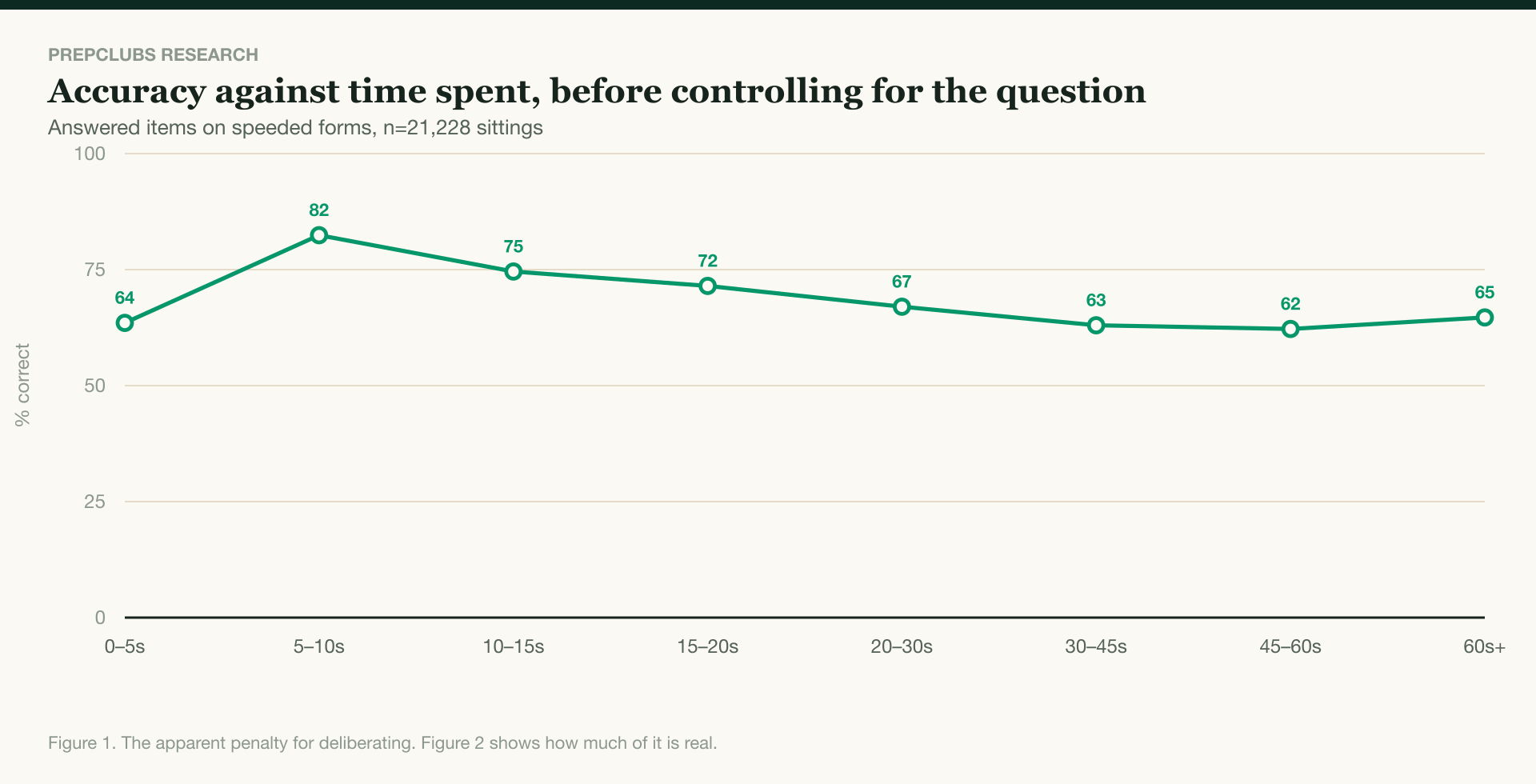
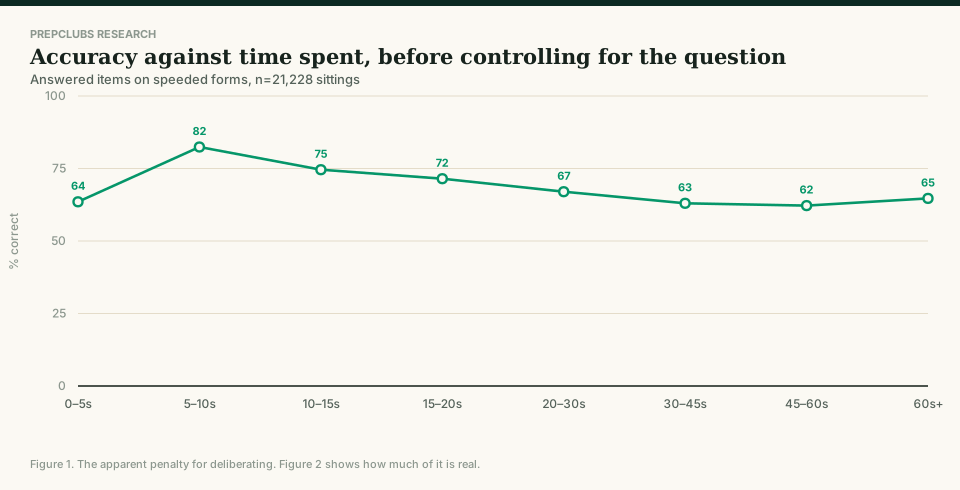
Group every answered item by how many seconds it took and the pattern is dramatic. Accuracy peaks in the 5–10s band at 82.4% and falls to 62.2% at the slow end. Read naively, that is a 20.2-point penalty for thinking.
| Seconds on the item | Item sittings | Answered correctly |
|---|---|---|
| 0–5s | 2,029 | 63.5% |
| 5–10s | 4,851 | 82.4% |
| 10–15s | 4,069 | 74.6% |
| 15–20s | 3,005 | 71.5% |
| 20–30s | 3,483 | 67% |
| 30–45s | 2,233 | 63% |
| 45–60s | 777 | 62.2% |
| 60s+ | 781 | 64.7% |
Answered items only, speeded forms only. An unanswered item has no dwell time to record.
The dip in the fastest band is worth noting on its own. Items answered in under five seconds run at 63.5%, below the peak, which is what carelessness looks like. But the size of that dip is the point: being too fast costs about 18.9 points on the items it affects, while never reaching an item costs everything on it.
3The same comparison inside the same question
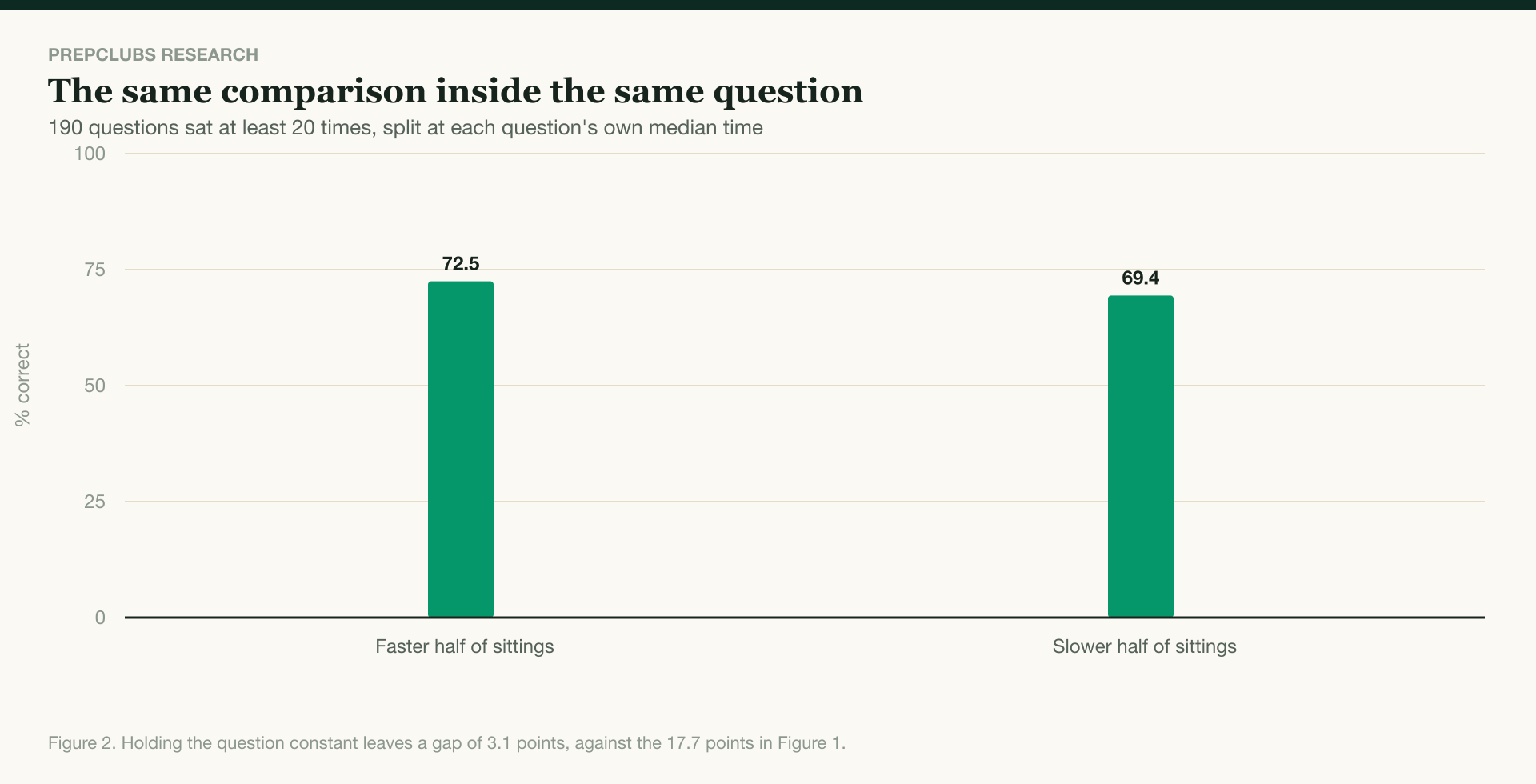
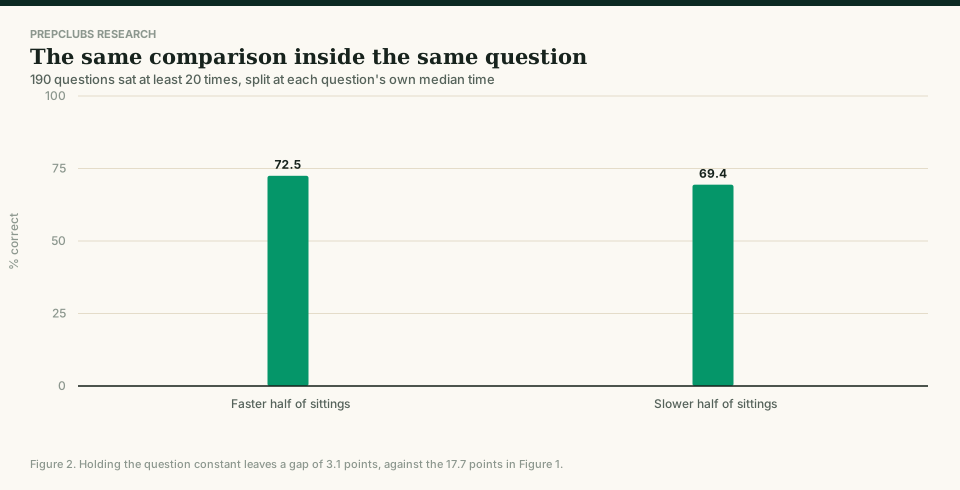
The comparison above is between different questions. To remove that, take every individual question sat at least 20 times, split its own sittings at its own median time, and compare the two halves. Item difficulty is then held exactly constant, because it is the same item.
| Measure | Value |
|---|---|
| Questions with enough sittings to split | 190 |
| Minimum sittings per question | 20 |
| Item sittings in the comparison | 17,825 |
| Faster half, answered correctly | 72.5% |
| Slower half, answered correctly | 69.4% |
| Gap | 3.1 points |
| Mean gap within a question | 0.2 points |
| Questions where the faster half scored higher | 102 of 190 (54%) |
The faster half wins on 54% of questions. That is not a rule, it is a coin landing slightly heavy on one side. Whatever is left after the control is small enough to be explained by stronger candidates answering faster, which this design does not rule out and does not need to.
4What the surplus time costs
If deliberation does not damage the item, the case for moving on has to be made in time rather than in accuracy. It is easily made.
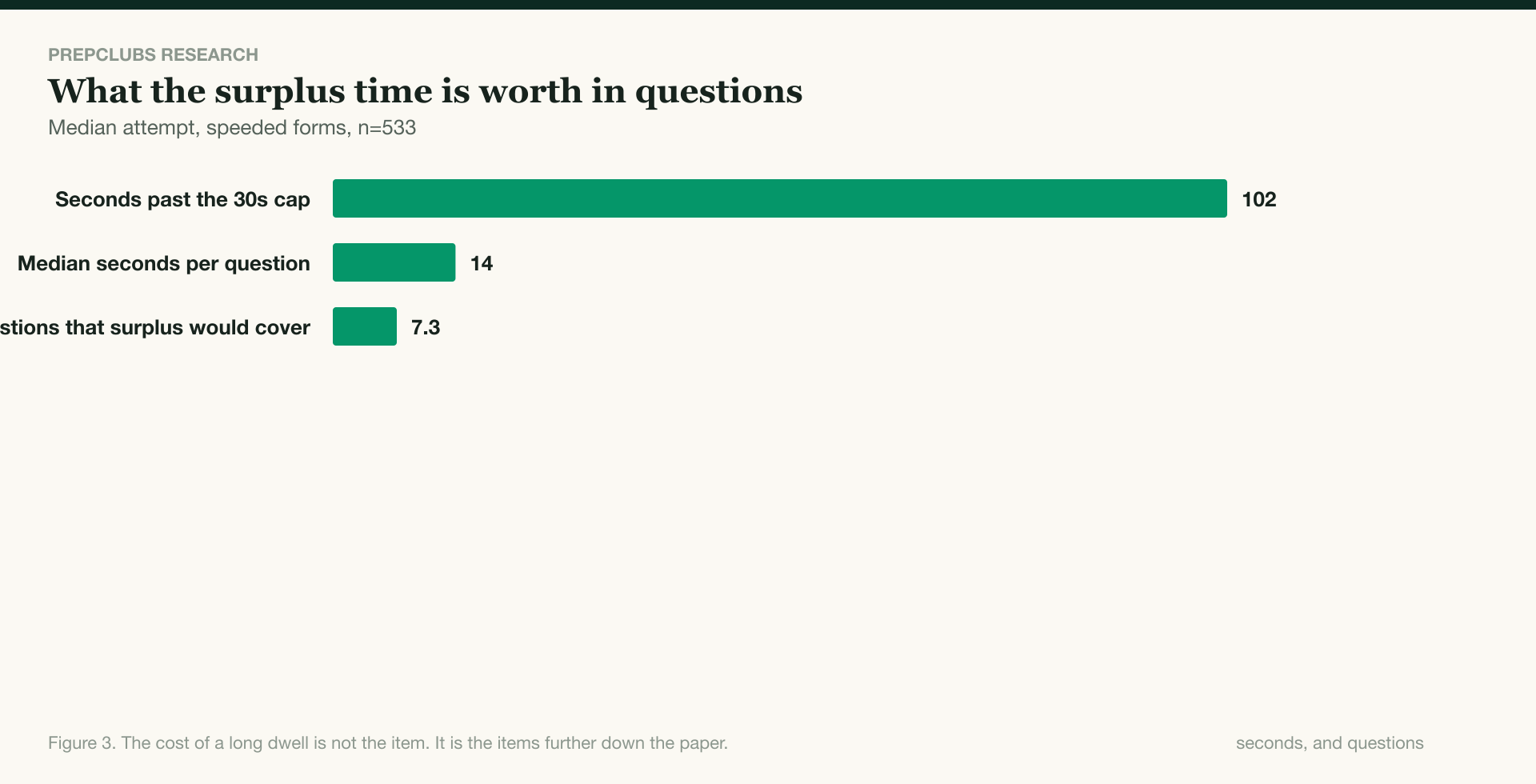
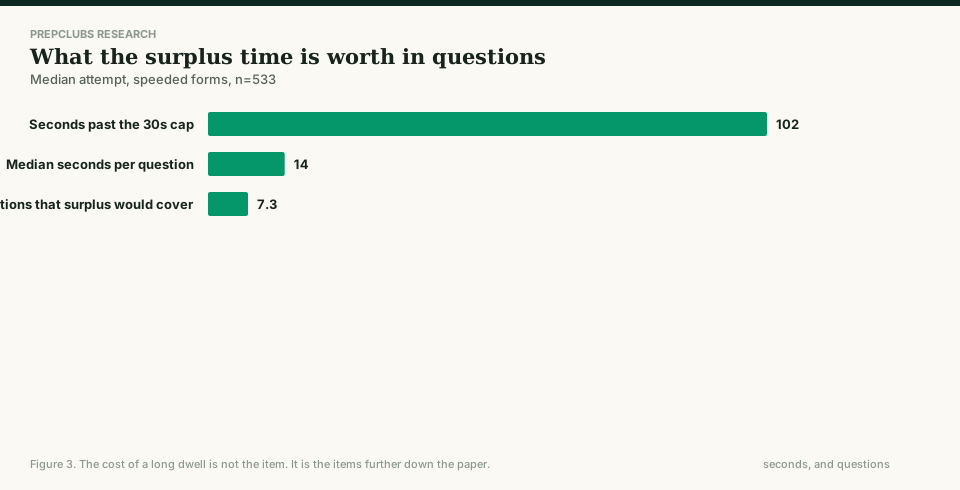
| Measure | Value |
|---|---|
| Attempts measured | 533 |
| Median seconds spent beyond the cap | 102s |
| Mean seconds spent beyond the cap | 249s |
| Median seconds per item | 14s |
| Questions the median surplus would cover | 7.3 |
| Share of the clock spent on over-cap items | 40.7% |
| Attempts with at least one item over 30 seconds | 98% |
| Attempts with at least one item over a minute | 63% |
The mean is far above the median because a minority of attempts sink several minutes into a handful of items.
Nearly two in three attempts contain at least one question that ate a full minute, and the median attempt gives 40.7% of its entire clock to items running over thirty seconds. That is where the unanswered final fifth in Report 2026-01 comes from. It is not a failure of knowledge at the end of the paper. It is a budget spent in the middle.
5The rule this supports
- Cap each item at about thirty seconds on a speeded form. When the cap is reached, answer with whatever you have and move on. You give up around 3.1 points of accuracy on that item and buy back the rest of the paper.
- Do not agonise about the answer you leave behind. The evidence that a longer look would have rescued it is thin: half of the questions here are answered no better by the people who took longer over them.
- Read the item before answering it. The one genuine speed penalty in the data is at the very fast end, under five seconds, which is the signature of answering without reading.
- Practise the cap, not the knowledge. A candidate who already knows the material and cannot pace it will keep producing the same score.
6What this does not show
The within-item split is observational. It holds the question constant but not the candidate, so a residual gap of a few points is consistent with stronger candidates answering faster as well as with any effect of speed itself. The report does not claim a causal penalty for thinking; it reports that the gain from thinking longer is too small to pay for what it costs elsewhere.
- The candidate is not held constant. The split is within a question, not within a person. A residual gap of 3.1 points is consistent with abler candidates simply answering faster.
- Timing is per item as recorded by the test player. An item revisited later accumulates time; an item abandoned and never answered contributes no reading at all.
- Thirty seconds is a choice, not a discovery. It is roughly twice the median item time on these forms, which makes it a usable instruction. Nothing in the data identifies an optimal cap.
7Sample, filters and discards
The corpus and the filters are shared with every other report in this series, so the two can be cited side by side. Speeded forms only: CCAT, Wonderlic, PI Cognitive, Cubiks Logiks.
| Attempts on record | 1,473 |
| Discarded: re-grade disagreed with the stored score | 556 |
| Discarded: no answers recorded | 26 |
| Discarded: used under half the allowed clock | 164 |
| Of which on speeded forms, carrying per-item timing | 533 |
| Analysed | 727 |
| Distinct candidates behind those attempts | 575 |
8The forms this report is computed from
Only forms allowing under thirty seconds a question carry per-item timing worth splitting, so the comparison is drawn on these four.
- CCAT
18 seconds a question over 50 items. The clearest case for a hard per-item cap.
- PI Cognitive Assessment
14 seconds a question. The tightest budget in the corpus, alongside Cubiks.
- Cubiks Logiks
14 seconds a question, and the form where the most of the paper goes unanswered.
- Wonderlic
14 seconds a question, and the steepest difficulty ramp we measure.
9Common questions
- How long should you spend on one aptitude test question?
- On a speeded form, no more than about thirty seconds. Not because thinking longer makes you wrong, which this report finds it largely does not, but because the time has to come from somewhere. The median attempt here spends 102 seconds past that cap across the paper, which at a median of 14 seconds an item is 7.3 questions never seen.
- Is it true that your first instinct is usually right on aptitude tests?
- Not as told. The raw data looks like it supports the claim: accuracy peaks in the 5–10s band and falls by 20.2 points at the slow end. But that comparison is between different questions, and slow answers land on hard questions. Inside the same question the faster half is ahead by only 3.1 points, and the faster half wins on just 102 of 190 items, which is close to a coin flip. The case for moving on is the clock, not intuition.
- Does rushing make you careless?
- At the very fast end, yes, a little. The 0–5s band runs at 63.5%, below the 82.4% of the 5–10s band, which is consistent with answers given without reading the item properly. The cost of being too fast is real but it is small, and it is bounded: an item answered in four seconds still has positive expected value, while an item never reached has none.
- What counts as a speeded test here?
- A form that allows under thirty seconds a question: the CCAT, Wonderlic, PI Cognitive and Cubiks Logiks forms on this platform. 533 analysed attempts on those forms carry per-item timing, which is what makes this comparison possible at all.
Suggested citation
“Holding the question constant, candidates in the faster half of sittings answer correctly 72.5% of the time against 69.4% for the slower half, a gap of 3.1 points across 190 items and 17,825 sittings. The median speeded attempt spends 102 seconds beyond a thirty-second-per-item cap, enough for 7.3 further questions. PrepClubs Research, Report 2026-02.”
Download the figures as CSVMethod and standardsAsk us to check a figure
Reproduce any figure or table with attribution to PrepClubs Research and a link to this page. The underlying per-question records are not published: joined to an attempt they are re-identifiable at this sample size.
Other reports in this series
- PCR-2026: The State of Timed Assessment 2026
Every finding of the year in one document.
- 2026-01: How much of a timed aptitude test is never answered
Abandonment by position on speeded and generous-clock forms.
- 2026-03: Which aptitude tests are built as a difficulty ramp
Accuracy by position, with selection controlled out.
- 2026-04: What candidates actually score on aptitude practice tests
Percentile bands per form, and what a raw score is made of.