Cognitive Aptitude Test: What It Is and Why Companies Use It
A cognitive aptitude test measures problem-solving speed across verbal, numerical, and abstract reasoning. Roughly 65 percent of large US employers use one to filter applicants, because cognitive ability is the single st

The honest answer about cognitive aptitude tests is that they exist for one reason: cognitive ability is the single strongest predictor of job performance, with a validity coefficient that meta-analyses put at roughly 0.5. That is higher than years of education (0.10), higher than unstructured interviews (0.20), and tied with structured interviews. When an employer puts a 15-minute cognitive screen at the top of the funnel, they are not being arbitrary. They are using the cheapest, fastest, most-validated hiring signal available.
This article unpacks what a cognitive aptitude test actually measures, which tests dominate the US and UK hiring markets, and what the practical implication is for candidates. If you have been asked to take one and want to understand the system before you prep, start here.
Quick takeaways
- A cognitive aptitude test measures problem-solving speed and pattern recognition across verbal, numerical, and abstract reasoning.
- Roughly 65 percent of large US employers use cognitive screens, with concentration in finance, tech, consulting, and PE-backed SaaS.
- The five dominant tests in 2026 are CCAT, Wonderlic, PI Cognitive, SHL Verify G+, and Watson-Glaser.
- Cognitive ability has a validity coefficient of about 0.51 for predicting job performance, near the top of every meta-analysis.
- Most cognitive tests run 12 to 30 minutes with 40 to 50 questions and no calculator.
- Practice raises scores by 5 to 12 percentile points on a 7- to 14-day prep cycle.
- Test scores are role-normed, so the same raw score lands at different percentiles depending on the role family.
What a cognitive aptitude test actually measures
A cognitive aptitude test, sometimes called a general mental ability test or an aptitude assessment, is a standardized assessment that measures the speed and accuracy with which a candidate can solve novel problems. It does not test domain knowledge. It does not test memory of facts. It tests the underlying processing capacity that psychologists call general cognitive ability, or g.
Most cognitive aptitude tests are made up of three to five question families. Verbal reasoning items measure vocabulary and inferential reading. Numerical reasoning items measure arithmetic, percentages, ratios, and basic algebra without a calculator. Abstract or spatial reasoning items measure pattern recognition, shape rotation, and series completion. The same numerical and verbal families show up outside corporate screening too: the IBEW aptitude test's math and reading sections gate entry to electrical apprenticeships with no-calculator algebra and reading comprehension. A small number of tests, like the Watson-Glaser, replace these with critical-thinking and logical-deduction items aimed at a different cognitive subskill.
What unites the best-known tests in the category is time pressure. The CCAT gives you 15 minutes for 50 questions. The Wonderlic gives you 12. The PI Cognitive gives you 12. On these speeded tests, very few candidates finish inside the limit, and the score distribution is determined as much by what you skip as by what you solve. The Watson-Glaser is the exception: 30 minutes for 40 items is generous, and on that test accuracy matters more than speed.

Roles in skilled trades and engineering often screen with a mechanical aptitude test rather than a general cognitive one; see the three main mechanical reasoning tests compared.
Why companies use cognitive aptitude tests
The reason cognitive aptitude tests dominate pre-employment screening is empirical, not ideological. Decades of validity meta-analyses, starting with Frank Schmidt and John Hunter's work in the 1980s and continuing through the 2010s, consistently find that general cognitive ability is the single strongest predictor of job performance. The estimated correlation between cognitive ability and supervisory ratings of performance is roughly 0.51 across thousands of studies.
That number outperforms most things hiring managers actually believe predict performance. Years of education predict performance at roughly 0.10 once a candidate is on the job. Unstructured interviews predict at 0.20. Reference checks predict at 0.26. Even structured behavioral interviews, the gold standard of the interview world, peak around 0.51, tied with cognitive ability. Work sample tests edge slightly higher at 0.54, but they are expensive and slow to administer at scale.
Cognitive aptitude tests offer three operational advantages that explain why they sit at the top of the funnel. They are cheap. A Criteria Corp seat costs an employer roughly $10 to $30 per candidate, versus $200 to $400 for a structured interview hour. They are fast. A 15-minute screen produces a score, while a structured interview consumes four hours of senior-staff time per shortlisted candidate. And they scale. A single hiring manager can review hundreds of CCAT scores in an afternoon and triage interviews against the role's published cutoff.
The combination of high predictive validity, low cost, and high speed is why Vista Equity Partners, Goldman Sachs, McKinsey, Magic Circle law firms, and roughly 65 percent of large US employers gate their pipelines with cognitive screens. At Magic Circle firms that screen is the Watson-Glaser, and Clifford Chance's reported cutoff is the 75th percentile.
The five tests that dominate the cognitive aptitude category
Most candidates do not realize they are interviewing for one of five specific tests. Knowing which test you are facing matters because the prep approach changes significantly. The chart below compares the five against the variables that affect prep.

| Test | Questions | Time | Sections | Heaviest employer pool |
|---|---|---|---|---|
| CCAT | 50 | 15 min | Verbal, math, spatial | Vista Equity portfolio, mid-market SaaS |
| Wonderlic | 50 | 12 min | Verbal, math, logic | NFL, Fortune 500 retail and finance |
| PI Cognitive | 50 | 12 min | Numerical, verbal, abstract | Sales-heavy companies, retail, manufacturing |
| SHL Verify G+ | Adaptive | About 24 min | Numerical, verbal, deductive | FTSE 100, EU corporates, global PE |
| Watson-Glaser | 40 | 30 min | 5 critical thinking sections | Magic Circle law, UK corporate legal |
The CCAT and Wonderlic look almost identical at a glance: 50 questions, mixed verbal/math/spatial, sub-15-minute. The difference is timing calibration. Wonderlic gives 14.4 seconds per question against the CCAT's 18 seconds, which makes the Wonderlic the faster of the two even though the question pool is similar.
PI Cognitive is also 50 questions in 12 minutes, but the question style leans more numerical than the Wonderlic. SHL Verify G+ is adaptive, meaning the difficulty of each question depends on whether you got the previous one right; this changes the prep approach substantially because guessing is penalized in expected value. Watson-Glaser is a different animal entirely: 30 minutes for 40 questions of critical thinking, not speed.
If the Predictive Index is the one you are facing, the Predictive Index Cognitive Assessment's 50-question, 12-minute format explains its scoring and pacing in the depth this comparison table only summarizes.
Job seekers on a military track face a different battery entirely, the ASVAB, which you can work through with free ASVAB practice broken down section by section.
How cognitive ability compares to other hiring predictors
The strongest argument for cognitive aptitude tests is the validity-coefficient table from decades of selection research. Validity coefficients run from 0 (no predictive power) to 1 (perfect prediction). Anything above 0.30 is operationally useful. Anything above 0.50 is exceptional.
| Predictor | Average validity | How it ranks |
|---|---|---|
| General cognitive ability | 0.51 | Best single predictor of job performance |
| Work sample tests | 0.54 | Strong, but slow and costly to administer |
| Structured interview | 0.51 | Tied with cognitive ability |
| Job knowledge tests | 0.48 | Strong for roles with codified knowledge |
| Conscientiousness (Big 5 trait) | 0.31 | Solid secondary predictor |
| Integrity tests | 0.31 | Comparable to conscientiousness |
| Unstructured interview | 0.20 | Weak, common, and overrated |
| Reference checks | 0.26 | Modest, often noisy |
| Years of education | 0.10 | Near zero once on the job |
| Years of experience | 0.18 | Weaker than most candidates assume |
The takeaway: when an employer combines a cognitive aptitude test with a structured interview, they are using two of the three highest-validity predictors available. That combination predicts performance at roughly 0.65 in compound terms. Candidates who treat the cognitive test as a formality and over-invest in interview prep are mis-prioritizing.
What candidates miss about cognitive aptitude tests
The single biggest misconception is that these tests measure intelligence in a fixed, untrainable way. They do not. They measure the speed at which you can apply problem-solving heuristics under time pressure, and that speed is highly coachable.
Published studies and aggregated candidate reports converge on roughly 5 to 12 percentile points of improvement from focused prep across a 7- to 14-day cycle. The gains come from three sources. The first is pattern recognition: cognitive tests reuse a small library of question patterns (number series, antonyms, spatial rotations) that candidates recognize on sight after seeing 30 to 50 instances. The second is timing discipline: candidates who never practice under strict time burn 2 to 4 minutes on the wrong items. The third is skip strategy: knowing when to abandon a hard question is a learned reflex, not an instinct.
The other thing candidates miss is that scores are role-normed. Criteria Corp, the publisher of the CCAT, applies different percentile lookup tables depending on the role family the employer tagged for the role. The same raw score of 32 can land at the 80th percentile against the sales norm group and the 72nd percentile against the software norm group. SHL applies a similar mechanism through its Verify G+ adaptive engine. The practical implication is that your target raw score depends on which role family you are interviewing for, not on a universal "good score" threshold.
What 727 practice attempts show about these tests
Most of what is written about cognitive aptitude tests comes from publisher norms and candidate anecdotes. Our PrepClubs Research series adds a third source: every scored attempt on our own practice forms, re-graded and published with its method. The annual review, The State of Timed Assessment 2026, covers 727 analysed attempts from 575 candidates across nine forms. Three findings are worth knowing before you sit any of them.
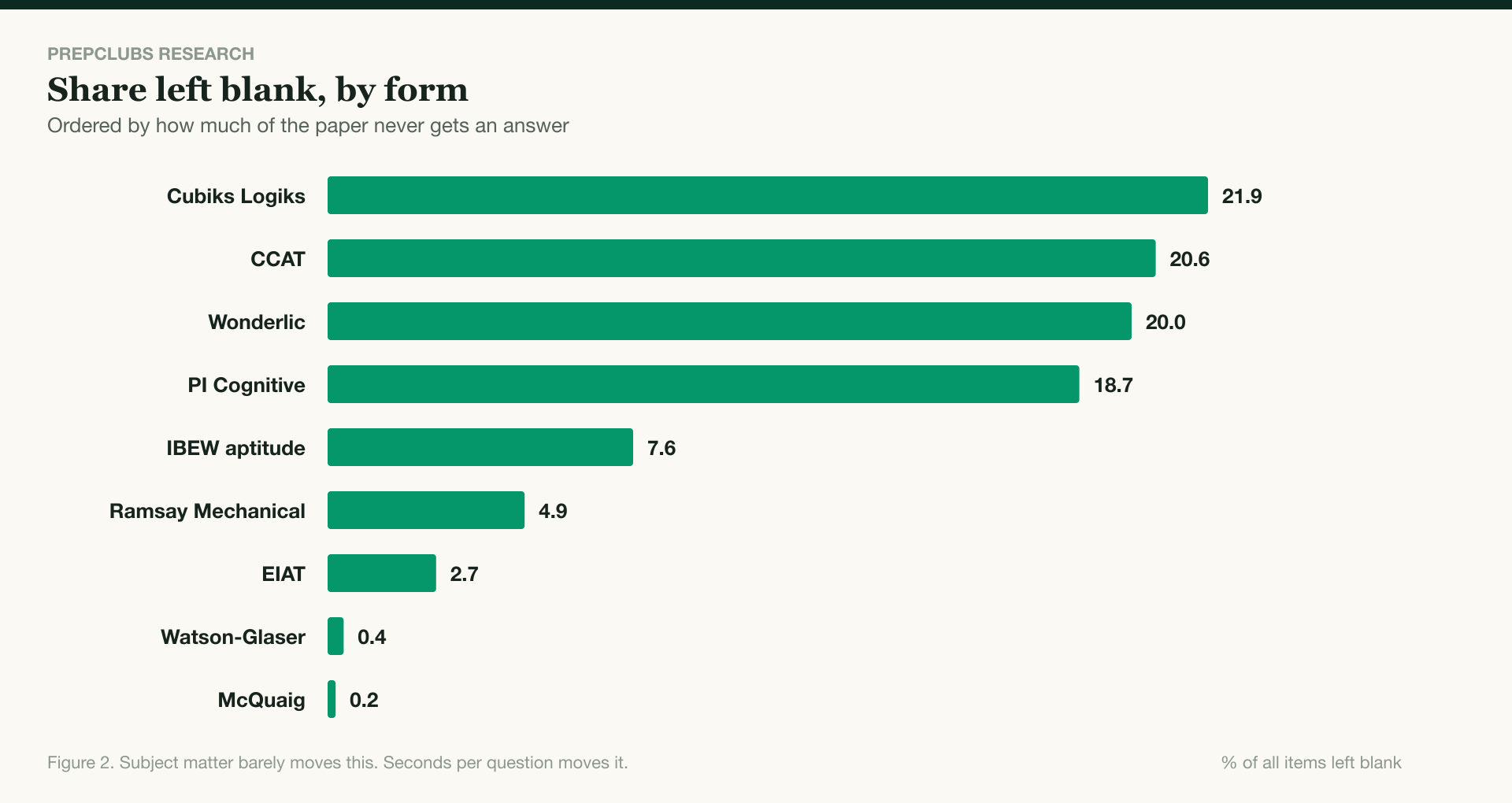
1. The clock decides the score on some tests and not on others. On the four speeded forms (CCAT, Wonderlic, PI Cognitive and Cubiks Logiks, 14 to 18 seconds a question) candidates left about a fifth of the paper blank. On forms that allow 30 seconds or more a question (Watson-Glaser, IBEW, EIAT, Ramsay Mechanical) the figure falls to between 0.4% and 7.6% (How much of a timed aptitude test is never answered). So "time pressure" is the defining feature of the speeded tests in this category, not of every test in it.
2. "They get harder as you go" is only half true. Of six forms with enough attempts to measure, three escalate steeply (Wonderlic, CCAT and PI Cognitive lose 32 to 43 points of accuracy from the first fifth to the last), two run flat (Cubiks Logiks and IBEW), and the Watson-Glaser runs backwards, with its hardest block first (Which aptitude tests are built as a difficulty ramp).
3. On speeded tests, reach beats accuracy. A raw score tracks how much of the paper you reached (correlation 0.72) more than accuracy on what you answered (0.56). On generous-clock forms the order reverses (0.59 against 0.77) (What candidates actually score on aptitude practice tests). That single fact changes how you should prepare: pacing drills for the first group, accuracy drills for the second.
Three real questions from our latest practice tests
One from each of the main question families, taken from the newest forms in our bank.
Numerical (CCAT Practice Test 15, question 35). If 15 workers take 8 days to build a wall, how many workers are needed to build it in 5 days?
A) 18 B) 20 C) 22 D) 24 E) 26
Answer: D) 24. The job is 15 times 8, which is 120 worker-days. Spread over 5 days, that needs 120 divided by 5, which is 24 workers. More workers, fewer days: if your answer went down, the relationship is upside down.
Logical (CCAT Practice Test 15, question 7). All items on the sale rack are discounted. This jacket is discounted. Is it from the sale rack?
A) Probably B) Not enough information C) It must be D) Yes E) No
Answer: B) Not enough information. The rule runs from sale rack to discounted, not back again. The jacket could be discounted for another reason. This reversed-rule trap turns up on the CCAT, the PI Cognitive and the Watson-Glaser alike.
Verbal (Wonderlic Practice Test 8, question 33). Which does not belong? COPPER, IRON, STEEL, GOLD, SILVER
A) Copper B) Silver C) Gold D) Iron E) Steel
Answer: E) Steel. Copper, iron, gold and silver are pure elements. Steel is an alloy of iron and carbon. Odd-one-out items reward finding the category first and checking each option against it.
For full-length practice on the specific test you face, start from the PrepClubs test library.
How to interpret a cognitive aptitude test score
Most cognitive aptitude tests report two numbers: a raw score (the count correct) and a percentile (your relative position against the norm group). Both matter, but the percentile is the number employers use for hiring decisions.
Typical cutoffs cluster as follows across the cognitive aptitude category. Customer success and entry-level operations roles target the 50th to 60th percentile. Sales roles target the 60th to 70th. Software engineering targets the 70th. Product management, strategy, and corporate development target the 75th to 80th. Director-level and executive roles target the 85th and above. These ranges are stable across CCAT, Wonderlic, PI Cognitive, and SHL Verify G+, with minor adjustments per test.
There is no penalty for wrong answers on most cognitive aptitude tests. The exceptions are SHL Verify G+, which is adaptive and effectively penalizes wrong answers by lowering subsequent question difficulty, and certain Watson-Glaser variants that use a correction-for-guessing formula. Outside those two cases, you should always guess on items you skip.
A general prep approach across cognitive aptitude tests
The prep cycle that works across most cognitive aptitude tests follows a 14-day arc, with 8 to 18 hours of total prep depending on your target percentile.
Days 1 to 2: Identify your test and your weakest section
Find out exactly which test you will take. Take one full-length untimed practice. Note which section ate the most time and which produced the most wrong answers. Most candidates discover one section that drags their score down disproportionately.
Days 3 to 6: Section-specific drilling
Drill your weakest section in 10-question timed sets. Math sets at 3 minutes, verbal at 2 minutes, spatial or abstract at 2 minutes. Review every wrong answer the same day. The goal is to bring each section to roughly equal accuracy.
Days 7 to 9: Build the skip trigger
This is the highest-leverage skill in cognitive test prep. On every problem, give yourself 3 seconds to decide solve-or-skip. Practice this in mixed-section sets. The skip trigger is what separates the 50th-percentile candidate from the 80th, more than raw ability.
Days 10 to 12: Full-length timed mocks
Run two to three full-length mocks under strict conditions. The score gap to your target tells you whether to focus on timing (small gap) or accuracy (larger gap) in the final days.
Days 13 to 14: Pattern memorization and rest
Day 13: drill the highest-yield patterns (number series, spatial rotations, antonym sets) one last time. Day 14: rest. Cognitive tests punish fatigue more than missed final prep.
Cognitive aptitude test FAQs
Is a cognitive aptitude test the same as an IQ test?
Not exactly, but they measure overlapping things. A clinical IQ test like the WAIS-IV is administered in a controlled clinical setting and produces a score that is meant to be stable across the lifespan. A cognitive aptitude test is a workplace screening tool that produces a score correlated with general cognitive ability (g) but optimized for fast, low-cost employer use. Scores on workplace cognitive tests correlate at roughly 0.6 to 0.8 with clinical IQ scores.
How long does a cognitive aptitude test take?
Most run between 12 and 30 minutes. The CCAT is 15 minutes for 50 questions. The Wonderlic and PI Cognitive are 12 minutes for 50. The SHL Verify G+ is adaptive and averages 24 minutes. The Watson-Glaser is 30 minutes for 40 critical thinking questions.
Can you prepare for a cognitive aptitude test?
Yes. Published studies and aggregated candidate reports converge on 5 to 12 percentile point gains across a 7- to 14-day prep cycle. The gains come from pattern recognition, timing discipline, and learned skip-strategy reflexes, not from raw ability change.
Why do companies use cognitive aptitude tests?
Because cognitive ability has a validity coefficient of roughly 0.51 for predicting job performance, which is the highest of any single screening predictor available at scale. The tests are also cheap (about $10 to $30 per candidate), fast (12 to 30 minutes), and easy to administer across hundreds of applicants.
What is a good cognitive aptitude test score?
It depends on the role. Software engineering typically targets the 70th percentile. Strategy, product, and corporate development target the 75th to 80th. Director and executive roles target the 85th and above. The same raw score lands at different percentiles depending on the role family because most platforms apply role-specific norm groups.
Are cognitive aptitude tests fair?
Cognitive tests are among the most studied selection tools in psychology and meet most statistical fairness criteria when applied consistently. They do show subgroup mean differences across demographic categories, which is why responsible employers pair them with other validated predictors rather than using them as the sole screen. Most modern test vendors publish adverse impact and fairness data on request.
Which cognitive aptitude test is hardest?
The Watson-Glaser is the hardest on a per-question basis because it requires applying five distinct decision rules across five sections. The CCAT and Wonderlic are the hardest on a time-pressure basis because the per-question budget is under 20 seconds. SHL Verify G+ feels hardest to most candidates because adaptive difficulty escalates as you answer correctly.
What happens if I fail a cognitive aptitude test?
Most employers do not give a second chance within the same hiring cycle. Some allow a retake after 6 to 12 months. Vista Equity Partners portfolio companies typically share scores across their portfolio for 12 months, so a fail at one Vista company can affect applications at sibling Vista companies. SHL and Criteria scores are often portable across cooperating employers within the same window.
Related on PrepClubs
-
Pillar. CCAT: format, score, and how to prepare. The most-used cognitive aptitude test in PE-backed tech.
-
Deep practice. Unlock 14 full-length CCAT mocks plus 12 topical drills. One-time payment, 30-day access. Current pricing is on the pricing page. Backed by the Money-back Guarantee.
-
Article. How hard is the CCAT, really?. Score distributions and Vista cutoffs.
-
Article. Companies that use the CCAT. The full Vista Equity portfolio plus 30 more confirmed CCAT employers.
-
Article. CCAT score explained: bands, percentile, and cutoffs by role. Raw-to-percentile lookup with role-specific targets.
-
Broader map. The 8 types of pre-employment tests employers use. Where cognitive aptitude sits among the other test types, and how to tell which one you were invited to.
Practice on PrepClubs
Practice on the same item-bank style your employer uses.
PrepClubs covers the five dominant cognitive aptitude tests with full-length timed mocks, section-specific drills, and percentile reporting. For the CCAT specifically: 1,350+ questions, 14 full-length 15-minute mocks, and 12 topical drills across math, verbal, and spatial. Every mock returns a raw score and a target-percentile read so you know which band you are sitting in before the real test. One-time payment, 30-day access. Backed by the Money-back Guarantee.