CCAT Score Explained: Bands, Percentile, and Cutoffs by Role
The CCAT mean is 24 out of 50. Software targets cluster at 31 (70th percentile), strategy and product at 35 (80th). This guide maps every raw score to its percentile band and to the role cutoff that actually decides whet

The honest answer about your CCAT score is that the raw number out of 50 means almost nothing on its own. The number that matters is the percentile, and the percentile that matters is the one your specific role family is being benchmarked against. A 32 can be the 80th percentile in a sales pipeline and the 72nd percentile in a software pipeline at the same Vista Equity portfolio company, on the same test, in the same week.
This guide walks every CCAT raw score from 10 to 50 through its percentile band, names the role families that actually use each cutoff, and lists what employers report as their pass marks. By the end, you will know exactly what to aim for and what to ignore.
Quick takeaways
- The CCAT average raw score is 24 out of 50, which is the 50th percentile.
- Fewer than 1 percent of candidates answer all 50 questions inside the 15-minute window.
- Software engineering roles at Vista Equity portfolio companies typically target 31 correct, roughly the 70th percentile.
- Strategy, product, and corporate development roles target 35 correct, roughly the 80th percentile.
- Director-level and Vista-headquarters roles push to 37 correct, around the 85th percentile.
- Criteria Corp rescales raw-to-percentile by role family, so the same 32 lands at different percentiles for software vs. sales.
- There is no penalty for wrong answers. Always guess on items you skip.
How the CCAT scoring engine actually works
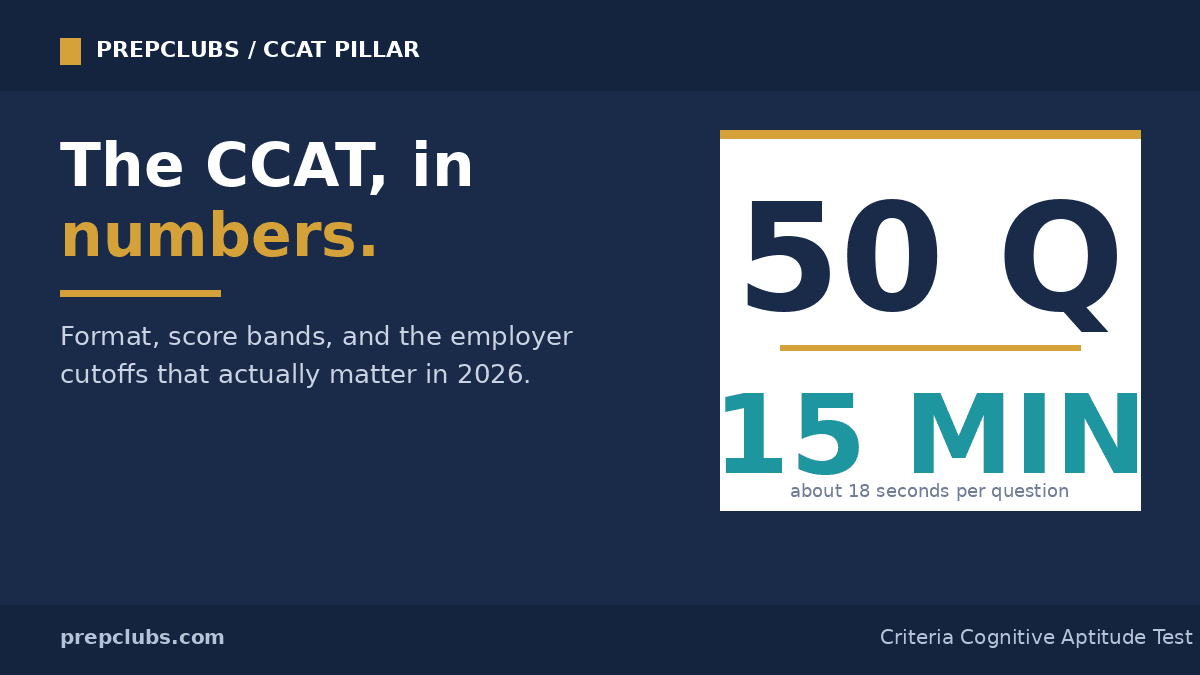
The CCAT is a 50-question, 15-minute test from Criteria Corp. Your raw score is the count correct out of 50, with no penalty for wrong answers and no partial credit. Criteria then converts that raw score into a percentile by comparing it against a norm group.
The detail most candidates miss is that Criteria does not use one universal norm group. When an employer sets up the CCAT inside the Criteria platform, they tag the role family: software engineering, sales, customer success, ops, executive. Each tag pulls a different percentile lookup table. That is why an identical 32 reads as 80th percentile against the sales norm and 72nd against the software norm. Software candidates as a population score higher on the CCAT, so the bar to clear them is higher.
The practical consequence is that raw-to-percentile tables published by competing prep sites are useful as a first approximation but cannot be treated as the final word. Use them to set your training target, then add 2 to 3 raw points of margin if you are interviewing for software, product, or strategy.
The chart below maps each raw score band to its approximate percentile and to the descriptive band Criteria uses internally.

What the CCAT raw score distribution looks like
The full population distribution of CCAT raw scores is roughly bell-shaped with a mean of 24, a median near 24, and a standard deviation of about 8.5. That puts roughly two thirds of candidates between a raw 16 and a raw 32. Below 16 sits the bottom 15 percent. Above 35 sits the top 10 percent. Above 40 sits the top 5 percent. Hitting a raw 45 or higher puts you in the rarefied top 1 to 4 percent, the band where employers actively call your recruiter to ask if the score is real.
Raw scores compress at both ends. A raw 12 is not meaningfully different from a raw 14 in employer eyes, both filter out at virtually every cognitive-screened company. A raw 47 is not meaningfully different from a raw 49, both clear any cutoff in existence. The middle 30 raw points, from about 18 to 38, are where every actual hiring decision happens.
The full CCAT score band lookup
The table below maps each raw score band to its approximate percentile and gives a one-line read on what employers do with that band. This is the reference asset most candidates want bookmarked. Percentile ranges are approximate, based on Criteria Corp norm groups and aggregated candidate reports across Vista Equity portfolio company hiring funnels.
| Raw score | Approx. percentile | Band label | What employers do with this score |
|---|---|---|---|
| 10 to 15 | 1st to 15th | Well below average | Filters out at every cognitive-screened role. Almost never advances. |
| 16 to 22 | 16th to 40th | Below average | Filters out at most Vista, Thoma Bravo, and Criteria-screened roles. |
| 23 to 25 | 45th to 55th | Average | Mean is 24. Clears entry-level cutoffs at a few employers but not most. |
| 26 to 30 | 60th to 69th | Above average | Clears most customer success and entry-level sales cutoffs. |
| 31 to 34 | 70th to 79th | Strong | Software engineering and analyst targets cluster here. |
| 35 to 39 | 80th to 89th | Very strong | Strategy, product, and senior IC ranges. |
| 40 to 44 | 90th to 95th | Top tier | Vista Equity portfolio leadership and executive cutoffs. |
| 45 to 50 | 96th to 99th | Exceptional | Under 1 percent of candidates reach this band. |
A practical read: if you are interviewing for any software, product, strategy, or corporate development role, you want to train toward 35 correct. Hitting 35 puts you safely above the software bar at 70th percentile and safely above the strategy bar at 80th percentile. Hitting 31 puts you exactly at the software bar with no margin, which means a single bad question pushes you under.
Why role family changes your target by 3 to 5 points
Criteria Corp publishes its norm groups by role tag for legal and validity reasons. The norms are based on the actual score distributions of candidates who took the CCAT for that role family across thousands of Criteria-platform employers. This produces a real effect: the same raw score lands at different percentiles depending on which norm group is applied.
The reason is selection bias on the candidate side. Software engineering candidates self-select into cognitive-test-heavy pipelines, are more likely to have prepped, and as a population score 3 to 5 raw points higher than sales or customer success candidates. So the software norm group has a higher median, and your raw 32 has to clear a higher bar to register as the same percentile.
The table below shows what target raw score actually corresponds to a competitive percentile for each Vista Equity portfolio role family. Use this as your prep target, not the universal table above.

| Role family | Target raw | Target percentile | Example Vista Equity employers |
|---|---|---|---|
| Customer success | 26 | 60th | Granicus, JAMF, Mediaocean |
| Mid-market sales | 29 | 65th | Drift, Apptio, Allocadia |
| Software engineering | 31 | 70th | Cvent, Finastra, PowerSchool |
| Data and analytics | 32 | 75th | PowerSchool, Allocadia, TIBCO |
| Product management | 34 | 78th | Mediaocean, TIBCO, Apptio |
| Strategy + corp dev | 35 | 80th | Vista headquarters, Drift |
| Director and above | 37 | 85th | Vista portfolio leadership |
These targets assume a Vista Equity or Vista-style portfolio environment, which uses CCAT cutoffs more strictly than the average Criteria-platform employer. Outside Vista, cutoffs run 2 to 3 raw points more forgiving across the board.
What candidates miss about the 70th vs. 80th percentile gap
The gap between the 70th and 80th percentile on the CCAT is only 4 raw items, from 31 to 35. That sounds small. In prep terms it is the difference between clearing a single full-length mock at threshold and clearing every mock comfortably.
The first 30 raw points on the CCAT are the easy points. The verbal section, simple arithmetic, and the easier spatial items together cover roughly 32 to 35 questions in a typical CCAT form. Candidates who hit a clean 31 are largely capturing those easy points and converting them under time pressure. Getting from 31 to 35 means starting to capture the middle-tier items: two-step word problems, passage inference, and the medium-difficulty spatial rotations. These take 25 to 30 seconds each rather than 12 to 18, which means timing discipline becomes the binding constraint.
Getting from 35 to 40 is a different problem entirely. Those 5 extra points come from the explicitly hard items that Criteria builds into every CCAT form as time sinks. Most candidates skip these correctly. Top scorers solve two of them quickly and guess the rest. This is a skill that comes only from doing 600 to 800 questions of focused practice, not from a 7-day prep cycle.
Where candidates actually lose points
The single biggest score leak on the CCAT is not difficulty. It is misallocation of the 15-minute budget. Three patterns repeat across thousands of candidate reports.
The first pattern is over-investment in math. The CCAT has roughly 20 math items per form, ranging from straightforward percentages to multi-step word problems. Most candidates can solve 14 to 16 of them with unlimited time. Under 15-minute pressure they solve 8 to 10 because they refuse to skip the hard ones. Skipping the 3 hardest math items costs you 3 raw points if you guess randomly. Attempting them costs you 4 minutes, which equals 12 to 15 easier items you never reached. The math is brutal: skip the math time sinks.
The second pattern is re-reading verbal passages. Each verbal passage on the CCAT sits behind 1 or 2 questions. Candidates who read the passage once, decide, and move spend roughly 45 seconds per question pair. Candidates who re-read spend 90 seconds and answer the same way 80 percent of the time. Train yourself to commit on the first read.
The third pattern is leaving blanks at the end. Because there is no guessing penalty, every blank is a lost expected value of 0.2 to 0.25 raw points. Candidates who run out of time with 8 blanks lose 1.6 to 2.0 raw points on average. The fix is to bank 30 seconds at the end of the test for pure guessing on any remaining items.
A first-party check on the score distribution
The bands above lean on Criteria's norm groups and candidate reports. We can add a direct measurement from our own practice forms. The PrepClubs Research series re-grades every scored CCAT-format attempt (50 questions, 15 minutes) and publishes the percentile bands with their caveats (What candidates actually score on aptitude practice tests).
| Practice percentile | Raw % correct | Out of 50 |
|---|---|---|
| 10th | 34% | 17 |
| 25th | 44% | 22 |
| Median | 54% | 27 |
| 75th | 68% | 34 |
| 90th | 82% | 41 |
Based on 189 analysed practice attempts. These are raw scores on PrepClubs practice forms, not official Criteria scores, and practising candidates are a self-selected group, so our median sits a few points above the published norm mean of about 24. The shape matches the bands above: a wide middle, and a thin top tail above 40.
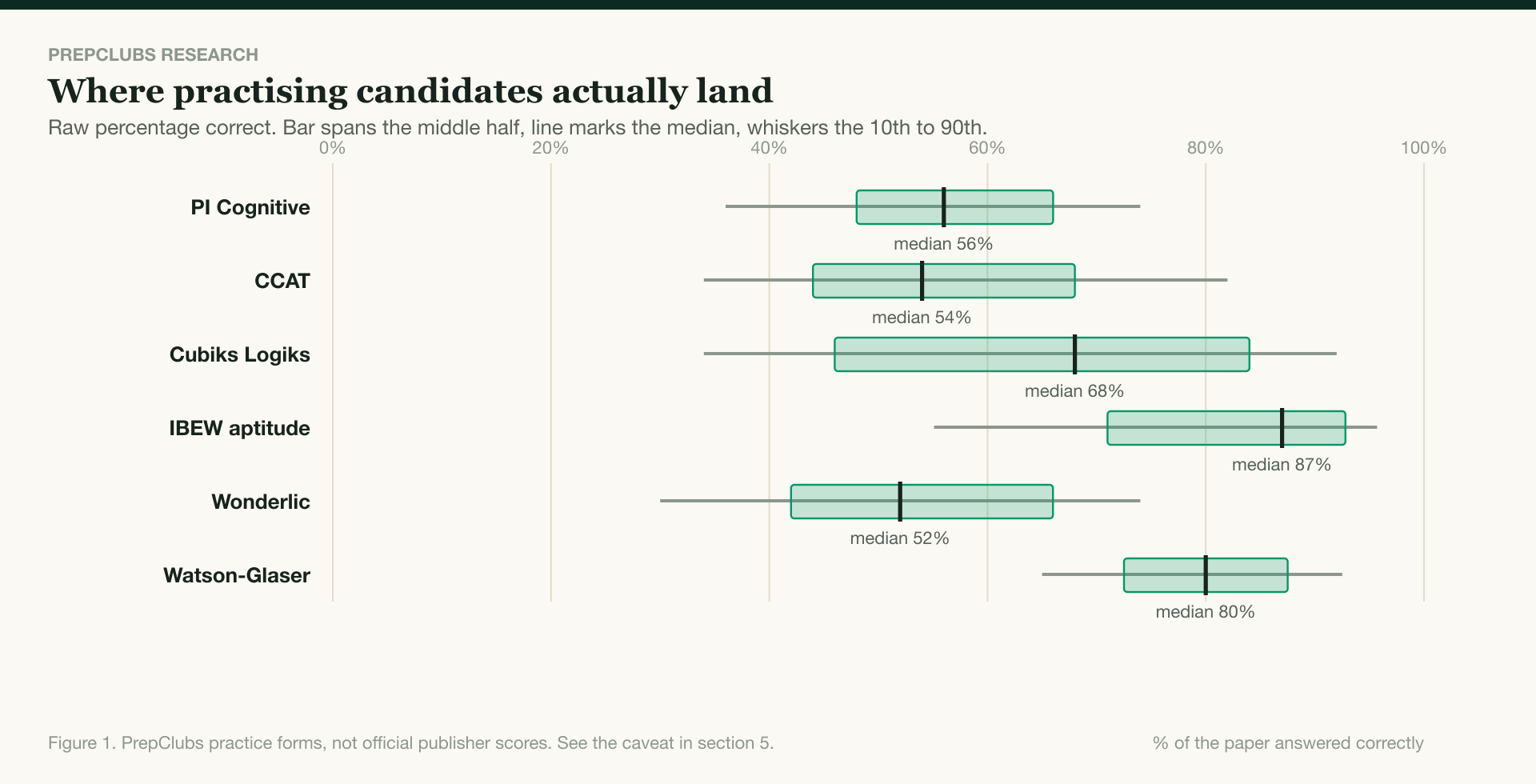
The research also confirms the blank-guessing point in the third pattern above. Across those 189 attempts, 20.6% of CCAT items were left blank, and guessing them would have added about 2.1 raw points per attempt, roughly a 7% lift on the average score (How much of a timed aptitude test is never answered).
Three real questions, three places points are lost
These come from CCAT Practice Test 15, the newest form in our bank. Each one matches a loss pattern described above.
Question 17 of 50 (two-step word problem). A phone plan costs $45 a month plus $0.10 per text message. If the bill was $63, how many texts were sent?
A) 140 B) 160 C) 180 D) 200 E) 220
Answer: C) 180. Take off the fixed charge first: $63 minus $45 is $18. Then $18 divided by $0.10 is 180 texts. Two steps, both simple. The time goes on setting it up, not on the arithmetic.
Question 25 of 50 (syllogism). All X are Y. No Y are Z. Which must be true?
A) Some Z are Y B) All Z are X C) All Y are X D) No X are Z E) Some X are Z
Answer: D) No X are Z. X sits entirely inside Y, and Y shares nothing with Z, so X cannot share anything with Z either. Sketching two circles takes three seconds and beats reasoning it out in words.
Question 18 of 50 (sentence completion, two blanks). Although the initial reports were ______, a thorough investigation revealed that the situation was far more ______ than anyone had anticipated.
A) reassuring ... dire B) detailed ... straightforward C) comprehensive ... simple D) alarming ... mild E) accurate ... predictable
Answer: A) reassuring ... dire. "Although" signals a contrast, and "far more than anticipated" says the truth was worse than expected. Only A pairs calm early reports with a serious reality. D has the contrast backwards.
The full form, with a worked explanation for all 50 items, is in the CCAT practice tests on PrepClubs.
How CCAT scores compare to Wonderlic, PI Cognitive, and SHL
If you are interviewing across multiple companies, you may face the CCAT, Wonderlic, PI Cognitive, and SHL Verify G+ in the same hiring cycle. The percentiles do not translate directly across tests because each uses a different population norm and a different question pool. The table below gives a rough equivalence chart so you can interpret a score you already have on one test against the others.
| Test | Average raw | 70th percentile raw | 80th percentile raw | 90th percentile raw |
|---|---|---|---|---|
| CCAT | 24 / 50 | 31 / 50 | 35 / 50 | 40 / 50 |
| Wonderlic | 20 / 50 | 26 / 50 | 30 / 50 | 35 / 50 |
| PI Cognitive | 20 / 50 | 26 / 50 | 30 / 50 | 35 / 50 |
| SHL Verify G+ | adaptive | scaled 7.0 | scaled 7.8 | scaled 8.5 |
The CCAT and Wonderlic are very similar tests with different difficulty calibrations. Wonderlic is 12 minutes for 50 questions versus the CCAT's 15 minutes for 50, so a Wonderlic 26 and a CCAT 31 are roughly the same level of performance under their respective time pressure. SHL Verify G+ is adaptive and reports on a scaled metric, so direct comparison requires the published SHL conversion table.
A 14-day prep plan calibrated to your raw score target
If your target is the 70th percentile (raw 31), plan for 8 to 10 hours of focused prep across 14 days. If your target is the 80th percentile (raw 35), plan for 14 to 18 hours. If your target is the 90th percentile or above (raw 40+), plan for 25 to 30 hours, and recognize that 90th-plus scores reward natural cognitive speed in ways that prep can only partially close.
If you have less than two weeks, how many days of prep a cognitive aptitude test really needs lays out 24-hour, 3-day, and 1-week versions of this plan.
Day 1: Diagnostic untimed
Take one full-length CCAT practice untimed. Score it. Note which section ate the most time and which produced the most wrong answers. The score from this mock is your starting baseline; the gap to your target is the prep budget.
Days 2 to 4: Weakest section, 10-question timed sets
Drill your weakest section in 10-question sets at strict time. Math sets at 3 minutes, verbal at 2 minutes, spatial at 2 minutes. Review every wrong answer the same day. Build a written list of the question patterns that beat you.
Days 5 to 7: Build the skip trigger
This is the single highest-leverage skill in CCAT prep. On every problem, give yourself 3 seconds to decide: solve or skip. Practice this in mixed-section sets of 25 questions. The goal is to move on from a hard problem in 18 seconds without hesitation.
Days 8 to 10: Full-length timed mocks
Run two full 15-minute mocks under strict conditions. The gap between your raw score on these mocks and your target is the gap your final prep days need to close. If you are within 2 raw points, focus on timing. If you are 5 or more raw points off, focus on accuracy.
Days 11 to 13: Pattern memorization for spatial and number series
The spatial section reuses roughly 7 underlying rotation patterns. The number series section reuses roughly 6 underlying sequence patterns. Memorize the patterns by working through 40 to 60 questions across both. After this volume you recognize most variants on sight, which collapses spatial time-per-question from 25 seconds to 12.
Day 14: Rest
Do not practice the day before your test. Sleep 8 hours. Cognitive tests punish fatigue more than missed final prep.
CCAT score FAQs
Is the CCAT scored out of 50?
Yes. Every CCAT form has 50 questions. Your raw score is the count correct out of 50. Wrong answers and blanks both count as zero, so there is no penalty for guessing. Criteria Corp then converts your raw to a percentile against a role-tagged norm group.
What is the average CCAT score?
The average raw score is 24 out of 50, which is the 50th percentile. Roughly two thirds of all candidates score between 16 and 32. The standard deviation is about 8.5 raw points.
What CCAT score do I need for a software engineering role?
The typical target at Vista Equity portfolio software roles is 31 correct, which is roughly the 70th percentile against the software norm group. A safer training target is 33 to 35, which gives you margin for a bad question or two.
What is a passing CCAT score for Vista Equity?
Vista does not publish universal cutoffs, but reported portfolio company cutoffs cluster at the 70th percentile (raw 31) for entry-level software, 75th to 80th percentile (raw 33 to 35) for product and strategy, and 80th to 85th percentile (raw 35 to 37) for senior IC and director roles. Vista headquarters strategy and corporate development roles report 85th percentile and above.
Can I retake the CCAT if I fail?
Some Criteria-platform employers allow a retake after a 6-month window. Vista Equity portfolio companies generally do not allow retakes within the same hiring cycle. If you fail at one Vista portfolio company, your score is typically valid for 12 months and may be referenced by sibling portfolio companies.
How long is a CCAT score valid?
Criteria Corp does not impose a universal expiration. Employer policies vary. Vista portfolio companies typically treat scores as valid for 12 months. Outside Vista, scores are often treated as valid for 24 months or longer.
What CCAT score puts me in the top 10 percent?
A raw score of 35 lands at roughly the 80th percentile, and a raw score of 40 lands at roughly the 90th percentile. The 90th percentile target requires answering 40 out of 50 questions correctly inside 15 minutes, which fewer than 5 percent of candidates achieve without focused prep.
How is the CCAT score reported to employers?
Criteria Corp's platform reports both the raw score (e.g., 32) and the role-specific percentile (e.g., 75th percentile for software). Employers see both. Some employers also see your section-level breakdown: verbal, math and logic, and spatial. The section breakdown rarely changes hiring decisions but can be referenced in follow-up interviews.
Related on PrepClubs
- Pillar. The CCAT in 2026: format, score, and how to prepare. The complete brand pillar on CCAT format, timing, and scoring.
- Deep practice. Unlock 14 full-length CCAT mocks plus 12 topical drills. One-time payment, 30-day access. Current pricing is on the pricing page. Backed by the Money-back Guarantee.
- Article. How hard is the CCAT, really?. The honest answer based on score distributions and Vista cutoffs.
- Article. Companies that use the CCAT. The full Vista Equity portfolio plus 30 more confirmed CCAT employers.
- Article. CCAT prep: a 7-day plan for the Criteria Cognitive Aptitude Test. The condensed prep cycle for time-constrained candidates.
Practice on PrepClubs
Train against the exact bands you need to hit.
PrepClubs CCAT prep ships 1,350+ questions across the same item-bank style Criteria Corp uses on the live test, 14 full-length 15-minute mocks with section-level percentile reporting, and 12 topical drills for math, verbal, and spatial. Every mock returns a raw score and a target-percentile read so you know which band you are sitting in before your real test. One-time payment, 30-day access. Backed by the Money-back Guarantee.
Practise for this exam
CCAT practice tests
Timed practice tests in the real CCAT format, with a worked explanation for every question, so you learn the method as well as the answer.