Electrician Aptitude Tests: Which Test Each Apprenticeship Program Uses
There is no single electrician aptitude test. See which one each apprenticeship uses, from the IBEW algebra and reading exam to the EIAT, and the passing score.

There is no single electrician aptitude test. Which one you sit is decided by the program you applied to, and these are not variations on a theme: one is algebra and reading with no calculator, another adds mechanical comprehension and tool knowledge, and several non-union programs have no entrance test at all. This guide maps each apprenticeship pathway to the exact test it administers, with the format, the passing rule and the source. Every mapping below comes from the program's own site or its sponsoring body, and where a pathway genuinely varies by local chapter it says so instead of inventing a national answer.
Quick takeaways
- The IBEW and NECA union track uses one test: algebra and functions plus reading comprehension, no calculator, scored 1 to 9. Do not confuse it with the elevator trade's similarly named EIAT.
- You need a 4 to move on. IBEW Local 81 states that a score of four or higher qualifies for an interview, and below that you wait three months and re-apply.
- Elevator constructor apprenticeships use a different test entirely, the EIAT, which adds mechanical aptitude and math to reading.
- Non-union chapters have no national test. IEC states plainly that requirements vary by chapter, and several IEC and ABC chapters use no entrance test at all.
- On the union track the test is a gate and the interview sets your rank. That is true for the elevator trade too.
- Mechanical reasoning is not on the IBEW test. If you are drilling gears and pulleys for an inside wireman application, you are studying the wrong thing.
- Utility employers use their own batteries, published by the Edison Electric Institute and chosen per job family.
Every pathway and its test, at a glance
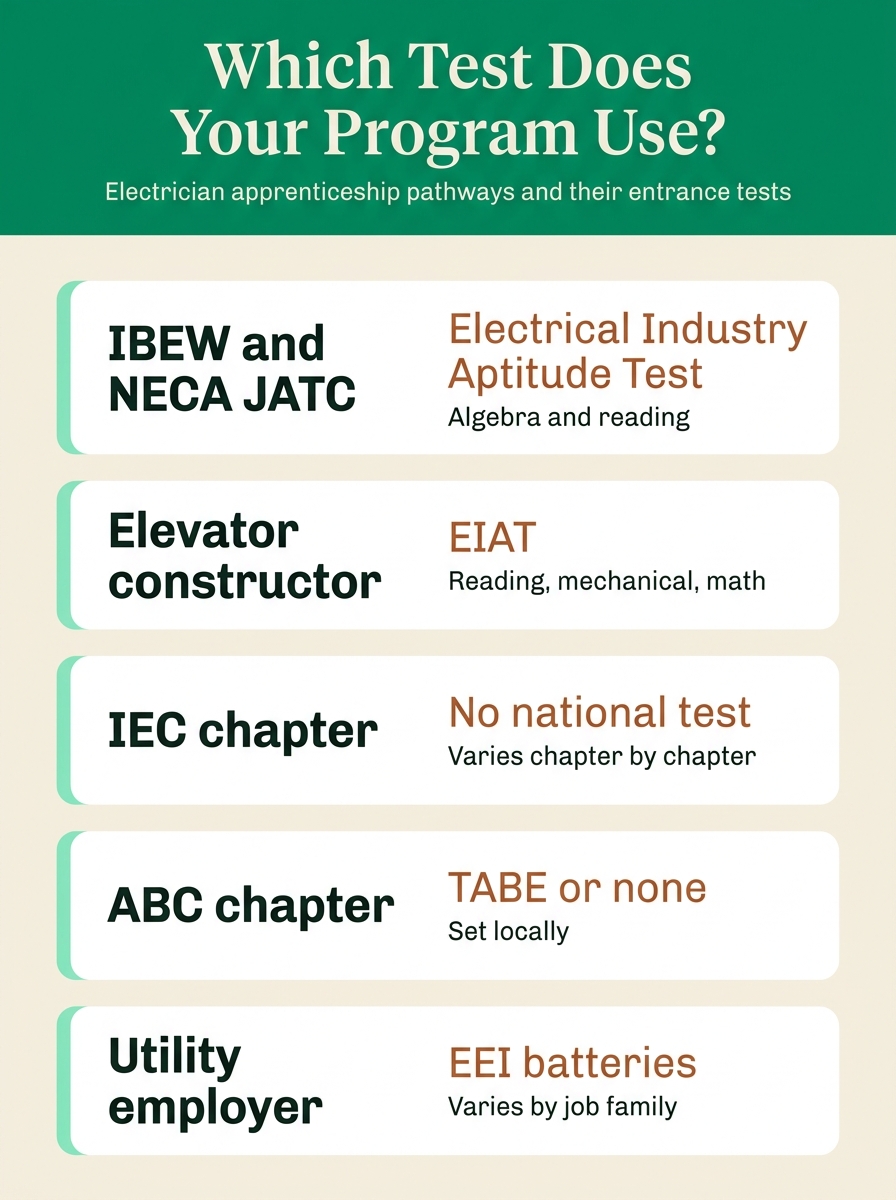
| Apprenticeship pathway | Test administered | What it covers | Who sets it |
|---|---|---|---|
| IBEW and NECA JATC (inside wireman, residential, sound and communications) | The IBEW/NECA aptitude test | Algebra and functions, reading comprehension | electrical training ALLIANCE |
| Elevator constructor (IUEC) | Elevator Industry Aptitude Test (EIAT) | Reading, mechanical aptitude, mathematics | NEIEP |
| IEC chapter apprenticeship | No national test | Varies chapter by chapter | The local IEC chapter |
| ABC chapter apprenticeship | Often a TABE assessment, sometimes nothing | Reading and math where used | The local ABC chapter |
| Utility employer (power company) | An EEI employment test battery | Depends on the job family | Edison Electric Institute, chosen by the employer |
1. IBEW and NECA apprenticeships: the ALLIANCE aptitude test
This is the test most people mean by an electrician aptitude test, and it runs across the union track: inside wireman, and at many local committees the residential wireman and sound and communications programs too. It goes by several names. Prep sites call it the IBEW or NJATC aptitude test, and training trusts such as Inland Empire publish it as the "Electrical Industry Aptitude Test." They are the same exam, and none of them is the elevator trade's EIAT.
IBEW Local 81 states that the test "is developed and scored under the standards of the Electrical Training Alliance" and "consists of algebra and reading comprehension." The electrical training ALLIANCE, the body formerly known as the NJATC, publishes sample items in exactly those two areas, Algebra and Functions and Reading Comprehension.
The section-level format comes from the Inland Empire Electrical Training Trust, which publishes it directly:
| Section | Questions | Time |
|---|---|---|
| Algebra and Functions | 33 | 46 minutes |
| Reading Comprehension | 36 | 51 minutes |
That is 69 questions in 97 minutes, and the same page states "You will not be allowed to use a calculator for the test." Scoring runs on a 1 to 9 scale, and Local 81 is explicit about the cut: a score of four or higher qualifies you for an interview. Score below four and, in Local 81's wording, you must wait three months and submit a new application, which means a failed attempt costs you a full application cycle rather than just a retest slot.
Note what is absent: no mechanical reasoning, no gears, no pulleys, no electrical theory. Candidates routinely arrive having drilled mechanical comprehension because prep sites blur this test with trades tests that do include it.
The content itself is high-school algebra and functions plus timed reading, so the way to prepare is to work real items in that exact format, on paper, without a calculator. You can take a free, full-length IBEW aptitude practice test to see where you stand before you pay for anything: a free, full-length IBEW aptitude practice test. For more worked questions and the section-by-section walkthrough, see the IBEW aptitude test practice guide and the NJATC naming and scoring explainer.
A worked algebra item in the IBEW format
The electrical training ALLIANCE sample page publishes items in exactly this style. Here is one worked the way you would on test day, with no calculator.
A crew runs conduit at a steady rate, so the feet completed is a linear function of hours worked: feet = m(hours) + b. After 2 hours the crew has run 90 feet. After 5 hours it has run 210 feet. (a) Find the rate m. (b) How many feet will be run at 8 hours?
Step 1, find the rate m as the change in feet over the change in hours: m = (210 minus 90) divided by (5 minus 2) = 120 divided by 3 = 40 feet per hour.
Step 2, find b by substituting one known point. Using (2 hours, 90 feet): 90 = 40(2) + b, so 90 = 80 + b, so b = 10.
Step 3, answer part (b) by substituting 8 hours into feet = 40(hours) + 10: feet = 40(8) + 10 = 320 + 10 = 330 feet.
That is the shape of the algebra and functions section: translate the words into a formula, solve for the unknown, then substitute. Nothing here needs a calculator if you keep the arithmetic in whole numbers.
Pacing the 69 questions
The ALLIANCE notes that most applicants have enough time, so treat the clock as a budget to manage rather than a trap. The two sections are timed separately, 46 minutes for 33 algebra items and 51 minutes for 36 reading items, which works out to about 84 seconds per algebra question and 85 seconds per reading question. A simple plan: on algebra, bank the items you can solve in under a minute first, flag the two or three longest, and come back; on reading, read the questions before the passage so you know what you are scanning for. Finishing is normal when you have drilled the format; the scores that stand out come from accuracy, not from rushing.
2. Elevator constructor apprenticeships: the EIAT
If you applied through the National Elevator Industry Education Program to become an elevator constructor with the IUEC, you sit a different exam. NEIEP states that the application "involves two steps: the Elevator Industry Aptitude Test (EIAT) and an interview".
Per NEIEP's own FAQ, "The EIAT assesses applicants on basic arithmetic, reading comprehension, mechanical comprehension, and general tool knowledge." NEIEP's official study guide puts it at 100 multiple choice questions on paper: Reading Comprehension 35, Mechanical Aptitude 35, Mathematics 30. It is scored pass or fail with 70% correct being the minimum passing grade, and clearing 70% gets you scheduled for an interview. A separate tool assessment counts toward your final interview score, which no prep site mentions.
The practical difference from the IBEW test is the mechanical section. Gears, pulleys, levers and tool knowledge are on this exam and absent from the union electrical one, which is why the two are not interchangeable prep. Our EIAT format guide breaks the sections down, and the Bennett, Ramsay and Wiesen comparison covers the mechanical styles in depth.
NEIEP publishes no time limit and no calculator policy for the EIAT, so treat any prep site stating one as unsourced. Ask your recruiting local.
3. IEC chapters: no national test, and it varies more than people expect
Independent Electrical Contractors is the largest non-union route, and this is where most published advice goes wrong. IEC states directly that "specific requirements vary by each chapter training program," and its national requirements are a high school diploma or GED, reliable transportation, and that "successful applicants must be able to meet certain physical requirements and demonstrate mechanical aptitude."
That last phrase is generic language, not a named test: IEC publishes no national standardized aptitude test. What chapters do differs sharply:
- Some run a reading and math entrance assessment, typically covering pre-algebra and geometry rather than the algebra-and-functions level of the union test.
- Passing marks, where a chapter sets one, are a percentage rather than a 1 to 9 band, and some chapters provide a calculator while others do not.
- Several chapters require no entrance test at all.
One warning, because it circulates widely: the 33-question, 46-minute algebra section and the 1 to 9 scale belong to the IBEW and NECA track. Sites that have not checked weld them onto IEC and ABC sentences. If a page says an IEC chapter scores you 1 to 9, it is repeating union figures.
4. ABC chapters: a TABE assessment, an NCCER module, or nothing
ABC chapters set their own entrance requirements too. Where a chapter does test, the instrument most often named is the TABE, the Test of Adult Basic Education, a general adult reading and math assessment rather than anything electrical. Chapters using it typically set a percentage or a grade-level cutoff, and some pair it with a required high school algebra credit. That credit is an additional requirement, not a way around the test.
A few chapters instead screen with a construction math module drawn from the NCCER Core curriculum. NCCER is a curriculum and craft-credential body, not an entrance-test publisher, so a chapter doing this is repurposing training material locally.
And several ABC chapters run no entrance test at all.
5. Utility employers: the EEI batteries
Applying to a power company rather than a joint apprenticeship committee means the test comes from the Edison Electric Institute, which states that its "employment test batteries are designed and validated for specific energy industry job families, including power plant operators, maintenance and craft positions, power dispatching positions, customer service representatives, and more."
The consequence is that there is no single utility test. EEI publishes several batteries and the employer picks the one matching the job family, so plant operator, craft and maintenance, and dispatch roles are screened by different instruments. CAST is the battery utilities most commonly name for construction and skilled trades roles, but the only reliable way to know is to ask the recruiter in writing before you prepare. Retest rules and score validity are set by the employer, not by EEI.
The difference that actually matters: a test gate versus an employment gate
Comparing scores across programs misses the structural difference that should actually shape which track you pursue.
On the union track, the test is a pass or fail gate and the interview sets your position. Clear a 4 and you earn an interview; your place on the ranked eligibility list comes from how that interview goes. The elevator trade works identically: clear 70%, get interviewed, and your ranking follows from the interview score, which NEIEP states is the average of the two interviewers' scores. That rank stays valid for two years, or until the list is exhausted.
On the non-union track, the gate is often employment rather than examination. Several IEC and ABC chapters require a member contractor to hire you before they will enroll you as an apprentice. In that model no amount of test preparation substitutes for finding a contractor willing to take you on.
What happens if you fail
Failure is recoverable everywhere, but the cost differs. On the IBEW track a score below four means waiting three months and submitting a new application with all supporting documents again. On the elevator side, NEIEP says applicants who fail "will not be interviewed and will be removed from the pool of applicants; however, they may re-apply during the next or subsequent recruitment period," which ties your retry to a recruitment window rather than a fixed number of months.
Nobody publishes a genuine pass or fail rate for these tests, so any site quoting one is inventing it. The electrical training ALLIANCE says most applicants have enough time to finish, so the pressure is not really the clock. What is verifiable is the structural pressure elsewhere: the union test allows no calculator, and scores feed a ranked list, so the practical bar is set by the other applicants in your cycle rather than by the minimum.
And yes, you can still get hired after failing one. A failed IBEW attempt does not bar you from an IEC or ABC chapter, a utility apprenticeship, or the elevator trade, because those are separate programs with separate tests.
FAQ
How hard is the electrician aptitude test?
The content is high-school algebra and functions plus reading comprehension, not advanced math, and the electrical training ALLIANCE says most applicants have enough time to finish its 69 questions in 97 minutes. The real difficulty is doing the arithmetic on paper with no calculator and ranking well against the other applicants rather than just clearing the minimum. If your algebra is solid and you can work fractions, ratios and equations by hand, it is manageable. If you have not done algebra in years, that is the gap to close first.
How do I pass an electrician aptitude test?
Identify which test your program actually administers, then prepare only for that one. For the IBEW and NECA test, drill algebra and functions and timed reading, and do it without a calculator. For the EIAT, add mechanical comprehension and tool knowledge. Preparing for the wrong test is the most common avoidable mistake in this trade.
Is the IBEW aptitude test hard?
It is scored 1 to 9 and a 4 qualifies you for an interview, so the minimum bar is not extreme. The real difficulty is that scores feed a ranked eligibility list, so clearing the minimum and ranking well are different goals, and the higher score is what gets you called.
What if I fail the IBEW aptitude test?
IBEW Local 81 states that an applicant scoring below four must wait three months and submit a new application, with all required documentation, in order to retest. Rules are administered by each local committee, so confirm the exact wait and re-application requirement with the JATC you applied to.
How many people fail the IBEW aptitude test?
No official pass or fail rate is published by the electrical training ALLIANCE or by the local committees, and any specific percentage you see quoted online is not sourced. What is documented is the qualifying threshold of 4 on the 1 to 9 scale and the three-month wait after a failure.
Can you still get hired if you fail an aptitude test?
Yes. Each program runs its own test, so a failure on one does not close the others. Non-union IEC and ABC chapters set their own entrance requirements and several use no test at all, utility employers use EEI batteries with their own rules, and the elevator trade runs a separate recruitment with the EIAT.
Is mechanical reasoning on the electrician aptitude test?
Not on the IBEW and NECA test, which covers algebra and functions and reading comprehension only. Mechanical comprehension is on the EIAT for the elevator trade and appears in utility and maintenance batteries. Check which test you are sitting before you spend prep time on gears and pulleys.
Related on PrepClubs
- Free IBEW aptitude test practice, math and reading, timed
- IBEW aptitude test study guide: the 9 skills it measures
- NJATC aptitude test: how it differs from the general IBEW exam
- Elevator Industry Aptitude Test (EIAT) practice, free
- Mechanical aptitude test questions: 12 worked examples
Ready to prepare for the test your program actually uses?
Once you know which exam you are sitting, the work is timed repetition against that exact format. PrepClubs runs a dedicated cluster for each. The IBEW cluster carries practice questions across full-length premium mocks plus a free diagnostic, and the EIAT cluster is built the same way. Each cluster opens with a free diagnostic so you can find your weak section before paying anything, and each comes with a 30-day Pass Guarantee that extends your access by another 30 days at no cost if you do not pass. Current pricing is on the pricing page. Join the 3,700+ students preparing this way.
Start with the test your program actually administers:
- IBEW and NECA track: the IBEW aptitude test cluster and the NJATC aptitude test cluster.
- Elevator constructor track: the EIAT cluster.
- To confirm the format first, read the electrical training ALLIANCE sample page.
Practise for this exam
IBEW practice tests
Timed practice tests in the real IBEW format, with a worked explanation for every question, so you learn the method as well as the answer.