The Bennett Mechanical Comprehension Test (BMCT) in 2026
The BMCT-II is 55 diagram questions in 25 minutes, scored by percentile. Here are the format, the score bands, the industry cutoffs, and where candidates lose points.

The honest answer is that the Bennett Mechanical Comprehension Test rewards two things most prep guides never mention in the same breath: a working grasp of everyday physics, and the nerve to move at roughly 27 seconds per question. The current edition, the BMCT-II, gives you 55 multiple-choice questions in 25 minutes, and every one is built around a diagram of pulleys, gears, levers, or other moving parts. Employers hiring for mechanical, maintenance, skilled-trades and engineering roles use it to judge whether you can reason about machinery before you ever touch it. Your raw score never reaches the hiring manager. A percentile does. This guide covers the format, the scoring, the cutoffs by industry, and the places candidates actually lose points.
Quick takeaways
- The BMCT-II is 55 multiple-choice questions in 25 minutes, about 27 seconds per question, every one based on a diagram.
- It is published by Pearson TalentLens and draws each sitting from a bank of more than 300 items spread across 12 mechanical categories.
- Scoring is by percentile against a norm group, not raw score. The 40th to 59th percentile is the usual hiring range for most roles.
- Aerospace and engineering roles often expect the 60th percentile and up; entry-level manufacturing sits lower.
- Most candidates lose points to time pressure and rusty fundamentals, not trick questions.
- There is no penalty for wrong answers, so leave nothing blank, and use the two untimed practice questions to settle into the interface rather than to learn the physics.
What the BMCT-II actually is
The Bennett Mechanical Comprehension Test has been a standard mechanical-reasoning screen for decades, and the version you will sit today is the BMCT-II, published by Pearson TalentLens. It measures one specific thing: whether you can apply basic physical principles to practical, real-world situations shown as pictures. You are not asked to recall formulas or do heavy arithmetic. You are asked to look at a diagram of a pulley, a gear train, a loaded beam, or two people carrying a plank, and decide what will happen.
The format is fixed. You get 55 multiple-choice questions and 25 minutes, which works out to around 27 seconds per item. Each question presents a short diagram and a single question with three answer options (A, B or C). Because each test is assembled from a bank of more than 300 items grouped into 12 categories, two candidates sitting at the same time will usually see different forms, so copying a neighbour is pointless. The test runs on computer in most modern administrations, and before the clock starts you get two untimed practice questions to get used to the interface.
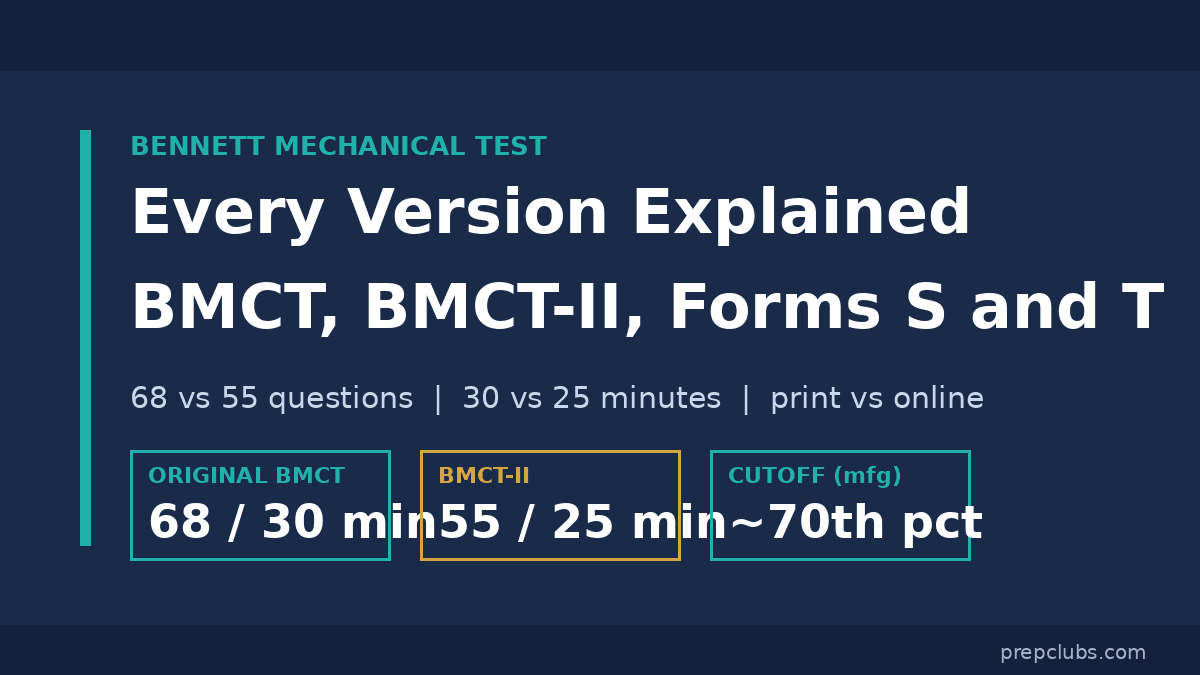
The BMCT-II replaced the older BMCT (Forms S and T) with refreshed artwork, updated norms, and a tighter item set. If a prep resource is still quoting 68 questions in 30 minutes, it is describing the older paper form, not the version most 2026 candidates will face.
For a version-by-version breakdown of the wider Bennett family (the original 68-question BMCT Forms S and T, withdrawn in 2017, and the current 55-question BMCT-II), see Bennett Mechanical Test: All Versions Explained.
The BMCT-II is only one of the mechanical tests employers use. If you are unsure which mechanical reasoning test you are actually sitting, the Bennett, Ramsay, and Wiesen line up side by side there.
The 12 categories: what the test is really asking
Underneath the artwork, the BMCT-II rotates through 12 recurring categories of mechanical reasoning. You do not need to name them on the day, but knowing them tells you exactly what to revise.
| Content area (items per sitting) | What it tests | Typical question |
|---|---|---|
| Pulleys and levers (7) | Mechanical advantage, fulcrum position, effort | Where to push to lift a load with least force |
| Hydraulics (6) | Pressure transfer, flow, siphons | Which piston rises, or which tank drains first |
| Resolution of forces, centrifugal force and inertia (6) | Combined forces, spinning objects, resistance to change in motion | Which way an object moves when two forces act on it |
| Structures, planes and slopes (6) | Supports, beams, ramps | Which support carries more weight |
| Miscellaneous (6) | Everyday mechanisms that fit no single area | What a simple device does when operated |
| Gears and belt drives (5) | Direction and speed of meshed gears and belts | Which way the final gear turns, and how fast |
| Gravity and velocity (4) | Falling objects, speed, momentum | Which object lands or stops first |
| Acoustics and optics (3) | Sound and light basics | How sound or reflection behaves |
| Center of gravity (3) | Stability, tipping, balance points | Which object topples first |
| Electricity (3) | Simple circuits, magnetism | Which bulb lights, or which way current flows |
| Heat (3) | Expansion, conduction, transfer | Which material expands or heats faster |
| Shape and volume (3) | Capacity, displacement, shape | Which container holds more |
The chart below sets out how examiners read the result once you have answered.

How BMCT-II scoring works
Here is the part that confuses people. Your raw score, the number of questions you answer correctly out of 55, is not what employers look at. Pearson converts that raw score into a percentile against a norm group, and the percentile is what the hiring manager sees. A percentile of 70 means you scored as well as or better than 70 percent of the people in that comparison group.
The norm group matters as much as your answers. Pearson offers several: a global norm group of everyone who has taken the test, a role-specific norm group matched to the job you applied for, and sometimes the pool of candidates who applied for the same job at the same time. The same raw score can land at the 55th percentile against one group and the 45th against a tougher one. The current BMCT-II norm groups were last refreshed in 2018 to better reflect the demographics of each industry.
There is no penalty for wrong answers, which has a direct strategic consequence: never leave a question blank. If 90 seconds remain and you have five questions left, answer all five with your best guess rather than carefully working one and skipping four.
The infographic below summarises how the percentile bands are usually read.

What score you need, by industry
There is no single national pass mark. Each employer sets its own cutoff, usually as a percentile against a chosen norm group. The general reading of the bands looks like this: below the 20th percentile is effectively a fail for almost any technical role; the 20th to 39th range only keeps you in the running if you scored strongly elsewhere; the 40th to 59th range is where most roles actually hire; and the 60th percentile and up marks you as a strong candidate who learns quickly.
Where the bar sits depends on the work. The BMCT is used widely across manufacturing, utilities, energy, aviation, automotive, and the skilled trades. Pearson TalentLens names job families rather than employers, and it publishes no role-specific cutoffs, so the bands below are a working guide, not an official scale. One skilled-trades route it does not cover is the IBEW electrical apprenticeship, which uses a timed algebra and reading exam instead. An aerospace or engineering role that depends on mechanical judgement will often look for the 60th percentile and above. An entry-level manufacturing or maintenance position may hire comfortably in the 40th to 59th band. If you do not know the employer's cutoff, a defensible target is the 70th percentile, which clears the common hiring range with a comfortable margin.
Why candidates underperform (the part other guides skip)
Most people who score below expectation do not fail because the physics is hard. They fail for four predictable reasons.
The first is time. At 27 seconds per question, there is no room to derive anything from first principles. Candidates who pause to reason out a gear train from scratch run out of clock with ten questions unanswered. The second is overthinking. The BMCT tests intuition about simple machines, and the obvious answer is usually correct; candidates talk themselves out of right answers by inventing complications the diagram does not show. The third is diagram misreading: missing an arrow that shows direction, a fixed versus movable pulley, or which end of a lever the load sits on. The fourth is leaving questions blank under pressure, which throws away free marks because there is no negative marking.
None of these are knowledge problems. They are pacing and habit problems, which is why timed practice matters more than re-reading a physics textbook.
A five-step way to prepare
- Relearn the six simple machines first. Levers, pulleys, gears, inclined planes, wedges, and screws account for most of the test. Get fluent in mechanical advantage and direction of motion for each.
- Drill under the clock. Practise in 25-minute blocks of 55 questions so 27 seconds per item starts to feel normal. Speed is a trained reflex, not a talent.
- Build a diagram-reading checklist. For every question, find the fixed point, the direction arrows, and the load before you choose. Most errors are reading errors.
- Answer everything. Train the habit of guessing fast on anything that would take more than 40 seconds, then moving on. No blanks.
- Review by category. Track which of the 12 categories you miss most and target those, rather than grinding questions you already get right.
Three worked examples
Pulley. A single fixed pulley is used to lift a 50 kg crate. Does it reduce the force needed? A fixed pulley only changes the direction of the force, not its size, so you still pull with a force equal to the crate's weight. The advantage is that you can pull down instead of lifting up. To actually halve the force, you need a movable pulley.
Gears. Two meshed gears sit side by side. The driver gear turns clockwise. Which way does the second gear turn? Meshed gears always turn in opposite directions, so the second gear turns counter-clockwise. If the driver has 10 teeth and the second has 20, the second also turns at half the speed.
Lever. A plank rests on a central fulcrum with a 10 kg weight 1 metre to the left. To balance it, where do you place a 5 kg weight on the right? Balance depends on weight times distance. The left side gives 10 times 1, which is 10. The right side needs to match, so 5 kg must sit 2 metres from the fulcrum.
For a longer free practice set with five walked-through items across pulleys, gears, hydraulics, stability, and circuits at real BMCT-II difficulty, see Bennett Mechanical practice test (free with walkthroughs).
FAQ
How many questions are on the Bennett Mechanical Comprehension Test?
The current BMCT-II has 55 multiple-choice questions with a 25-minute time limit, roughly 27 seconds per question. Older paper forms had 68 questions in 30 minutes.
Is the BMCT-II hard?
The individual concepts are basic physics, so the difficulty is the pace, not the content. Candidates who practise under timed conditions usually find it manageable; those who try to reason every question from scratch run out of time.
What is a good BMCT score?
Scores are reported as percentiles, not raw marks. The 40th to 59th percentile is the typical hiring range, the 60th and up is considered strong, and a defensible target when you do not know the employer's cutoff is the 70th percentile.
Can you use a calculator on the Bennett test?
No. The BMCT is a conceptual reasoning test, not a calculation test. Any arithmetic involved is simple enough to do in your head, and calculators are generally not permitted.
Is there negative marking on the BMCT?
No. There is no penalty for a wrong answer, so you should answer every question even if you are guessing. Leaving items blank only costs you marks.
How long does the BMCT-II take?
The timed section is 25 minutes for 55 questions. Add a few minutes for instructions and the two untimed practice questions, so budget around 30 to 35 minutes in total.
What changed between the BMCT and the BMCT-II?
The BMCT-II is the current edition, with updated artwork, a refreshed item bank, and norms last updated in 2018. If a resource quotes 68 questions in 30 minutes, it is describing the older form.
How do I pass the Bennett test?
Relearn the six simple machines, drill in timed 55-question blocks, read each diagram carefully for direction and fixed points, and answer every question. Most failures are pacing problems, not knowledge gaps.
Related on PrepClubs
- Pillar. The Bennett Mechanical Comprehension Test hub. Format, practice, and scoring for the BMCT-II in one place.
- Practice. Start the Bennett diagnostic. A full-length BMCT-II style form of 55 three-choice picture questions in 25 minutes, with the same per-area split as the real test; the Bennett Mechanical practice bank has 8 full-length forms.
- Compare. The CCAT, a speeded cognitive aptitude test. How a 50-question speed test differs from mechanical reasoning.
- Article. The Wonderlic test format and scoring. Another fast, time-pressured pre-employment test and how it is scored.
Practice on PrepClubs
What PrepClubs offers for Bennett candidates.
PrepClubs runs a Bennett Mechanical (BMCT-II style) practice bank: 8 full-length forms of 55 original three-choice picture questions, each timed at 25 minutes and built on the same per-area split as the real test (pulleys and levers, hydraulics, gears and belt drives, and the rest). Start with the diagnostic form to see which areas cost you points, then work through the remaining forms under the clock.
Start the Bennett diagnostic or see the full Bennett Mechanical practice bank
Practise for this exam
Bennett practice tests
Timed practice tests in the real Bennett format, with a worked explanation for every question, so you learn the method as well as the answer.