CompTIA Network+ N10-009 Exam: Objectives, Questions, Cost, Difficulty and Value
Everything about the CompTIA Network+ N10-009 exam in one place: the five weighted domains and a study-hour budget, 90 questions in 90 minutes and the 720 scaled pass mark, the $399 voucher and retake rules, how hard it

The CompTIA Network+ N10-009 exam is a single test of up to 90 multiple-choice and performance-based questions in 90 minutes, and you pass at 720 on a 100-to-900 scale, per CompTIA. It covers five weighted domains, with Networking Concepts and Troubleshooting worth 47 percent together. The US voucher is $399 bought directly from CompTIA.
This guide puts everything about the exam itself in one place: the format, how the scaled score works, the exact domain weightings and how to budget study time against them, how hard it is compared with A+, what it costs to sit and renew, and whether it is worth taking at all. It also includes three real questions from the PrepClubs Network+ bank with worked answers.
Last updated: September 25, 2026.
Quick takeaways
- N10-009 is the current Network+ version (V9), launched June 20, 2024. The previous N10-008 English exam retired in December 2024.
- The exam is a maximum of 90 questions in 90 minutes, mixing multiple-choice and performance-based questions (PBQs). You pass at 720 on a 100-to-900 scale, per CompTIA.
- Five domains: Networking Concepts (23%), Network Implementation (20%), Network Operations (19%), Network Security (14%) and Network Troubleshooting (24%). Concepts and Troubleshooting are 47 percent of the exam.
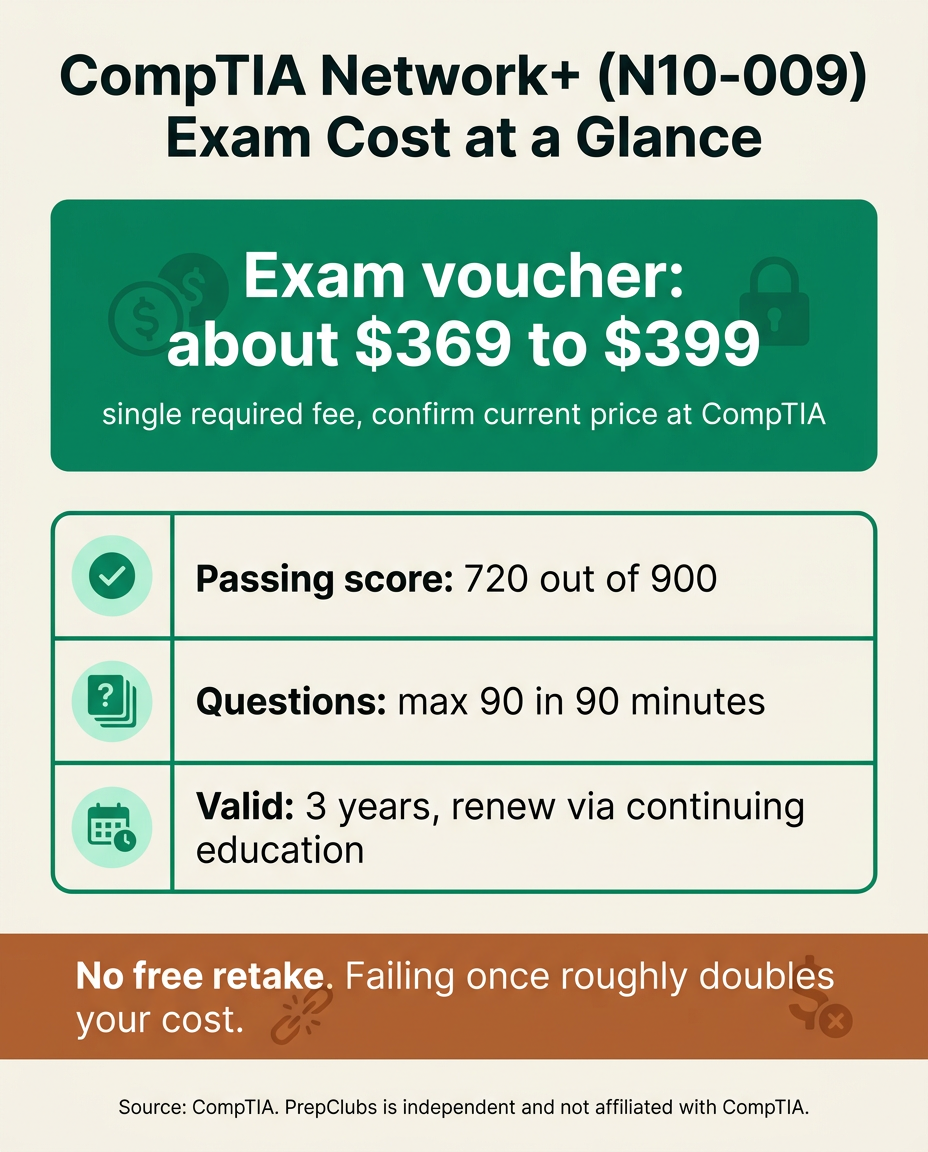
- The voucher is $399 from CompTIA in the US (list price since June 1, 2026). There is no free retake, so failing once roughly doubles your exam cost.
- Network+ is narrower but deeper than A+. Subnetting and PBQs are where most of the difficulty sits.
- It is worth it for networking, sysadmin and infrastructure roles. If cybersecurity is your only target, you can often go straight to Security+, but learn the networking anyway.
- PrepClubs is independent prep material and is not affiliated with or endorsed by CompTIA.
The N10-009 exam at a glance
Get the format exact first, because it shapes how you practice. Per CompTIA's official Network+ page:
| Attribute | Network+ N10-009 |
|---|---|
| Number of exams | 1 (no Core 1 and Core 2 split like A+) |
| Questions | Maximum of 90 |
| Time limit | 90 minutes |
| Question types | Multiple-choice and performance-based (PBQs) |
| Passing score | 720 on a 100-to-900 scale |
| Launch date | June 20, 2024 |
| Recommended experience | CompTIA A+ plus 9 to 12 months as a junior network administrator or network support technician |
| US voucher (CompTIA direct) | $399 |
Coming from A+, the biggest surprise is usually that Network+ is one exam. You book one N10-009 sitting, pass it once, and you hold the certification. One voucher, one exam day.
The recommended experience line is a recommendation, not a hard prerequisite. It does explain why the standard advice is to take A+ first: the exam assumes you have already touched real network gear.
Why you might see fewer than 90 questions
Candidates often finish with 75, 80 or 85 questions instead of 90 and worry the exam broke. It did not. CompTIA's wording is "maximum of 90," and the delivered count can vary. The number you see tells you nothing about how you are doing. Prepare for the full 90 in 90 minutes, and a shorter exam is only ever easier.
PBQs come first and eat time
Performance-based questions are interactive tasks: match connectors to standards, configure a simulated device, place components in a topology, or order troubleshooting steps. There are usually a handful, and they tend to appear at the start. Under-prepared candidates sink 15 minutes into the first PBQ and then race the multiple-choice items.
A sane play: skim the PBQs, do the quick ones, flag the rest, clear the multiple-choice questions to bank time, then return to the flagged PBQs. You can only run that play if you have practiced the real format.
How the 720 passing score works
Most explanations see 720 out of 900 and translate it to "about 80 percent." That is not how it works.
The 100-to-900 range is a scaled score. CompTIA converts your raw performance onto that scale using a model that accounts for the difficulty of the items you saw. Two candidates with the same number of correct answers can end up with different scaled scores if their items differed in difficulty. CompTIA does not publish per-item weightings, so there is no honest "you need exactly 65 of 90 correct."
Practice to a margin above 720, not to an exact percentage. On full-length practice tests scored as a straight percentage, treat a consistent 85 percent or higher as your green light. That cushion survives the scaling and a few unlucky items.
The five N10-009 domains and their weightings
Here are the current domains and weightings from CompTIA's N10-009 objectives. Use the official names: Domain 1 is "Networking Concepts" (some guides paraphrase it as "Networking Fundamentals," which was the N10-008 title), and Domain 2 is "Network Implementation," singular.
| # | N10-009 domain | Weight |
|---|---|---|
| 1.0 | Networking Concepts | 23% |
| 2.0 | Network Implementation | 20% |
| 3.0 | Network Operations | 19% |
| 4.0 | Network Security | 14% |
| 5.0 | Network Troubleshooting | 24% |
Troubleshooting is the single heaviest domain, Concepts is close behind, and Security is the lightest. That last one surprises people, because "network security" sounds central. On Network+ it is the smallest slice, and the deeper security material belongs to Security+.

What each domain covers
- Domain 1, Networking Concepts (23%). The OSI model, topologies and network types, ports and protocols, IP addressing and subnetting, cloud concepts, and newer topics like SDN, SD-WAN, VXLAN, zero trust and infrastructure as code. Subnetting speed lives here.
- Domain 2, Network Implementation (20%). Routing and switching technologies, wireless standards, and physically or logically building out a network.
- Domain 3, Network Operations (19%). Documentation, monitoring, high availability, disaster recovery and organizational processes. This domain grew in N10-009, so do not treat it as an afterthought.
- Domain 4, Network Security (14%). Security concepts, common attacks and hardening. Real, but the lightest domain.
- Domain 5, Network Troubleshooting (24%). The troubleshooting methodology and the tools for diagnosing cabling, connectivity, wireless and performance problems. The heaviest domain and heavily PBQ-relevant.
What changed from N10-008
If you are studying from older material, know what moved:
| Domain | N10-008 | N10-009 |
|---|---|---|
| Networking Concepts (was Fundamentals) | 24% | 23% |
| Network Implementation | 19% | 20% |
| Network Operations | 16% | 19% |
| Network Security | 19% | 14% |
| Network Troubleshooting | 22% | 24% |
Security dropped the most and Operations gained the most. N10-009 also added SDN, SD-WAN, zero trust, VXLAN and infrastructure as code. If your study guide predates mid-2024, check it covers these, or you will study to a retired blueprint.
Where to spend your study time
A weighting is a study instruction if you read it as one. Here is a defensible study-hour budget for N10-009.
| Domain | Exam weight | Suggested share of study hours |
|---|---|---|
| 5.0 Troubleshooting | 24% | about 24% |
| 1.0 Networking Concepts | 23% | about 25% |
| 2.0 Implementation | 20% | about 20% |
| 3.0 Operations | 19% | about 19% |
| 4.0 Security | 14% | about 12% |
Two deliberate tweaks. Give Domain 1 slightly more than its 23 percent, because subnetting and the OSI model underpin questions in every other domain. And do not over-invest in Domain 4, especially if Security+ is your next cert. With Concepts and Troubleshooting at 47 percent combined, nearly half your hours belong there. For a day-by-day version of this plan, see our Network+ practice test and study plan.
How hard is Network+?
For most people Network+ is a step up from A+ in depth but narrower in scope, so it is a different kind of hard rather than simply harder. A+ is wide and shallow across two exams. Network+ goes deep on one subject and expects you to reason about subnets, protocols and traffic flow instead of recognizing terms.
| Difficulty factor | A+ (220-1201 / 220-1202) | Network+ (N10-009) |
|---|---|---|
| Number of exams | Two cores | One exam |
| Shape | Wide and shallow | Narrow and deep |
| Core challenge | Coverage breadth, two passes | Depth on one subject |
| Signature hard topic | Performance-based troubleshooting | Subnetting and protocol reasoning |
| Question count | Max 90 per core | Max 90 |
People who struggled with A+'s breadth sometimes find Network+ more comfortable because it stays on one subject. People who breezed through A+ on hardware familiarity sometimes find Network+ tougher because it demands reasoning they could skip before.

Three things drive the difficulty, and all three are trainable:
- Subnetting. Math under time pressure that you cannot fake. It is also completely learnable through repetition, and once the process clicks, subnetting questions become some of your most reliable points.
- Depth of understanding. You have to know which protocol does what, where a problem sits in the OSI model, and why a configuration behaves the way it does. Definitions alone are not enough.
- PBQs. Subnetting tasks, configuration scenarios and troubleshooting sequences take longer than multiple-choice and cannot be guessed. Candidates who run out of time almost always lost it here.
Coming straight from A+ helps. The A+ Core 1 networking domain introduces IP addressing, common ports and basic network hardware, exactly the foundations Network+ builds on. If you are still weighing A+ first, our read on how hard CompTIA A+ is covers that step.
CompTIA does not publish an official Network+ pass rate, so treat any exact figure you see online as unofficial. Your own scores on full-length, timed N10-009 practice are a far better readiness signal.
Three real Network+ questions, worked
These come verbatim from PrepClubs' Network+ bank. Try each before reading the answer.
Question 1: subnetting (Domain 1)
From PrepClubs Network+ Practice Test 1, question 27.
A 192.168.100.0/24 network is divided evenly into /28 subnets. How many subnets result, and how many usable hosts does each one hold?
- A. 16 subnets of 16 usable hosts each
- B. 16 subnets of 14 usable hosts each
- C. 8 subnets of 30 usable hosts each
- D. 14 subnets of 16 usable hosts each
Answer: B. Going from /24 to /28 borrows 4 bits, so there are 2^4 = 16 subnets. Each subnet keeps 32 - 28 = 4 host bits, which is 16 addresses, and 16 - 2 = 14 usable once you remove the network and broadcast addresses. Option A forgets to subtract those two addresses. Option D applies the subtract-two rule to the subnet count instead of the host count. Option C describes a /27.
Question 2: troubleshooting methodology (Domain 5)
From PrepClubs Network+ Practice Test 4, question 4.
Amara Okafor, a technician at Ridgeline Freight, receives a ticket that says only "the network is slow at the Denver depot." She has not yet examined any device or spoken to anyone at the depot. According to the CompTIA troubleshooting methodology, what should she do FIRST?
- A. Replace the depot uplink cable, since slow links are often cabling faults
- B. Collect monitoring graphs, device logs and the scope of affected users
- C. Escalate the ticket to the WAN carrier as a probable circuit fault
- D. Reboot the depot's core switch to clear any congested interface buffers
Answer: B. The methodology starts with identifying the problem, and the first part of that step is gathering information. "The network is slow" says nothing about which users, applications or times are affected. Replacing the cable jumps to a fix for a cause nobody has tested. Rebooting the switch is also an unplanned fix, and it wipes interface counters and logs that would help locate the cause. Escalating to the carrier assumes a WAN fault with no evidence.
Question 3: ports and protocols (Domain 1)
From PrepClubs Network+ Practice Test 24, question 16.
An administrator is securing directory authentication traffic between application servers and a domain controller so that queries and bind credentials are encrypted. Which port should be permitted for secure LDAP?
- A. TCP 636
- B. TCP 389
- C. TCP 88
- D. UDP 1812
Answer: A. LDAPS is LDAP wrapped in TLS and listens on TCP 636. TCP 389 is standard LDAP, which sends simple bind credentials in cleartext unless StartTLS is negotiated. TCP 88 is Kerberos, and UDP 1812 is RADIUS, both different services.
Notice the pattern: the subnetting and port questions reward speed drilling, while the troubleshooting question rewards knowing the method in order. That is the whole exam in miniature.
What the Network+ exam costs
The voucher is the only required cost. Everything else is a choice about how you prepare.
| Cost item | Typical US amount | Required? |
|---|---|---|
| N10-009 exam voucher (CompTIA direct) | $399 | Yes |
| Retake after a fail | another full voucher | Only if you fail |
| Voucher with a bundled retake (CompTIA) | costs more up front | Optional |
| Study materials and practice tests | varies | Optional |
| Renewal every three years | continuing education, not a new exam fee | Later |
CompTIA raised the Network+ list price to $399 on June 1, 2026, up from $390. Authorized resellers sometimes sell the same voucher for less, and older pages still quote $358 or $369, so confirm the live price on CompTIA's store before you buy.
Discounts that actually lower the price
- Academic pricing. CompTIA's academic store sells discounted vouchers to eligible students, typically verified with a school email address.
- Retake bundles. CompTIA sells vouchers bundled with a second attempt. They cost more up front but hedge the retake risk if you are unsure of your readiness.
- Employer and workforce programs. Many employers, and some state workforce and veterans programs, reimburse or cover certification vouchers. Ask before you pay out of pocket.
The retake math
There is no free retake. If you do not pass, you buy another voucher. There is no waiting period between your first and second attempt, but from the third attempt onward you wait 14 days between tries, per CompTIA's retake policy. In budget terms, failing once roughly doubles your exam cost, which is the strongest argument for full-length practice before you book.
Renewal
Network+ is valid for three years. You renew by earning 30 continuing education units over the cycle, completing CompTIA's renewal course, or passing a higher-level CompTIA exam. For most people, earning Security+ inside the three-year window renews Network+ automatically, which folds the renewal into the next step of a normal career path.
Is Network+ worth it?
For someone heading into networking, systems administration or infrastructure roles, yes, because it proves the vendor-neutral networking depth that A+ only touches. Where a Cisco cert proves you know Cisco gear, Network+ proves you understand networking concepts that apply everywhere.
For someone whose target is cybersecurity specifically, you can often skip it and go straight to Security+, which security roles list by name more often and which appears on the US Department of Defense baseline lists for certain positions.
| Your target | Network+ verdict |
|---|---|
| Networking, sysadmin, infrastructure | Worth it. Directly relevant depth. |
| General IT, keeping options open | Worth it. Broad, vendor-neutral foundation. |
| Cybersecurity specifically | Often skippable. Go to Security+, but learn the networking basics anyway. |
| Already strong networking experience | Skippable. Experience may cover it. |

Realistically, Network+ maps to roles like junior network administrator, network technician, help desk escalation and infrastructure support. It is a stepping stone, not a senior credential. Pay varies too widely by role and region to quote a single honest figure, so treat Network+ as the credential that gets you into networking-track work, where experience and later certs drive compensation.
The catch if you skip it: skipping the exam is defensible, skipping the knowledge is not. Security+ assumes you understand ports, protocols, the OSI model and how traffic moves. If you go straight to Security+, study those fundamentals anyway. The Security+ exam format guide shows what that next exam looks like, and the CompTIA certifications list lays out the full A+, Network+ and Security+ path.
FAQ
What are the Network+ exam objectives?
They are CompTIA's official list of what N10-009 tests, organized into five weighted domains: Networking Concepts (23%), Network Implementation (20%), Network Operations (19%), Network Security (14%) and Network Troubleshooting (24%). CompTIA publishes the full objectives with sub-objectives for each domain.
How many questions are on the Network+ exam?
A maximum of 90 in 90 minutes, mixing multiple-choice and performance-based questions, per CompTIA. You may see fewer than 90 in a given sitting. That is normal and says nothing about your score.
What is the passing score for Network+, and is 720 the same as 80 percent?
You pass at 720 on a 100-to-900 scale. It is a scaled score that accounts for item difficulty, not a percentage of questions correct. Aim for a consistent 85 percent or higher on full-length practice tests to build a safe margin.
How much does the Network+ exam cost?
The N10-009 voucher is $399 when bought directly from CompTIA in the US (list price since June 1, 2026). Resellers and academic pricing can be lower. There is no free retake, so a fail means buying another voucher.
Is Network+ harder than A+?
It is deeper on networking but narrower in scope, so it is a different kind of hard. A+ tests breadth across two exams. Network+ tests depth on one subject, especially subnetting and protocol reasoning, in one exam.
What is the hardest part of Network+?
For most people, subnetting under time pressure and the performance-based questions. Both take time and cannot be guessed. Drill subnetting until it is automatic, and practice PBQs as their own study block.
Is Network+ worth it in 2026?
Yes, if you are heading into networking, sysadmin or infrastructure roles. If your only goal is cybersecurity, going straight to Security+ is a defensible path, provided you still learn networking fundamentals, because Security+ assumes them.
How long is Network+ valid?
Three years. You renew with 30 continuing education units, CompTIA's renewal course, or a higher-level CompTIA certification such as Security+, not by paying another full exam fee.
Related on PrepClubs
- Network+ practice test and study plan: four more worked N10-009 questions and a two-week, domain-weighted plan.
- CompTIA A+ practice test: the cert CompTIA recommends before Network+.
- Security+ practice test: the usual next step after Network+.
- CompTIA certifications list: where Network+ sits in the full CompTIA path.
Prepare for N10-009 where the points are
Network+ rewards the candidate who practices where the exam puts its points: Troubleshooting, Networking Concepts and fast subnetting, under a real 90-minute clock. PrepClubs' Network+ track has 29 full-length, 90-question N10-009 practice tests plus a 25-question diagnostic, every answer with a written rationale and a per-domain breakdown so you know exactly what to drill next. More than 3,700 students have prepared with PrepClubs, and the track is backed by our Money-back Guarantee. Practice at prepclubs.com/tests/network-plus.
Practise for this exam
CompTIA Network+ (N10-009) practice tests
Full-length timed forms across every exam domain at the official weighting, with a clear rationale for every answer. Start with the 25-question diagnostic to see which domains need the most work.