Security+ Practice Test and Study Plan (SY0-701)
How to turn a Security+ practice test into a study plan: sit it timed, tag misses by domain, study the objective, re-test fresh. Plus a domain-weighted 30-day SY0-701 plan, what free sets and dumps can and cannot do, and

A Security+ practice test only helps if you use it as a diagnostic. Sit a full-length SY0-701 set under the real clock (up to 90 questions in 90 minutes), tag every miss by domain, study the objective behind each miss, then re-test with fresh questions. Repeat until you score a steady 85 percent or more, a safe margin over CompTIA's 750 passing score on the 100-to-900 scale.
This page gives you both halves of that: how to work a practice test so it actually teaches, and a 30-day study plan weighted to the five SY0-701 domains. It also covers what free question sets can and cannot do, why exam dumps are a trap, and three real questions from the PrepClubs Security+ bank, worked through.
Last updated: September 25, 2026.
Quick takeaways
- SY0-701 is a maximum of 90 questions in 90 minutes, multiple-choice plus performance-based questions (PBQs), passing at 750 on a 100-to-900 scale, per CompTIA.
- A practice test used as a score-chaser teaches almost nothing. Used as a diagnostic against the five domains, it tells you exactly what to study next.
- Weight your hours by domain: Security Operations is 28 percent of the exam, General Security Concepts only 12 percent.
- Free question sets are a fine way to find your level. They usually run short on depth, PBQ-style items, and answer rationales.
- Never study from dumps that claim to reproduce live exam items. Using them breaks CompTIA's candidate agreement and can cost you the certification.
- Aim for a repeatable 85 percent or higher on full-length tests before you book.
- PrepClubs is independent prep material and is not affiliated with or endorsed by CompTIA.
The exam you are practicing for
| Attribute | Security+ SY0-701 |
|---|---|
| Maximum questions | 90 |
| Time limit | 90 minutes |
| Question types | Multiple-choice and performance-based (PBQs) |
| Passing score | 750 on a scale of 100 to 900 (scaled) |
| Recommended experience | CompTIA Network+ and two years in a security or systems administrator role |
| English retirement date | June 11, 2027 (Security+ V8 launches on or around November 17, 2026) |
Two details trip up people who only drill flashcards. First, 750 is a scaled score, not a percentage. CompTIA weights items by difficulty and publishes no question-by-question key, so "I need 83 percent" is not a real target. Second, PBQs usually come first and eat time. A bank of nothing but plain multiple-choice under-prepares you for the format you meet in the first ten minutes. The full exam guide covers scoring, PBQs, cost, and the V8 transition in detail.
The five domains, and why your practice should be weighted
CompTIA publishes a fixed weight for each SY0-701 domain. Read it as a budget for your practice hours.
| SY0-701 domain | Exam weight | Share of 20 study hours |
|---|---|---|
| 4.0 Security Operations | 28% | About 5.5 |
| 2.0 Threats, Vulnerabilities, and Mitigations | 22% | About 4.5 |
| 5.0 Security Program Management and Oversight | 20% | About 4 |
| 3.0 Security Architecture | 18% | About 3.5 |
| 1.0 General Security Concepts | 12% | About 2.5 |

Most people do the reverse. They over-drill domain 1.0 because every course opens with it, then run out of time before the two heaviest domains at the back. Security Operations and Threats, Vulnerabilities, and Mitigations together are half the exam.
How to use a full-length practice test
This method is what separates a practice test that teaches from one that just scores you. Run it every time you sit a full-length set.
1. Sit it timed, once, cold
Take a full 90-question set under the real clock, PBQs and all, in one sitting. No pausing to look things up. The score barely matters. What you are collecting is the list of misses, plus a first read on your pacing and stamina.
2. Tag every miss by domain and by reason
For every question you got wrong or guessed, write down its domain and why you missed it. There are only three reasons: you did not know the concept, you knew it but misread the question, or you narrowed to two and picked wrong. Each has a different fix, and lumping them together is why re-taking the same test five times stops helping.
3. Study the objective, not the question
When you miss a question about, say, certificate revocation, do not just memorize that the answer was OCSP. Go to the SY0-701 objective it maps to and learn the surrounding concept, because the real exam asks a reworded version. A written rationale that explains why each option is right or wrong is where the learning lives.
4. Re-test with a fresh set, not the same one
Re-taking an identical test rewards remembering that "B was the answer to number 14." Prove you fixed a weak objective with questions you have not seen. This is the real reason bank depth matters: you need enough distinct questions to test the same objective from several angles.
Free practice tests: what they do well and where they run out
A free set is worth taking first. It does one thing very well: it tells you, fast, how far you are from a pass and which domains are dragging you. It also costs nothing to fail, which is the whole point of a diagnostic.
Where free sets usually stop is structural, not a conspiracy. A fixed pool of multiple-choice questions is cheap to produce. Deep, rationale-rich, PBQ-style material is not.
| What you need to pass | What a typical free set gives you |
|---|---|
| Hundreds of distinct questions | A few dozen, often recycled across sites |
| PBQ-style scenario practice | Plain multiple-choice only |
| A written rationale on every option | A bare answer key, or nothing |
| Fresh questions to re-test weak spots | The same pool you have already memorized |
| Full-length 90-question stamina reps | Short 10-to-20 question quizzes |
The honest sequence: take a diagnostic to find your level. If you already score comfortably above passing on a near-full-length set, you may need very little more. If there is a real gap, move to a full-length bank with rationales for the actual work, and do it before you buy a voucher, not after a 20-question quiz. PrepClubs' 25-question timed Security+ diagnostic gives you a domain-by-domain breakdown and a rationale for every answer, so you can see the gap before you decide anything.
Practice questions versus exam dumps
A rationale-backed practice question teaches you why an answer is right, so you can handle the next question that tests the same idea in different words. A dump hands you the answer to a specific item someone claims appeared on the exam. That teaches nothing transferable and, if the items are real, breaks the CompTIA candidate agreement, which can get your result invalidated or your certification revoked.
Here is a simple example of the reasoning SY0-701 rewards:
An organization wants to ensure that a stolen laptop's stored data cannot be read. Which control best addresses this? A. A host-based firewall. B. Full-disk encryption. C. Multi-factor authentication. D. A strong password policy.
The answer is B. A dump stops there. A rationale tells you why: full-disk encryption protects data at rest on a device you no longer control, while MFA and passwords protect access to a running session and a firewall protects network traffic. None of those stop someone pulling the drive and reading it. Learn that mapping of control to what it protects, and every rewording of the question falls to it.

Dumps fail for three more reasons: many carry outdated SY0-601 content or wrong answers, recall breaks the moment the exam rephrases, and PBQs cannot be dumped at all because you are performing a task, not picking a letter.
When you judge any question source, check it in this order:
- Rationales on every option. If the explanation just restates the answer, it is a dump with better formatting.
- Written to SY0-701, not SY0-601. If it lists "Attacks, Threats, and Vulnerabilities" as domain 1, it is the retired exam.
- PBQ-style scenarios included. Log excerpts, rule sets, ordering tasks.
- Original questions, not leaked items.
A few hundred well-explained, current, original questions beat thousands of bare dump items.
Three real Security+ practice questions, worked
These are verbatim from the PrepClubs Security+ bank. Try each one before reading the answer.
Question 1: control types (General Security Concepts)
From the PrepClubs Security+ diagnostic, question 1.
After a service outage, an operations team restores affected servers from backups and reapplies the correct configuration to return systems to a known-good state. In control terminology, what type of control is this restoration activity BEST classified as?
- A. Corrective control
- B. Detective control
- C. Preventive control
- D. Directive control
Answer: A. Corrective controls act after an incident to repair the damage and return systems to a known-good state. Restoring from backup reverses the effect of the outage rather than stopping it (preventive), spotting it (detective), or guiding behavior through policy (directive).
Question 2: reading an authentication log (PBQ-style, Threats, Vulnerabilities, and Mitigations)
From PrepClubs Security+ Practice Test 3, question 23.
A SOC analyst reviews the authentication log excerpt below for the account bkoenig. The account belongs to a staff member based in one office who does not travel.
09:02 UTC  login SUCCESS  src 203.0.113.20  geo City-A
09:19 UTC  login SUCCESS  src 198.51.100.55 geo City-B (approx 6000 km from City-A)
09:20 UTC  login SUCCESS  src 203.0.113.20  geo City-A
09:41 UTC  MFA push APPROVED src 198.51.100.55 geo City-B
Which indicator BEST explains why this activity should be flagged as suspicious?
- A. A brute force pattern of repeated failed logins
- B. Impossible travel between the 09:02 and 09:19 logins
- C. An MFA push approved from the City-A source address
- D. Out-of-cycle logging outside the scheduled change window
Answer: B. Successful logins seventeen minutes apart from cities roughly 6,000 km apart cannot be the same person, especially for someone who does not travel, so at least one session belongs to someone holding stolen credentials. There are no failed logins (A), the MFA push was approved from City-B, not City-A (C), and the events fall in a normal morning sequence (D).
Question 3: restoring from differential backups (PBQ-style, Security Architecture)
From PrepClubs Security+ Practice Test 3, question 45.
A team runs a full backup every Sunday and a differential backup each weeknight. The server fails on Thursday morning before that day's differential runs. To restore to the most recent available state, arrange the restore actions in the correct order.
(1) Restore Sunday's full backup. (2) Restore Wednesday night's differential backup. (3) Restore Monday night's differential backup.
Which ordering correctly and efficiently restores the server?
- A. Restore Wednesday's differential first, then Sunday's full
- B. Restore Sunday's full, then Monday's, then Wednesday's differential
- C. Restore Wednesday's differential only, with no full restore
- D. Restore Sunday's full, then Wednesday's differential only
Answer: D. A differential captures everything changed since the last full backup, so each night's differential already contains the nights before it. You need the Sunday full as the base, then Wednesday's differential. Monday's adds nothing (B), the full must go down first (A), and a differential cannot rebuild a system on its own (C).
Each of these turns on a concept, not a memorized fact. That is what your practice should train.
A 30-day Security+ study plan, weighted by domain
This plan assumes some IT background (roughly the Network+ level CompTIA recommends) and about an hour a day on weekdays, a bit more on weekends: roughly 35 to 45 hours in total. The day counts follow the domain weights. That is the whole trick.
| SY0-701 domain | Exam weight | Days in this plan |
|---|---|---|
| 4.0 Security Operations | 28% | 8 |
| 2.0 Threats, Vulnerabilities, and Mitigations | 22% | 6 |
| 5.0 Security Program Management and Oversight | 20% | 5 |
| 3.0 Security Architecture | 18% | 5 |
| 1.0 General Security Concepts | 12% | 3 |
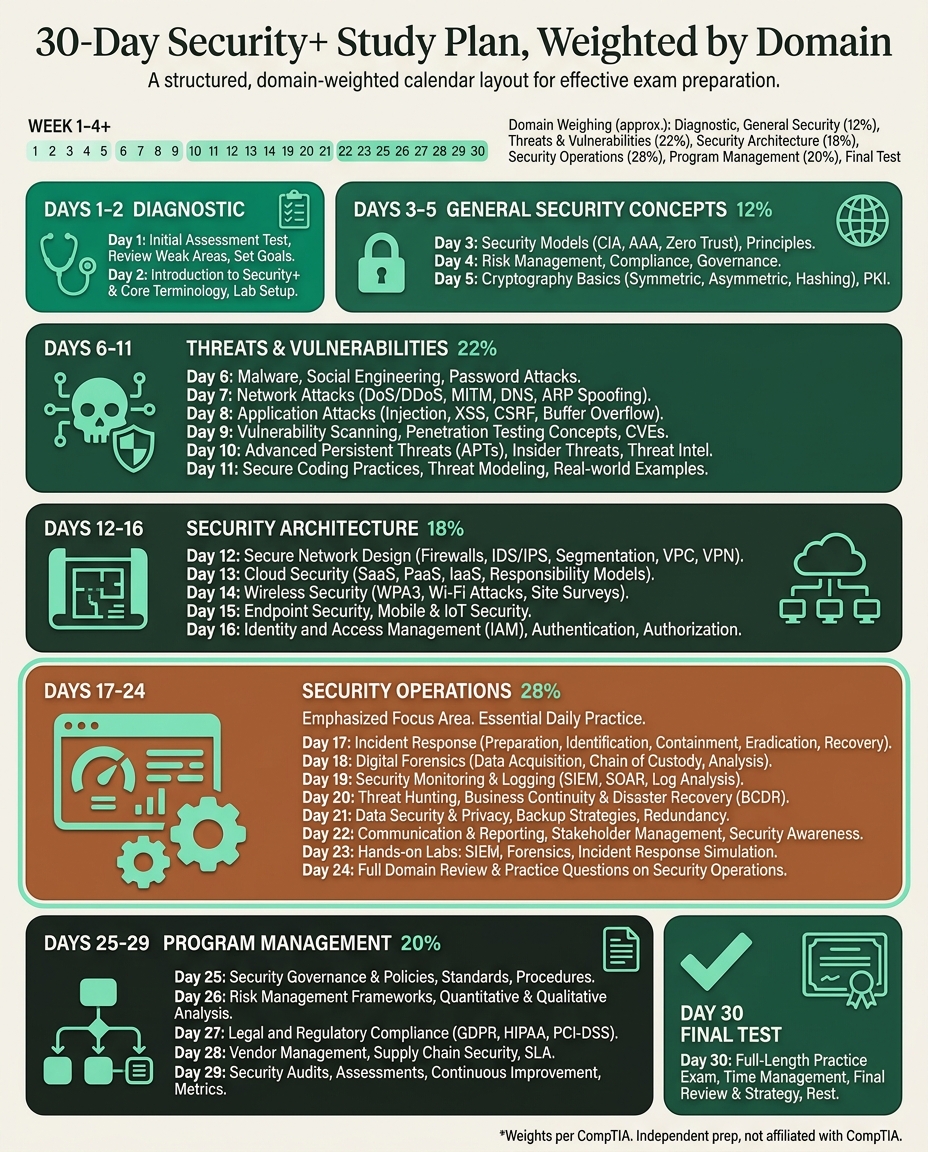
- Days 1 to 2, diagnostic and setup. Take a full-length diagnostic cold and tag every miss by domain. Download the SY0-701 objectives from CompTIA. Pick two core resources, one video series and one question bank. Two, not eight.
- Days 3 to 5, General Security Concepts (12%). Control types, the CIA triad, authentication and authorization, zero trust, and cryptography basics (encryption, hashing, PKI, certificates). Keep it tight and move on.
- Days 6 to 11, Threats, Vulnerabilities, and Mitigations (22%). Threat actors, attack vectors, application and cloud vulnerabilities, indicators of compromise, and the matching mitigations. Drill practice questions after each concept.
- Days 12 to 16, Security Architecture (18%). Cloud, on-premises, hybrid, IoT and ICS/SCADA models, data protection (classification, encryption at rest and in transit, DLP), and resilience (backups, high availability). Draw the diagrams yourself.
- Days 17 to 24, Security Operations (28%). Hardening, vulnerability management, SIEM and log analysis, IAM in practice, automation, incident response, and forensics basics. This is where most PBQs come from, so spend part of each day on scenario tasks, not just reading. Sit a second full-length test around day 20 and re-tag.
- Days 25 to 29, Security Program Management and Oversight (20%). Governance, risk management and the risk register, third-party risk, compliance, and audits. Technical people lose easy marks here because it is about policy and business judgment.
- Day 30, final full-length test. Real conditions, PBQs and all. If you are at 85 percent or above and it is repeatable, you are ready. Re-read the rationales for anything shaky, then stop. Sleep does more for a scenario exam than one more hour of notes.
Pick your timeline by your starting point
| Your starting point | Realistic timeline |
|---|---|
| Hold Network+, some security exposure | 2 to 4 weeks |
| General IT background, new to security | 4 to 6 weeks |
| Career changer, little IT background | 8 to 12 weeks |
Career changers can follow the same weighted structure. Stretch each domain block and add more practice-test cycles.
Short on time: 7-day and 3-day versions
If you have one week and the background already, run it like this:
| Day | Focus | Practice action |
|---|---|---|
| 1 | Baseline | One full-length timed test, tag every miss |
| 2 to 3 | Two heaviest domains | Drill Security Operations and Threats, Vulnerabilities, and Mitigations |
| 4 | PBQs | Work scenario tasks specifically |
| 5 | Architecture and Program Management | Drill domains 3.0 and 5.0 |
| 6 | Second full-length test | Fresh questions, re-tag, confirm gaps closed |
| 7 | Light review | Re-read rationales for anything still shaky, then rest |
With only three days, compress days 2 to 5 into one heavy day on the two biggest domains plus PBQs, and keep both full-length tests. Whatever you cut, cut review days first. The full-length sittings are the part you never cut. For the last 24 hours, the test day checklist covers the night before and the room itself.
FAQ
How many questions are on a Security+ practice test?
A realistic full-length practice test matches the real exam: up to 90 questions in 90 minutes, mixing multiple-choice with PBQ-style scenarios. Short 10-to-20 question quizzes can place you, but they do not build the pacing the real exam needs.
Are free Security+ practice tests good enough to pass?
They are a good way to find your level, and some people with a strong networking background pass using free questions plus a course. Most career switchers find free sets run short on depth, PBQ practice, and rationales, and add a full-length bank before test day.
What score should I get on practice tests before booking?
A repeatable 85 percent or higher on full-length, timed tests you have not seen before. The real exam's 750 is a scaled score, so that margin protects you against harder items and a bad day.
How many practice questions do I need for Security+?
Enough that you stop seeing repeats before test day and can test each weak objective from several angles. A few dozen questions confirm your level. A few hundred original questions with rationales is a realistic amount to close gaps.
Is a practice test the same as an exam dump?
No. A legitimate practice test uses original questions written to the published objectives, with rationales that teach. A dump claims to reproduce live exam items, which breaks CompTIA's candidate agreement and can get your certification revoked.
How long does it take to study for Security+?
Two to four weeks if you hold Network+ and have some security exposure, four to six weeks with general IT experience, and eight to twelve weeks for a career changer. Take a full-length diagnostic first and plan from your real score.
How many hours a day should I study for Security+?
About an hour on weekdays and a bit more on weekends is enough for the 30-day plan, roughly 35 to 45 hours in total. Consistency beats marathon sessions for scenario-based material.
How do I practice performance-based questions?
Practice the tasks, not answer keys: firewall rule sets, log excerpts, ordering incident-response or recovery steps, and matching controls to scenarios. Work them in the Security Operations block of your plan, where most PBQs come from.
Related on PrepClubs
- Security+ SY0-701 exam guide: questions, format, passing score, cost, difficulty and PBQs in one place.
- Security+ renewal and CEUs: what happens after you pass.
- CompTIA Network+ practice test: the cert CompTIA recommends before Security+.
- CompTIA certifications list: where Security+ sits in the CompTIA path.
- CISSP practice test: the management-level cert many Security+ holders target next.
Drill Security+ the way that gets you certified
A practice test that only gives you a number is a wasted afternoon. What gets you to 750 is a full-length bank you use as a diagnostic, with a rationale on every option so each miss becomes something learned. PrepClubs' Security+ track is built that way: a 25-question timed diagnostic to find your weak domains, then 10 full-length practice tests (900 original SY0-701 questions), including 98 PBQ-style scenario items, each question tagged to its domain. It is backed by our Money-back Guarantee, and current plans are on the pricing page.
Practice at prepclubs.com/tests/security-plus.
Practise for this exam
CompTIA Security+ (SY0-701) practice tests
Full-length timed forms across every exam domain at the official weighting, with a clear rationale for every answer. Start with the 25-question diagnostic to see which domains need the most work.