CISSP Practice Test, Question Strategy and Study Plan
What a CISSP practice test can and cannot tell you, how to read BEST and FIRST questions, four real practice questions worked through, and a domain-weighted study plan for working professionals.

The best CISSP practice test is not the one with the most questions. It is the one that teaches you to pick the best answer among several correct ones, because that is what the exam scores. The CISSP is an adaptive exam of 100 to 150 items in up to 3 hours, passing at 700 out of 1000, per ISC2. Practice that trains manager-level reasoning, with a rationale on every question, beats a bigger dump.
This guide is the practical side of CISSP prep: what a practice test can and cannot tell you, how to read BEST and FIRST questions, four real practice questions worked through, and a domain-weighted study plan for working professionals.
Last updated: September 2026.
Quick takeaways
- The CISSP is a computer adaptive test (CAT): 100 to 150 items, up to 3 hours, 700 out of 1000 to pass, per ISC2. You cannot go back to a question once you answer it.
- Many CISSP questions have two or more defensible answers. The qualifier word (BEST, FIRST, MOST, GREATEST) tells you which one the exam wants.
- Think like a risk manager, not an engineer: assess, contain or escalate before you fix, and leave business decisions with the accountable owner.
- A giant question dump trains recognition. Rationales train the reasoning the exam measures.
- A short practice set is a good diagnostic but a poor predictor. It is not adaptive and usually easier than the real exam.
- Weight your study hours to the eight domains, starting with Security and Risk Management at 16 percent.
What a CISSP practice test can and cannot tell you
Take a diagnostic before you study anything. A 25-question set spread across the eight domains answers three useful questions:
- Are you thinking like a manager or a technician? If your instinct keeps reaching for the hands-on fix, a short set exposes it fast.
- Which domains are weak? Even 25 questions will flag the two or three you should worry about.
- Is the exam close or months away? Scoring near random is honest, early information, worth having before you pay the $749 exam fee.
What a short or fixed practice set cannot do:
- It is not adaptive. The real CISSP gets harder as you succeed. A fixed set of easy-to-medium items can hand you a comfortable score the real exam will not.
- It is usually too small. A 25-question set you have seen twice is a memory test.
- It often skews toward definitions. Good scenario questions are hard to write, so many sets lean on recall. The exam leans on judgment.
A good diagnostic score means you are ready to start studying seriously, not ready to sit.
| Feature | Typical short practice set | Depth-focused bank |
|---|---|---|
| Question count | About 10 to 25, often reused | Hundreds of fresh items |
| Style | Mostly definitions | Scenario, best-answer judgment |
| Domain coverage | Uneven | All eight, weighted to the outline |
| Rationales | Rare or one line | Full, including why each wrong option is wrong |
| Best use | Starting diagnostic | Actual exam preparation |

Why a bigger question bank is the wrong thing to shop on
CISSP practice banks compete on one number: 4,000, 5,000 or more questions. On most exams more practice is simply better. The CISSP is different for two reasons.
It is adaptive. No two candidates see the same set, and the engine is measuring how you reason under pressure, not whether you have seen an item before. Memorizing a large pool does not transfer when the wording changes.
It is judgment-based. Several answers are often defensible. If your practice was pure recognition ("I have seen this one, it is C"), you are stuck the moment two options both look right.
So read "5,000 questions" as a large recognition drill: useful for coverage, weak for judgment. What moves your score is the rationale on the question you just got wrong, explaining why the managerial answer outranked the technical one.
When you compare banks, judge them on this:
- A written rationale on every item, covering why each wrong option is wrong.
- Scenario and management framing, not definition recall.
- Full-length timed sets, so you practice pacing and committing without going back.
- Per-domain feedback, so you know which of the eight domains is dragging you down.
- Original questions only. Any bank advertising "real exam questions" is selling brain dumps, which violate ISC2 policy and can cost you your certification.
- Access that fits your exam date. Check how long access lasts and whether it auto-renews, so it matches a one-off exam.
How to read a CISSP question
Step 1: find the qualifier word
Almost every hard CISSP question hinges on one word. Find it before you read the options.
| Qualifier | What it is really asking |
|---|---|
| BEST | Which option most completely and correctly solves the scenario |
| FIRST | Which step comes before all others in the correct sequence |
| MOST effective | Which option produces the greatest risk reduction |
| GREATEST | Which risk, threat or impact is largest and most urgent |
| PRIMARY | Which purpose or driver matters most |
The qualifier changes the answer. The best long-term control can be the wrong answer to a FIRST question, because something has to happen before you deploy it.

Step 2: answer as the manager who owns the risk
A security manager follows process and policy before improvising, weighs business impact rather than technical elegance, makes sure the right owner decides, and prefers preventive and governance controls when the question allows. When one option says "immediately reconfigure the system" and another says "assess the impact and follow the plan," the second is usually right unless the qualifier asks for a specific technical control.
Step 3: eliminate the technically-right-but-wrong answer
When two options survive, cut the one that:
- skips a step (in a FIRST question, anything that assumes an earlier step already happened),
- solves the wrong problem (a great control for a different risk),
- is the technician's reflex (the hands-on fix when a process answer exists), or
- overreaches or underreaches (too drastic or too weak for the stated risk).
Four real practice questions, worked
These come verbatim from PrepClubs' CISSP bank. The first two are a deliberate pair: the same lifecycle, two different stages, two different right answers.
From PrepClubs CISSP Practice Test 1, question 105 (Security Operations):
Using a common incident response lifecycle of detection, response, mitigation, reporting, recovery, remediation, and lessons learned, an analyst has just confirmed that a server is actively compromised and malware is spreading to other hosts. What is the BEST immediate action at this stage?
A. Rebuild the server now from a known-good image B. Review firewall logs to trace the initial entry point C. Isolate the affected server to contain the spread D. Notify management and regulators of the compromise
Answer: C. The compromise is confirmed and spreading, so containment comes first. Rebuilding (A) is recovery and destroys evidence. Tracing the entry point (B) is worth doing, but more hosts fall while you do it. Reporting (D) is a later stage and does nothing to stop the spread.
From PrepClubs CISSP Practice Test 1, question 106 (Security Operations):
Using the same incident response lifecycle, an analyst receives a single alert that a workstation may have contacted a suspicious domain once, with no sign of active harm or spread. Following an evidence-preserving process, what is the BEST first action at this early stage?
A. Isolate every workstation on the subnet as a precaution B. Document the alert and analyze whether an incident exists C. Reimage the workstation from a known-clean baseline image D. Notify regulators that a reportable breach has occurred
Answer: B. Here there is only a suspicion, so the first job is to record the alert and decide whether an incident exists at all. Isolating a whole subnet (A) is out of proportion to one unconfirmed alert. Reimaging (C) destroys the evidence the analysis needs. Reporting a breach (D) is premature and may be wrong. Put the two questions side by side and you have the lesson: the right action depends on which stage you are in, and the qualifier plus the facts in the stem tell you the stage.
From PrepClubs CISSP Practice Test 1, question 109 (Security Operations):
A vendor releases a critical patch for a widely used production application. An administrator wants to deploy it to all production servers immediately to close the vulnerability. What is the BEST approach in a mature operations environment?
A. Deploy to all production servers now and test afterward B. Block the vulnerability at the firewall and skip patching C. Test in non-production, then deploy via an expedited change D. Defer the patch to the next annual maintenance window instead
Answer: C. Test first, then move the patch through change control, expedited because it is critical. Deploying untested (A) can break every server at once. A firewall block (B) can buy time, but skipping the patch accepts a risk nobody decided to accept. Waiting a year (D) leaves the flaw open for months.
From PrepClubs CISSP Practice Test 4, question 97 (Security Operations):
A security operations center receives many alerts at once during a busy morning. Before responders start working them, what should the team do FIRST to allocate effort sensibly?
A. Contain the hosts named in the highest-severity alerts B. Open an incident ticket for every alert in the queue C. Triage the alerts by severity and business impact D. Collect forensic images from the affected endpoints
Answer: C. Triage ranks the queue so scarce responder time goes to what matters. Containment (A) is right once an alert has been triaged and validated, not before. Ticketing everything (B) still leaves the work unprioritized, and imaging (D) is a later evidence step for confirmed incidents.
Notice that none of these turns on an obscure fact. Each turns on sequence and ownership, which is exactly what rationale-backed practice teaches and a bare question dump does not.
A domain-weighted CISSP study plan
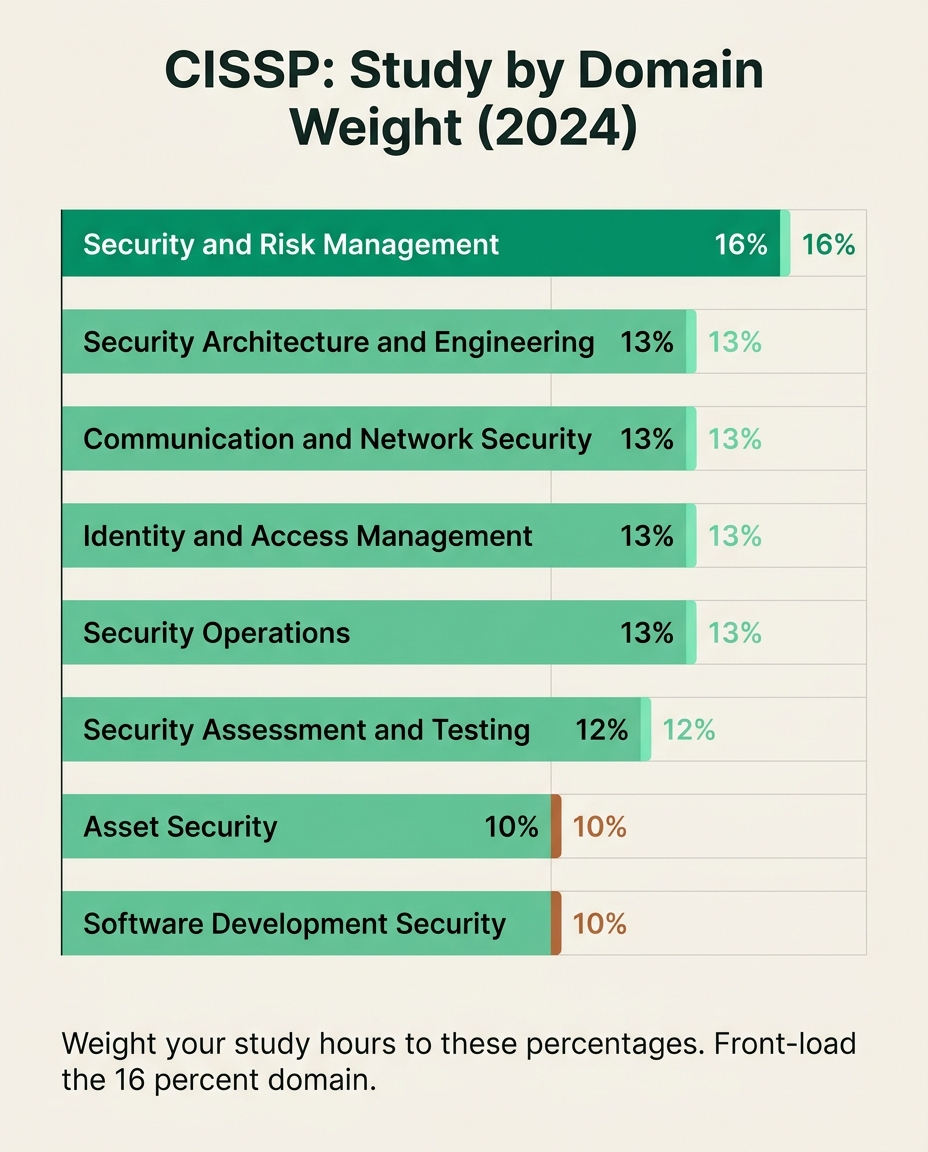
Spreading your hours evenly across eight domains wastes time on light material and under-prepares the heavy ones. Weight them to the current ISC2 outline:
| Domain | Weight | Share of study hours |
|---|---|---|
| Security and Risk Management | 16% | Highest, and first |
| Security Architecture and Engineering | 13% | High |
| Communication and Network Security | 13% | High |
| Identity and Access Management (IAM) | 13% | High |
| Security Operations | 13% | High |
| Security Assessment and Testing | 12% | Medium |
| Asset Security | 10% | Lightest |
| Software Development Security | 10% | Lightest |
With 100 hours to spend, that is roughly 16 on Security and Risk Management and about 10 each on Asset Security and Software Development Security.

The order to study in
- Security and Risk Management first. It is the heaviest domain and the risk-based mindset it builds is what answers questions in every other domain.
- The four 13 percent domains next: Architecture and Engineering, Communication and Network Security, IAM, and Security Operations. They are the bulk of the exam.
- Security Assessment and Testing, which connects to the operations and architecture work you just did.
- Asset Security and Software Development Security last, once your foundation is set.
A realistic weekly rhythm
If you work full time, a sustainable plan is 8 to 12 study hours a week over a few months rather than a cram. How many weeks you need depends on how much of the outline overlaps with your day job.
- Two focused weekday sessions of about an hour on the current domain.
- One longer weekend session: reading plus a mixed-domain practice set.
- A rolling review block that revisits earlier domains so they do not fade.
Consistency over months beats a short cram.
How to use practice inside the plan
- Diagnose across all eight domains before you start, and again at the halfway point.
- Read every rationale, especially on questions you got right. Right for the wrong reason is a miss waiting to happen.
- Train the qualifier words. Ask "best from whose point of view?" The answer is almost always the organization's.
- Re-test on fresh questions, because the exam rewords endlessly.
- Finish with full-length timed sets of 125 questions in 3 hours, committing to each answer with no going back. Aim for a comfortable margin, not a specific percentage, since the real score is scaled.
Before you book, confirm you meet the five-year experience rule or are happy to start as an Associate of ISC2. The full format, cost and eligibility picture is in our CISSP exam guide.
FAQ
How many practice questions do I need to pass the CISSP?
There is no fixed number, because the exam is adaptive. A few hundred original, rationale-backed questions across all eight domains, worked until your weak domains are solid, plus several full-length timed sets, is a realistic target.
Are free or short CISSP practice tests worth taking?
Yes, as a diagnostic. ISC2 and many prep sites offer short quizzes that show where you stand. They rarely carry full rationales or enough fresh scenario questions to close a reasoning gap, so treat the score as a starting point.
Do practice test scores predict my real CISSP score?
Not reliably. A fixed set is not adaptive and is often easier than the live exam. Use practice scores to find weak domains and track progress, not as a pass prediction.
Why do CISSP questions have two correct answers?
By design. ISC2 writes several legitimate security actions into the options so the exam can test judgment. The qualifier word (BEST, FIRST, MOST) tells you which one is intended.
How do I answer CISSP "first" questions?
Work out the correct sequence and pick the step that comes before all others. In incident scenarios that usually means analyze or contain before eradicating and recovering. Cut any option that assumes an earlier step already happened.
How long should I study for the CISSP?
Many working professionals plan 8 to 12 hours a week over a few months. Domains that overlap with your job need fewer hours than unfamiliar ones.
Should I use CISSP exam dumps?
No. Dumps claim to reproduce live exam items, which violates ISC2 policy and can void your certification. They also train recognition rather than the reasoning the exam scores.
Related on PrepClubs
- CISSP exam: CAT format, domains, questions, cost and difficulty: the full format, fee and eligibility guide.
- CISSP vs CISA vs Security+: which certification fits your career stage.
- Security+ practice test: the entry-level certification many CISSP candidates hold first.
- Adaptive vs static tests: how adaptive formats change pacing and guessing.
Practice the reasoning the CISSP actually scores
The CISSP rewards the candidate who can read a scenario, spot the qualifier and choose the answer a security manager would give. PrepClubs' CISSP track is built around that skill: a 25-question diagnostic, then 10 full-length practice tests of 125 original scenario questions each in a 3-hour timed format, weighted to the eight domains, with a written rationale on every answer that explains why the best option beats the plausible ones. It is backed by our Money-back Guarantee, and more than 3,700 students have prepared with PrepClubs. Practice at prepclubs.com/tests/cissp.
Practise for this exam
CISSP (Certified Information Systems Security Professional) practice tests
Full-length timed forms across every exam domain at the official weighting, with a clear rationale for every answer. Start with the 25-question diagnostic to see which domains need the most work.