The 8 Types of Pre-Employment Tests Employers Use (and Which One You Are About to Take)
The 8 types of pre-employment tests employers actually use, how to tell which one you were invited to from the time limit, and which ones you can practice for.

Employers use eight practical types of pre-employment test: general cognitive ability, critical thinking, multi-section reasoning batteries, numerical and data interpretation, mechanical aptitude, trade apprenticeship aptitude, speed-and-accuracy mental agility, and job knowledge or certification exams. Most published lists of pre-employment assessment tests group them by what the employer wants to measure, which is useless when you have an assessment invite open in another tab and 48 hours to prepare. This list is built for the candidate side instead. Each type below names the real branded tests that sit inside it, the time limit that gives it away, and whether practice moves your score or not.
Quick takeaways
- The name in your invite email plus the time limit identifies your test faster than anything else. A 12-minute, 50-question test is almost certainly the Wonderlic or PI Cognitive; 15 minutes and 50 questions is the CCAT.
- Eight of the twelve test types you will meet are genuinely practiceable. Four of them are not, and buying practice for those is wasted money.
- Cognitive ability tests are the single most common paid screen in US corporate hiring, and they are the type where practice moves a score most reliably, because most of the loss is pacing rather than knowledge.
- Trade and apprenticeship tests (IBEW, elevator industry) run far longer than corporate screens: 97 minutes of testing for the IBEW, not 12.
- Personality questionnaires, integrity tests, emotional intelligence games, and physical or drug screening are all real, all common, and all a poor use of your prep time.
- Test publishers publish the format openly. Criteria Corp, Wonderlic, Predictive Index, and Pearson TalentLens all document their own question counts and timings.
How to identify your test in 30 seconds
Open the invite email and look for two things: the product name and the time limit. Vendors rarely hide either. If the email only says "assessment," the time limit narrows it fast, because the major types of aptitude tests have distinctive, well-documented lengths.
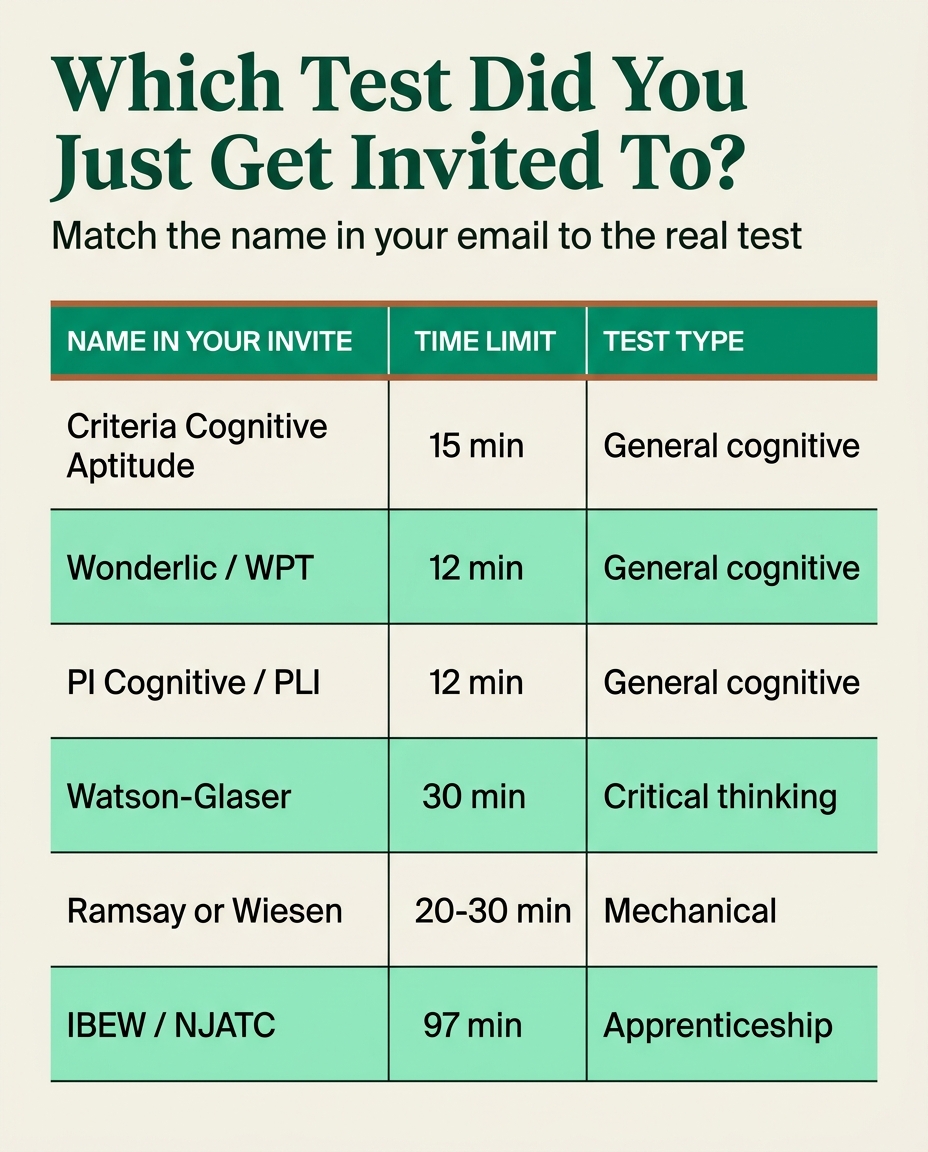
The vendor domain in the assessment link works too. A link to criteriacorp.com means the CCAT or another Criteria instrument. A Predictive Index portal means the PI Cognitive Assessment, the PI Behavioral Assessment, or both.
The fastest tell is the clock. Match the time limit and question count in your invite against the most common branded screens:
| Test | Questions | Time limit | Category |
|---|---|---|---|
| CCAT | 50 | 15 minutes | Cognitive ability |
| Wonderlic (WPT-R) | 50 | 12 minutes | Cognitive ability |
| PI Cognitive | 50 | 12 minutes | Cognitive ability |
| McQuaig Mental Agility | 50 | 15 minutes | Speed and accuracy |
| Ramsay MAT-4 | 36 | 20 minutes | Mechanical |
| Bennett BMCT-II | 55 | 25 minutes | Mechanical |
| Wiesen WTMA | 60 | 30 minutes | Mechanical |
| IBEW (NJATC) | 69 | 97 minutes | Trade apprenticeship |
If your invite names a test that is not here, open the vendor's own candidate page and read the time limit first. That one number places almost any screen into one of the eight types below.
The 8 types, with the real tests inside each
PrepClubs covers every type below with full-length mocks and topical drills, so once you identify your type you can practise the specific test rather than a generic "aptitude" sample.
| # | Type | What it measures | Real tests in this category | Practice |
|---|---|---|---|---|
| 1 | General cognitive ability | Speed plus reasoning under hard time pressure | CCAT, Wonderlic, PI Cognitive | CCAT, Wonderlic, PI Cognitive |
| 2 | Critical thinking | Inference, assumptions, deduction from written argument | Watson-Glaser | Watson-Glaser |
| 3 | Reasoning battery | Verbal, numerical and abstract items in one window | Cubiks Logiks | Cubiks Logiks |
| 4 | Numerical and data interpretation | Quant reasoning from tables and charts | GMAT-style screens | GMAT-style |
| 5 | Mechanical aptitude | Applied physics, tools, machines, force | Ramsay, Wiesen | Ramsay, Wiesen |
| 6 | Trade apprenticeship | Algebra plus reading, long form | IBEW, EIAT | IBEW, EIAT |
| 7 | Speed and accuracy | Switching between item types without lag | McQuaig Mental Agility | McQuaig |
| 8 | Job knowledge and certification | Domain knowledge against a published blueprint | CompTIA A+, Network+, Security+, CISSP, CISA | A+, Network+, Security+ |
1. General cognitive ability tests
The most common paid screen in US corporate hiring, and what most candidates mean by "the aptitude test." All three major products share a design: roughly 50 questions, a very short window, mixed verbal, numerical and logical items, increasing difficulty.
The Criteria Cognitive Aptitude Test runs 50 questions in 15 minutes across verbal, math and logic, and spatial reasoning, per criteriacorp.com. The Wonderlic runs 50 questions in 12 minutes, per wonderlic.com. The PI Cognitive Assessment is also 50 questions in 12 minutes, per predictiveindex.com.
Almost nobody finishes. That is the design, not a failure on your part, and it is why practice pays here more than anywhere else: most of the score you leave behind is pacing and question-recognition, not intelligence.
2. Critical thinking tests
Watson-Glaser is the standard, used heavily in law, consulting, and graduate schemes. It runs 40 questions in about 30 minutes across five sections: inference, recognising assumptions, deduction, interpretation, and evaluating arguments, per its publisher Pearson TalentLens.
It is a precision test rather than a speed test, and it punishes the instinct to answer from real-world knowledge instead of the passage in front of you. Firms like Clifford Chance set percentile cutoffs rather than raw pass marks.
3. Multi-section reasoning batteries
Cubiks Logiks, owned by Talogy, packs verbal (24 questions), numerical (16), and abstract reasoning (10) into a single 12-minute window. A harder Logiks Advanced variant runs 30 questions in 20 minutes for graduate and senior roles.
One detail worth knowing: Logiks is positively marked with no guessing penalty, so a blank answer is strictly worse than a guess. Several competitor guides still repeat an old negative-marking claim that does not apply.
4. Numerical and data interpretation tests
Used in consulting, banking, and finance screens. Typically 30 to 40 questions in 60 to 90 minutes, with data-sufficiency and problem-solving items drawn from tables and charts, sometimes with a verbal critical-reasoning section attached.
This is the one cognitive category where subject knowledge genuinely matters. Ratios, percentages, and rates come up constantly, and a candidate who has not touched that maths in a decade loses marks to rust rather than to time pressure.
5. Mechanical aptitude tests
For maintenance, manufacturing, and technician roles. The Ramsay MAT-4, published by Ramsay Corporation, runs 36 questions in 20 minutes; the Wiesen WTMA runs 60 questions in 30 minutes. Both test applied physics (levers, pulleys, gears, fluids, basic electrical reasoning) as diagrams rather than equations.
Practice works here because the underlying physics is a small, closed set of principles. Once you can recognise which principle a diagram is testing, the answer usually follows in seconds.
6. Trade apprenticeship aptitude tests
A different animal entirely. The IBEW aptitude test used for electrical apprenticeships, administered through the electrical training ALLIANCE, is 69 questions across two timed sections: 33 algebra and functions questions in 46 minutes, then 36 reading comprehension questions in 51 minutes. The Elevator Industry Aptitude Test, whose study material comes from NEIEP, runs three sections (reading, arithmetic, mechanical comprehension) over roughly 60 to 75 minutes with no calculator.
These are long, scored competitively against other applicants for a small number of slots, and the algebra is genuinely learnable. This is where serious preparation gains the most ground.
7. Speed and accuracy tests
The McQuaig Mental Agility Test, from The McQuaig Institute, is the clearest example: 50 questions interleaving roughly 20 verbal, 20 numerical, and 10 logical items with no announced section breaks.
The difficulty is switch cost. Every time the item type changes you lose a beat re-orienting, and across 50 questions that lag is the score. Practising the switching itself, rather than any single question type, is what helps.
8. Job knowledge and certification exams
Where a role requires proven domain knowledge, the "test" is a real certification exam against a published blueprint: CompTIA A+, Network+, and Security+ in IT support and security, then CISSP and CISA further up. Unlike the other seven types above, certification exams test knowledge you have to actually learn, and the vendor publishes the exact objectives you will be examined on. For the IT path, the A+, Network+ and Security+ sequence is the standard entry route.
The 4 types you will also meet, and should not buy practice for
Search results for this topic usually list twelve or so categories and treat them all as equivalent. They are not. These four are common, real, and a poor use of your prep budget.
Personality questionnaires (Hogan, DISC, Big Five, PI Behavioral, SHL OPQ32). There is no right answer to buy your way toward, and most have built-in consistency checks that flag strategic answering. Answer honestly and quickly.
Integrity and risk tests. Same logic, with a sharper edge: these are explicitly built to detect people trying to present a false profile.
Emotional intelligence assessments. Often game-based now. Some ability-based versions have mildly learnable elements, but not enough to justify paid prep.
Physical ability and drug screening. Not cognitive tests at all. Nothing to practise.
Eight practiceable types plus these four is where the "twelve types of employment tests" framing comes from. The distinction that matters is not how many there are, it is which ones respond to preparation.
What actually moves a score in 48 hours
The honest version, because most candidates find out about their test with days rather than weeks to spare.
For the timed cognitive tests (types 1, 3, 4, 7), the fastest gain is pacing. Take one full-length mock under real time pressure, note exactly where you stalled, then drill that question type. A candidate who has never seen a 12-minute 50-question format loses marks to shock alone on their first attempt.
For mechanical and apprenticeship tests (types 5 and 6), the fastest gain is content. The principles are a closed set. Work through them.
For certification exams (type 8), 48 hours is not enough if you are starting cold, and any guide implying otherwise is selling something. Those need weeks against the published objectives.
Whichever type you drew, time yourself on a free, full-length practice test in the real format before you spend anything. One timed run tells you whether your problem is pacing or content, and that is what decides how you spend the hours you have left.
FAQ
What are the 12 different types of employment tests?
The usual twelve-item list combines the eight practiceable types (general cognitive ability, critical thinking, reasoning batteries, numerical and data interpretation, mechanical aptitude, trade apprenticeship, speed and accuracy, and job knowledge or certification) with four you cannot meaningfully prepare for: personality questionnaires, integrity and risk tests, emotional intelligence assessments, and physical or drug screening. Different sources split these slightly differently, which is why the count ranges from five to twelve depending on who is writing.
What are the four main types of tests?
If you compress the list, most pre-employment testing falls into four families: cognitive ability tests (reasoning under time pressure), knowledge and skills tests (what you know or can do), personality and behavioural assessments (how you work), and physical or medical screening. The first two respond to practice; the last two largely do not.
What are some examples of pre-employment tests?
The Criteria Cognitive Aptitude Test, the Wonderlic, the PI Cognitive Assessment, Watson-Glaser, Cubiks Logiks, the Ramsay MAT-4, the Wiesen WTMA, the IBEW apprenticeship aptitude test, the Elevator Industry Aptitude Test, the McQuaig Mental Agility Test, and certification exams such as CompTIA A+ and Security+.
What are the different types of job tests?
Job tests split by what the employer is trying to predict. Aptitude and cognitive tests predict how quickly you will learn the role. Job knowledge and certification exams confirm what you already know. Personality and situational judgement assessments predict how you will behave. Physical tests confirm you can meet the role's physical demands.
How do I know which pre-employment test I have been invited to?
Check the product name and the time limit in your invite email, then match them against the chart above. If neither is stated, the vendor domain in the assessment link usually identifies it: criteriacorp.com for the CCAT, a Predictive Index portal for the PI Cognitive Assessment.
Can you actually practise for a pre-employment test?
For cognitive, mechanical, apprenticeship, and certification tests, yes, and the gains are real because so much of the loss is pacing, format shock, and forgotten content rather than raw ability. For personality, integrity, and emotional intelligence assessments, no, and any product promising to raise those scores is selling you something that does not work.
Do employers tell you your score?
Rarely for cognitive screens. Most treat the result as an internal cutoff and simply advance or reject you. Some apprenticeship programmes publish a ranked list or a band, and certification exams give you a scaled score immediately.
Related on PrepClubs
- What a cognitive aptitude test measures and why companies use it
- CCAT test format, score bands, and prep
- Wonderlic test format and scoring
- Watson-Glaser test format and scoring
- Mechanical reasoning tests: Bennett, Ramsay and Wiesen compared
Practice the test you were actually invited to
Once you know your type, practise that specific test rather than a generic aptitude sample. PrepClubs covers around 21 pre-employment tests, each with full-length mocks that replicate the real timing plus topical drills for the question types you keep losing marks on. Start with the free practice test for your test, and if you decide to go deeper, every cluster is a one-time payment, with the current figures on the pricing page.
If you do not pass your real test, the Pass Guarantee extends your access by 30 days at no cost. Over 3,700 students have used PrepClubs to prepare for exactly these tests.