What Is a Good Wonderlic Score: Bands, Cutoffs by Job, IQ Conversion and How Scoring Works
A good Wonderlic score is one that clears your role's cutoff. The average is about 20 of 50, 27+ clears most professional roles, and 30+ is strong. Bands, job norms and cutoffs, the IQ conversion table, how scoring works

A good Wonderlic score is one that clears the cutoff for the job you applied for. On the classic 0 to 50 scale, the average is about 20, 27 or higher clears most professional cutoffs, and 30 or more is strong for almost any role. Employer targets run from about 17 for security and warehouse jobs to 31 and up for chemists.
Last updated: September 25, 2026.
This guide puts everything about the number in one place: how the test is built and scored, the percentile bands, the averages and cutoffs by job, the Wonderlic to IQ conversion table, what practising candidates actually score today, and four real questions from our newest practice test.
Quick takeaways
- The Wonderlic cognitive test is 50 questions in 12 minutes. Almost nobody finishes, and Wonderlic says you are not expected to.
- On the classic scale your score is the number of correct answers, 0 to 50. The all-candidate average is about 20 to 21.
- A 20 is roughly the 50th percentile, a 26 roughly the 80th, a 29 roughly the 90th, and 40 or more is the top 1 percent.
- There is no universal pass mark. Employers set a minimum per role, from about 17 (security, warehouse) to 30 to 34 (chemist, R&D).
- The popular IQ rule of thumb is IQ = (score x 2) + 60, so 20 is about IQ 100 and 30 is about IQ 120. It is an approximation, not a clinical IQ.
- The fastest route into the next band is reaching more of the paper, not getting cleverer on the questions you already reach.
How the Wonderlic is built and scored
The test you are most likely facing is the cognitive section of Wonderlic Select. Wonderlic describes it as 50 questions in 12 minutes, covering "simple math, basic logic, language comprehension, spatial reasoning, pattern identification, and more", with questions that get harder as the test goes on. No calculator is allowed. The format is the same 50-in-12 structure the Wonderlic Personnel Test (WPT-R) has used for decades, and a shorter 30-question, 8-minute version (WPT-Q) also exists.
Wonderlic Select adds two untimed sections: 58 motivation questions and 150 personality questions. Most people finish the whole package in about 35 minutes, according to Wonderlic's candidate FAQ. Only the cognitive section is timed.

Two ways the score is produced
The classic 0 to 50 score. On the WPT and WPT-R, your score is simply the count of correct answers. There is no curve applied to your individual result. Every published norm, every employer cutoff table and every NFL number you have ever seen is on this scale, which is why this guide uses it.
The current Wonderlic Select score. Wonderlic now says its algorithm uses "a candidate's overall response pattern, additionally weighting each question based on its level of difficulty and the impact of guessing", and compares you against the demands of the specific job. Its FAQ states there is no universal "good" or "average" score and no pass or fail grade for Select. In practice, employers still set a minimum for each role, and the 0 to 50 bands below remain the clearest way to judge where you stand.
One rule holds on both versions: a blank earns nothing. If you cannot solve an item, narrow the options and pick one rather than leaving it empty.
The pacing math
12 minutes over 50 questions is 14.4 seconds per item. Strong candidates spend 6 to 8 seconds on the easy early items to bank time for the harder ones at the back. Use these flat-pace checkpoints to catch a collapse early.
| At this minute | Be at least at question |
|---|---|
| 2 | 8 |
| 4 | 17 |
| 6 | 25 |
| 8 | 33 |
| 10 | 42 |
| 12 | 50 |
Where people stop matters as much as how accurate they are. A candidate who reaches only 25 questions usually scores in the low to high teens. Reaching 36 to 42 is where scores in the mid 20s to 30 come from. There is no path to a top-quartile score that involves answering 30 questions perfectly.
The average Wonderlic score and the percentile bands
The all-candidate average on the classic scale is about 20 to 21. That figure describes the applicant pool that sat the test, and it has been quoted for years. Scoring 20 means you performed at the midpoint.
| Raw score (0 to 50) | Approx. percentile | Approx. IQ equivalent | Roles this typically clears |
|---|---|---|---|
| 10 or below | Bottom 10% | 80 or below | Below the minimum for nearly all roles |
| 11 to 19 | 10th to 45th | 82 to 98 | Some entry-level and warehouse roles |
| 20 to 21 | About 50th | 100 to 102 | Clerical, retail, customer service |
| 22 to 26 | 55th to 80th | 104 to 112 | Sales, nursing, administrative |
| 27 to 32 | 80th to 93rd | 114 to 124 | Accounting, engineering, management |
| 33 to 40 | 94th to 99th | 126 to 140 | Chemist, R&D, systems analyst |
| 41 to 50 | Top 1% | 142 to 160 | Exceptional at any employer |
The band matters less than the gap between your score and the role's cutoff. A 27 is strong on paper, but for an R&D chemist role where the norm is 31 it is below target.

The NFL scores that dominate search results sit on this same scale. The league used the test for decades and dropped it before the 2022 Combine. Our ranked list of every reported NFL Wonderlic score covers the highs, the lows and which famous numbers are wrong. For your own application, the job tables below are what count.
Wonderlic scores by job: averages and employer cutoffs
Two different numbers get mixed up here. An occupational norm is descriptive: the average score of people who work in that job. A cutoff is prescriptive: the minimum an employer accepts for a specific opening. Cutoffs usually sit around or a little below the norm, and they move with the size of the applicant pool.
The norms below are the widely cited figures from Wonderlic's older occupational tables, not a current Wonderlic publication. Where sources disagree slightly, the range is shown.
| Role or job family | Commonly cited average | Typical cutoff target |
|---|---|---|
| Chemist, R&D scientist | 31 | 30 to 34 |
| Programmer, software engineer | 29 | 28 to 32 |
| Systems analyst, engineer | 29 or higher | 29 to 33 |
| Accountant, financial analyst | 28 to 29 | 27 to 30 |
| Manager, executive trainee | 28 to 29 | 26 to 30 |
| Registered nurse | 23 | 22 to 25 |
| Sales representative | 24 to 25 | 22 to 26 |
| Clerical, administrative, bank teller | 21 to 22 | 21 to 24 |
| Customer service, retail, cashier | 21 | 20 to 23 |
| Security guard | 17 | 17 to 21 |
| Warehouse, general labor | 15 | 10 to 15 |
Other figures you will see reported include 26 for electronics technicians and up to 35 for systems analysts. The pattern holds everywhere: the more a job depends on learning fast and solving problems under time pressure, the higher the number. The gap between a security cutoff and a chemist cutoff is roughly 14 points on a 50-point scale.

How to guess the cutoff for your role
Recruiters rarely share the number, but three signals help. If the Wonderlic comes after a phone screen and an interview, the cutoff is usually role-specific and high, because companies do not spend interview time and then filter on a low bar. If it is the very first step before any human contact, it is a mass filter and the bar is set to thin a large pool, so aim for the top of your band. If the job ad stresses complex analytical work, assume the upper end.
Why the same score passes one job and fails another
A 21 is not "a 21" in a vacuum. Apply for a software engineering role and a 21 is well under the programmer norm of 29, so the screen reads it as a fail. Apply for a retail management role with the same 21 and you are at or above the norm, in the upper half of that pool. Same candidate, same number, opposite outcomes.
Worked example: is a 24 good? Run three checks.
- Against the population: 24 is above the average of about 20. Above average, full stop.
- Against the job: for a bank teller (norm about 22) or a nurse (norm 23), a 24 is at or above the typical hire. For a programmer (norm 29), it is several points short.
- In percentile terms: 24 sits around the 70th percentile, the upper middle of all test-takers.
So a 24 is good for a nursing or teller role and a signal to prepare more for an engineering one. It also explains why a retake for a different application can produce a "better" result with no change in ability: you were measured against an easier benchmark.
What counts as a failing Wonderlic score
No score is a universal fail. A failing score is any score below the minimum the employer set for that role. Three practical patterns are still worth knowing.
- 10 or below falls under the minimum for nearly every role in the norm tables. The usual cause is pacing or test-day conditions, and practice moves it.
- 11 to 19 clears some low-complexity roles but falls short of most professional cutoffs. It is not a fail for a warehouse job; it is a fail for an analyst track.
- Below 27 for competitive professional roles starts to look thin, and below 23 is usually under the line. For finance, technology, consulting or law-adjacent roles, treat 27 as the floor and 30 as the target.
The Wonderlic to IQ conversion table
The rule of thumb most prep resources use is IQ = (Wonderlic score x 2) + 60. It works because both scales are built on a bell curve, with a Wonderlic 20 lining up with the IQ mean of 100. It is a convenient approximation, not an official Wonderlic conversion. Wonderlic once printed an IQ equivalent on its own reports and now treats the two as different things.
The underlying link between the tests is strong. Dodrill (1981), testing 120 adults, found correlations of .93 and .91 between Wonderlic scores and Wechsler (WAIS) Full Scale IQ, and later studies in clinical samples found correlations in a similar range. That is why the Wonderlic is often called a short-form IQ test, even though it is a 12-minute speeded screen and not a full clinical assessment.
| Wonderlic raw score | IQ equivalent (x 2 + 60) | Approx. percentile | What it typically signals |
|---|---|---|---|
| 5 | 70 | 2nd | Below the test's useful floor |
| 10 | 80 | 9th | Below most employer minimums |
| 14 | 88 | 21st | Common for some entry-level retail |
| 16 | 92 | 30th | Lower average |
| 18 | 96 | 39th | Just below the mean |
| 20 | 100 | 50th | The population average |
| 22 | 104 | 61st | Slightly above average |
| 24 | 108 | 70th | Clears clerical and many sales cutoffs |
| 26 | 112 | 79th | Common entry-level white-collar target |
| 28 | 116 | 86th | Accountant and manager territory |
| 30 | 120 | 91st | Programmer and consulting target |
| 32 | 124 | 95th | Strong for finance and technology |
| 34 | 128 | 97th | Strong for any demanding role |
| 36 | 132 | 98th | Rare in a large applicant pool |
| 40 | 140 | 99.6th | Top 1 percent |
| 45 | 150 | 99.9th+ | The practical ceiling |
| 50 | 160 | Beyond 99.9th | A perfect score, almost never seen |
Each 2 raw points you add is worth 4 IQ-equivalent points. The percentile column follows from the same bell curve the formula assumes, so read it as approximate.
Where the formula breaks down
- The floor. Below about 7, the test stops separating people cleanly, so an IQ of 70 from a score of 5 is suggestive, not measured.
- The ceiling. At 45 and above you are answering 90 percent of items under time pressure, and real norms compress the top, so a straight line overstates the very highest scores.
- What is sampled. The Wonderlic leans on processing speed and verbal and numerical reasoning, and under-samples spatial reasoning compared with a Wechsler. Two people with the same Wonderlic can have quite different full IQ profiles.
Employers almost never convert your score to an IQ. They compare the raw number, or its percentile, with the role's cutoff. Keep the IQ figure for your own calibration, and never put a Wonderlic-derived IQ on a resume. If you have a strong result, quote the raw score or percentile instead.
What practising candidates actually score today
The published norms describe applicant pools from decades of hiring. Our PrepClubs Research series adds a current, first-party view by re-grading every scored attempt on our own Wonderlic-format practice forms (What candidates actually score on aptitude practice tests).
| Practice percentile | Raw % correct | Out of 50 |
|---|---|---|
| 10th | 30% | 15 |
| 25th | 42% | 21 |
| Median | 52% | 26 |
| 75th | 66% | 33 |
| 90th | 74% | 37 |
This is based on 53 analysed practice attempts on PrepClubs forms written to the published 50-question, 12-minute format. These are not official Wonderlic scores, and people who practise are a self-selected group, so read the table as where practising candidates sit against each other. Plugging the median of 26 into the IQ formula gives 112, which says more about a motivated, prepared group than about anyone's clinical IQ.
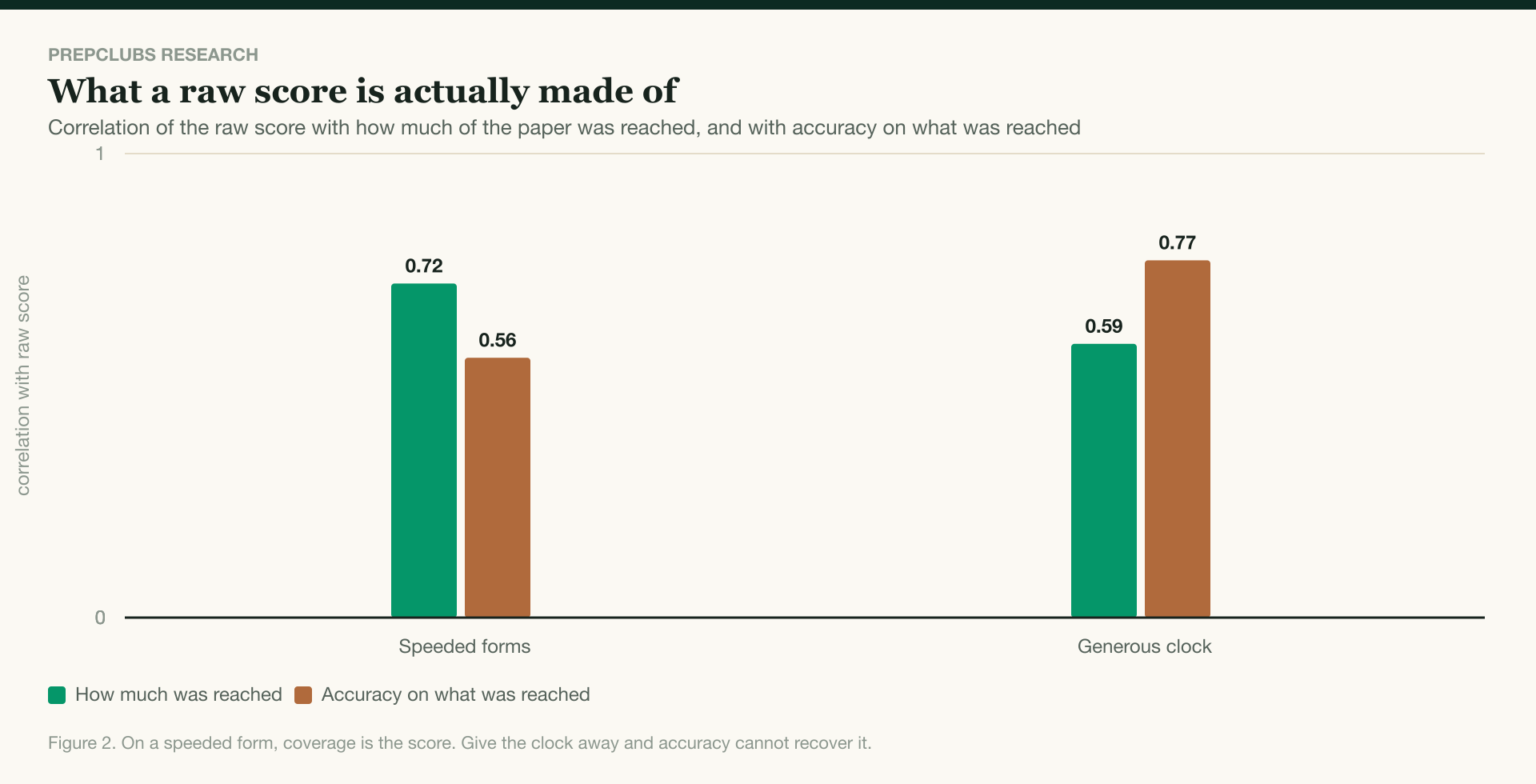
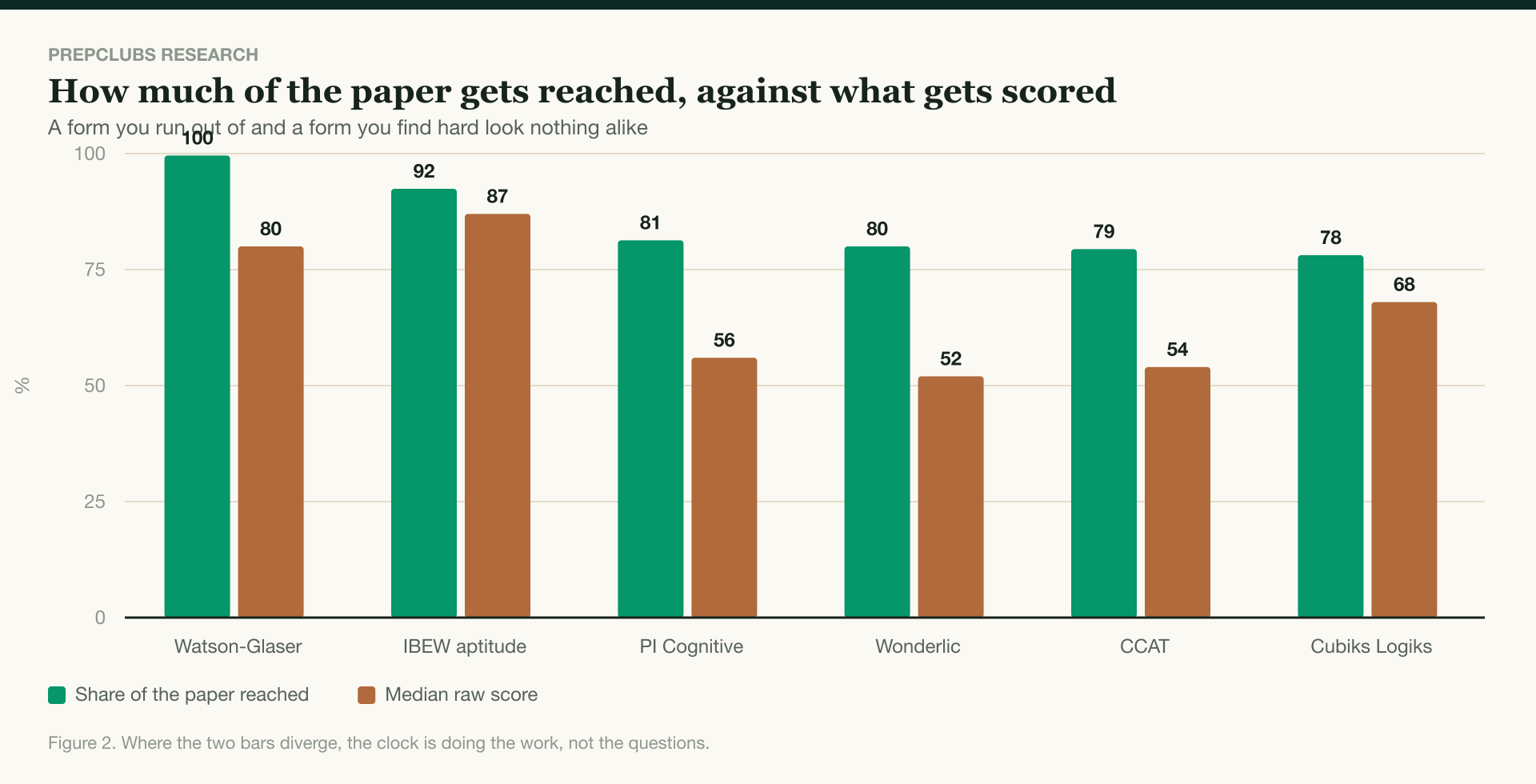
The more useful finding is what the score is made of. On speeded forms like this one, the raw score tracks how much of the paper you reached (correlation 0.72) more closely than your accuracy on the items you answered (0.56). On forms with a generous clock the order flips. Our Wonderlic-format candidates reached 80% of the paper on average, left 20% blank, and left 56% of the final fifth unanswered (How much of a timed aptitude test is never answered).
Difficulty also climbs steeply. On answered items, accuracy fell from 82.5% in the opening fifth of our Wonderlic-format papers to 39.7% in the closing fifth, the steepest ramp of any form we measured (Which aptitude tests are built as a difficulty ramp). Put the two together and a large part of a Wonderlic score, and of any IQ figure derived from it, is pacing: how many of the late, hard items you reach with time to think.
Four real questions from Wonderlic Practice Test 8
These are real items from PrepClubs Wonderlic Practice Test 8, the newest form in our bank. They come from across the paper, so you can feel the difficulty step up. Give yourself about 14 seconds each.
Question 9 of 50. A number is tripled and then 4 is added. The result is 25. What is the original number?
A) 6 B) 7 C) 5 D) 9 E) 8
Answer: B) 7. Work backwards and undo the last step first. 25 minus 4 is 21, and 21 divided by 3 is 7. Check: 7 times 3 is 21, plus 4 is 25.
Question 26 of 50. A tank has an inlet pipe that fills at 8 litres a minute and an outlet that empties at 3 litres a minute. With both open, how long does it take to fill 100 litres from empty?
A) 25 min B) 15 min C) 18 min D) 22 min E) 20 min
Answer: E) 20 min. The tank really gains 8 minus 3, which is 5 litres a minute, and 100 divided by 5 is 20. The common slip is to ignore the outlet and divide 100 by 8, which gives 12.5 minutes and matches nothing on the list.
Question 36 of 50. The average of 5 numbers is 18. If one is removed, the average of the rest becomes 16. What was the removed number?
A) 24 B) 28 C) 22 D) 30 E) 26
Answer: E) 26. Turn averages into totals. Five numbers averaging 18 sum to 90. Four numbers averaging 16 sum to 64. The removed number is 90 minus 64, which is 26.
Question 46 of 50. A shop cuts the price of a $200 coat by 10%, then takes a further 20% off the new price. What does the coat cost now?
A) $180 B) $140 C) $162 D) $160 E) $144
Answer: E) $144. Take the cuts one at a time. 10% off $200 leaves $180, and 20% of $180 is $36, so the coat costs $144. $140 is the trap: it adds the two discounts into a single 30%.
Reaching question 46 with time left to solve it already puts you ahead of most practising candidates. For more worked items by question type, see our Wonderlic practice test walkthroughs, and for the publisher's own examples, Wonderlic's official sample questions.
How to read your score report and move up a band
If the employer shares your result, you will usually see the raw score, a percentile against a general population, and sometimes a comparison with the job-family norm. The job-family comparison is the one that drove the decision. What the report does not show is the employer's internal cutoff, so a 24 that did not advance means 24 was below that role's line, not that 24 is a bad score. Our guide to reading a score report walks through each field.
The Wonderlic rewards process as much as raw ability, so the fastest gains come from how you take the test.
- Use a skip rule. If you cannot see the path to an answer in about 12 seconds, pick your best option and move on. One stuck question costs you three or four easy ones at the end.
- Bank the easy points. Spend 6 to 8 seconds on the early items and hold to the checkpoints in the pacing table.
- Loop back. Speed through the back half, mark anything not obvious, reach question 50, then return to the marked items with whatever time is left.
- Drill the recurring types. Percentages, ratios, averages, number series, analogies and word problems come back on every form, and recognising the type saves seconds on each one.
- Practise under the real clock. Untimed practice teaches you to solve the problems. Only timed practice teaches you which ones to skip.
A focused week of timed practice typically moves a candidate 4 to 8 raw points, often a full band. The 7-day Wonderlic prep plan lays out each day, and how to pass the Wonderlic covers test-day tactics. Retake rules vary by employer; many ask you to wait 6 to 12 months, so prepare for the first sitting rather than counting on a second. If the invitation came from a college or allied-health program rather than an employer, you are probably sitting the Wonderlic SLE, which has its own program cutoffs.
FAQ
What is the average Wonderlic score?
About 20 to 21 out of 50 on the classic scale. A 20 is the midpoint of the applicant pool and corresponds to an IQ of about 100 on the common rule of thumb. Wonderlic's current Select product says there is no universal average, because it scores against the demands of each job.
What is a good Wonderlic score?
It depends on the role. For retail or customer service, 20 to 23 is good. For professional roles in finance, technology or consulting, aim for 30 or above. As a general rule, anything above 21 is above average and 27 or more clears most competitive cutoffs.
What Wonderlic score do I need for a software engineering job?
The programmer norm is 29, and many technology screens gate at around 30. A defensible target is 30 to 32. A score in the low 20s is above the population average but usually below the line for a developer role.
Is a Wonderlic score of 21 good?
A 21 is just above average, so it is competitive for many customer-facing and clerical roles. For analytical or technical roles it is below the typical cutoff. The same 21 can pass a retail management screen and fail a software engineering screen at the same company.
What is a failing Wonderlic score?
There is no universal failing score. It is any result below the minimum the employer set for that role. A 10 or below falls under nearly every role's minimum, and for competitive professional roles anything below 23 is usually under the line.
What IQ is a Wonderlic score of 30?
About 120, using IQ = (score x 2) + 60. That is roughly the 90th percentile and the typical target for programming, engineering and consulting roles. Treat it as an estimate, not a clinical IQ result.
Is the Wonderlic scored only on correct answers?
On the classic WPT scale, yes: one point per correct answer, 0 to 50. Wonderlic says its current Select scoring also weights each question by difficulty and the impact of guessing. On either version a blank earns nothing, so answer every item.
What is the highest possible Wonderlic score?
50, which requires every question correct in 12 minutes. Scores of 40 or more are in the top 1 percent. Cincinnati Bengals punter Pat McInally is the only NFL player publicly known to have scored a perfect 50.
Related on PrepClubs
- Wonderlic test overview: format, timing and position targets
- Every NFL Wonderlic score on record, highest to lowest
- Wonderlic practice test walkthroughs
- 7-day Wonderlic prep plan
- CCAT vs Wonderlic compared
- What is a good cognitive test score, per test
Know your number before the employer does
The candidates who clear a cutoff with room to spare are the ones who walked in already knowing their score. PrepClubs has 8 full-length Wonderlic practice tests on the real 50-question, 12-minute format, each with worked explanations for every item, plus the pacing practice that moves a raw score into the next band. More than 3,700 students have prepared on PrepClubs, and Wonderlic prep is backed by our Money-back Guarantee.
Practice at prepclubs.com/tests/wonderlic.
Practise for this exam
Wonderlic practice tests
Timed practice tests in the real Wonderlic format, with a worked explanation for every question, so you learn the method as well as the answer.
FAQ