How to Pass the Wonderlic: 9 Tactics for the 12-Minute Format
How to pass the Wonderlic test: 9 tactics built on the 14.4 seconds per question you actually get. Triage rules, a clock plan, and the cutoff you need to hit.

The honest answer to how to pass the Wonderlic test is that you manage a clock, not that you outthink the person next to you. The test is 50 multiple-choice questions in 12 minutes, which is 14.4 seconds per question, and difficulty climbs as you move through it. Almost nobody finishes all 50. That means every point you score is the product of a triage decision you made in the first two seconds of looking at a question. Most Wonderlic test tips lists stop at "manage your time." The nine tactics below say what that actually means, second by second, ordered the way you use them on test day.
Quick takeaways
- 720 seconds, 50 questions. Your real budget is 14.4 seconds per item, and the back half costs more than the front half.
- There is no penalty for a wrong answer, so a blank is strictly worse than a guess. Every item gets an answer.
- Bank time early. Questions 1 to 15 are the cheapest points on the test.
- Triage in two seconds: solve now, guess now, or come back. Refusing to decide is what burns the clock.
- Do not review. A review pass costs you fresh questions you have not seen.
- Aim at your role's cutoff, not at 50. Most professional cutoffs sit between 24 and 32.
- No calculator is allowed, so mental arithmetic fluency is worth more than any test-taking trick.
The 12-minute math that drives every tactic
Wonderlic time management is not one skill among several here. It is the whole test. Everything below comes out of one calculation. Twelve minutes is 720 seconds. Fifty questions divided into 720 seconds gives you 14.4 seconds each, and that is the average, not the ceiling on any individual item. A single two-step percentage problem you insist on solving properly can eat 45 seconds, which is three other questions you will now never see.
The Wonderlic also ramps. The first stretch of the test is deliberately easy and the back half is not, so an even 14.4 seconds across all 50 items is the wrong plan. You want to spend well under budget early and carry the surplus forward.
The scoring rules make the triage cheap. Each correct answer is one raw point on a 0 to 50 scale. There is no penalty for a wrong answer, and calculators are prohibited, per Wonderlic's own candidate guidance. Those two facts together mean a fast wrong answer costs you nothing and a slow right answer can cost you two other points.
One nuance almost every tips article gets wrong. The classic 0 to 50 raw score belongs to the older Wonderlic Personnel Test, and it is still the number most employer cutoffs are written against. Wonderlic's current product, Wonderlic Select, is scored differently: the company states that Select "does not provide a singular numerical cognitive ability score" and that responses are weighted by item difficulty through a proprietary algorithm rather than counted flat, per Wonderlic's candidate FAQ. The practical effect on your tactics is small, because reaching more correct answers inside 12 minutes helps under either scheme. The practical effect on your expectations is not: if you sit Select, do not expect a score out of 50 back. The full format breakdown, including how the cognitive section sits inside the wider Wonderlic Select battery, is in our Wonderlic test format and scoring guide.
How to pass the Wonderlic test: the 9 tactics in order
1. Treat 14.4 seconds as a ceiling, not an average
Most candidates read the "14 seconds per question" figure as permission to spend 14 seconds on everything. It is not. It is the number you have to beat on the easy items so you can afford the hard ones. Set your internal ceiling at 10 seconds for anything in the first third of the test. If an item in that stretch is still unsolved at 10 seconds, it is a harder item than its position suggests and you should be guessing.
2. Bank time on questions 1 to 15
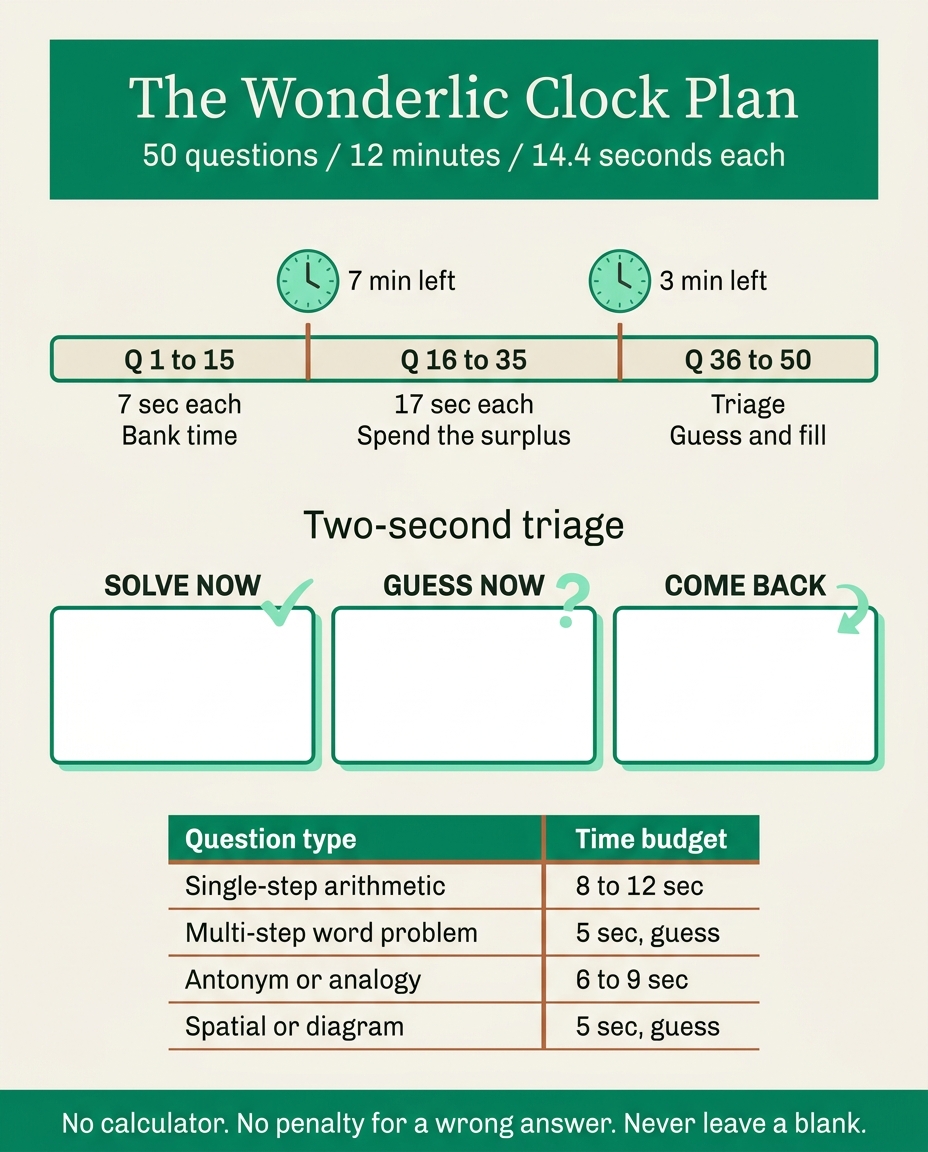
Because difficulty rises through the test, the front is where the surplus lives. Work the first 15 items at roughly 7 seconds each. That is 105 seconds spent, and it leaves 615 seconds for the remaining 35 questions, or about 17.5 seconds each. You just bought yourself three extra seconds per item on the part of the test that actually needs it.
The failure mode here is perfectionism on easy questions. Double-checking a simple antonym question because it "seems too easy" is the single most expensive habit on this test.
3. Triage every item in two seconds: solve, guess, or come back
Before you start solving, spend two seconds classifying. Three buckets only.
- Solve now. You can see the path to the answer immediately.
- Guess now. Multi-step arithmetic, an unfamiliar word, a spatial item you cannot picture. Pick an option, mark it, move.
- Come back. You can solve it, but not fast. Answer something plausible first so it is never blank, then move on.
The mistake is not choosing badly. The mistake is staring at a question for 20 seconds while deciding whether to stare at it longer.
4. Guess immediately on any multi-step word problem
Roughly half of a standard Wonderlic is quantitative, and the quantitative items that eat clocks are the multi-step ones: successive discounts, ratio-then-percentage chains, compound rate problems. A one-step calculation is worth solving. A problem that needs you to write down an intermediate result and then operate on it again is a 40-second item on a 14-second budget.
This is a pure time trade, not a statement about whether you could solve it. You could. It costs three other points.
5. Answer every single item, including the ones you never read
Because wrong answers carry no deduction on the classic scored version, an unanswered question is a guaranteed zero and a guessed question is not. Reserve the last 20 seconds of the 12 minutes for exactly one job: filling in an answer for every item you have not touched. If eight items are blank and you guess at roughly one-in-four odds, you can reasonably expect about two extra points. Two points is the distance between a 22 and a 24, and 24 is a real cutoff at real employers.
One caveat worth knowing. Wonderlic's own Select sample instructions tell candidates that "guessing is not likely to improve your score," because the Select algorithm weights responses rather than counting them. Blind guessing still beats a blank on the classic raw-scored version, and it costs you nothing on either. Just do not treat it as a scoring exploit.
6. Never take a review pass
On a normal exam, checking your work is good practice. On the Wonderlic it is a net loss. Re-reading five answered questions at eight seconds each is 40 seconds, which is roughly three questions you have not seen yet. Three fresh items give you better expected points than confirming three answers you already got right.
If you finish the test early, which is rare, then review. If you do not, the review pass does not exist.
7. Use scrap paper for arithmetic only, never for setup
Scrap paper is allowed and it is useful, but only for the thing your head cannot hold: a carried digit, a running subtotal, a two-column comparison. Writing out the setup of a word problem in full sentences or algebraic form is a writing exercise that produces no points. Get in, hold the number, get out.
8. Check the clock exactly twice
Every glance at the timer costs one to two seconds and, worse, resets your concentration. Fifteen glances across the test is around 30 seconds, or two questions given away for information you did not act on.
Check it twice, and check it against the banked plan from tactic 2 rather than against a flat pace.
- After question 20. Fifteen items at 7 seconds is 105 seconds, then five more at about 17.5 seconds is another 88. That is roughly 193 seconds spent, so you want about 8 minutes 45 seconds left on the clock.
- After question 35. Another 15 items at about 17.5 seconds adds 263 seconds, for roughly 455 seconds spent in total. You want about 4 minutes 25 seconds left.
If you are behind at either checkpoint, the correction is not to speed up your solving. It is to move more items into the "guess now" bucket.
9. Aim at your cutoff, not at 50
This is the tactic that changes the other eight. Employers do not score you against a perfect paper. They score you against a role-specific cutoff, and those cutoffs cluster well below 50. Aim at your cutoff, not at 50.
If your target is 24, your job is to secure 24 clean points inside 12 minutes, which changes how aggressively you should skip. Someone chasing 24 can afford to guess on every multi-step math item and still clear the bar on verbal and single-step arithmetic. Someone chasing 32 cannot. Our role-by-role Wonderlic cutoff breakdown has the full mapping.
Your per-question-type time budget
Incumbent tips articles tell you to "manage your time." This is what that actually means, item by item. These budgets are derived from the 720-second total, not from any published vendor timing.
| Question type | Share of a standard test | Time budget | Decision rule |
|---|---|---|---|
| Single-step arithmetic | Quantitative, about half the test overall | 8 to 12 seconds | Always solve |
| Multi-step word problem | Part of the same quantitative half | 5 seconds | Guess and move |
| Antonym, synonym, analogy | Verbal, a little under half the test | 6 to 9 seconds | Solve if the word is familiar, guess if not |
| Sentence logic, word rearrangement | Verbal | 10 to 14 seconds | Solve, these reward a careful read |
| Number series, pattern | Logical and analytical, a small slice | 10 seconds | Solve if the pattern shows in two terms |
| Spatial or diagram | Logical and analytical, a small slice | 5 seconds | Guess unless it is obvious |
The point of the table is not the exact second count. It is that a spatial item and a sentence-logic item should never receive the same amount of your clock, and most candidates give them the same amount.
What our practice data says about these tactics
The tactics above are built from the 720-second arithmetic. We can now check them against real attempts. The PrepClubs Research series re-grades every scored practice attempt, and three of its findings bear directly on how to pass the Wonderlic.
Thinking longer barely helps on the item itself. Across 190 questions sat at least 20 times each on speeded forms, the faster half of answers to the same question were right 72.5% of the time and the slower half 69.4%, a gap of just 3.1 points (What an extra thirty seconds on a question actually buys). Dwelling does not make you wrong. It simply buys very little.
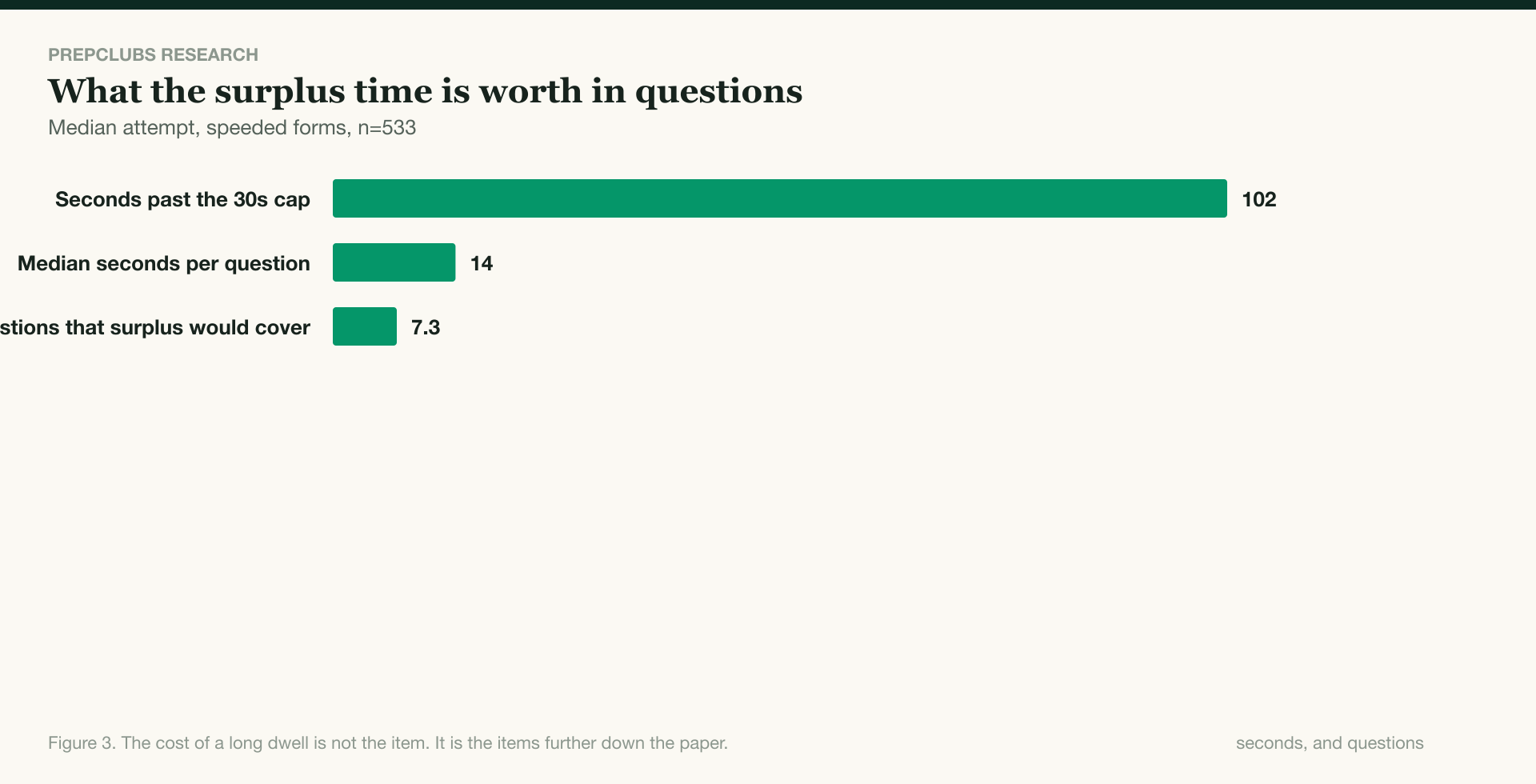
The cost lands further down the paper. The median attempt spent 102 seconds beyond a 30-second-per-item cap. At the median pace of 14 seconds an item, that is 7.3 questions you never reach, and 63% of attempts had at least one item that ate a full minute. This is the real reason behind the guess-now rule above.
Blanks are real, and guessing is worth about two marks. On our Wonderlic-format forms, candidates left 20% of the paper blank on average and 56% of the final fifth. With five options and no deduction, a blank is worth about 0.2 of a mark as a guess, which adds up to roughly 2 marks per attempt, about a 7% lift on the average score (How much of a timed aptitude test is never answered). That is the measured version of the last-20-seconds fill-in rule.
Practise the triage on three real questions
These are from Wonderlic Practice Test 8, the newest form in our bank. For each one, decide in two seconds: solve now, guess now, or come back.
Question 7 of 50 (solve now). If 4 kg of rice costs $12, what does 7 kg cost?
A) $22 B) $18 C) $21 D) $19 E) $20
Answer: C) $21. $12 divided by 4 is $3 a kilo, and 7 times $3 is $21. One step, under ten seconds.
Question 28 of 50 (solve, but read the question). If 4x + 2 = 3x + 9, what is the value of 2x?
A) 14 B) 7 C) 11 D) 9 E) 3.5
Answer: A) 14. Subtract 3x from both sides to get x + 2 = 9, so x is 7. The question asks for 2x, which is 14. The option 7 is there for anyone who solves for x and stops.
Question 43 of 50 (solve if you get here with time). If 2a + b = 20 and b = 3a, what is b?
A) 10 B) 5 C) 12 D) 6.7 E) 4
Answer: C) 12. Substitute 3a for b: 5a = 20, so a is 4 and b is 12. The option 4 is the value of a, not b.
Notice that the late item is not harder mathematics than the early ones. It just arrives when the clock is nearly gone. The full form with all 50 explanations is in the Wonderlic practice tests on PrepClubs.
Know your number: the score you actually need
There is no universal Wonderlic passing score. Your pacing plan depends entirely on the target your employer set for the role. The mean score is around 20 out of 50, and "above average" starts at 21.
| Target score | Roughly what it clears | What it demands of your clock |
|---|---|---|
| 17 to 20 | Entry level, hourly, warehouse, retail | Solve the front 20 well, guess most of the back half |
| 21 to 23 | Administrative, routine professional, customer service lead | Front 25 solid, aggressive triage after |
| 24 to 26 | Sales, supervisory, general corporate screens | Need the verbal half nearly clean |
| 27 to 32 | Analyst, technical, engineering, consulting tracks | Need speed on multi-step math, not just triage |
If you do not know your employer's cutoff, plan for 24. It clears the most common corporate screens and it is a realistic target inside a short prep window.
The 3-day version and the 24-hour version
Most Wonderlic advice assumes weeks. If you found out about your test yesterday, here is what fits.
If you have 3 days. Day one, take one full-length timed mock cold, before reading anything. The score is diagnostic, not a verdict. Day two, drill the quantitative half only, since it is the largest share of the test and the most trainable in a short window. Day three, take two more full-length timed mocks and practise the triage buckets rather than the content. Our 7-day Wonderlic prep plan compresses cleanly into three if you drop the verbal drilling days.
If you have 24 hours. Take one full-length timed mock tonight. Note the exact question number where you ran out of clock. Tomorrow morning, take one more mock with a single goal: reach a higher question number, even if your accuracy drops. Pacing is the variable you can move in a day. Vocabulary is not.
Either way, take at least one timed full-length mock before the real thing. The specific skill you need is deciding fast under a countdown, and that skill only trains under a countdown. Working through Wonderlic sample questions by type untimed teaches you the content but not the triage.
If you want to run the 12-minute clock right now, use a free, timed Wonderlic-format practice test and note the exact question where you run out of time. That number is the one tactic 2 and the pacing table above are built to move.
FAQ
Is the Wonderlic hard to pass?
It is hard to finish, not hard to pass. The content is roughly middle-school to early-high-school level arithmetic and vocabulary. What makes it difficult is 50 items in 12 minutes with rising difficulty. Most candidates do not reach the last question. Passing means clearing a role cutoff, and most cutoffs sit between 17 and 32, well short of a perfect paper.
Is a 27 on the Wonderlic good?
Yes. Consistent with published Wonderlic norm data, a 27 sits well into the upper fifth of test takers and clears most analyst and technical screens. It sits above the common 24 corporate cutoff with margin, and below the 30 to 32 range that engineering and consulting tracks tend to want.
Is 37 a good Wonderlic score?
A 37 is very strong. On the published norm distribution it sits near the top of the range and above the cutoff for essentially every commercial hiring use of the test. Scores at that level are usually the result of finishing 40 or more questions accurately, which requires genuine speed rather than triage alone.
What IQ is a 34 Wonderlic?
The conversion most published sources use is IQ = (Wonderlic score x 2) + 60, which puts a 34 at roughly 128. Treat that as an approximation. It is a 12-minute proxy, not a full clinical IQ administration. It is derived from the test's own norms rather than from a clinical study of you.
Should I skip questions on the Wonderlic?
You should skip solving, never skip answering. Mark a plausible option on anything you are not going to work out, then move. Because there is no deduction for a wrong answer, a two-second guess is always better than a blank, and it is usually better than a 40-second correct solve.
Can you use a calculator on the Wonderlic?
No. Calculators are prohibited. All arithmetic is designed to be done mentally or on scrap paper, which is exactly why fluency with percentages, ratios, and simple fractions matters more than any single strategy on this list.
How many questions should I aim to answer?
As many as your cutoff requires plus a margin, not 50. If your target is 24, reaching question 35 with high accuracy beats reaching question 45 with scattered accuracy. Speed is only valuable when it is not costing you correctness on the items you chose to solve.
Does the Wonderlic still get used for the NFL?
The NFL Combine stopped administering the Wonderlic in 2022. The test remains widely used in commercial hiring, which is where nearly every candidate encounters it now. If you arrived here from the NFL side of the story, the commercial cutoffs above are the ones that will actually apply to you.
Related on PrepClubs
- Your target number. What is a good Wonderlic score. Score bands, cutoffs by job family, and the IQ conversion.
- Short prep window. The 7-day Wonderlic prep plan. A day-by-day schedule you can compress to three days.
- Question drilling. Wonderlic sample questions by type. Worked examples for each question family.
- Where to sit it. Where to take the Wonderlic test. Online and in-person delivery, and what to expect on the day.
- Same format, different test. The PI Cognitive Assessment. Also 50 questions in 12 minutes, so every tactic on this page transfers.
Practice on PrepClubs
Triage is a skill you can only build against a real countdown. The Wonderlic cluster on PrepClubs gives you full-length timed mocks plus a free diagnostic, so you can rehearse the 12-minute clock and the guess-now rule under real pressure before test day. Current pricing is on the pricing page, and the Pass Guarantee extends your access by 30 days at no extra cost if you need more time.
Browse the full Wonderlic test hub to start.
Practise for this exam
Wonderlic practice tests
Timed practice tests in the real Wonderlic format, with a worked explanation for every question, so you learn the method as well as the answer.