The Predictive Index in 2026: Cognitive vs Behavioral, Score, and How to Pass
The Predictive Index is two different tests under one brand: a 12-minute, 50-question Cognitive Assessment scored 100 to 450, and an untimed Behavioral. This article walks the format of both, the published score-to-perce

The honest answer is that "the Predictive Index" is two completely different tests sold under one brand, and most candidates lose time conflating them. The PI Cognitive Assessment is a 12-minute, 50-question speed-of-thought ability test scored on a 100 to 450 scale. The PI Behavioral Assessment is an untimed personality questionnaire that places you on a four-factor profile. They are not interchangeable. Hiring teams use them for different purposes, weight them differently, and almost never set a "pass" mark on the behavioral side. This article walks through the format of both, what scores actually mean against the published bands, and the prep approach that separates a 27 from a 32 on the cognitive side.
Quick takeaways
- PI Cognitive: 50 questions, 12 minutes, 14.4 seconds per question on average. Scored 100 to 450. Average raw score is roughly 20 out of 50, mapping to a scaled score of 250 and the 50th percentile.
- PI Behavioral: untimed (most candidates finish in 5 to 7 minutes). Two adjective checklists. Output is a four-factor profile, not a numeric score.
- A scaled score of 320 (raw 27) sits at the 80th percentile and is the floor for most senior individual contributor and management roles.
- Hiring teams set their own Cognitive Target by job. Predictive Index publishes a Reference Group with target bands by Job Function in their Target Scoring Guide.
- Most candidates do not finish the Cognitive in 12 minutes. The published average is 20 correct out of 50, which means the median candidate either guessed or skipped roughly 60 percent of the questions.
- The Behavioral cannot be "failed" in the way Cognitive can. It can, however, knock you out of a role if your profile is a poor match for the Reference Profile the hiring team set.
- Practice on real format under real time pressure is the single intervention that moves Cognitive scores. Self-paced prep without a clock does almost nothing.
PI Cognitive vs PI Behavioral: stop conflating them
When a candidate gets an invitation to take "the Predictive Index," they are almost always being asked to take the PI Cognitive Assessment, the PI Behavioral Assessment, or both back to back. The two tests share a brand, share an administration platform, and share a hiring team's dashboard. Almost nothing else.
The PI Cognitive Assessment is the timed cognitive ability test. It is closely modeled on (and was originally licensed from) the Wonderlic. Same 50-question count. Same 12-minute time limit. Comparable mix of verbal, numerical, and abstract reasoning. The Predictive Index acquired and rebranded a Wonderlic-style test in 2014 (the original Predictive Learning Indicator, or PLI), and the test is sometimes still called the PLI inside Predictive Index documentation. If you see PLI in a job posting, assume PI Cognitive.
The PI Behavioral Assessment is something else entirely. It is an untimed two-step adjective checklist. You pick the words you feel describe how others expect you to behave, then pick the words that describe how you actually see yourself. The output is a four-factor profile (Dominance, Extraversion, Patience, Formality) and a Reference Profile label such as Analyzer, Operator, Maverick, Captain. Hiring teams compare your profile against the Reference Profile they set as the job's behavioral target.
The reason this matters: candidates spend prep time on the Behavioral as if it can be "studied," and they cut prep time on the Cognitive as if 12 minutes is plenty. Both moves are wrong. The Cognitive is where the cutoffs are; the Behavioral is where the fit calls are made.
The chart below sets the visual context for the rest of the article: a candidate, a 12-minute timer, and the abstract reasoning patterns that anchor the Cognitive side of the brand.

If you are still unsure which PI assessment you are actually taking, the tell is in the invitation email itself.
PI Cognitive format: 50 questions in 12 minutes
The Cognitive is a single 12-minute block. There are no sections, no breaks, and no calculator. Questions appear one at a time and you can move forward but not back, depending on the test version. The on-screen timer counts down from 12:00.
The 50 questions are drawn from three reasoning types in roughly equal proportions:
- Verbal reasoning. Synonyms, antonyms, analogies, sentence completion, occasional reading-comprehension snippets. Usually 14 to 18 questions on a typical form.
- Numerical reasoning. Arithmetic, ratios, percentages, simple algebra, number series, basic word problems. No calculator allowed. Usually 14 to 18 questions.
- Abstract / spatial reasoning. Pattern completion, odd-one-out, figure rotation, sequence prediction. Usually 14 to 18 questions, often skewed slightly higher than the other two.
Predictive Index does not publish a fixed split per form, and candidates report that the question mix can shift slightly between forms. The verbal and numerical sections look very similar to Wonderlic-style items. The abstract section is what people remember, partly because it is visually distinctive and partly because it is where most candidates lose time.
Average solve time, if you attempted every question, would be 14.4 seconds. The reality is that nobody hits 14.4 seconds on every item. A well-prepared candidate burns 8 to 10 seconds on easy verbal items to bank time for harder spatial questions, where 25 to 30 seconds is realistic.
Sample PI Cognitive questions
These three are representative of what shows up on a typical form. Each is one of three categories you will see.
Verbal: opposite-meaning question. Choose the word most OPPOSITE in meaning to RAPID.
A. Quick B. Slow C. Fast D. Hasty E. Speedy
Show answer and explanation
Correct answer: B (Slow)
The other four options are all near-synonyms for RAPID. SLOW is the direct antonym. The trap is reading too fast and picking a near-match like Quick or Fast.
Numerical: number series. Find the next number in the series: 5, 10, 15, 20, ?
A. 22 B. 24 C. 25 D. 28 E. 30
Show answer and explanation
Correct answer: C (25)
Arithmetic series adding 5 each step. 20 plus 5 equals 25. Number-series items on PI Cognitive look easy in isolation, but they appear next to harder algebraic items and the temptation is to over-think the simple ones.
Abstract: pattern series. Predictive Index spatial questions show a sequence of figures with one missing or one that breaks the pattern. Your job is to identify the rule (rotation, reflection, sequence change) and pick the option that fits.
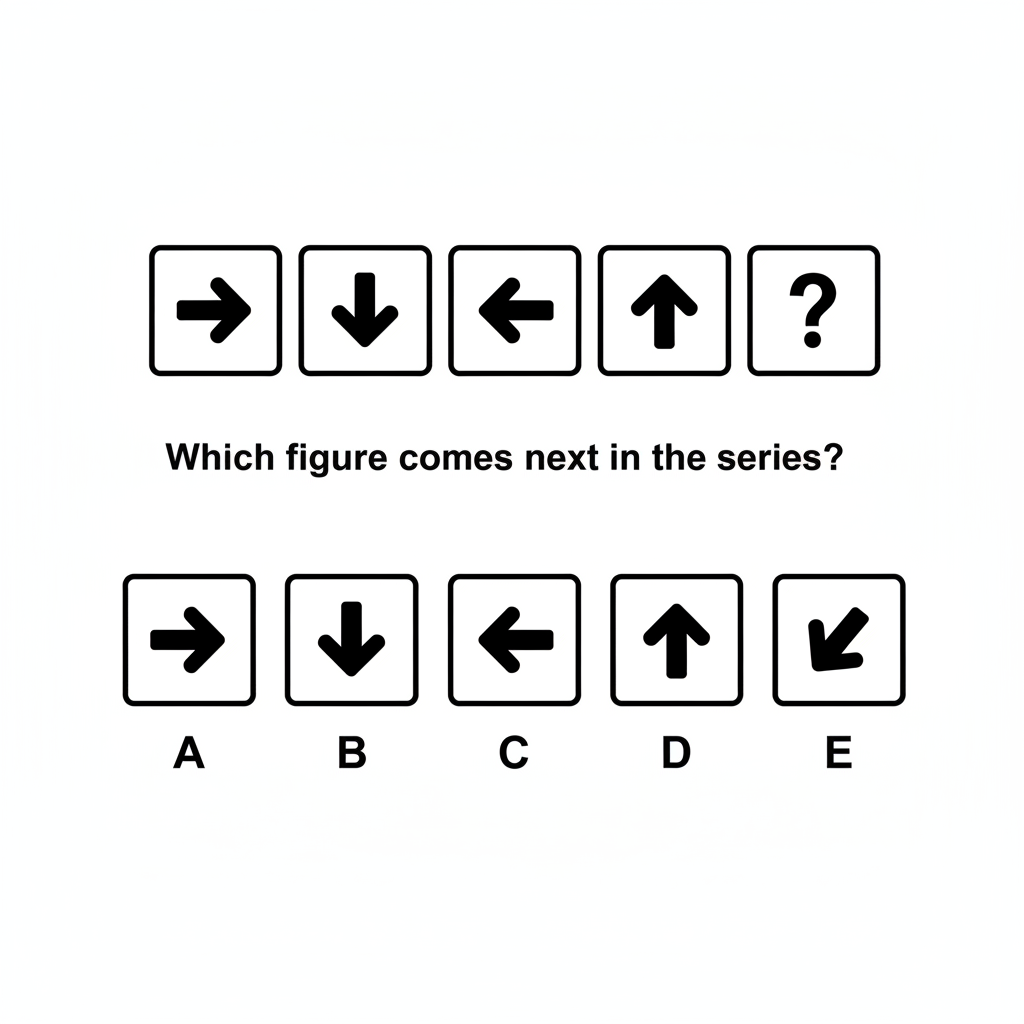
These typically appear 5 to 7 times across a single 12-minute form. The fastest approach is to verbalize the rule (here, "the arrow is rotating 90 degrees clockwise") before scanning the answer options.
A worked numerical example. PI Cognitive folds short word problems into the numerical items, and the fast route is rarely the textbook setup.
A team of 3 workers finishes a job in 8 hours. Working at the same rate, how many hours would it take 4 workers to finish the same job?
A. 5 B. 6 C. 7 D. 10.7 E. 12
Answer: B (6 hours). The job is fixed at 3 workers times 8 hours, which is 24 worker-hours. Split those 24 worker-hours across 4 workers and you get 6 hours. Sanity-check the direction: more workers means fewer hours, so the answer has to be below 8, which rules out D and E on sight. Option D (10.7) is the trap for anyone who multiplies 8 by 4 and then divides by 3. On a no-calculator test, counting worker-hours beats setting up an equation every time.
For the publisher's own examples, work through the official PI Cognitive Assessment sample questions on the Predictive Index support site before test day.
PI Cognitive scoring: 100 to 450 scale
Your raw score is the count of correct answers out of 50. Predictive Index does not penalize for wrong answers, so a guess is always better than a blank.
The raw score is then converted to a scaled score on the 100 to 450 range. The scaled score is normed against the general working population, where 250 is the average and one standard deviation is roughly 70 points. The scaled-score conversion is fixed by the publisher and does not change between forms.
The percentile is what most candidates actually want to know, because it answers the question "where do I sit relative to other candidates?" A scaled score of 250 sits at the 50th percentile. A scaled score of 320 sits at the 80th. A scaled score of 380 sits roughly at the 95th.
The chart below is the score-to-percentile-to-job-target view that most candidates are actually looking for when they ask "what is a good PI Cognitive score?"

If you want the scoring math in context, walk it alongside the PI Cognitive's 50 questions in 12 minutes, broken down, which shows how each correct answer moves your raw count and where the clock forces the trade-offs that shape it.
Target scores by job role
Predictive Index ships a Target Scoring Guide that maps Job Functions to a recommended Cognitive Target. Hiring teams override these freely, but the Reference Group anchors most defaults.
| Raw correct | Scaled score | Percentile | Typical job-target band |
|---|---|---|---|
| 12 | 175 | 15th | Below most production-role targets |
| 17 | 220 | 35th | Entry-level production / customer-service |
| 20 | 250 | 50th | Average. Most production roles. |
| 23 | 280 | 65th | Mid-level professional / specialist |
| 27 | 320 | 80th | Senior individual contributor / management |
| 32 | 380 | 95th | Executive, strategy, complex analytical roles |
A "defensible target" for most graduate and analyst roles in finance, consulting, and software is 280 to 320 scaled (raw 23 to 27). For Vista Equity portfolio operating roles and similar performance-driven environments, candidates report cutoffs in the 320 to 360 range, similar to CCAT cutoffs in the same portfolio. For C-suite and top-of-house strategy roles, the published target is roughly 380 (raw 32, 95th percentile).
The Predictive Index Cognitive Target is not a hard cutoff in every case. Some hiring teams use it as a screening floor, others use it as one factor among several. The deciding factor is usually how the company configured the role's Cognitive Target alongside the Behavioral target. If the Cognitive Target is set high and the candidate misses by 30 scaled points, the system flags the candidate as below target and the resume rarely advances.
Why most candidates run out of time
The published average of 20 correct out of 50 is not because the items are abnormally hard. It is because the format punishes pacing errors.
A typical pacing failure looks like this. The candidate opens the Cognitive feeling time-aware, gets a verbal item that should take 8 seconds, talks themselves into 18 seconds because they want to be sure, and burns the bank by question 10. By question 30, they are guessing. The last 20 questions get the worst time allocation, which is exactly backwards: spatial items appear with higher frequency in the back half of most forms, and spatial items reward time spent.
The fix is mechanical, not intellectual. On the verbal section, if you do not see the answer in 8 seconds, you will not see it. Pick the closest option and move on. On the numerical section, do not solve a problem that asks "which of these is largest" by computing each value. Estimate. On the spatial section, identify the rule before you look at the options; if you stare at the options first, you will pattern-match to the wrong answer.
Practice on real format under real time pressure is the only intervention that consistently moves scores. Self-paced practice with the timer off is mostly familiarization, not skill building.
For a focused walk-through of the format, the strict 12-minute timing, and worked sample questions of each type, see Predictive Index Test: Format, Time Limit, Sample Questions.
Pacing checkpoint table. The PI Cognitive gives you 50 questions in 12 minutes, which is 720 seconds, or about 14 seconds per question on a flat pace. Glance at the on-screen countdown against this table and you will know within a second whether you are ahead or behind.
| Minute elapsed | Clock shows | On-pace question |
|---|---|---|
| 2 | 10:00 | 8 |
| 4 | 8:00 | 17 |
| 6 | 6:00 | 25 |
| 8 | 4:00 | 33 |
| 10 | 2:00 | 42 |
| 12 | 0:00 | 50 |
Being one row behind is recoverable. Being two rows behind by the 6-minute mark means you should switch to guess-and-move on anything that is not immediate, because spatial items cluster in the back half and reward the time you save earlier.
Seven-day prep plan
This is the plan we recommend for candidates with a Cognitive invite landing in 7 days or fewer.
Day 1: Diagnostic and pacing audit. Take one full 12-minute Cognitive practice test. Note where you ran out of time. Note which question types you got wrong vs. skipped. Skipped items are pacing failures. Wrong items are content failures. The mix tells you whether to focus on speed or technique.
Day 2: Verbal under time. Drill 60 verbal items in 12 minutes (5 second target per item, faster than the test). Synonyms, antonyms, analogies. The goal is to see the answer instantly so you bank time for harder items.
Day 3: Numerical under time. Drill 60 numerical items in 12 minutes. Ratios, percentages, number series, basic algebra. Practice estimating instead of computing.
Day 4: Spatial drilling. Spend 45 minutes on abstract reasoning items. No timer. Focus on naming the rule (rotation, reflection, alternation, sequence) before looking at the options.
Day 5: Full timed practice test. 12 minutes, 50 questions. Score it. Compare to your Day 1 baseline.
Day 6: Targeted weakness drilling. Spend the day on whichever section had the worst per-item accuracy. If your Day 5 weakness was spatial, drill 30 spatial items, then 20 mixed items.
Day 7: Light review and rest. One half-length practice (25 questions in 6 minutes) for confidence calibration. Do not cram.
This is the plan we use for our Vista Equity portfolio CCAT prep coaching, adapted to the PI Cognitive format. The scaffolding works because PI Cognitive and CCAT share the speed-versus-accuracy core. Wonderlic-style verbal/numerical/abstract is well-trodden territory.
Five-minute pre-assessment checklist. Run this in the last hour before you open the test.
- Confirm the format you are facing: 50 questions, 12 minutes, no calculator, one question at a time.
- Keep blank scratch paper and a pen next to you. The numerical items are built for quick scratch-paper arithmetic, not mental gymnastics.
- Close every other tab and silence notifications. A single interruption in a 720-second test costs real questions.
- Load the pacing checkpoints in your head: about 8 questions by minute 2, 25 by minute 6, 42 by minute 10.
- Set a skip rule in advance. If a verbal item is not obvious in about 8 seconds, pick the closest option and move on.
- In the final 30 seconds, put an answer on every remaining item. There is no penalty for a wrong guess.
PI Behavioral: what it actually measures
The Behavioral is the second half of the PI suite. You are shown two adjective lists and asked to:
- Pick the words that describe how you are expected to behave by your environment.
- Pick the words that describe how you actually see yourself.
The 86-word adjective list is fixed. There is no time limit, but most candidates finish in 5 to 7 minutes. The output is a four-factor profile across:
- Dominance. Drive to take charge and influence outcomes.
- Extraversion. Drive for social interaction and outward expression.
- Patience. Preference for stability, consistency, and follow-through.
- Formality. Preference for structure, rules, and detail.
These four factors combine into one of 17 Reference Profiles such as Analyzer, Operator, Specialist, Captain, Maverick, Strategist. Hiring teams set a Reference Profile target for the role and compare your profile against it.
The Behavioral cannot be "failed" the way the Cognitive can. There is no minimum score. But you can be filtered out if your profile is a poor fit for the role's Reference Profile. The conventional wisdom that you should "answer honestly" is correct, with one nuance: read the role description first. If the role calls for an outward-facing relationship-driven seller and your honest profile is an introverted analyst, that mismatch is the signal the system is designed to surface. Suppressing your profile to fit a role you would not enjoy is a worse outcome than not getting the role.
Companies that use the Predictive Index
Predictive Index reports more than 10,000 companies use one or both assessments. The most common use cases:
- Operating partner-driven private equity portfolios. Vista Equity portfolio companies use PI Cognitive alongside or instead of CCAT. Other operating-partner-heavy PE firms (Thoma Bravo, Insight Partners) also use PI broadly.
- Mid-market software and SaaS companies for sales, customer success, and operations roles, especially where the company has standardized on a single hiring framework.
- Manufacturing and logistics for production and supervisor roles where Wonderlic-style cognitive tests are already common.
- Professional services firms for analyst and entry-level consulting roles, often as a Wonderlic alternative.
- Healthcare and education for administrative and operations roles.
When you receive a PI Cognitive invitation, the company's hiring team has already chosen the Cognitive Target for the role. You do not see the target. You see only your own scaled score after submission, and only if the company shares it back (most do not, by default).
Consulting candidates at BCG and Bain typically face the PI Cognitive alongside HireVue's video interview in the same funnel, and the two assessments score very different things; see HireVue in 2026: assessment, interview, games, and companies for the format breakdown and the AI rubric that pairs naturally with the PI Cognitive prep on this page.
FAQ
What is a good score on the Predictive Index?
For the Cognitive Assessment, a "good" score depends on the role. Average is 250 scaled (raw 20). A defensible target for most graduate and professional roles is 280 to 320 scaled (raw 23 to 27). For senior, strategic, or analytically demanding roles, 320 to 380 (raw 27 to 32) is the standard target band. For the Behavioral, "good" is not a useful frame: the question is whether your profile matches the role's Reference Profile.
Can you fail the Predictive Index?
You can functionally fail the Cognitive by scoring below the Cognitive Target the hiring team set for the role. There is no published universal pass mark; it varies by role and employer. You cannot fail the Behavioral, but a poor match to the Reference Profile can knock you out of consideration.
Is the Predictive Index Cognitive Assessment harder than the Wonderlic?
The Cognitive Assessment is structurally near-identical to the Wonderlic Personnel Test: 50 questions, 12 minutes, mixed verbal/numerical/abstract reasoning. The PI Cognitive may include a slightly higher proportion of abstract reasoning items, which most candidates report as the hardest section. For test-prep purposes, Wonderlic and PI Cognitive prep are interchangeable.
Can you retake the Predictive Index?
Retake policy is set by the employer, not by Predictive Index. Some employers allow a retake after 6 to 12 months. Others lock in the first attempt. Predictive Index itself does not impose a global cooldown.
Does the Predictive Index Cognitive Assessment have a calculator?
No. You may use scratch paper for arithmetic. The numerical section is designed to be solved without a calculator, with most items reducible to estimation rather than full computation.
How long does the full PI assessment take?
The Cognitive is 12 minutes timed. The Behavioral is untimed but typically 5 to 7 minutes. Account for an additional 5 minutes of instructions and setup. Total elapsed time is roughly 25 to 30 minutes if you take both back to back.
What happens if I do not finish the Cognitive in 12 minutes?
Unanswered questions are scored as wrong. There is no penalty above and beyond that, so you should always guess on items you have not answered when the timer is in the final 30 seconds. The "average" raw score of 20 already reflects most candidates not finishing.
Is the Predictive Index the same as the PLI?
Yes, in current usage. PLI is the older name (Predictive Learning Indicator). When Predictive Index acquired the assessment in 2014 it was rebranded as the PI Cognitive Assessment. Some legacy job postings and HR systems still say PLI.
Related on PrepClubs
- Pillar. PI Cognitive Assessment overview. The full pillar page with the latest cutoffs, employer list, and prep paths.
- Deep practice. PI Cognitive practice tests. Full-length timed practice with score reports. Money-back Guarantee.
- Compare. The Wonderlic Test in 2026. Same 50-questions-in-12-minutes format. Useful comparison for understanding pacing.
- Article. What Score Do You Need on the Wonderlic. Role-by-role cutoffs that translate directly to PI Cognitive targets.
- Article. How Hard Is the CCAT, Really. The CCAT is a similarly structured speed-of-thought test used by many of the same employers (Vista Equity portfolio).
- Article. Companies That Use the CCAT. Useful overlap reference: many CCAT employers also accept PI Cognitive.
Practice on PrepClubs
Full-length PI Cognitive practice with the real 12-minute clock.
Self-paced prep with the timer off does not move scores. Our PI Cognitive practice tests run on the real format, the real time limit, and the real question mix. Each session ends with a per-section breakdown so you can see exactly where you lost points and where you bled time. Backed by our Money-back Guarantee. Current pricing is on the pricing page.
Practise for this exam
PI Cognitive practice tests
Timed practice tests in the real PI Cognitive format, with a worked explanation for every question, so you learn the method as well as the answer.
FAQ