Cognitive Ability Test Examples: What Each Format Asks and How It Is Scored
Cognitive ability test examples from the CCAT, Wonderlic, and PI Cognitive: 10 question formats, a real example of each, and how each test is actually scored.

If an employer sent you a cognitive ability test, you are almost certainly sitting one of three: the Criteria Cognitive Aptitude Test (CCAT), the Wonderlic, or the Predictive Index Cognitive Assessment. All three are timed, all three are multiple choice, and none of them expects you to finish. Below are 10 real question formats drawn from those three tests, one worked example each, and exactly how each test converts your answers into the number a hiring manager sees. This is about hiring assessments, not the clinical cognitive screens a doctor administers, which are an entirely different instrument.
Quick takeaways
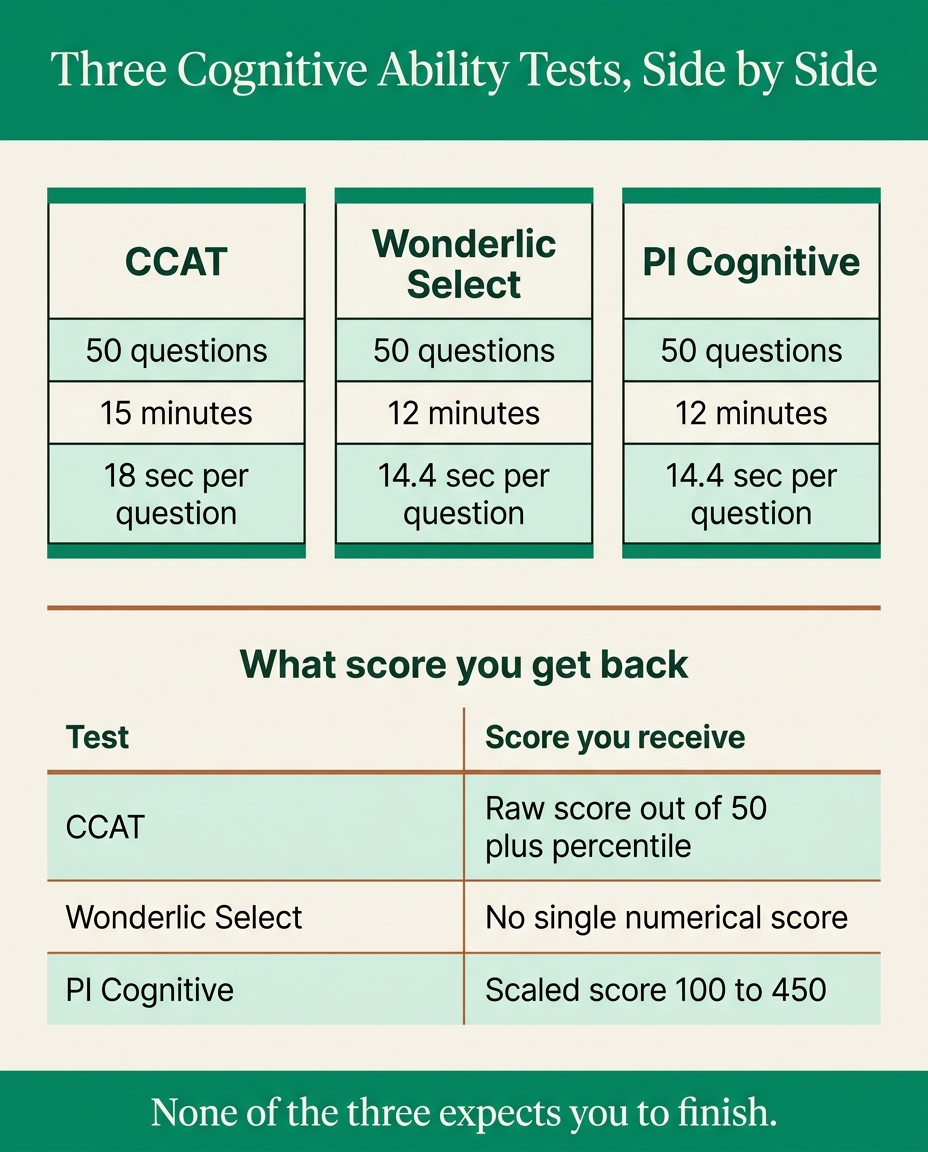
- The CCAT is 50 questions in 15 minutes. The Wonderlic and the PI Cognitive are both 50 questions in 12 minutes.
- Criteria states the average CCAT test taker answers 24 questions correctly and that fewer than 1 percent finish all 50.
- The three tests score completely differently: CCAT gives a raw score out of 50 plus a percentile, PI gives a scaled score from 100 to 450, and current Wonderlic Select gives no single number at all.
- Every format below falls into one of three families: verbal, numerical, or abstract and spatial.
- Not finishing is the design, not a failure. Predictive Index says outright that most respondents will not answer all 50 items.
- Practising the format matters more than practising the content, because the constraint is the clock.
What a cognitive ability test is in a hiring context
A pre-employment cognitive ability test measures how quickly you learn, reason, and solve unfamiliar problems. Employers use it because it is a short, standardised signal that is hard to fake, and it usually sits early in the funnel as a screen rather than late as a tiebreaker.
That is a different thing from a clinical cognitive test. If you searched this phrase looking for the MoCA or MMSE, the three-word recall exercise, or a dementia screen, none of the examples below apply to you. Everything here is the hiring kind. For the wider context on why companies run these at all, see our guide to what a cognitive aptitude test is and why companies use it.
The three tests side by side
| Test | Questions | Time | Seconds per question | Score you receive | What "average" means |
|---|---|---|---|---|---|
| CCAT (Criteria) | 50 | 15 minutes | 18 | Raw score out of 50 plus a percentile | Mean 24.2, median 24 in Criteria's norm sample |
| Wonderlic Select | 50 | 12 minutes | 14.4 | No single numerical score, a job-fit read | Not published as a single average by the vendor |
| PI Cognitive | 50 | 12 minutes | 14.4 | Scaled score from 100 to 450 | Global mean 250, which PI maps to a raw score of 20 |
Question counts and timings are from the vendors: Criteria Corp for the CCAT, Wonderlic for Wonderlic Select, and the Predictive Index for the PI Cognitive Assessment.
The 18 seconds versus 14.4 seconds gap is the single most useful line in that table. The CCAT gives you a quarter more thinking time per item than the other two, which is why CCAT prep and Wonderlic prep are not interchangeable even though the question families overlap.
The 10 question formats, with an example of each
1. CCAT verbal: opposite meaning
Criteria's own candidate prep page uses an opposite-meaning item as its verbal sample (its published example asks for the opposite of LENGTHEN, with "truncate" as the answer). The format gives you a word and asks which option means the opposite. The PrepClubs item below is written in that same format.
Example. LENGTHEN most nearly means the opposite of: (a) stretch (b) extend (c) shorten (d) measure (e) repeat.
Answer: (c) shorten. Of the five options, only "shorten" reverses the meaning of lengthen. Stretch and extend are near-synonyms planted as traps, and measure and repeat are unrelated. Criteria describes its verbal family as testing word meaning, how words relate to one another, and the role context plays in word choice.
2. CCAT math and logic: multi-step word problem
Example. A team logged 18, 22, 26, and 30 support tickets across four days. What is the daily average? (a) 22 (b) 24 (c) 25 (d) 26 (e) 28.
Answer: (b) 24. Criteria describes this family as "problem solving skills, arithmetic, logic, and numerical reasoning", and it is the largest of the three CCAT subscores by question volume.
3. CCAT spatial reasoning: odd one out
Example. Four of five shapes are the same figure rotated. One is a mirror image rather than a rotation. Pick the one that does not belong.
Answer: the mirror image. Criteria describes spatial items as visualising objects in physical space and identifying patterns and outliers. The CCAT is the only one of the three tests here that reports spatial reasoning as its own named subscore.
4. Wonderlic: date and sequence ordering
This is a real Wonderlic sample item, published by the vendor in its own Select sample assessment.
Example. Which of the following is the earliest date? Jan. 16, 1898 / Feb. 21, 1889 / Feb. 2, 1898 / Jan. 7, 1898 / Jan. 30, 1889.
Answer: Jan. 30, 1889. Two options are 1889, so the year filter resolves it to two candidates, and January beats February. The format rewards a sorting habit, not arithmetic.
5. Wonderlic: verbal analogy
Another published Wonderlic sample item.
Example. LOW is to HIGH as EASY is to: SUCCESSFUL / PURE / TALL / INTERESTING / DIFFICULT.
Answer: DIFFICULT. The relationship in the stem is antonym, so the answer must be the antonym of EASY. TALL is the distractor, because it belongs to the same semantic field as HIGH.
6. Wonderlic: number series
Example. What is the next number in the series? 29 41 53 65 77 ___ . Options: 75 / 88 / 89 / 98 / 99.
Answer: 89. The interval is a constant 12. The distractor 88 exists to catch an off-by-one.
7. Wonderlic: data to graph interpretation
Example. Orders across five hours were 27, 99, 80, 115, 213. Which graph represents that trend?
Answer: the one that rises, dips at hour three, then rises steeply. This is the format most candidates do not expect, and it is why "the Wonderlic is just math and vocabulary" is wrong. Wonderlic lists its content areas as simple math, basic logic, language comprehension, spatial reasoning, and pattern identification, becoming harder as the test progresses.
8. PI Cognitive: verbal reasoning
Predictive Index does not publish named question subtypes, so the item below is a PrepClubs practice item written in the same domain rather than a vendor sample.
Example. All auditors in the sample were certified. Some certified staff were contractors. Which must be true? (a) All auditors were contractors (b) Some auditors were contractors (c) No auditors were contractors (d) None of these must be true.
Answer: (d). The overlap between certified staff and contractors does not have to include any auditor. PI reports verbal as one of three domains and recommends employers ignore the per-domain subscores entirely.
9. PI Cognitive: numerical reasoning
Example. A subscription costs $180 a year. It rises 15 percent, then a promotion takes 10 percent off the new price. What do you pay? (a) $180.00 (b) $186.30 (c) $189.00 (d) $207.00.
Answer: (b) $186.30. 180 x 1.15 = 207, then 207 x 0.9 = 186.30. Successive percentages do not cancel, which is exactly what the item is testing.
10. PI Cognitive: abstract reasoning
Example. A shape sequence adds one side each step and alternates fill between solid and hollow. The fourth figure is a solid pentagon. What is the fifth?
Answer: a hollow hexagon. Two rules run in parallel, and abstract items almost always combine two rules rather than one. The PI interface shows five items on screen at once, so scanning ahead for the easy ones is part of the format.
How each test is actually scored
This is where the three tests stop resembling each other, and it is the part most articles skip.
CCAT. You get a raw score, which is the count of correct answers out of 50, plus a percentile ranking against Criteria's norm group. Criteria states on its own candidate page that the average test taker answers 24 questions correctly and that fewer than 1 percent of candidates answer all 50. The score report also breaks out three subscores (verbal ability, math and logic, spatial reasoning) and plots your raw score against a suggested range for the job family, for example a management range of 20 to 50. Our CCAT format, score, and prep guide covers the percentile bands in detail.
PI Cognitive. You get a scaled score between 100 and 450, not a raw count. The global mean is 250, which Predictive Index maps to a raw score of 20 correct, drawn from a norm group of more than 288,000 results. Employers set a Cognitive Target for the role, baselined at 250, and scores below the target lose match points on a sliding scale rather than triggering a hard fail. PI explicitly recommends that employers do not use the raw, verbal, numerical, or abstract subscores in a decision.
Wonderlic Select. Current Wonderlic Select does not return a single cognitive score at all. The vendor states that Select "does not provide a singular numerical cognitive ability score" and that there is no passing or failing grade, because responses are weighted by item difficulty and the impact of guessing through a proprietary algorithm. The familiar 0 to 50 raw score belongs to the older Wonderlic Personnel Test, which is still what most published employer cutoffs are written against. Our Wonderlic format and scoring guide explains which one you are likely sitting.
To see how that scaled score is earned in practice, worked PI Cognitive sample questions and timing show how the 50 questions map onto the 12-minute clock item by item.
What counts as a good score
| Test | Population midpoint | A competitive result | What the number is compared against |
|---|---|---|---|
| CCAT | Raw 24 (Criteria norm sample) | Above 30 clears most professional job-family ranges | A suggested range per job family, not a universal cutoff |
| PI Cognitive | Scaled 250 (raw 20 equivalent) | At or above the role's Cognitive Target | A per-role target the employer sets, default 250 |
| Wonderlic (classic scale) | Around 20 out of 50 | 24 and up for most corporate screens | A role-specific cutoff the employer chooses |
The pattern across all three is the same. There is no universal pass mark. The number that decides your outcome is set by the employer for that specific role, which is why "what is a good score" is always answered relative to a job family. Our guide to what counts as a good aptitude test score works through that logic across the wider test catalogue.
Format at a glance: what each one asks and how it is scored
The ten items above fall into a handful of recurring formats. This table maps each format to what it is testing and how the answer is marked, so you can tell at a glance which drill to run. Every format links to a page of worked examples you can practise.
| Format | What it asks | How it is scored |
|---|---|---|
| Verbal reasoning (antonyms, analogies, syllogisms) | Pick the word or conclusion the relationship in the stem forces | One mark per correct option, no penalty for a wrong guess on the CCAT and Wonderlic |
| Numerical reasoning (word problems, percentages, averages) | Work a short calculation to a single numeric answer | One mark per correct answer; speed matters more than hard maths |
| Number series | Find the rule linking the terms and extend it | One mark; distractors sit one step either side of the answer |
| Logical reasoning (deduction from given statements) | Decide what must be true, not what could be true | One mark; the trap option is usually what is merely possible |
| Abstract reasoning (shape sequences, odd one out) | Spot one or two rules running in parallel across figures | One mark; abstract items usually combine two rules, not one |
For the category as a whole, our cognitive ability test guide covers how these formats are mixed and weighted across the main vendors.
Two more worked examples, step by step
The items earlier in this guide gave you the format of each family. These two show the full working, because on the two families candidates lose the most time on, number series and logical deduction, the method is what saves the seconds.
Number series (numerical). What is the next number in this series? 4, 7, 13, 25, 49, ___ . Options: 73 / 91 / 97 / 98 / 99.
Step 1: the gaps are 3, 6, 12, 24, which double each step, so an "add a changing amount" rule is in play. Step 2: test whether each term follows from the one before by a fixed operation. 4 times 2 minus 1 is 7; 7 times 2 minus 1 is 13; 13 times 2 minus 1 is 25; 25 times 2 minus 1 is 49. The rule is multiply by 2, then subtract 1. Step 3: apply it once more. 49 times 2 is 98, minus 1 is 97. Answer: 97. The distractor 98 is there to catch anyone who multiplies by 2 and forgets the minus 1.
Logical reasoning (deduction). All graduate trainees hold a security pass. No security pass holder is a contractor. Which must be true? (a) Some contractors are graduate trainees (b) No graduate trainee is a contractor (c) All pass holders are graduate trainees (d) Some graduate trainees are contractors.
Step 1: take the two statements as given. Every graduate trainee is inside the set of pass holders. The set of pass holders and the set of contractors do not overlap at all. Step 2: if no pass holder is a contractor, and every graduate trainee is a pass holder, then no graduate trainee can be a contractor. Step 3: check the traps. Option (c) reverses the first statement, which is not allowed; options (a) and (d) assert an overlap the statements rule out. Answer: (b). The skill the item tests is separating what must be true from what is merely possible.
FAQ
Can you give me some examples of cognitive ability tests?
The three you are most likely to meet in US hiring are the Criteria Cognitive Aptitude Test (CCAT), the Wonderlic, and the Predictive Index Cognitive Assessment. Others in regular use include SHL's general ability tests, Raven's Progressive Matrices, the Thomas International GIA, the McQuaig Mental Agility Test, and Talogy's Logiks range.
What is an example of a cognitive test question?
A verbal analogy is the classic: "LOW is to HIGH as EASY is to ___", where the correct answer is DIFFICULT because the relationship in the stem is opposition. That specific item is published by Wonderlic in its own candidate sample assessment.
How do you pass a cognitive ability test?
There is usually no fixed pass mark. You clear the employer's threshold by answering as many items correctly as the clock allows, which makes pacing the deciding variable. On a 12-minute, 50-question test you have 14.4 seconds per item, so the practical skill is deciding fast which items to solve and which to answer quickly and move past.
Is the CCAT harder than the Wonderlic?
They are close in content but different in pressure. The CCAT gives 15 minutes for 50 items (18 seconds each) against the Wonderlic's 12 minutes for 50 (14.4 seconds each), so the Wonderlic is the tighter clock. The CCAT leans more on spatial reasoning, which it reports as its own subscore.
How many questions do people usually get right?
Criteria publishes that the average CCAT test taker answers 24 correctly and that fewer than 1 percent answer all 50. Predictive Index maps its global mean scaled score of 250 to a raw score of 20 correct. Both vendors treat not finishing as normal.
Are these the same as an IQ test?
No, although they correlate with one. These are short, job-context instruments built to predict on-the-job learning speed, administered under a hard time limit and scored against a working-population norm group rather than against a general-population IQ distribution.
Can you practise for a cognitive ability test?
Yes, and the gain comes mostly from format familiarity and pacing rather than from learning new content. Knowing that successive percentages do not cancel, or that abstract items usually run two rules at once, removes the seconds you would otherwise spend working out what the question wants.
Related on PrepClubs
- CCAT in full. CCAT test format, score, and prep. The 50-in-15 breakdown, percentile bands, and job-family ranges.
- Why employers use these. What a cognitive aptitude test is and why companies use it. The definitional companion to this examples page.
- How long to prepare. How long to study for a cognitive aptitude test. Turning the time you have left into a plan.
- Watson-Glaser. Watson-Glaser test format and scoring. The critical-thinking screen used for law and senior roles.
- More worked examples. Aptitude test examples with worked solutions. Ten question types across the wider aptitude-test catalogue.
Practice on PrepClubs
Reading examples tells you what the formats are. Sitting them under a countdown tells you where your clock runs out, which is the part that decides your score. The fastest way to find out is to try a set of real-format questions against the timer before test day.
For the lead example in this guide, you can work through a free, full-length CCAT practice test in the real 50-questions-in-15-minutes format, no sign-up required.
If your test is in 48 hours, the highest-value thing you can do is take one full-length timed mock tonight and a second tomorrow, then spend whatever is left on the question family you scored worst on. There is no PDF answer key to memorise for any of these three tests, because the item banks rotate, so timed repetition is the only preparation that transfers. PrepClubs covers all three of these tests with full-length premium mocks plus topical drills: the CCAT cluster is 15 full-length mocks plus 12 topical drills, 1,350 questions in total. The Wonderlic and PI Cognitive clusters are structured the same way. Access runs for a set window rather than as a recurring subscription, and the 30-day Pass Guarantee extends that access by a further 30 days at no cost if you sit your test and do not pass. Current pricing is on the pricing page.
Start with a free practice test or go straight to the CCAT test page for the format, scoring, and employer cutoffs.