
Free IQ-style test: Raven's Progressive Matrices practice
Looking for a free IQ test? Matrix puzzles are the heart of most of them, and Raven's Progressive Matrices is the original. This is an IQ-style test, not a clinical IQ test: 23 original picture puzzles in 40 minutes, the length of the abbreviated Advanced Progressive Matrices, with the rule behind every answer explained. You get a raw score and can see how it compares with other people who practise here, not an IQ number we cannot back up.


By PrepClubs Editorial Team, updated November 5, 2026
23 puzzles · 40 min · every answer explained
What this Raven's-style practice includes
Raven's Progressive Matrices was invented by John C. Raven in 1938 and has been validated across 80+ years of research as one of the cleanest tests of abstract reasoning ability. Because it is language-independent, it is used internationally by military selection programs, research institutions, and some global consulting firms in regions where verbal tests face language barriers.
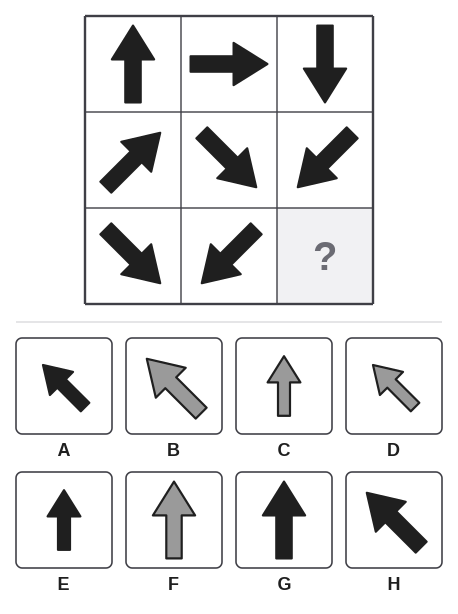
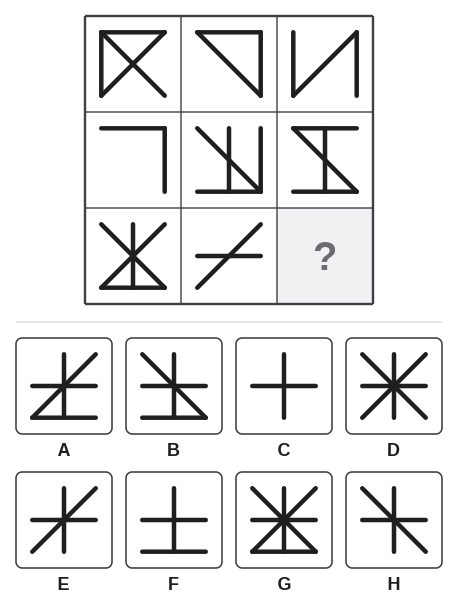
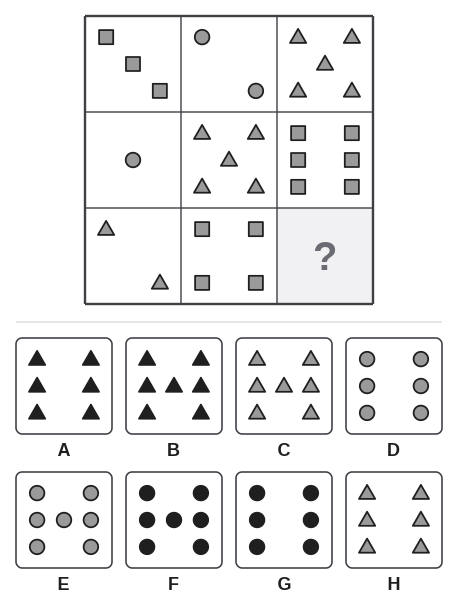
Each form has 23 picture puzzles that get harder from start to finish, built to the abbreviated Advanced Progressive Matrices format. Most are 3x3 grids with eight candidate pieces; a few are 2x2 grids (six pieces) or 4x4 grids. You choose the piece that completes the pattern across the rows and columns. There are 8 forms and 184 puzzles in total.
Every puzzle is original, made by PrepClubs rather than copied from Pearson or other prep sites. Each one is checked so that exactly one option fits, and every explanation names the rule that produces the answer.
Three sample Raven's matrix questions with walkthroughs
Each sample is shown as in the real test: a 3 x 3 grid with the last cell missing and eight options, A to H. Look for the rule before reading the walkthrough.
- A.A
- B.B
- C.C
- D.D
- E.E
- F.F
- G.G
- H.H
- A.A
- B.B
- C.C
- D.D
- E.E
- F.F
- G.G
- H.H
- A.A
- B.B
- C.C
- D.D
- E.E
- F.F
- G.G
- H.H
What your score means: two honest tables
A raw score only means something next to other people's scores. The first table compares you with other PrepClubs practisers. The second shows how percentiles map to the IQ scale, so you can read a result from a real, normed IQ test. The two cannot be converted into each other, and we do not pretend they can.
Raw score to percentile on our 23-puzzle forms
Where a raw score sits among people who have taken a timed PrepClubs Raven's-style form.
| Raw score (out of 23) | Percentile among practisers | How it reads |
|---|---|---|
| 22 to 23 | Above the 96th | Top 5 percent. Few puzzles left to learn from. |
| 20 to 21 | 77th to 96th | Strong. The hardest late items are where the points are. |
| 18 to 19 | 51st to 77th | Above the middle. |
| 15 to 17 | 26th to 51st | Around the middle. The typical score is 17 or 18. |
| 13 to 14 | 9th to 26th | Below the middle. Work on separating the row rule from the column rule. |
| 12 or fewer | Below the 9th | Start with the walkthroughs below, then retake a fresh form. |
Source: the first completed timed attempt per person on PrepClubs Raven's-style forms, attempts under 5 minutes removed, November 2026. A typical attempt uses about 17 of the 40 minutes. Practisers are job candidates who chose to prepare, not a sample of the general population, so this is not an IQ norm.
Percentile to IQ score on a normed IQ test
IQ tests are scaled so the average is 100 and the standard deviation is 15. Labels are the Wechsler (WAIS-IV) classification bands.
| IQ score | Percentile | Classification |
|---|---|---|
| 145 | 99.9th | Very superior |
| 130 | 98th | Very superior. The usual line for Mensa and many gifted programmes. |
| 120 | 91st | Superior |
| 115 | 84th | High average |
| 110 | 75th | High average |
| 100 | 50th | Average |
| 90 | 25th | Average |
| 85 | 16th | Low average |
| 70 | 2nd | Borderline |
Percentiles follow from the normal curve (mean 100, SD 15) and are rounded. Only a normed test taken under controlled conditions gives a real IQ score.
What the real Raven's feels like
The real Raven's Progressive Matrices is delivered through several platforms: Pearson Q-Interactive for clinical and research use, TalentLens for hiring, and custom administrations for military selection programs. The interface shows one matrix at a time with a grid of 8 candidate answer pieces below. You click the piece that completes the pattern.
Raven's is language-independent, which is why it is popular in multi-national hiring pipelines where verbal tests would disadvantage non-native speakers. It is also popular in military selection, research institutions, and a handful of global consulting firms in markets where the CCAT or Wonderlic is rarely used.
Unlike the CCAT or Wonderlic, Raven's does not reward speed. The clock is forgiving enough that most candidates finish with time to spare. What Raven's rewards is pattern-rule decomposition: the ability to separate "rule that applies to rows" from "rule that applies to columns" and apply both simultaneously. Candidates who try to hold both rules in their head at once typically score in the 40th to 55th percentile range. Candidates who write the two rules down on scratch paper often score 10 to 15 percentile points higher.
Keep prepping
What Raven's candidates say
que me gusto
Keep building score gains
Raven's practice FAQs
Start prepping for your Raven's tonight. 30 days of full access.
Real format, real timing, real score report. Pay once, train.
Want the full Raven's prep? Every full-length practice form, 30 days of access, one payment, Money-back Guarantee.