CISA Practice Questions, Question Types and Study Plan
How ISACA CISA questions are built, what each qualifier word demands, four real practice questions from the PrepClubs bank with worked answers, and a domain-weighted 10 to 12 week study plan.

CISA practice questions test auditor judgment, not recall. Every ISACA CISA question describes a situation and asks what an independent auditor should do, recommend or conclude, and a qualifier word (FIRST, BEST, GREATEST, PRIMARY) decides which of several plausible answers is credited. The exam is 150 such questions in 4 hours, per ISACA.
This guide shows how CISA questions are built, decodes each qualifier, walks through four real questions from the PrepClubs CISA bank, and then gives you a domain-weighted 10 to 12 week study plan so your practice goes where the exam puts its points.
Last updated: September 25, 2026.
Quick takeaways
- The CISA is 150 multiple-choice questions in 4 hours (about 96 seconds each), scored on a scaled 200-to-800 range with 450 to pass, per ISACA.
- Questions are scenarios asking for the auditor's action. The correct answer almost always preserves independence: an auditor observes and reports, never fixes the control.
- The qualifier decides the answer: FIRST means sequence, BEST and MOST mean effectiveness, GREATEST means magnitude, PRIMARY means main purpose.
- There is no penalty for wrong answers, so never leave a question blank.
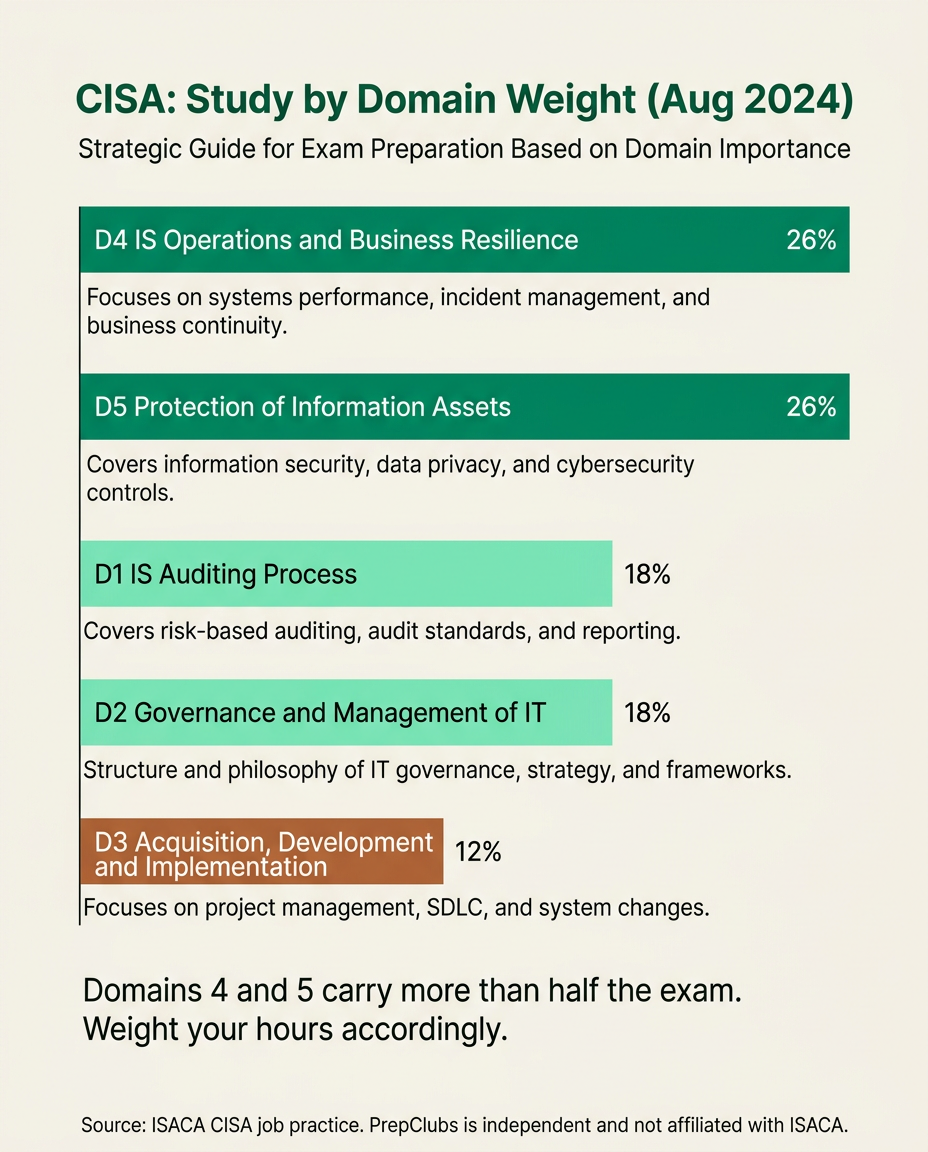
- Domains 4 and 5 are 26 percent each, more than half the exam. Budget study hours to the weights, not evenly.
- A realistic part-time plan is 10 to 12 weeks at six to eight hours a week, shorter if you already work in audit.
- PrepClubs is independent prep material and is not affiliated with or endorsed by ISACA.
The exam these questions live in
Per ISACA's current exam content outline, effective August 1, 2024:
| Attribute | ISACA CISA |
|---|---|
| Questions | 150, all multiple-choice |
| Time | 4 hours |
| Scoring | Scaled, 200 to 800 |
| Passing score | 450 (scaled, not a percentage) |
| Wrong-answer penalty | None |
| Domains | 5 job practice areas |
| Question style | Scenario, asking for the best auditor action |
450 to pass is not 56 percent. It is a scaled score that ISACA adjusts for the difficulty of your question set, so there is no fixed number of correct answers to aim for. Practice to consistent, comfortable passes on full-length sets instead. Fees, retakes and the experience rule are covered in our CISA exam cost and domains guide.
How CISA questions are written
The difficulty is not vocabulary. It is that several answers describe real actions auditors take, and only one is the correct auditor action for the scenario as written. Read like an engineer or a manager and you will pick a plausible wrong answer.
The independence principle
An auditor observes and reports; an auditor does not fix. An auditor who implements the control they are meant to evaluate has compromised the audit. So across all five domains, questions offer a tempting "fix it" option, and the credited answer is usually the one that documents, evaluates and reports instead.
The auditor's default order of operations:
- Understand and document the situation (gather evidence).
- Evaluate the impact and risk.
- Report the finding to the appropriate level.
- Recommend or follow up, only after the steps above.

The auditor never jumps to step 4, and never to actually fixing the control, before the earlier steps. That ordering answers a large share of the exam.
CISA question types: the qualifier words decoded
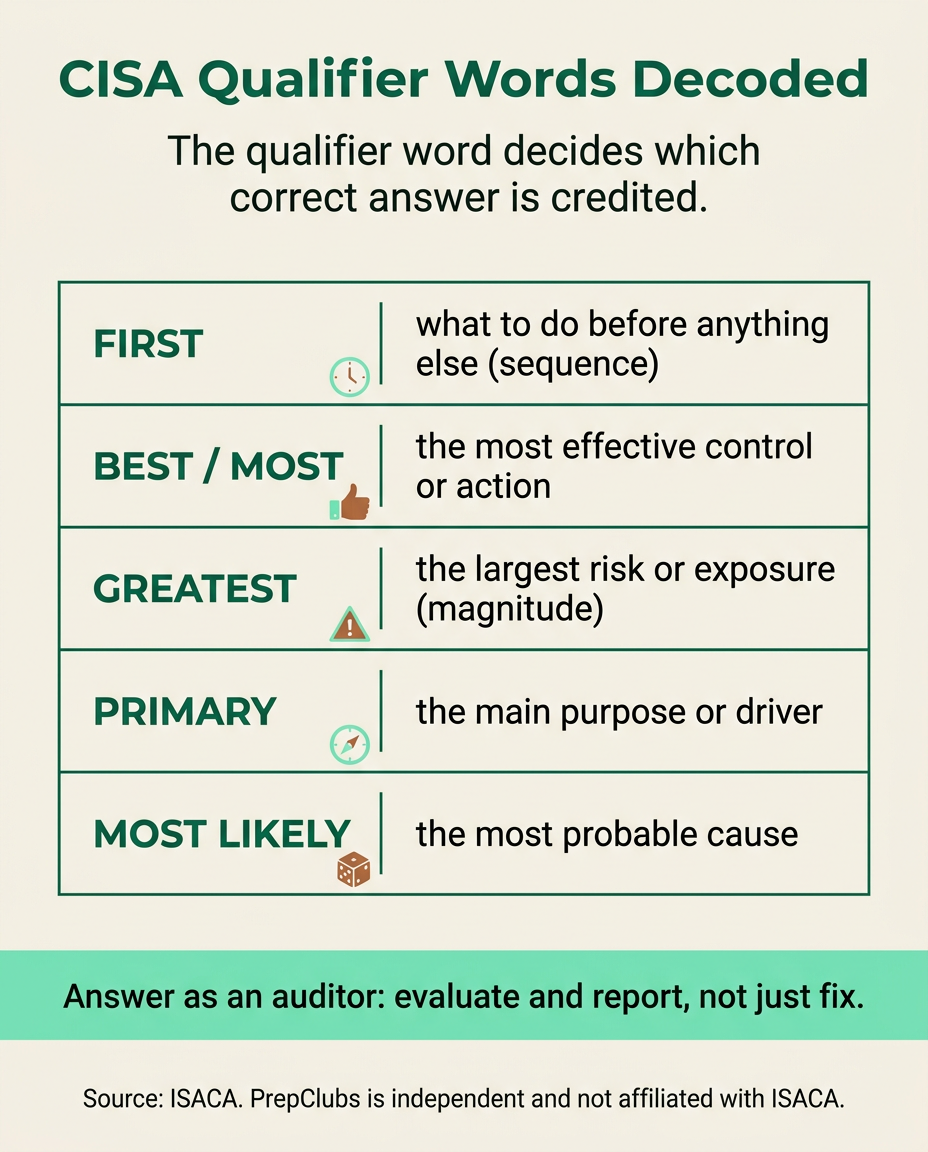
ISACA asks you to select the correct or best answer, and "best" does real work in that instruction. Read the qualifier before the options, because the same four options can have a different credited answer under FIRST than under BEST.
| Qualifier | What it asks | How to answer |
|---|---|---|
| FIRST | Sequence and priority | The action that must come before the others |
| BEST / MOST | Effectiveness | The most effective control or response, usually preventive and structural over detective or discretionary |
| GREATEST | Magnitude | The largest risk or exposure, not the most frequent one |
| PRIMARY | Main purpose or driver | The chief reason or objective |
| MOST LIKELY | Probability | The most probable cause or outcome |
Four real CISA practice questions, one per qualifier
These are verbatim from PrepClubs' CISA bank. Cover the answer and commit to a letter first.
FIRST: sequence beats a good action
From PrepClubs CISA Practice Test 1, question 125 (Domain 5).
During a review of user access, an IS auditor finds several active accounts belonging to employees who left the organization months ago. What should the auditor do FIRST?
- A. Report the terminated-user access to senior management as a formal audit finding.
- B. Instruct IT to disable the affected accounts before continuing the review.
- C. Recommend automated deprovisioning driven by the HR leaver process feed.
- D. Determine the extent and cause from the termination and access review processes.
Answer: D. The first step is to understand the condition: how many accounts, how long they stayed active, whether they were used after termination, and why the termination and access review processes missed them. That evidence makes the eventual finding supportable. Reporting first (A) risks an unsupported finding. Telling IT to disable accounts (B) takes on a management job and impairs independence. Recommending automation (C) proposes a fix before the cause is known. This is the engineer's trap in its purest form: disabling the accounts solves today's problem, but only D tests the control that failed.
BEST: operating evidence beats paperwork
From PrepClubs CISA Practice Test 1, question 22 (Domain 1).
An IS auditor is evaluating whether segregation of duties exists between the staff who initiate and those who approve payments. Which of the following provides the BEST evidence that the segregation actually operates?
- A. The organization chart showing separate reporting lines for the two teams.
- B. The written policy requiring initiation and approval to be separated.
- C. A signed management representation that no one holds both duties.
- D. Observation and review of the access rights actually held by each role.
Answer: D. Design and operation are different questions. Charts and policies show how duties are supposed to be split; only the entitlements actually granted in the payment application show whether one person can both initiate and approve. An org chart (A) is compatible with one user holding both entitlements. A policy (B) is the criteria you test against, not evidence it operates. A management representation (C) is the weakest evidence and just restates the assertion under test.
GREATEST: rank by size of exposure
From PrepClubs CISA Practice Test 8, question 109 (Domain 4).
Two companies sign a reciprocal agreement to host each other's operations after a disaster. What is the GREATEST limitation an IS auditor should raise about this arrangement?
- A. The partner may lack spare compatible capacity when disaster strikes.
- B. The agreement may not state which party pays for data transfer costs.
- C. The partner's staff may need training on the recovery procedures.
- D. The agreement may not be reviewed by legal counsel each year.
Answer: A. A reciprocal agreement promises resources neither party has reserved. When disaster strikes, the partner may have used its spare capacity, may run an incompatible platform after years of separate change, and will put its own recovery first if the same regional event hits both. Cost allocation (B), training (C) and legal review (D) are fixable details. Only A decides whether recovery is possible at all.
PRIMARY: the chief concern, not every concern
From PrepClubs CISA Practice Test 1, question 14 (Domain 1).
An organization asks its internal IS audit team to both select and implement a new access-management tool and then audit its effectiveness the following year. What is the auditor's PRIMARY concern with this arrangement?
- A. Auditing a tool the audit team implemented is a self-review threat.
- B. Selecting the tool outside the procurement policy is a compliance gap.
- C. The audit team may lack vendor training to test the tool competently.
- D. The implementation may consume hours reserved for the annual audit plan.
Answer: A. Selecting and implementing the tool makes the audit team the owner of that control's design, so auditing it later means judging their own work. That self-review threat impairs independence in fact and in appearance. B, C and D are real but secondary: a procurement issue, a competence gap training can fix, and a resourcing problem. None of them makes the audit opinion worthless the way A does.
Notice that three of the four answers turn on independence or evidence quality, not on technical knowledge. That is the CISA in miniature.
Same options, two qualifiers
Here is an original illustration of how much work the qualifier does. An organization has just suffered a data breach, and the options are: contain the incident, notify affected customers, investigate the root cause, and review the incident response plan.
If the qualifier is FIRST, the credited answer leans toward containment, because you stop the damage before anything else. If the question asks what BEST prevents a recurrence, the answer shifts toward reviewing and improving the incident response plan, the most effective forward-looking control. Same four options, two different credited answers, decided entirely by one word.
Reading CISA questions under time pressure
Four hours for 150 scenarios is roughly 96 seconds each. Use the same routine every time so you do not overthink:
- Find the qualifier and restate what it asks for: sequence, effectiveness, magnitude or purpose.
- Anchor to the auditor role. Ask "what does an independent auditor do here," not "what would I do as the engineer or manager."
- Read all four options fully. Do not stop at the first one that looks right.
- Cut the independence-breakers. Any option where the auditor fixes, configures or implements the control is almost always wrong.
- On FIRST questions, when unsure, prefer gathering evidence and assessing impact. If two options remain, pick the one the auditor role favors and move on. There is no penalty for guessing.
What makes a CISA practice bank worth using
Because every option on the CISA is a real audit activity, a bank of bare answers teaches you very little. Two things matter:
- Rationales on every question. The explanation of why the independent, process-following answer wins is the lesson. A few hundred scenario questions with real auditor-judgment rationales beat thousands of bare items.
- Full-length sets weighted like the exam. 150 questions in 4 hours is a stamina test. Practice at full length, with Domains 4 and 5 carrying their 26 percent each, so your accuracy holds in hour four.
Avoid "dumps" that claim to reproduce live exam items. Using them breaches ISACA's candidate agreement, can cost you the certification, and trains recall instead of the reasoning the exam scores.
How to study for the CISA: a domain-weighted plan
Convert the weights into hours
Say you have 70 hours across ten weeks. Split them by the 2024 domain weights:
| Domain | Weight | Hours out of 70 |
|---|---|---|
| 1. Information Systems Auditing Process | 18% | about 13 |
| 2. Governance and Management of IT | 18% | about 13 |
| 3. Acquisition, Development and Implementation | 12% | about 8 |
| 4. Operations and Business Resilience | 26% | about 18 |
| 5. Protection of Information Assets | 26% | about 18 |
Domains 4 and 5 each get more than double the time of Domain 3. That is not neglect; it is spending scarce hours where they earn the most points.
A 10 to 12 week plan
For part-time study at six to eight hours a week. Compress it if you already work in audit; extend it if you are new to the field.
- Weeks 1 to 2: Domain 1, the auditing process. Audit lifecycle, evidence, sampling and risk-based planning. Everything else assumes this vocabulary.
- Weeks 3 to 4: Domain 2, governance and management of IT. IT strategy, policies, organizational structure, and how governance relates to audit.
- Week 5: Domain 3, acquisition, development and implementation. Project management, SDLC controls and post-implementation review. Cover it, then move on.
- Weeks 6 to 8: Domain 4, operations and business resilience. IT operations, incident management, backup, disaster recovery and business continuity.
- Weeks 9 to 10: Domain 5, protection of information assets. Access controls, network security, encryption and physical security, framed as what an auditor evaluates.
- Weeks 11 to 12: full-length practice and correction. Timed 150-question sets, scored by domain, then re-spend your last hours on whichever heavy domain is weakest.
Let practice results steer the second half
The blueprint gives you a starting allocation; your practice scores give the correction. When you break a full-length practice exam down by domain, you get an honest map of where the remaining hours belong. That matters most for the two 26 percent domains, where a weak score costs the most. The most common reason candidates who know the material still fall short is answering like practitioners: choosing "disable the account" when the question wants "find out why the deprovisioning control failed." Practice until the auditor's answer is your reflex.
FAQ
What kind of questions are on the CISA exam?
All 150 are multiple-choice scenario questions asking for the best auditor action, recommendation or conclusion, per ISACA. They test judgment and independence rather than definitions, which is why several options usually look correct.
What does BEST mean in a CISA question?
BEST asks for the most effective option, not merely a correct one. Several options may help; the credited answer addresses the issue most effectively, often a preventive or structural control over a detective or discretionary one, or direct evidence over a representation.
How do I answer "what should the auditor do first" questions?
Follow the auditor's sequence: gather evidence and evaluate the extent and impact first, then report, then recommend. Eliminate options that fix the control, escalate before the facts are known, or recommend a solution before the cause is understood.
Is there a penalty for wrong answers on the CISA?
No. There is no penalty for incorrect answers, so answer every question. Eliminate what you can and make your best choice.
How long should I study for the CISA?
A realistic part-time plan is 10 to 12 weeks at six to eight hours a week, roughly 60 to 90 hours. Candidates already in audit can compress it. Weight the hours to the domains, with Domains 4 and 5 getting the most.
Why do people fail the CISA even when they know the material?
Most often by answering like an engineer instead of an auditor. The CISA rewards the document, evaluate, report and recommend posture over the hands-on fix, so candidates who keep choosing "fix it" miss questions they otherwise understand.
Is the CISA review manual enough on its own?
The manual covers the knowledge, but it does not rehearse the auditor mindset or the stamina of 150 questions in 4 hours. Pair it with scenario questions that carry rationales, and use per-domain practice scores to redirect your last weeks.
Should I use CISA exam dumps?
No. Dumps that claim to reproduce live items breach ISACA's candidate rules and can cost you the certification. They also train recall instead of the auditor reasoning the exam scores. Use original, rationale-backed questions.
Related on PrepClubs
- CISA exam cost, domains and passing score: every fee, the retake rules, the experience waivers and whether the CISA is worth it.
- CISSP vs CISA: how the auditor path differs from the security-leadership path.
- CISSP practice test: the other senior security exam many CISA holders add.
Practice the auditor's judgment
What gets you past 450 is practice that trains the auditor's reasoning: document before you fix, evaluate before you escalate, report rather than implement, and read the qualifier before the options. The four questions above come from PrepClubs' CISA track: 10 full-length, 150-question practice tests plus a 25-question diagnostic, weighted to the five domains like the real exam, with a written rationale on every question. More than 3,700 students have prepared with PrepClubs, and the track is backed by our Money-back Guarantee. Practice at prepclubs.com/tests/cisa.
Practise for this exam
CISA (Certified Information Systems Auditor) practice tests
Full-length timed forms across every exam domain at the official weighting, with a clear rationale for every answer. Start with the 25-question diagnostic to see which domains need the most work.