10 Jobs You Can Get With a CompTIA A+ (and the Objectives Each One Tests)
What jobs can you get with CompTIA A+? Ten real titles, each mapped to the 220-1201 and 220-1202 objectives it draws on, with sourced and dated salary bands.

What jobs can you get with CompTIA A+? The entry tier of IT support: help desk, desktop support, field service, and the technician roles that sit under them. What almost nobody tells you is which part of the exam each of those jobs actually draws on, and that matters, because Core 1 and Core 2 are two different exams testing two different halves of the work. A field service technician lives in Core 1 hardware. A help desk technician lives in Core 2 operating systems and software troubleshooting. Below are 10 jobs, each mapped to the objectives it tests, with a salary figure that names its source and its date.
Quick takeaways
- The A+ is two exams. Core 1 (220-1201) covers hardware, networking, mobile, virtualization, and hardware troubleshooting. Core 2 (220-1202) covers operating systems, security, software troubleshooting, and operational procedures.
- 220-1101 and 220-1102 retired on 25 September 2025. If an article or a study guide is still teaching those codes, it is out of date.
- Each exam is a maximum of 90 questions in 90 minutes. Core 1 passes at 675 out of 900, Core 2 at 700 out of 900.
- The Bureau of Labor Statistics puts the median annual wage for computer user support specialists at $60,340 and for computer network support specialists at $73,340, both May 2024 figures.
- BLS states that support specialist candidates "may qualify with a high school diploma plus relevant information technology (IT) certifications", which is the case for the A+ in one sentence.
- Searching job boards for "CompTIA A+" returns almost nothing. Search the job titles instead. There is a list of the right search strings further down.
What the CompTIA A+ actually certifies in 2026
The current version is V15, launched 25 March 2025, made up of Core 1 (exam code 220-1201) and Core 2 (exam code 220-1202). You need both to be certified. The previous V14 series, 220-1101 and 220-1102, retired on 25 September 2025, so any 2025-dated listicle you find on this topic is very likely mapping jobs to a version that no longer exists.
Per CompTIA, each exam runs to a maximum of 90 questions in 90 minutes, mixing multiple choice with drag-and-drop and performance-based items. Core 1 passes at 675 out of 900. Core 2 passes at 700 out of 900. CompTIA's recommended experience is 12 months of hands-on work in an IT support specialist role, which is a recommendation and not a requirement.
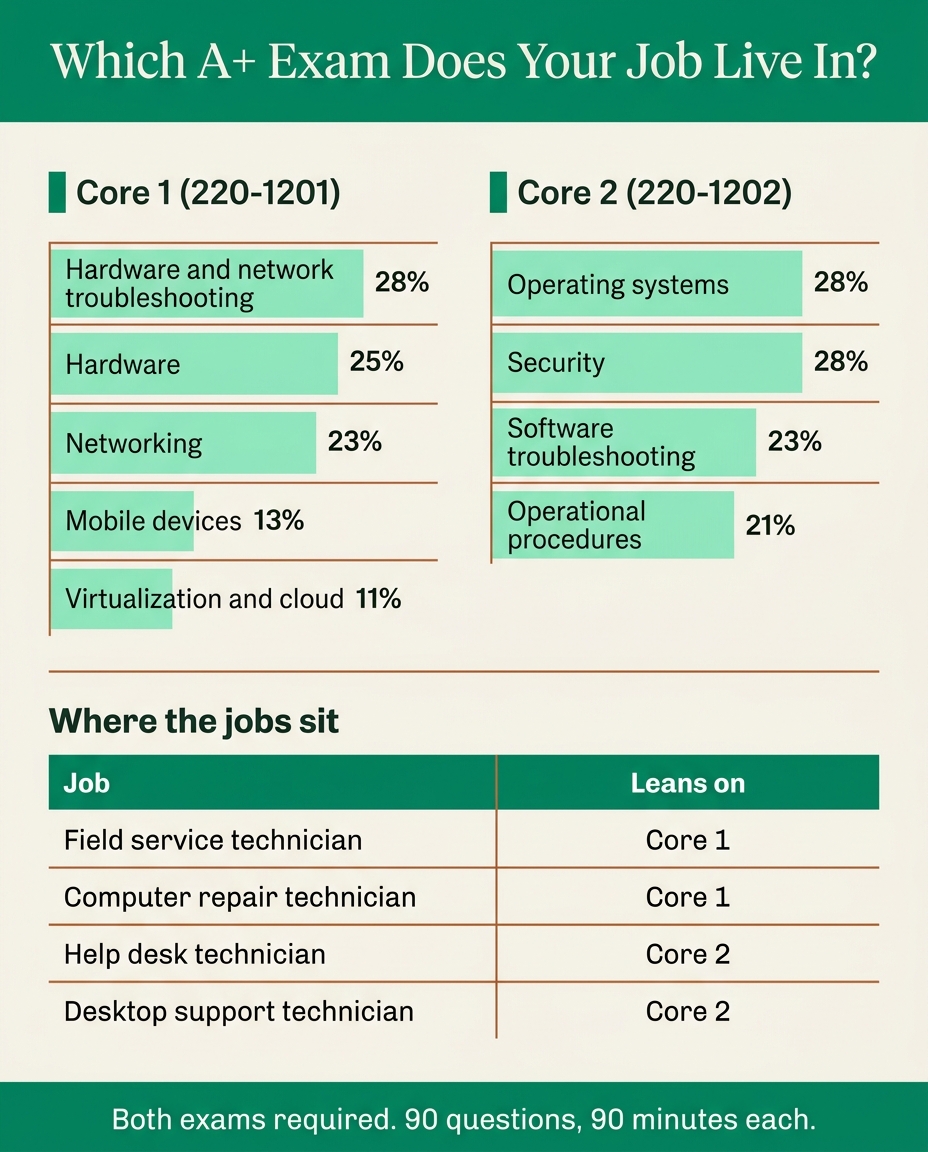
Here are the domains and their weightings, because everything below maps back to this table.
| Core 1 (220-1201) domain | Weight | Core 2 (220-1202) domain | Weight |
|---|---|---|---|
| Hardware and network troubleshooting | 28% | Operating systems | 28% |
| Hardware | 25% | Security | 28% |
| Networking | 23% | Software troubleshooting | 23% |
| Mobile devices | 13% | Operational procedures | 21% |
| Virtualization and cloud computing | 11% |
Two combinations do most of the work. Core 1 hardware plus hardware troubleshooting is 53 percent of that exam and covers nearly all the physical-repair roles. Core 2 operating systems plus security is 56 percent of that exam and covers nearly all the desk-based roles.
The 10 jobs, mapped to the objectives each one tests
Salary conventions, stated once so every figure below is readable. BLS figures are median annual wages from the Occupational Outlook Handbook, reference period May 2024, pages last modified 28 August 2025. Indeed figures are average base pay derived from job postings over a trailing 36-month window, with the date Indeed states the page was updated. The two are not the same measure and are deliberately not converted into each other.
1. Help desk technician
First-line phone, chat, and ticket support. Password resets, application faults, printer queues, escalation.
Objectives it tests: Core 2 operating systems (28%) and software troubleshooting (23%) carry the daily work. Operational procedures (21%) covers the ticketing, documentation, and communication half that most candidates underrate. Core 1 hardware and network troubleshooting (28%) covers the diagnose-over-the-phone part.
Pay: $23.62 per hour average base, Indeed, updated 15 August 2026. The nearest BLS occupation, computer user support specialists, has a median annual wage of $60,340, May 2024.
2. IT support specialist
The broadest title on this list and the one CompTIA itself names as the A+ destination. Mixed desk, remote, and walk-up support across hardware and software.
Objectives it tests: genuinely both exams. Core 1 hardware (25%) and hardware and network troubleshooting (28%), plus Core 2 operating systems (28%) and security (28%). If you want a single role that uses the whole certification, this is it.
Pay: $63,766 per year average base, Indeed, updated 17 August 2026. BLS median for computer user support specialists is $60,340, May 2024.
3. Desktop support technician
Second-line support for end-user machines. Imaging, driver issues, application installs, hands-on fixes at the desk.
Objectives it tests: Core 2 operating systems (28%) is the dominant one, with software troubleshooting (23%) close behind. Core 1 hardware (25%) covers the component swaps.
Pay: $24.96 per hour average base, Indeed, updated 16 August 2026.
4. Field service technician
On-site work across multiple customer locations. Installs, repairs, decommissions, and a lot of driving.
Objectives it tests: Core 1 hardware (25%), mobile devices (13%), and hardware and network troubleshooting (28%). Core 2 operational procedures (21%) is unusually load-bearing here, because it covers safety, environmental handling, and professional customer communication, which is most of what separates a good field tech from a competent one.
Pay: $27.81 per hour average base, Indeed, updated 17 August 2026. The highest hourly figure on this list.
5. Computer repair technician
Bench work. Diagnose, replace, test, return. Retail, refurbishment, or in-house repair depots.
Objectives it tests: the narrowest mapping of the 10, and almost entirely Core 1: hardware (25%) plus hardware and network troubleshooting (28%). That is 53 percent of one exam and very little of the other.
Pay: $19.61 per hour average base for computer technician, Indeed, updated 16 August 2026. "Computer repair technician" has no separately tracked page, so this is the closest honestly comparable title. It is the lowest figure on this list, which is why the role is usually a stepping stone rather than a destination.
6. Installation and deployment technician
Rolling out new machines, peripherals, and endpoints at scale. Common on refresh projects and new-site builds.
Objectives it tests: Core 1 hardware (25%) and networking (23%) for the physical and connectivity side, plus Core 2 operating systems (28%) for imaging and installation.
Pay: $24.23 per hour average base for installation technician, Indeed, updated 17 August 2026. Note that "IT asset technician" and "device deployment technician" do not have their own tracked salary pages, so this is the closest honestly comparable title rather than an exact match.
7. IT technician (systems support)
The internal generalist. One person covering user support, small-scale admin tasks, and whatever the business needs that day.
Objectives it tests: Core 2 across the board, operating systems (28%), security (28%), and operational procedures (21%). This is the role where the Core 2 security domain stops being exam content and starts being your actual job.
Pay: $25.93 per hour average base for IT technician, Indeed, updated 17 August 2026.
8. Network technician
Patching, cabling, switch and access-point support, connectivity troubleshooting under a network engineer.
Objectives it tests: Core 1 networking (23%) and hardware and network troubleshooting (28%). It is the one job on this list where the A+ is genuinely a floor rather than a fit, because CompTIA Network+ is the certification the role is actually built around.
Pay: $26.39 per hour average base for network technician, Indeed, updated 17 August 2026. BLS puts the median annual wage for computer network support specialists at $73,340, May 2024, with a 10th percentile of $46,010 and a 90th percentile of $124,470.
9. Technical support engineer
Product-side support at a software or hardware vendor. Deeper diagnosis, reproduction of faults, escalation to engineering.
Objectives it tests: Core 2 software troubleshooting (23%) and operating systems (28%) are the core. Core 1 virtualization and cloud computing (11%) matters more here than in any other role on this list, because vendor environments are rarely bare metal.
Pay: $85,311 per year average base, Indeed, updated 17 August 2026. The highest figure in the group, and it usually reflects a role that wants the A+ plus product-specific depth.
10. Junior systems administrator
The first step out of support and into infrastructure. Account provisioning, patching, backups, basic server tasks.
Objectives it tests: Core 1 virtualization and cloud computing (11%) and networking (23%), plus Core 2 operating systems (28%) and security (28%).
Pay: BLS gives a median annual wage of $96,800 for network and computer systems administrators, May 2024, with a 10th percentile of $60,320. That median is for the whole occupation, not for junior roles. A junior administrator starting from an A+ should expect the bottom of that range, which is why the 10th percentile is the more honest number to anchor on.
Salary bands at a glance, with sources and dates
| Role | Figure | Measure | Source and date |
|---|---|---|---|
| Computer user support specialists | $60,340 | Median annual wage | BLS OOH, May 2024 |
| Computer network support specialists | $73,340 | Median annual wage | BLS OOH, May 2024 |
| Network and computer systems administrators | $96,800 | Median annual wage, whole occupation | BLS OOH, May 2024 |
| Help desk technician | $23.62 / hour | Average base from postings | Indeed, 15 Aug 2026 |
| Desktop support technician | $24.96 / hour | Average base from postings | Indeed, 16 Aug 2026 |
| Field service technician | $27.81 / hour | Average base from postings | Indeed, 17 Aug 2026 |
| IT support specialist | $63,766 / year | Average base from postings | Indeed, 17 Aug 2026 |
| Technical support engineer | $85,311 / year | Average base from postings | Indeed, 17 Aug 2026 |
Two pieces of context worth having. The BLS all-occupations median annual wage is $49,500 (May 2024), so every role here sits above it. But the median across all computer occupations is $105,990, so entry-tier IT support sits well below the wider field it is the on-ramp to. BLS also projects computer support specialist employment to fall about 3 percent between 2024 and 2034 while still averaging roughly 50,500 openings a year, mostly from turnover. That is a churning entry tier, not a closing one.
The job titles to actually search for
The single most common complaint about the A+ is that searching job boards for "CompTIA A+" returns nothing usable. That is because employers put the certification in the requirements block, not in the title. Search titles instead.
- help desk technician, help desk analyst, service desk analyst
- IT support specialist, technical support specialist, end user support
- desktop support technician, desktop support analyst
- field service technician, field technician, onsite technician
- computer technician, PC technician, repair technician
- deployment technician, installation technician, IT asset technician
- IT technician, systems support technician
- network technician, network support technician
- technical support engineer, product support engineer
- junior systems administrator, associate systems administrator
Filter on entry level or 0 to 2 years, then read the requirements block. The A+ shows up there far more often than it shows up in a title.
Where the A+ stops and the next cert starts
The A+ gets you into the support tier. It does not, on its own, get you into security or networking, and it is honest to say so. Two natural next moves:
- Networking. If jobs 8 and 10 are the target, Network+ is the certification the work is built around. See our Network+ practice guide.
- Security. BLS gives information security analysts a median annual wage of $124,910 (May 2024) and projects 29 percent growth from 2024 to 2034, but also lists a bachelor's degree plus several years of related experience as the typical entry route. Treat that as a destination two or three moves away, not a next step. Our free Security+ practice test is the usual second stop, and the CompTIA trifecta explains how the three stack.
FAQ
What jobs can you get with CompTIA A+ and no experience?
Help desk technician, computer repair technician, deployment technician, and desktop support are the four that most regularly hire without prior professional IT experience. CompTIA recommends 12 months of hands-on experience but does not require it, and BLS notes that support specialist roles may be entered with a high school diploma plus relevant IT certifications.
Is CompTIA A+ worth doing in 2026?
For the entry support tier, yes, because it is the certification employers name most often in that tier's requirements blocks. It is not a shortcut into security or cloud roles. Our honest read is in Is CompTIA A+ worth it.
Is CompTIA A+ difficult to pass?
It is two 90-minute exams of up to 90 questions each, with performance-based items that ask you to complete a task rather than pick an answer. Core 1 passes at 675 out of 900 and Core 2 at 700 out of 900. The difficulty is breadth rather than depth: Core 1 alone spans hardware, networking, mobile devices, virtualization, and troubleshooting.
Which A+ exam should I take first?
Core 1 (220-1201), then Core 2 (220-1202). That is the order CompTIA numbers them and the order that matches how the content builds. You need both to be certified.
What should I do after CompTIA A+?
Get into a support role and then pick a direction. Network+ if the work you enjoy is connectivity and infrastructure. Security+ if it is access control and risk. Both are natural follow-ons from Core 2's security domain, which is 28 percent of that exam.
Do the old 220-1101 and 220-1102 objectives still count?
No. That V14 series retired on 25 September 2025. The current V15 exams are 220-1201 and 220-1202, launched 25 March 2025. Studying the retired objectives will leave gaps against the exam you actually sit.
Does CompTIA A+ guarantee a job?
No certification does. What the A+ does is get your application past the requirements filter for the roles above, which is where most candidates without a degree or prior experience get screened out.
Related on PrepClubs
- Practice questions. CompTIA A+ practice test. Question formats, performance-based items, and how to drill them.
- The honest read. Is CompTIA A+ worth it. What the certification does and does not do for an entry-level candidate.
- Next certification. CompTIA Network+ practice test.
- The full stack. The CompTIA trifecta. How A+, Network+, and Security+ fit together.
- Security path. Free Security+ practice test.
Practice on PrepClubs
PrepClubs is independent practice material and is not affiliated with or endorsed by CompTIA. Every question in the bank is written by us, never taken from a live exam.
If your exam is booked for next week, the useful sequence is a cold full-length mock on day one to find your weakest domain, then two days drilling that domain, then a second timed mock. Core 1 and Core 2 are separate bookings, so run that cycle twice rather than trying to prepare for both at once.
The A+ cluster is 10 full-length premium mocks plus a free diagnostic, 925 original practice questions in total, for $69 as a one-time payment with 30-day access. If you prepare with PrepClubs and do not pass your real exam, we extend your access at no extra cost. No fine print and no satisfaction-guarantee hedge.
Start with the free A+ practice test, browse the A+ hub, or get A+ access.
Junaid Khalid runs PrepClubs, a practice-test platform with 1,600+ students who have prepped for cognitive, aptitude, and certification exams.