The CompTIA Trifecta (A+, Network+, Security+): Order, Timeline, and Cost
The CompTIA Trifecta is A+, Network+, and Security+. Here is the order to take them, a realistic timeline, and the real cost, plus when to skip a cert.

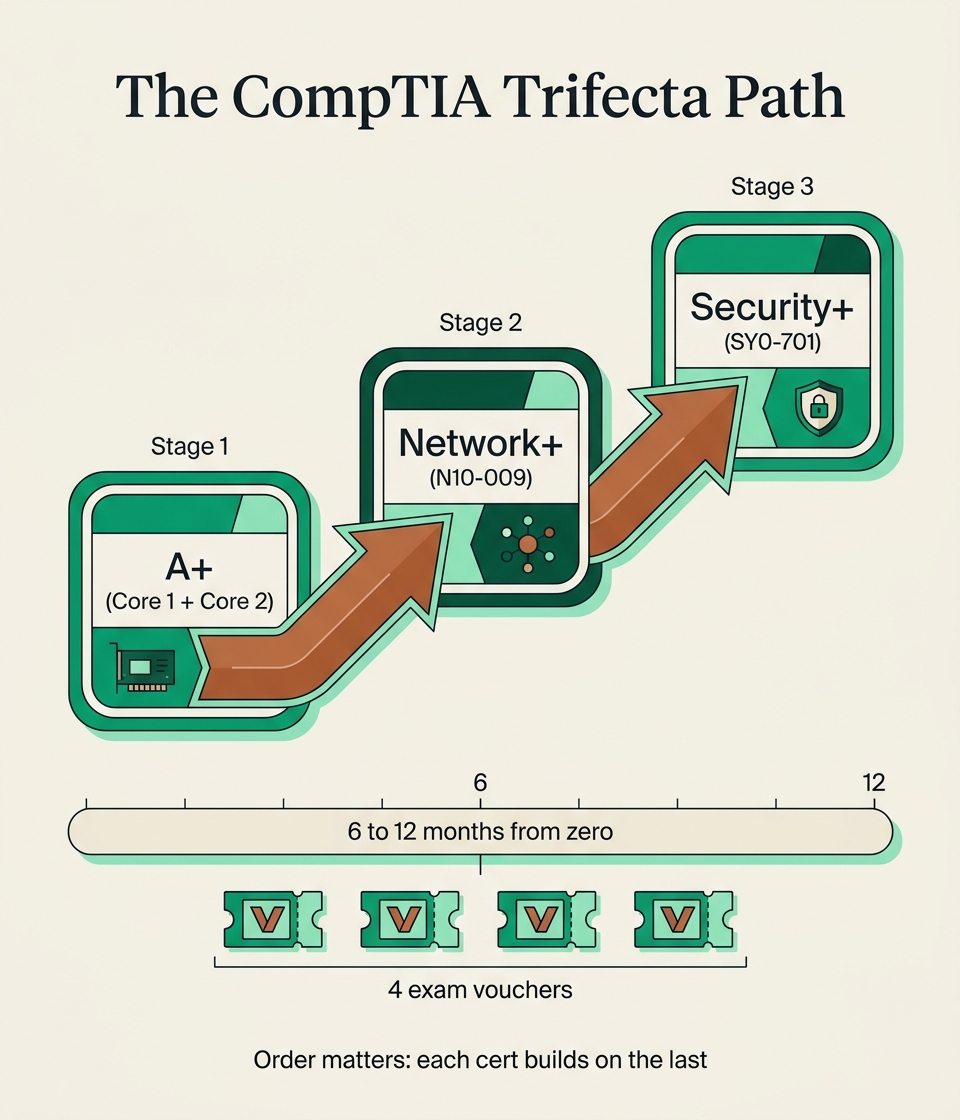
The CompTIA Trifecta is three certifications, taken as a path: A+, then Network+, then Security+. It is the standard way people with no formal IT background prove baseline competency in hardware, networking, and security, in that order. Take them in sequence, budget six to twelve months if you are starting from zero, and expect to pay for four separate exam vouchers, because A+ alone is two exams.
That is the short answer. The rest of this guide is the practical version: the exact order and why it works, a realistic timeline, what it actually costs, and the honest case for when you should skip a cert rather than grind all four exams.
Quick takeaways
- The Trifecta is CompTIA A+, Network+, and Security+, usually taken in that order.
- It is four exams, not three: A+ is Core 1 (220-1201) and Core 2 (220-1202), both required, plus one Network+ exam and one Security+ exam.
- Realistic timeline from zero: 6 to 12 months of steady study, per CompTIA's own guidance and common candidate reports.
- Cost is meaningful. Individual CompTIA exam vouchers run roughly $250 to $400 each, per CompTIA's published US pricing, so four vouchers is a real budget line.
- Each cert is valid for 3 years and renews through continuing education (CEUs) or by earning a higher cert.
- Skipping a cert is defensible in specific cases. This guide names them honestly instead of insisting everyone needs all three.
- PrepClubs is independent prep material and is not affiliated with or endorsed by CompTIA.
What the Trifecta is, and why the order
The three certs map to the three layers a support-and-security career is built on, and each one assumes the last.
- CompTIA A+ is the foundation: hardware, operating systems, mobile devices, basic networking, and troubleshooting. It is two exams (Core 1 and Core 2), and it is the entry point that assumes no prior IT knowledge.
- CompTIA Network+ goes deep on networking: the OSI model, IP addressing and subnetting, routing and switching, and network troubleshooting. It assumes the networking basics A+ introduced.
- CompTIA Security+ is entry-level cybersecurity: threats, cryptography, access control, and security operations. It assumes you understand the networks you are now securing.
The order matters because the knowledge stacks. You cannot secure a network (Security+) you do not understand (Network+), and you struggle to understand a network without the hardware-and-OS grounding A+ gives you. Taken in order, each cert makes the next one easier. Taken out of order, you fight uphill.
| Cert | Exams | Broad focus | Assumes |
|---|---|---|---|
| A+ | 2 (Core 1, Core 2) | Hardware, OS, troubleshooting | Nothing |
| Network+ | 1 (N10-009) | Networking, subnetting, routing | A+ level basics |
| Security+ | 1 (SY0-701) | Cybersecurity fundamentals | Network+ level basics |
A realistic timeline
CompTIA's own guidance and the common experience of career switchers land in the same range: six to twelve months from a standing start, studying steadily around a job. Here is how that breaks down.
| Stage | Typical time (from zero) |
|---|---|
| A+ Core 1 | 4 to 8 weeks |
| A+ Core 2 | 4 to 8 weeks |
| Network+ | 6 to 10 weeks |
| Security+ | 6 to 10 weeks |
| Total | Roughly 6 to 12 months |
Two things compress that. If you already work in IT support, you may test out of large chunks of A+ and move faster. And if you have real networking experience, some people skip A+ entirely (more on that below). Two things stretch it: studying only occasionally, and booking exams before your practice scores are comfortably passing. The candidates who finish in six months treat it like a part-time course, not an occasional hobby.
What the Trifecta actually costs
This is where honesty matters, because the exam vouchers are the real expense and they add up. Per CompTIA's published US pricing, a single exam voucher runs roughly $250 to $400 depending on the certification. The Trifecta is four vouchers (two for A+, one each for Network+ and Security+), so the exam cost alone is a genuine budget line before you add any study material.
A few cost realities worth planning around:
- A+ is two vouchers. People routinely forget this and under-budget. Core 1 and Core 2 are billed separately.
- Retakes cost another voucher. Failing an exam means paying again to re-sit it, which is exactly why passing on the first attempt is worth preparing for properly.
- Renewal is ongoing. Each cert lasts three years and must be renewed through continuing education units (CEUs) or by earning a higher-level cert, per CompTIA. The Trifecta is not a one-time purchase for life.
Because retakes are their own voucher, the smartest money move is to not fail. Practice to a comfortable margin above each passing score before you book, so you pay for each exam once.
When to skip a cert (the honest version)
Not everyone needs all three, and pretending otherwise wastes people's money. Here are the defensible cases, which mirror the real debate among working IT professionals.
- You already have hands-on experience. With one to two years in IT, many people skip A+ and start at Network+, because A+ mostly certifies what they already do daily.
- Your target is strictly cybersecurity, fast. Some career switchers go A+ then straight to Security+, treating Network+ as optional. It works for the certification, though the networking gap tends to show up on the job.
- A role-specific path fits better. For some networking careers, a vendor cert like the CCNA is a stronger signal than Network+. If a job posting names a specific cert, chase that one.
The Trifecta is a strong default for someone starting from zero with a broad IT-support-to-security goal. It is not a mandate. Match the certs to where you actually are and where you want to land.
FAQ
Is the CompTIA Trifecta three exams or four?
Four. A+ requires passing two separate exams, Core 1 (220-1201) and Core 2 (220-1202), plus one Network+ exam and one Security+ exam. That is four vouchers in total.
What order should I take the CompTIA Trifecta in?
A+, then Network+, then Security+. The knowledge stacks: A+ gives the hardware and OS foundation, Network+ builds networking depth on top, and Security+ secures the networks you now understand. Out of order, each exam is harder.
How long does the CompTIA Trifecta take?
From no IT background, roughly 6 to 12 months of steady study, per CompTIA's guidance and common candidate experience. People already working in IT often move faster and may skip parts of A+.
How much does the CompTIA Trifecta cost?
Per CompTIA's published US list pricing, A+ is $274 per exam (two exams, so $548), Network+ is $399, and Security+ is $439. Retakes cost another voucher, and each cert renews every three years, so budget for the full path plus renewal.
Can I skip A+ and go straight to Network+ or Security+?
Yes, if you already have hands-on IT experience. Beginners generally should not, because A+ builds the foundation the later certs assume. If your goal is strictly cybersecurity and you have some background, A+ then Security+ is a common shortcut, though the networking gap can catch up with you.
Do CompTIA certifications expire?
Yes. Each is valid for three years and renews through continuing education units (CEUs) or by earning a higher-level CompTIA certification, per CompTIA. The Trifecta is an ongoing credential, not a one-and-done.
Related on PrepClubs
-
CompTIA A+ practice test: drilling Core 1 and Core 2 to a pass.
-
CompTIA Network+ practice test: the five N10-009 domains and how to drill them.
-
Security+ practice test: using a full-length SY0-701 bank the right way.
-
Free Security+ practice test: where a free diagnostic ends and real prep begins.
-
The complete CompTIA certification list: all 17 certifications with cost, exam code, difficulty, and renewal window.
Prepare for the whole path, not just one exam
The Trifecta is four exams and a real budget, and the one thing that blows up the budget is a retake. That is the case for preparing each exam properly the first time. PrepClubs covers the CompTIA path with dedicated practice tracks for A+, Network+, and Security+: full-length practice tests with performance-based tasks and written rationales, per-domain breakdowns so you drill where the points are, and a free diagnostic for each exam so you know exactly where you stand. Each track is a one-time purchase with 30 days of access, not a subscription, and if you prepare with PrepClubs and do not pass your real test, we extend your access at no extra cost. No fine print. PrepClubs has helped more than 1,600 students prepare for cognitive and certification assessments. See the CompTIA practice tracks.
FAQ