PI Cognitive Assessment Practice Test (Free)
The PI Cognitive Assessment is 50 questions in 12 minutes across numerical, verbal, and abstract reasoning. Here is a free walkthrough with worked sample questions, the raw-to-scaled score bands, and where candidates los

Take a free PI Cognitive Assessment practice test. Run a full 50-question, 12-minute set on PrepClubs, built to mirror the Predictive Index Cognitive Assessment (also called the PLI), scored the moment you finish, then use the walkthroughs below to fix your slowest question types. Start the free PI Cognitive practice test.
The honest answer about the PI Cognitive Assessment is that it is not a hard test question by question. It is hard because you get 50 questions and 12 minutes, which works out to about 15 seconds each. Almost nobody finishes. The candidates who score well are not smarter; they are faster at recognising the question type and moving on. This walkthrough shows you the three question types, walks four sample questions end to end, and tells you what your raw score actually converts to.
Quick takeaways
- The PI Cognitive Assessment (the test inside the Predictive Index) is 50 questions in 12 minutes, delivered as 10 screens of 5 questions each.
- Questions come from three families: numerical reasoning, verbal reasoning, and abstract (pattern) reasoning. There are nine underlying question types and they shuffle constantly.
- Your raw score is simply the number of correct answers. The average is about 20 out of 50, which maps to a scaled score of 250 and the 50th percentile against a norm group of more than 288,000 test takers.
- The scaled score runs from 100 to 450. There is no single passing score. Employers set a Job Target range, and analytical roles in consulting and finance typically sit higher than operational roles.
- You are not expected to answer all 50. Accuracy on the questions you do reach matters more than racing to the end and guessing.
- The fastest score gains come from drilling the three question types until you can classify a question in under three seconds, not from learning new maths.
What the PI Cognitive Assessment actually is
The PI Cognitive Assessment is the cognitive half of the Predictive Index. The other half, the PI Behavioral Assessment, measures work style and is not timed or scored for right and wrong answers. If you are unsure which one you are sitting, the format gives it away: the cognitive test is the timed, 50-question, 12-minute one. For the full split between the two, see our breakdown of the Predictive Index cognitive and behavioral formats and the dedicated guide to the PI Behavioral Assessment.
Some employers call this exact test the PLI (Predictive Learning Indicator). It is the same 50-questions-in-12-minutes test under a different label. The Predictive Index sells it to companies through hiring software, so the candidate experience is consistent: 10 screens, 5 questions per screen, a single visible countdown timer, and no going back to a previous screen once you advance.
The test is adaptive only in the sense that the question mix is unpredictable. It does not get harder as you go. A hard abstract-reasoning item can sit right next to a one-step arithmetic question. That randomness is deliberate. The Predictive Index is measuring how quickly you can switch between modes of thinking, not how deep you can go on any single problem.
The three question types you will actually see
Every question on the PI Cognitive Assessment belongs to one of three families. Knowing which family a question is in, before you read it closely, is half the battle.
Numerical reasoning covers number series (spot the pattern and continue it), straightforward arithmetic and percentages, and short word problems involving ratios, rates, or simple algebra. Verbal reasoning covers analogies, antonyms and synonyms, sentence logic, and the occasional formal-logic statement. Abstract reasoning is the non-verbal set: which shape comes next in a sequence, which figure does not belong, and matrix-style pattern completion.
| Family | What it tests | Typical question forms |
|---|---|---|
| Numerical | Speed with numbers and patterns | Number series, percentages, rate and ratio word problems |
| Verbal | Reasoning with words | Analogies, antonyms, synonyms, sentence logic |
| Abstract | Non-verbal pattern recognition | Next-in-series shapes, odd-one-out, matrix completion |
The reason this matters for timing: each family rewards a different first move. On a number series, you look at the gaps between terms before anything else. On a verbal analogy, you name the relationship in the first pair before you scan the options. On an abstract item, you look for one rule (rotation, count, shading) at a time. Candidates who try to solve every question with the same approach burn seconds they do not have.

Four sample questions, walked through
These four samples mirror the style of the real test. Time yourself: give each one about 15 seconds before you look at the explanation. If you need longer, that is the signal for what to drill.
Sample 1 (numerical, number series)
What number comes next in this series?
4, 8, 16, 32, ?
A) 40 B) 48 C) 56 D) 64 E) 128
The move here is to check the relationship between consecutive terms before assuming it is addition. The gaps (4, 8, 16) are not constant, so it is not an arithmetic series. Each term is double the one before it: 4 to 8, 8 to 16, 16 to 32. The next term is 32 times 2, which is 64. The answer is D. The common trap is E (128), which you land on if you double twice or misread 32 as the term to skip.
Sample 2 (numerical, percentage word problem)
A retailer lists a jacket at $80 and marks it down 25 percent in a sale. What is the sale price?
A) $55 B) $58 C) $60 D) $64 E) $70
Twenty-five percent of $80 is $20. Subtract that from $80 and the sale price is $60. The answer is C. Under time pressure, the faster route is to recognise that a 25 percent discount means you pay three quarters of the price, and three quarters of $80 is $60. Training yourself to see "25 percent off equals times 0.75" removes a calculation step.
Sample 3 (verbal, analogy)
HORSE is to FOAL as SHEEP is to ___?
A) Wool B) Lamb C) Ewe D) Ram E) Flock
Name the relationship in the first pair before you read the options: a foal is the young of a horse. So you need the young of a sheep, which is a lamb. The answer is B. The distractors are all sheep-related (wool is the product, a ewe is the female, a ram is the male, a flock is the group), which is exactly how the PI Cognitive Assessment builds verbal traps. Lock the relationship first and the wrong options stop being tempting.
Sample 4 (abstract, next in series)
This is an abstract-reasoning item. Work out the rule that governs how the figure changes from one step to the next, then decide which figure continues the pattern. Do not look for more than one rule at a time.
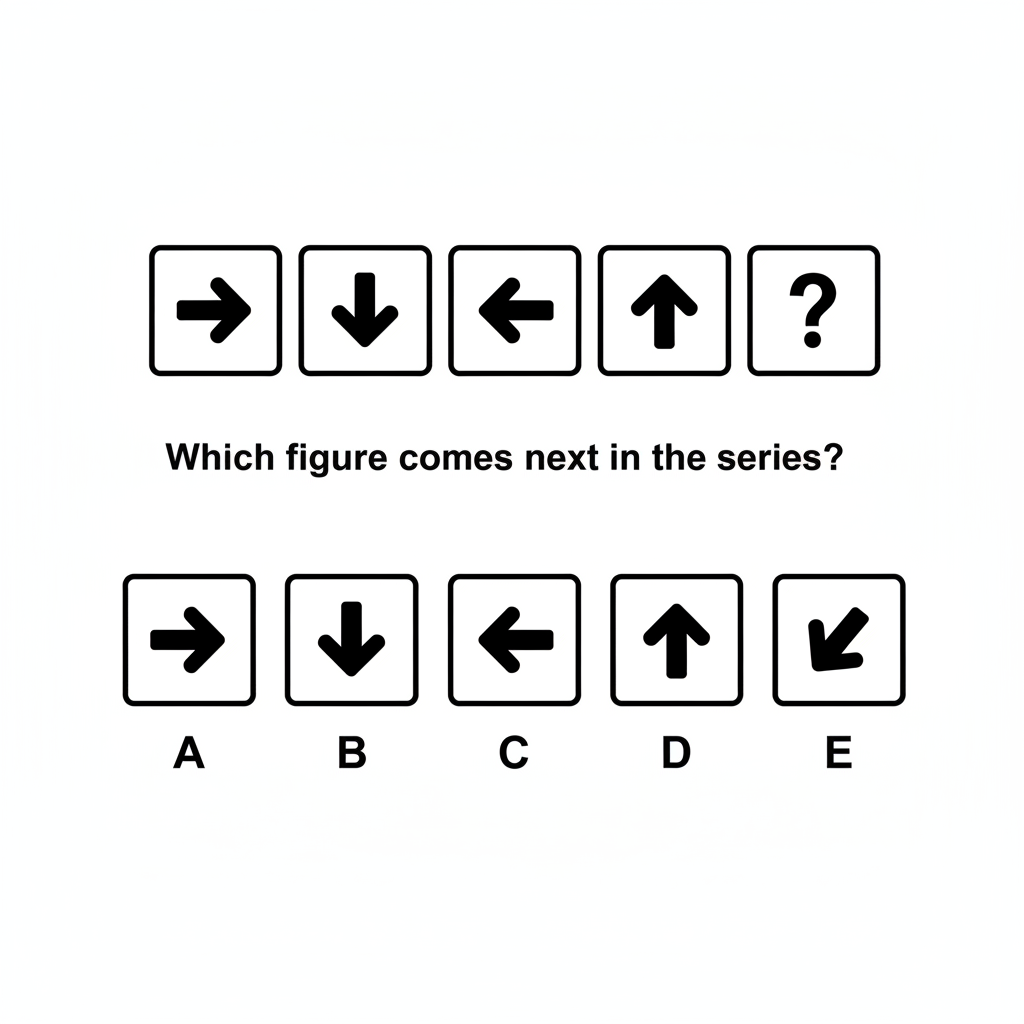
The way to approach this one is to track a single property across the steps. Ask what is staying the same and what is changing: is the shape rotating by a fixed amount, is something being added each step, or is shading alternating? Once you can state the rule in one sentence ("the arrow turns a quarter-turn clockwise each time", for example), the correct option is the one that obeys that rule for the next step. We are not giving the answer letter here on purpose; the skill being tested is finding the rule yourself in seconds, which is exactly what you will do under the timer. Full worked abstract sets are in the PrepClubs practice bank linked below.
What your score actually means
Your raw score is the count of correct answers out of 50. That raw number is then placed against the Predictive Index norm group of more than 288,000 assessments and converted to a scaled score between 100 and 450, plus a percentile. The anchor point worth memorising: a raw score of 20 equals a scaled score of 250 equals the 50th percentile. Everything else is read relative to that.
The table below is the practical version. Treat the scaled and percentile columns as approximate; the Predictive Index publishes the 250-equals-average anchor, and the surrounding bands are drawn from reported prep ranges, not an official per-point chart.
| Raw correct (of 50) | Approx scaled score | Approx percentile | What it typically signals |
|---|---|---|---|
| 12-15 | 205-230 | ~20-35th | Below most Job Targets; entry and operational roles |
| 16-19 | 235-248 | ~38-48th | Just under the norm-group average |
| 20 | 250 | 50th | The norm-group average (288,000+ takers) |
| 21-25 | 255-282 | ~55-70th | Comfortable for many mid-level roles |
| 26-30 | 285-312 | ~73-85th | Common analyst and graduate-scheme target |
| 31-36 | 315-345 | ~88-96th | Consulting, finance, and management targets |
| 37+ | 350-450 | 97th+ | Top of the norm group |
The chart below collects every score band in one place.

The critical thing to understand is that there is no universal pass mark. Inside the Predictive Index platform, the hiring manager sets a Job Target with a cognitive range for the role. If your score sits at or above that target, your cognitive match is treated as a full ten, and there is no penalty for scoring above it. A score that is excellent for a customer-support role can be merely average for a strategy-consulting role. For how this compares across other cognitive tests, the PrepClubs guide to what counts as a good cognitive test score puts the PI scale next to the CCAT and Wonderlic. For the timing mechanics specifically, see Predictive Index test format and timing.
Where candidates lose points
The biggest point leak is not difficulty. It is the timer combined with the no-back-button rule. Candidates who treat the PI Cognitive Assessment like a school test, reading each question carefully and double-checking, reach question 30 of 50 and run out of time on questions they could easily have answered.
The second leak is over-investing in one hard item. A single abstract-reasoning matrix can eat 60 seconds, which is the time budget for four other questions. The disciplined move is to give any one question a hard cap (around 20 seconds), make your best choice, and move on. Because there is no penalty structure that punishes a wrong answer more than a blank one, leaving an item blank is almost never correct; a fast guess on a question you cannot crack is better than a careful blank.
The third leak is mode-switching cost. Going from a percentage word problem straight into a shape-rotation item forces a mental gear change, and that change costs a second or two every time. The only fix is volume: the more mixed practice you do, the smaller the switching cost becomes, until classifying a question by family is automatic.
Before you obsess over any single item, it helps to know how many questions you actually need to finish to hit your target, because that number, not raw difficulty, is what your pacing should be built around.
A practice routine that works
You do not need weeks. You need focused, mixed, timed practice. A workable routine over five to seven days looks like this. First, do one untimed full set so you see all three families and learn the question forms without pressure. Second, drill each family separately: a block of number series, a block of analogies, a block of abstract patterns, until your first move on each is automatic. Third, switch to timed mixed sets of 50 questions in 12 minutes, and review every miss by family so you know whether your weakness is numerical, verbal, or abstract. Fourth, in the final two sessions, practise the triage skill directly: force yourself to skip-and-guess on anything you cannot classify in three seconds, so the habit holds on test day.
The numbers-first version of the goal: if the average is a raw 20 and you want to clear a typical analyst Job Target around the 75th percentile, you are aiming for roughly 26 to 30 correct. Getting there is usually a speed gain, not a knowledge gain, and speed responds quickly to mixed timed practice.
FAQ
How many questions are on the PI Cognitive Assessment and how long do I get?
Fifty questions in 12 minutes, presented as 10 screens of 5 questions each. That is about 15 seconds per question, and most candidates do not reach all 50.
What is a good score on the PI Cognitive Assessment?
There is no single pass mark. The average raw score is about 20 out of 50 (scaled 250, 50th percentile). Many analyst and graduate roles target roughly 26 to 30 correct, and consulting or finance roles often sit higher. The employer's Job Target for the specific role is what actually matters.
Is the PI Cognitive Assessment the same as the PLI?
Yes. The PLI (Predictive Learning Indicator) is the same 50-question, 12-minute test under a different name. Some employers use the older PLI label, but the format and scoring are identical.
Do I lose points for wrong answers?
No. Your raw score is the number of correct answers. Because there is no extra penalty for a wrong answer over a blank, a fast guess on a question you cannot solve in time is generally better than leaving it blank.
Can I use a calculator?
In most administrations no calculator is allowed, and scratch paper rules depend on the employer and whether the test is proctored. The numerical questions are designed to be solvable by hand in seconds, so the test is really checking mental arithmetic speed, not heavy calculation.
How is the raw score converted to the scaled score?
Your number of correct answers is compared against a norm group of more than 288,000 previous test takers and mapped to a scaled score between 100 and 450, along with a percentile. A raw 20 is the anchor: it converts to a scaled 250 and the 50th percentile.
How many times can I retake it?
Retake policy is set by the employer, not by the Predictive Index. Some allow a single sitting per application, others permit a retake after a waiting period. Assume one attempt unless the employer tells you otherwise.
If you want the underlying breakdown of how the 50-in-12 format produces a raw 17 to 23 median and how that converts to the 100 to 450 scaled score employers see, read PI Cognitive Assessment: 50 Questions in 12 Minutes Explained.
Related on PrepClubs
- Pillar. The Predictive Index cognitive and behavioral formats. The hub page for everything PI, including which test you are sitting.
- Deep practice. PI Cognitive practice with full walkthroughs. Timed 50-question sets and worked answers. Money-back Guarantee.
- Format. Predictive Index test format and timing. The screen-by-screen timing mechanics in detail.
- Compare. The Predictive Index in 2026: cognitive vs behavioral. How the two halves of the PI differ and how hiring uses each.
- Behavioral. PI Behavioral Assessment explained. The untimed work-style half of the Predictive Index.
- Guide. What is a good cognitive test score. PI scaled scores set next to CCAT and Wonderlic benchmarks.
Practice on PrepClubs
Train for the 15-second clock, not just the questions
The PI Cognitive Assessment is won on speed and triage, so PrepClubs practice sets run on the real 50-questions-in-12-minutes clock, mix all three question families the way the live test does, and give you a worked walkthrough for every item so you learn the fastest first move. Every miss is tagged numerical, verbal, or abstract so you know exactly what to drill next. Money-back Guarantee.
Practise for this exam
PI Cognitive practice tests
Timed practice tests in the real PI Cognitive format, with a worked explanation for every question, so you learn the method as well as the answer.