Predictive Index Test: Format, Time Limit, Sample Questions
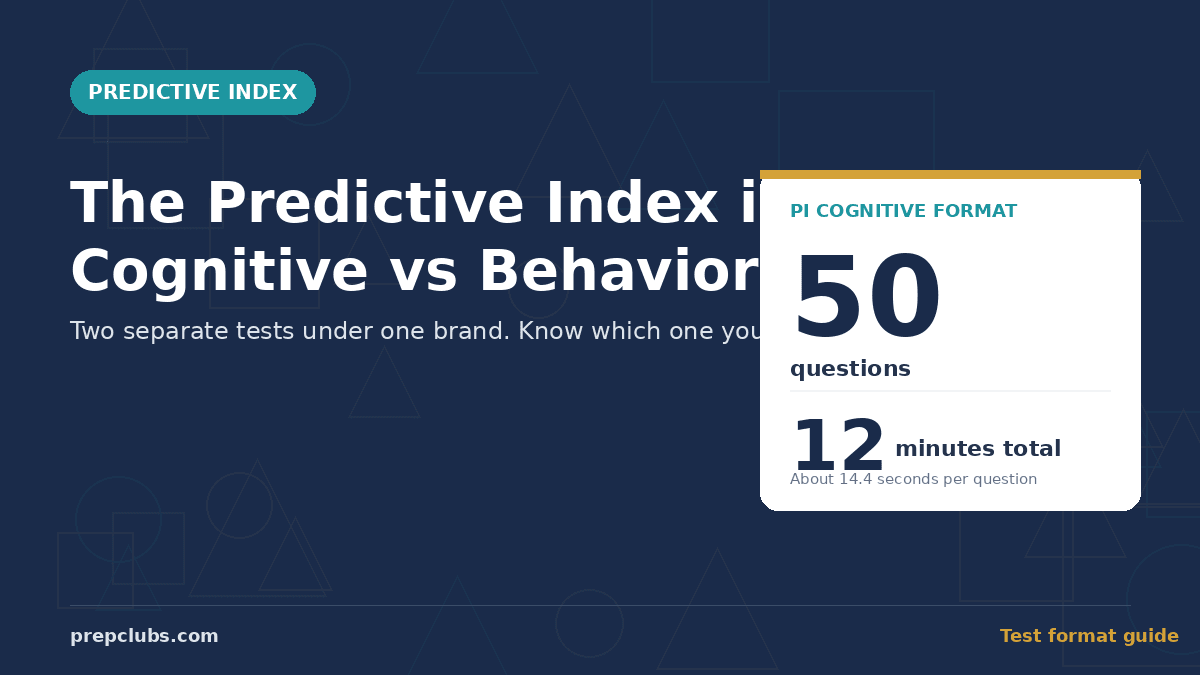
The Predictive Index Cognitive Assessment is 50 questions in 12 minutes, about 15 seconds each, drawn from numerical, verbal, and abstract reasoning. It is scored on a 100 to 450 scale against a norm group, with no unive

The honest answer is that the Predictive Index test is not hard because the questions are hard. It is hard because there are 50 of them and you have 12 minutes, which is about 15 seconds per question. The test, properly the PI Cognitive Assessment, mixes numerical, verbal, and abstract reasoning into one timed run, and almost nobody finishes all 50. The average candidate answers about 20 correctly. What separates a strong score from an average one is pacing and knowing when to skip, not raw intelligence.
Quick takeaways
- The PI Cognitive Assessment is 50 questions in 12 minutes, roughly 15 seconds per question. It is published by Predictive Index and often arrives alongside the PI Behavioral Assessment.
- Questions come from three areas: numerical reasoning, verbal reasoning, and abstract reasoning, interleaved rather than grouped. A candidate sees at most 18 numerical, 16 verbal, and 16 abstract items.
- The raw score (correct out of 50) is converted to a scaled score from 100 to 450, with a global mean of 250 and a standard deviation of 80. Scores are reported in 10-point increments.
- The average candidate gets about 20 of 50 correct, which maps to a scaled score around 250. Getting about 40 correct lands near the 98th percentile.
- There is no universal pass mark. Each employer sets a cognitive Job Target range for the role, and your match score (1 to 10) reflects how close your scaled score is to that target.
- The norm group is large, roughly 288,000 prior test-takers, which is why the percentile is stable across employers even though the target moves.
- Most candidates lose the test on pace, not difficulty. Spending 40 seconds on one numerical item costs you two or three easy questions later in the run.
What the Predictive Index test actually is
Predictive Index sells two assessments that employers frequently send together, and candidates mix them up constantly. The PI Behavioral Assessment is a 6-minute, untimed-per-item personality and work-drive checklist. The PI Cognitive Assessment, the subject of this article, is the hard one: 50 questions in a strict 12 minutes, measuring general cognitive ability under time pressure. If your invitation mentions a 12-minute timer and 50 questions, you are sitting the Cognitive.
The Cognitive is also marketed under the name PLI (Predictive Learning Indicator) in some markets and through some resellers, but it is the same instrument with the same 50-questions-in-12-minutes format. It is used most heavily by operating-partner private equity portfolio companies, mid-market software and services firms, and a long tail of employers who run it as an early screen before any human reviews the application.
This article covers the format, the strict timing, worked examples of all three question types, how the 100-to-450 scaled score is built, and the pacing mistakes that cost candidates the most. For the wider PI suite, including how the Cognitive and Behavioral fit together, read The Predictive Index in 2026: Cognitive vs Behavioral, Score, and How to Pass.
Candidates mix the two up constantly; if that is you, start with PI Cognitive versus PI Behavioral, and how to tell them apart.
Format and timing: 50 questions in 12 minutes
The PI Cognitive Assessment is 50 multiple-choice questions with a hard 12-minute limit. That is about 15 seconds per question if you answer every one, which almost nobody does. There is no separate timer per question and no penalty structure beyond the clock: unanswered questions simply score as incorrect, and there is no negative marking for wrong answers, so guessing on items you cannot reach is strictly correct strategy.
The three question types are interleaved, not grouped into sections. You might get a numerical item, then a verbal one, then two abstract items, in no fixed order. Because the test draws from an item bank, the exact mix varies between candidates, but a single sitting caps out at 18 numerical, 16 verbal, and 16 abstract items. The test is computer-based and usually unproctored, delivered through a link, so you take it on your own machine.
The chart below frames the test before we work through each question type.

The single most important format fact is that the test is designed so that finishing all 50 is rare. The clock, not the question difficulty, is the adversary. That changes how you should approach it: the goal is to maximise correct answers in 12 minutes, which means moving fast and skipping anything that will eat more than 20 seconds.
The three question types, with worked examples
Numerical reasoning
Numerical items test arithmetic, ratios, percentages, number series, and word problems. They reward quick mental math and recognising the shortcut rather than grinding through long calculation.
Worked example. A team completes 18 units in 6 hours. Working at the same rate, how many units would 3 such teams complete in 4 hours? The fast path: one team makes 3 units per hour (18 divided by 6), so 3 teams make 9 units per hour, and over 4 hours that is 36 units. The answer is 36. The trap is computing per-team totals for 6 hours and then trying to rescale, which wastes time.
Verbal reasoning
Verbal items test vocabulary, analogies, antonyms, and short logical deductions from sentences. They reward fast reading and a wide working vocabulary.
Worked example. Which word is most nearly opposite in meaning to "candid"? Options: honest, secretive, blunt, frank. The answer is secretive. Honest, blunt, and frank are all near-synonyms of candid, which is the distractor pattern: three words cluster around the prompt's meaning and one sits opposite. Spotting the cluster is faster than weighing each option individually.
Abstract reasoning
Abstract items test pattern recognition with shapes, sequences, and matrices. They reward seeing the rule quickly rather than describing it fully.
Worked example. A single arrow rotates 90 degrees clockwise at each step in a series. If it currently points North, where does it point after three steps? North to East is one step, East to South is two, South to West is three, so the answer is West. The trap is losing track of the count under time pressure; tracking the rule as "three steps clockwise equals 270 degrees" gets you to West in one move.
How the scaled score works
Your raw score is the number of questions you answer correctly out of 50. That raw number is then converted into a scaled score that runs from 100 to 450, with a global mean of 250 and a standard deviation of 80. The scaled score is what employers actually read, because it places your performance against the norm group of roughly 288,000 prior test-takers rather than against the raw count. Scores are reported in 10-point increments.
The mapping matters because the raw-to-scaled relationship is not linear at the extremes, and the difference between an average and a strong score is smaller in raw terms than candidates expect. The reference figures below are approximate and shift slightly with the norm group an employer selects.
The infographic below pins the format facts and the raw-to-scaled landmarks to one reference image.

| Raw score (of 50) | Scaled score (approx.) | What it signals |
|---|---|---|
| ~20 | ~250 | Average, around the 50th percentile |
| ~25 | ~280 | Solid, above the midpoint |
| ~30 | ~310 | Above average |
| ~40 | ~430 | Around the 98th percentile, top-tier |
There is no universal pass mark. Each employer defines a cognitive Job Target, a target scaled-score range for the specific role, and your match score from 1 to 10 reflects how closely your score sits to that target. A scaled score that meets or exceeds the target produces a match score of 10. The same score can be a strong match for one role and a weak match for another, which is why "what score do I need" only has an answer once you know the role.
Where candidates lose time
Candidates almost never fail the PI Cognitive on difficulty. They fail it on pace, and the losses cluster in three predictable places.
The first is grinding on a hard numerical item. A single percentage or ratio question that you cannot crack in 20 seconds is not worth 45 seconds, because that 45 seconds is two or three easier questions you will now never reach. The discipline is a hard internal cap: if an item is not yielding in about 20 seconds, mark a guess and move on.
The second is reading verbal items twice. Under time pressure candidates re-read the sentence to be sure, which doubles the cost of every verbal question. The fix is to trust the first read and answer, because verbal items on this test are rarely subtle enough to reward a second pass.
The third is leaving the end of the test blank. Because there is no negative marking, every unanswered question is a wasted chance. With 30 seconds left, the correct move is to fill every remaining answer with a guess rather than leave them blank, which on a four-option question adds an expected one or two correct answers for free.
What 215 practice attempts show about PI Cognitive pacing
We can put numbers on the pacing advice above. Our PrepClubs Research series re-grades every scored attempt on our PI Cognitive-format practice forms (50 questions, 12 minutes) and publishes the results with their caveats. The PI Cognitive is our most-attempted form, with 215 analysed attempts.
- The end of the paper goes unanswered. Candidates left 18.7% of all items blank, and 55.8% of the last ten questions (How much of a timed aptitude test is never answered). Guessing those blanks would have been worth about 1.9 correct answers per attempt.
- The paper gets harder, then levels off. Among 70 attempts that answered every item, accuracy was 87.7% on the first ten questions, about 65% through the middle, and 56% to 57% on the last twenty (Which aptitude tests are built as a difficulty ramp). Bank the opening quickly: it is where the cheap marks are.
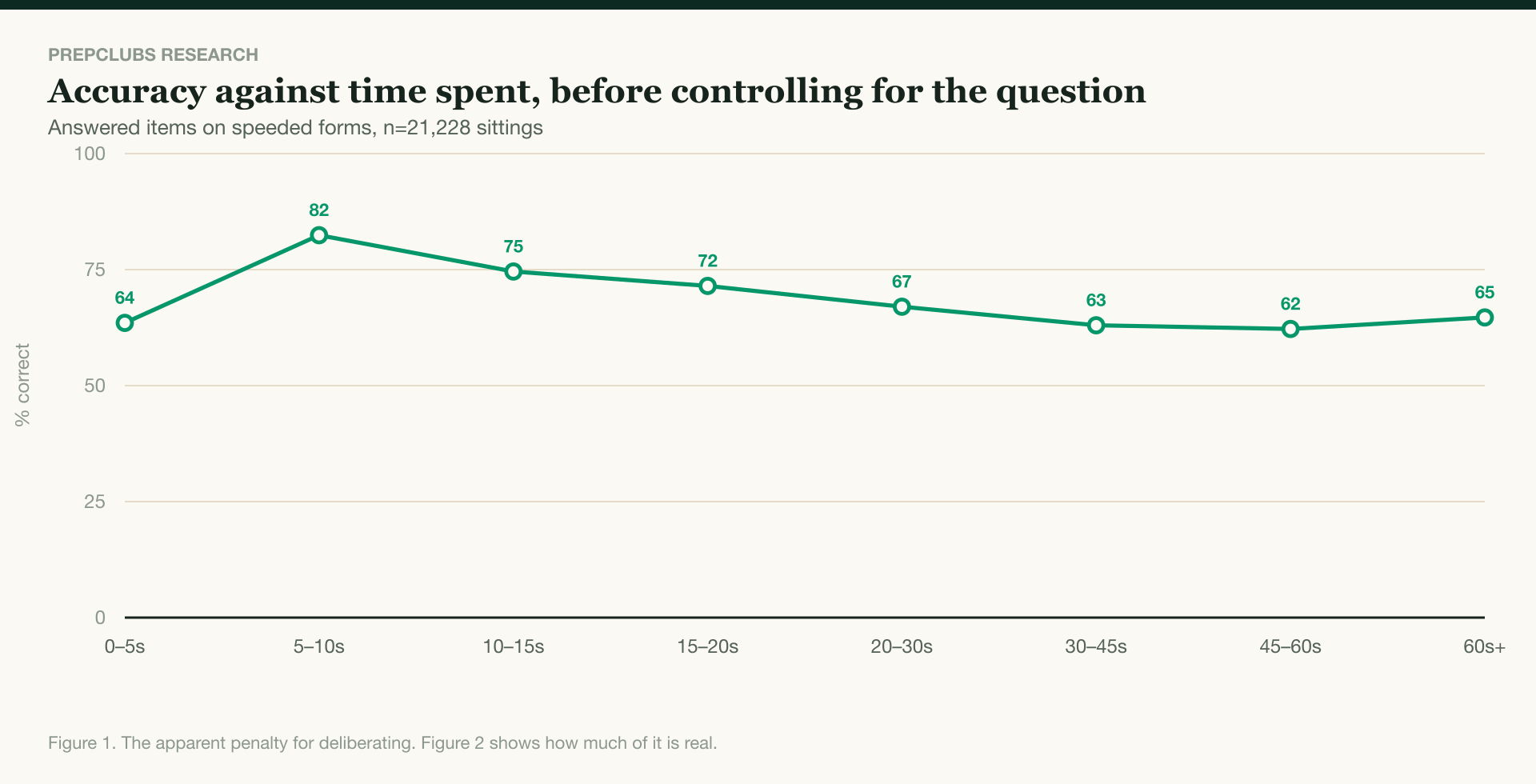
- Slow answers are not much more accurate. On speeded forms including this one, the faster half of answers to the same question were right 72.5% of the time and the slower half 69.4%. Extra time barely changes the item in front of you. Meanwhile the median attempt spent 102 seconds past a 30-second-per-item cap. That surplus is 7.3 questions never reached (What an extra thirty seconds on a question actually buys).
- Where practising candidates land. The median practice score was 28 out of 50 (56%), with the middle half between 24 and 33 and the 90th percentile at 37 (What candidates actually score on aptitude practice tests). These are raw scores on PrepClubs practice forms, not Predictive Index scaled scores.
Three real questions from our latest PI Cognitive practice test
These come from PI Cognitive Practice Test 8, the newest form in our bank. Try each in about 15 seconds.
Question 16 of 50 (abstract). Which figure comes next in the series?
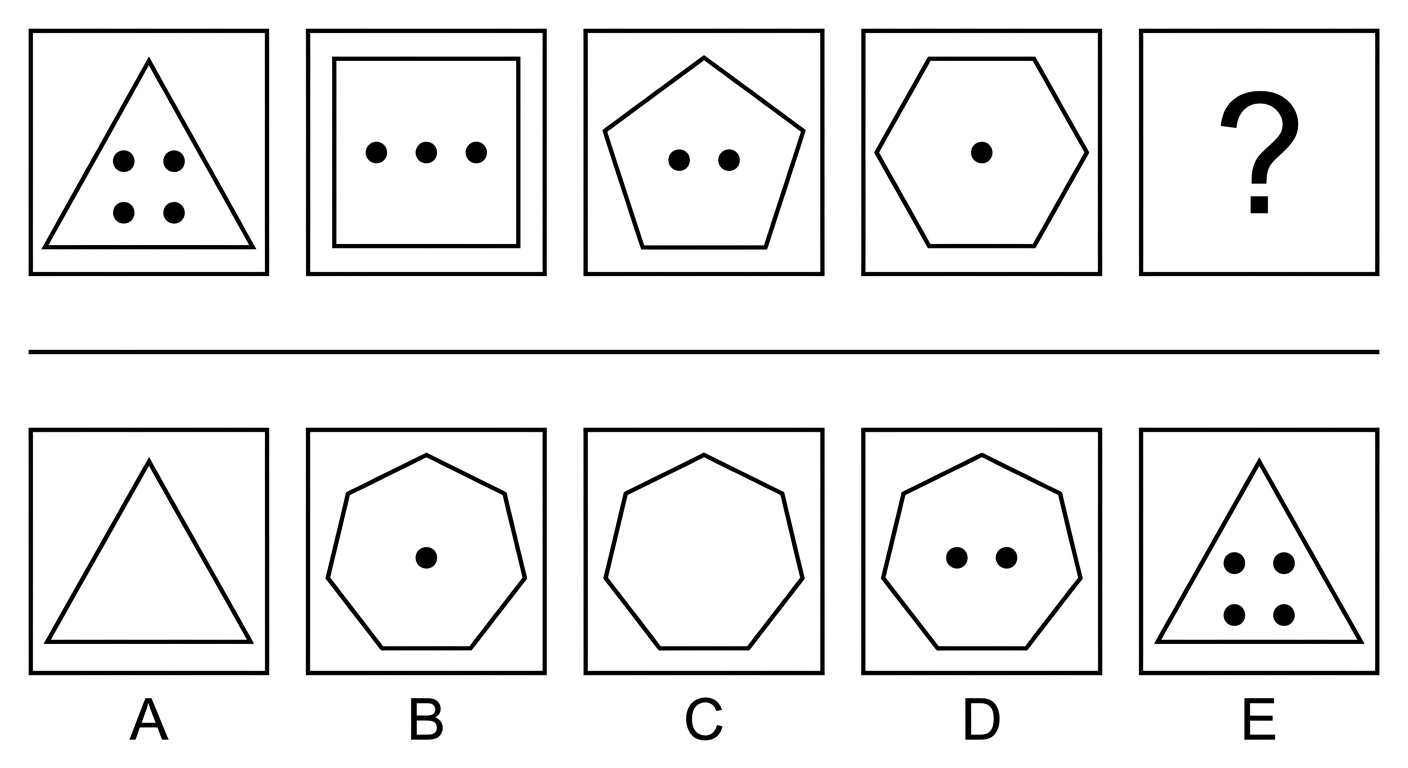
Answer: C. Two counters move at once. The shape gains a side each step (3, 4, 5, 6), so the next has seven sides. The dots count down (4, 3, 2, 1), so the next has none. Only C satisfies both. When a series moves two things, extend each one separately, then keep the option that fits both.
Question 30 of 50 (number series). What comes next: 4, 8, 14, 22, 32, ?
A) 40 B) 42 C) 44 D) 46 E) 48
Answer: C) 44. The gaps are 4, 6, 8 and 10, growing by 2 each time, so the next gap is 12 and 32 plus 12 is 44.
Question 41 of 50 (verbal reasoning). Assume: Only licensed pilots fly this plane. Omar flew this plane. Conclusion: Omar is a licensed pilot.
A) Invalid B) Definitely true C) Definitely false D) Uncertain E) Probably true
Answer: B) Definitely true. "Only licensed pilots fly this plane" makes the licence a requirement. Omar flew it, so he must hold one. Compare "all licensed pilots fly this plane", which would tell you nothing about Omar.
The full form, with explanations for all 50 items, is in the PI Cognitive practice tests on PrepClubs.
How to prepare in a week
A week of focused, timed practice moves PI Cognitive scores meaningfully, because most of the gain comes from pacing and question familiarity rather than new knowledge. Spend the first two days drilling numerical shortcuts: percentages, ratios, and number series, until you recognise the pattern in a few seconds. Spend the next two days on full-length, strictly timed 12-minute runs so the 15-seconds-per-question pace stops feeling frantic. Use the final days to review every question you got wrong or skipped, and decide in advance which question types you will skip-and-guess on under pressure.
The one habit that helps most is practising with the clock actually running. Untimed practice teaches you the questions but not the pacing, and pacing is the whole test. For full-length timed practice with the real 12-minute clock and single-item navigation, work through our PI Cognitive practice.
For a free, fully worked run before you commit to anything, the PI Cognitive Assessment practice test walkthrough takes you through four sample questions, the raw-to-scaled score bands, and the triage habit that protects your score under the 12-minute clock.
FAQ
How long is the Predictive Index test?
The PI Cognitive Assessment is 50 questions in 12 minutes, about 15 seconds per question. The separate PI Behavioral Assessment takes about 6 minutes and is not timed per item, which is why candidates confuse the two.
What is a good score on the PI Cognitive Assessment?
There is no universal pass mark. The raw average is about 20 of 50, which maps to a scaled score near 250. A scaled score above 270 is solid for most roles, and a score near 430 sits around the 98th percentile. What counts as good depends on the cognitive Job Target the employer set for the role.
How is the PI Cognitive Assessment scored?
Your raw score (correct out of 50) is converted to a scaled score from 100 to 450, with a mean of 250 and a standard deviation of 80, reported in 10-point increments. The scaled score places you against a norm group of roughly 288,000 test-takers and is compared to the role's Job Target to produce a match score from 1 to 10.
Can you finish all 50 questions in 12 minutes?
Most candidates do not. The test is designed so that completing all 50 is rare, and the average candidate answers about 20 correctly. The goal is to maximise correct answers in the time available, not to reach the end.
Is there negative marking on the PI Cognitive Assessment?
No. Wrong answers are not penalised beyond scoring as incorrect, so guessing on questions you cannot reach is the correct strategy. Always fill in every remaining answer before the clock runs out.
What question types are on the Predictive Index test?
Numerical reasoning, verbal reasoning, and abstract reasoning, interleaved rather than grouped. A single sitting includes at most 18 numerical, 16 verbal, and 16 abstract items.
Is the PI Cognitive the same as the PLI?
Yes. The Predictive Learning Indicator (PLI) is the same instrument as the PI Cognitive Assessment, with the same 50-questions-in-12-minutes format and the same 100-to-450 scaled score. The name varies by market and reseller.
Can you retake the PI Cognitive Assessment?
Retake policy is set by the employer, not by Predictive Index. Some allow a single retake per application; many do not allow a retake within the same cycle. Because the test draws from an item bank, a retake usually presents different questions.
For the deeper breakdown of why 50 questions in 12 minutes feels faster than the math suggests and what pacing actually clears the Cognitive Job Target, see PI Cognitive Assessment: 50 Questions in 12 Minutes Explained.
Related on PrepClubs
- Pillar. PI Cognitive Assessment overview and preparation. The full pillar page with the latest format, employer use, and prep paths for both PI assessments.
- Deep practice. Full PI Cognitive practice with the 12-minute clock. One-time payment. Current pricing is on the pricing page. Money-back Guarantee. Timed full-length runs with worked explanations for every item.
- Compare. The Predictive Index in 2026: Cognitive vs Behavioral, Score, and How to Pass. How the Cognitive and Behavioral fit together in the PI suite.
- Behavioral. PI Behavioral Assessment: What's Measured and How Hiring Uses It. The 6-minute personality side of the suite, which often arrives in the same invite.
- Guide. What is a good cognitive test score: per-test benchmarks. Cross-test benchmarks including PI, CCAT, Wonderlic, and Watson-Glaser.
Practice on PrepClubs
Full-length PI Cognitive practice with the real 12-minute clock.
The PI Cognitive rewards pacing, and pacing only improves when the clock is actually running. Our PI Cognitive practice tests run the full 50 questions in 12 minutes with the same single-item navigation as the real test, interleaving numerical, verbal, and abstract items, and ship with worked explanations for every question so you learn the shortcut, not just the answer. One-time payment. Money-back Guarantee.
Practise for this exam
PI Cognitive practice tests
Timed practice tests in the real PI Cognitive format, with a worked explanation for every question, so you learn the method as well as the answer.