PI Behavioral Assessment: What's Measured and How Hiring Uses It
The PI Behavioral Assessment is a 6-minute, 86-adjective free-response checklist that maps you to one of 17 Reference Profiles across four families (Analytical, Social, Stabilizing, Persistent). There is no pass mark, on

The honest answer is that the PI Behavioral Assessment is not a personality test in the way most candidates assume. It is a 6-minute, two-list adjective checklist that maps you to one of 17 Reference Profiles, and the only score that matters to a hiring team is the gap between your profile and the Job Target the role was set against. There are no right answers and there is no pass mark. There is only a fit score, and most candidates lose the seat because they pick adjectives that do not match how they actually behave, not because the underlying drives are wrong for the role.
Quick takeaways
- The PI Behavioral Assessment takes 6 minutes, has no time pressure on individual items, and uses 86 adjectives across two checklists.
- It measures four primary factors (Dominance, Extraversion, Patience, Formality) plus Objectivity as a secondary factor.
- Output is one of 17 Reference Profiles in four families (Analytical, Social, Stabilizing, Persistent), plus a graph showing your "natural self" versus "expected behavior" pattern.
- Predictive Index reports more than 10,000 client companies in 140+ countries use the assessment, including Maersk, IKEA, DBS Bank, Nestle, and a long tail of US private equity portfolio companies.
- There is no pass mark. A candidate is rejected when their profile sits far outside the Job Target the role was set against, not because a single answer was wrong.
- Choose at least 6 adjectives per list. Fewer than 6 throws an "insufficient response" flag and the recruiter typically gets prompted to re-send the invite.
- Pick adjectives that genuinely describe how you behave at work today, not aspirational ones. The two lists cross-validate each other and a large gap between "expected" and "natural" reads as instability.
What the PI Behavioral Assessment actually is
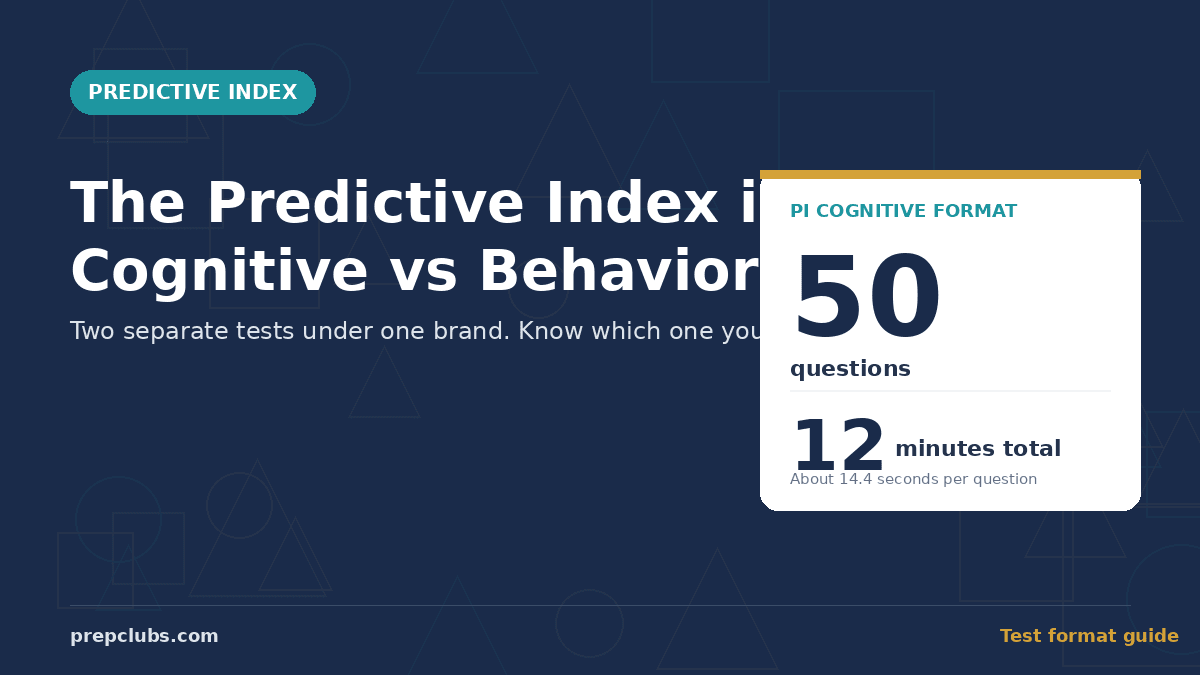
Predictive Index sells two distinct assessments that hiring teams sometimes ship together: the PI Cognitive Assessment (50 questions, 12 minutes, a hard ability test) and the PI Behavioral Assessment (6 minutes, untimed per item, a personality and work-drive instrument). Candidates conflate them constantly. The Behavioral is the one that takes 6 minutes, has no scratch paper, no calculator, no countdown clock on individual questions, and no obvious "hard" items.
The Behavioral was built in 1955 by Arnold Daniels and has been continuously refined since. The current scoring engine, the one most candidates encounter through TalentHub or a workday integration, returns five raw factor scores, a primary profile, a secondary profile, and a Self versus Self-Concept overlay graph that hiring teams read more often than the factor scores themselves.
This article walks the format, the four factors, the 17 Reference Profiles, the Job Target overlay, and the seven specific mistakes that get candidates filtered out at this stage. For the Cognitive side of the suite, the timing-and-pacing breakdown, the 100-to-450 scoring scale, and the seven-day prep plan, read The Predictive Index in 2026: Cognitive vs Behavioral, Score, and How to Pass.
If you were also sent the PI Cognitive's separate 12-minute timed test, treat it as a different discipline entirely, since it rewards speed and pacing where the Behavioral rewards honest self-report.
The 86-adjective free-response format
The assessment shows you two prompts back to back. The first asks you to select the adjectives that describe how others expect you to behave at work. The second asks you to select the adjectives that describe how you actually are. The same 86-word checklist appears under both prompts. There is no per-item timer. The whole thing typically takes 5 to 7 minutes.
Two structural facts make this format more punishing than candidates expect. The first is that there is no fixed answer count. You can select 6, 26, or all 86 adjectives if you want, but you must select at least 6 per list. Fewer than 6 throws an "insufficient response" flag and most ATS integrations require the recruiter to re-send the invite, which usually counts against you. The second is that the gap between List 1 (expected behavior) and List 2 (natural behavior) is the signal hiring teams look at first. A small gap reads as stable and self-aware. A large gap reads as either a role mismatch or a candidate who is performing.
The adjective set is not random. Each of the 86 words is associated with one of the five factors below, and each is weighted. "Assertive" loads heavily on Dominance. "Quiet" loads negatively on Extraversion. "Methodical" loads positively on Formality. When you select an adjective, you add weight to the underlying factor whether you realize it or not.
The four primary factors and Objectivity
The assessment reports five factors. The first four are the ones the Reference Profile is built from.
| Factor | What it measures | High-score behavior | Low-score behavior |
|---|---|---|---|
| A. Dominance | The drive for control and impact on people and processes | Independent, direct, takes initiative, comfortable with conflict | Collaborative, accommodating, prefers consensus, avoids conflict |
| B. Extraversion | The drive for social interaction and connection with others | Outgoing, persuasive, group-oriented, networks easily | Reserved, task-focused, prefers depth over breadth in interactions |
| C. Patience | The drive for consistency, stability, and a predictable pace | Steady, even-keeled, prefers established processes, dislikes rapid change | Fast-paced, restless, comfortable with ambiguity and rapid pivots |
| D. Formality | The drive for structure, rules, and detail | Detail-oriented, follows process, plans before acting, risk-averse | Informal, flexible, comfortable improvising, tolerates ambiguity |
| E. Objectivity | Decision-making style (secondary factor) | Data-driven, logical, dispassionate | Intuitive, subjective, weight personal experience heavily |
Objectivity is reported alongside the four primary factors but does not drive the Reference Profile assignment. It is mostly used for development conversations rather than hiring filters.
The factor scores themselves are reported as a numeric value above or below the population mean. Hiring teams rarely look at the raw numbers. They look at the resulting Reference Profile and at the Self versus Self-Concept overlay.
The chart below previews the four-factor frame and the four Reference Profile families those factors produce. It is the visual anchor for the rest of the article.

The 17 Reference Profiles, grouped by family
Every candidate is assigned one Reference Profile based on the combined factor pattern. The 17 profiles cluster into four families that mirror the dominant factor combinations.
| Family | Reference Profiles | Common roles |
|---|---|---|
| Analytical | Analyzer, Controller, Venturer, Specialist, Strategist | Engineering, finance, data, technical PM, strategy consulting |
| Social | Altruist, Captain, Collaborator, Maverick, Persuader, Promoter | Sales, account management, business development, HR business partner |
| Stabilizing | Adapter, Craftsman, Guardian, Operator | Operations, customer success, fulfillment, regulated industries |
| Persistent | Individualist, Scholar | Research, deep specialist tracks, independent contributor roles |
Each Reference Profile is a written paragraph describing predicted workplace behavior, communication style, decision-making style, and ideal management style. The profiles are not value judgments. A Guardian is not "worse" than a Persuader. They are different patterns that fit different roles. A Persuader sitting in an actuarial role tends to leave within 18 months. A Guardian in a quota-carrying sales role tends to underperform on outbound prospecting.
This is the core insight hiring teams use the assessment for. Predictive Index ships a Job Target Library with recommended profile patterns for common roles. Hiring teams then tune the target for their specific context and compare your profile against it. If your profile sits well outside the target range on Dominance or Patience, you are filtered out at the behavioral stage even if your Cognitive score and resume are strong.
How hiring teams actually use the result
Hiring teams use three artifacts the assessment produces, in this order of weight:
The Job Fit Score is a 1 to 10 composite of how closely your profile matches the Job Target the recruiter set the role against. A 9 or 10 is a strong match. A 4 or below is a strong mismatch. Most operating-partner private equity portfolio companies set 7 as the minimum threshold.
The Self versus Self-Concept overlay graph is a visual comparison of List 1 ("how others expect you to behave") and List 2 ("how you actually are"). A tight overlap suggests a candidate who is stable in the role they are currently in. A wide gap suggests either a role mismatch or a candidate who is suppressing their natural drives to perform. Recruiters trained on the PI Hire methodology read this graph first.
The Reference Profile paragraph is the qualitative summary. Hiring managers without formal PI training tend to skim straight to this paragraph and form an impression in 30 seconds. The phrasing of the profile description matters: words like "independent," "direct," and "comfortable with risk" land positively for sales and leadership tracks but negatively for compliance and audit tracks.
The lookup below groups the 17 Reference Profiles by family, with the dominant factor pattern that defines each family.

Companies that use the PI Behavioral Assessment
Predictive Index reports more than 10,000 client companies in over 140 countries use the Behavioral Assessment, with the heaviest concentration in three segments.
The first is operating-partner private equity portfolio companies. Vista Equity, Thoma Bravo, and HGGC portfolio companies have used PI as a standard part of leadership and senior individual contributor hiring for more than a decade. The Behavioral usually arrives alongside the Cognitive Assessment in the same email invite.
The second is global consumer and industrial companies that built their early hiring stack on PI. Maersk, IKEA, Nestle, and DBS Bank are publicly referenced. The use here tends to be heavier in country manager, regional director, and senior commercial roles than in entry-level.
The third is US mid-market companies in distribution, manufacturing, and software, often introduced to the assessment through a fractional COO or a PI-certified HR consultant. This is the long tail: 8,000-plus companies under 500 employees who use the assessment for both hiring and team-fit decisions.
If you have received a PI Behavioral invite from a company name you do not recognize, it is almost certainly one of those mid-market companies. The behavior of the assessment is the same regardless of employer. What varies is the Job Target the recruiter set the role against.
The seven mistakes that get candidates filtered out
Candidates lose the seat at the Behavioral stage for predictable reasons. These seven account for roughly nine out of ten rejections at this step.
Picking aspirational adjectives instead of accurate ones. The most common failure mode. A candidate applying for a sales role checks "outgoing," "persuasive," "competitive," and "assertive" on both lists when their natural pattern is none of those. The result is a profile that does not match how the candidate behaves on day 30, which the hiring manager picks up on within two weeks of onboarding and which the candidate's profile owner attributes to "performing the assessment."
Selecting too few adjectives. Fewer than 6 per list throws an insufficient-response flag. Some candidates also game the test by selecting only 6 specific adjectives, which produces an unusually flat profile that PI's scoring engine flags as low confidence.
Selecting too many adjectives. Candidates who select 40-plus on each list dilute the signal and tend to produce a "no strong drives" profile that hiring managers read as indecisive or low-self-awareness.
Wildly different choices between List 1 and List 2. The gap is meaningful but it should not be enormous. A profile where the "expected behavior" list is full of high-Dominance, high-Extraversion adjectives and the "natural" list is full of high-Patience, high-Formality adjectives gets flagged as a role-fit risk.
Treating it like a personality test with right and wrong answers. There are no right answers. There are answers that match the role and answers that do not. Trying to second-guess "what they want" usually backfires because the cross-validation between the two lists catches the inconsistency.
Rushing in the first 30 seconds. The assessment has no timer per item, but the median completion time is 5 to 7 minutes. Candidates who finish in under 3 minutes tend to skim the adjective list and miss subtle distinctions (for example, "decisive" and "stubborn" are not synonyms in this context, and they load on different factors).
Not preparing at all. The right preparation is not memorizing adjectives. It is reviewing the four factors, reading two or three Reference Profile descriptions that resemble your natural pattern, and identifying the adjectives that load on the factors your role actually requires. A candidate who has spent 20 minutes thinking about which adjectives are accurate for them produces a cleaner, more defensible profile than one who has not.
How to prepare in 90 minutes
This is the prep plan most candidates can complete the evening before a PI Behavioral invite.
Spend 20 minutes reading the descriptions of the four primary factors above and identifying which two are dominant for you in a work setting. Most people are clear on two of the four within a few minutes of honest reflection.
Spend 20 minutes scanning the 17 Reference Profile names and reading the description of the three that sound closest to your natural pattern. The Predictive Index public reference site lists all 17 with one-paragraph descriptions.
Spend 30 minutes pulling up the job description for the role you are applying for and listing the five behaviors the role actually requires. "Independent decision-making," "comfort with ambiguity," "long-cycle relationship-building." This is the Job Target the recruiter set the role against, expressed in plain English.
Spend the final 20 minutes practicing the adjective selection on a free-form sheet. Pick 10 to 15 adjectives that describe how the role expects you to behave. Pick 10 to 15 adjectives that describe how you actually behave. Note where the lists overlap and where they diverge. If the divergence is large, ask yourself honestly whether the role is the right fit.
For full-length, timed practice with the Cognitive side of the suite, where pacing actually does matter, work through our PI Cognitive practice with the real 12-minute clock.
PI Behavioral versus PI Cognitive: do not confuse them
The Behavioral and the Cognitive ship under the same Predictive Index brand and the same client account, which is why candidates confuse them. They measure different things, are scored differently, and prep differently.
| Dimension | PI Behavioral | PI Cognitive |
|---|---|---|
| What it measures | Work-related personality and drive pattern | General cognitive ability under time pressure |
| Format | 86 adjectives across two checklists | 50 mixed verbal, numerical, and abstract questions |
| Time | 5 to 7 minutes typical, no item timer | 12 minutes strict for all 50 questions |
| Score | Reference Profile + Job Fit Score (1-10) | Scaled 100-450, with 250 the population mean |
| Pass mark | None, fit-based filter against Job Target | None official, but 250-280 is the common floor for individual contributors |
| Prep that works | Self-reflection on factors and role requirements | Timed full-length practice with pacing drills |
| Prep that does not work | Memorizing "right" adjectives | Untimed self-paced review |
The two are graded by completely different engines and serve different filtering purposes in hiring. A strong Cognitive score and a weak Behavioral fit can still pass a role. A weak Cognitive and a strong Behavioral fit usually does not. For the full breakdown of the Cognitive side, read PI Cognitive vs Behavioral and how the score works.
For a side-by-side breakdown of the two assessments, including how to tell from the invitation email which one you are about to take and what each result actually does in the hiring funnel, see PI Cognitive vs PI Behavioral: which one are you taking.
For a side-by-side on this, see how PI Behavioral differs from the timed PI Cognitive test.
FAQ
What is a good score on the PI Behavioral Assessment?
There is no scaled score on the Behavioral the way there is on the Cognitive. There is a Job Fit Score from 1 to 10 that measures how closely your profile matches the Job Target the role was set against. A 9 or 10 is a strong match. A 7 is the common minimum hiring threshold in operating-partner private equity portfolio companies. Below 5 is usually a filter.
How long does the PI Behavioral Assessment take?
The official time is "approximately 6 minutes," and the median completion time is between 5 and 7 minutes. Individual items are not timed. Candidates who finish in under 3 minutes tend to under-perform because they skim the adjective list.
Can you fail the PI Behavioral Assessment?
There is no pass mark in the academic sense. You are filtered out when your profile sits far outside the Job Target the recruiter set the role against. Common patterns that filter candidates out: very low Dominance for senior leadership roles, very low Patience for compliance and audit roles, very low Formality for regulated-industry roles.
What are the 17 Reference Profiles?
The 17 profiles cluster into four families. Analytical: Analyzer, Controller, Venturer, Specialist, Strategist. Social: Altruist, Captain, Collaborator, Maverick, Persuader, Promoter. Stabilizing: Adapter, Craftsman, Guardian, Operator. Persistent: Individualist, Scholar. Each is a descriptive paragraph about predicted workplace behavior, not a value judgment.
Should I pick adjectives that match the job description?
You should pick adjectives that accurately describe how you behave at work today. If those adjectives also match the job description, the role is a strong fit and the assessment will reflect that. If they do not match, picking adjectives that you think the role wants typically backfires because List 2 ("how you actually are") cross-validates List 1 and the inconsistency reads as either role mismatch or performing.
Does Predictive Index report the assessment to candidates?
Predictive Index offers a free "Candidate Score Report" through their public site that returns your Reference Profile, the four-factor pattern, and a written description. It does not return your Job Fit Score against a specific role since that depends on the Job Target the recruiter set. For the 6-minute prep version, the public assessment is a reasonable rehearsal.
How many adjectives should I select?
At least 6 per list (the technical minimum). The typical candidate selects between 12 and 25 adjectives per list. Below 10 produces a low-confidence profile. Above 35 dilutes the signal. The right count depends on how many adjectives genuinely describe you, not on a target count.
Can you retake the PI Behavioral Assessment?
The assessment is designed to be taken once per role. Retakes are typically only permitted when the recruiter explicitly re-sends the invite, usually because of an insufficient-response flag or a system error. Most ATS integrations carry your existing profile forward to other roles at the same company, which means the result follows you internally.
Related on PrepClubs
- Pillar. PI Cognitive Assessment overview. The full pillar page with the latest cutoffs, employer list, and prep paths for both assessments in the suite.
- Deep practice. Full PI Cognitive practice with the 12-minute clock. One-time payment. Current pricing is on the pricing page. Money-back Guarantee. The Behavioral does not require timed practice but the Cognitive does.
- Compare. The Predictive Index in 2026: Cognitive vs Behavioral, Score, and How to Pass. The brand-level overview of both tests in the PI suite.
- Guide. What is a good cognitive test score: per-test benchmarks. Cross-test benchmarks including PI, CCAT, Wonderlic, and Watson-Glaser.
Practice on PrepClubs
Full-length PI Cognitive practice with the real 12-minute clock.
The PI Behavioral does not reward timed practice. The PI Cognitive does. Self-paced prep without the timer running does not move Cognitive scores. Our PI Cognitive practice tests run the full 50 questions in 12 minutes with the same single-item navigation as the real test, and ship with worked walkthroughs for every question. One-time payment. Money-back Guarantee.