CompTIA A+ vs Network+: Which Should You Take First?
A+ vs Network+ comes down to your experience. CompTIA recommends A+ first, then 9 to 12 months hands-on, then Network+. Here is exactly when to skip A+.
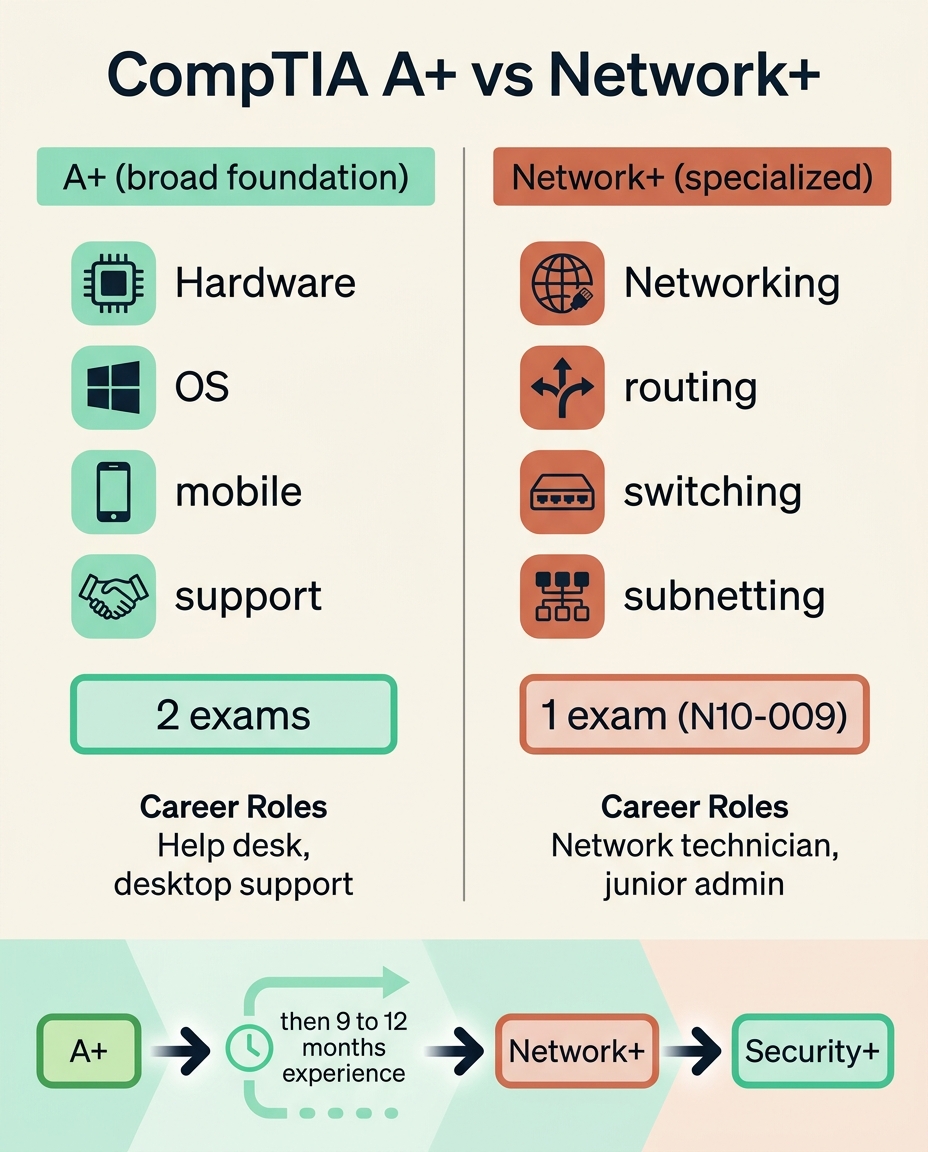
If you are a true beginner, take the CompTIA A+ first, then Network+. The A+ is the broad entry-level foundation covering hardware, operating systems, and end-user support, while Network+ is the more specialized step into networking, routing, switching, and subnetting. CompTIA's own recommended path is A+ first, then 9 to 12 months of hands-on networking experience, then Network+, per CompTIA. The honest exception: if you already have real desktop or support experience, or you specifically want an infrastructure role, you can skip the A+ and go straight to Network+.
Neither is a hard prerequisite for the other, so the real question is not "which is required" but "which order fits your background and your target job."
Beginners take A+ first; experienced support staff can start at Network+
Quick takeaways
- The A+ is broad and foundational (hardware, OS, mobile, support). Network+ is specialized (networking, routing, switching, subnetting).
- CompTIA recommends A+ first, then 9 to 12 months of hands-on networking experience, then Network+, per CompTIA.
- Neither is a hard prerequisite for the other. The recommendation is guidance, not a gate.
- Take A+ first if you are new to IT. Skip to Network+ if you already have support experience or want an infrastructure role.
- The A+ is two exams (Core 1 and Core 2); Network+ is a single exam. That affects cost and time.
- Both feed the "CompTIA Trifecta" alongside Security+, a common early-career sequence.
- PrepClubs is independent prep material and is not affiliated with or endorsed by CompTIA.
A+ vs Network+ at a glance
Here is the side-by-side, sourced from CompTIA's published exam details.
| Attribute | CompTIA A+ | CompTIA Network+ |
|---|---|---|
| Focus | Hardware, OS, mobile, support | Networking, routing, switching, subnetting |
| Number of exams | 2 (Core 1 220-1201, Core 2 220-1202) | 1 (N10-009) |
| Max questions | 90 per core | 90 |
| Passing score | 675 (Core 1), 700 (Core 2), 100-to-900 scale | 720 (100-to-900 scale) |
| Best for roles | Help desk, desktop support, field tech | Network technician, junior admin, NOC |
| Recommended experience | Entry-level, no prerequisite | A+ plus 9 to 12 months hands-on networking |
The clearest structural difference: the A+ is two exams you sit on two days with two vouchers, and Network+ is one. That alone makes the A+ a bigger time and cost commitment.
What each certification actually covers
The A+ is the wide net. Core 1 (220-1201) covers hardware, mobile devices, networking basics, virtualization, and hardware troubleshooting. Core 2 (220-1202) covers operating systems, security, software troubleshooting, and operational procedures. It is designed to prove you can support end users across a mix of technologies, which is exactly what help desk and desktop support roles need.
Network+ goes deep on one slice. It covers network fundamentals, implementations, operations, security, and troubleshooting, with real weight on subnetting, routing and switching concepts, and network hardware. It assumes you already understand basic computing and want to prove you can stand up and troubleshoot a network.
Which is harder?
Difficulty depends on your starting point, not on some fixed ranking. For a complete beginner, the A+ can feel harder simply because it is two exams covering a huge surface area, so there is more raw material to hold in your head. For someone who already does desktop support, the A+ can feel like validating what they do daily, while Network+ introduces genuinely new material in subnetting and routing that trips people up.
The A+ is broader; Network+ is deeper on a narrower topic
So the honest read: the A+ is harder in breadth (two exams, more topics), and Network+ is harder in depth (subnetting math and networking concepts that are new to most beginners).
When to take A+ first
Take the A+ first if any of these describe you:
- You are new to IT with no professional support experience.
- You are targeting a help desk, desktop support, or field technician role.
- You want the broad foundation before specializing, so networking concepts land on solid ground.
- You are building the full CompTIA Trifecta and want to follow CompTIA's recommended order.
For most career changers and students, this is the default, and it matches what CompTIA recommends.
When you can skip A+ and go straight to Network+
Skipping the A+ is reasonable when:
- You already work in support and the A+ would mostly validate skills you use daily.
- You specifically want an infrastructure or networking role and want the specialized credential faster.
- Your employer or a job posting asks for Network+ specifically and not the A+.
Because Network+ has no hard prerequisite, nothing stops you from starting there. Just be honest about the subnetting and routing content, since that is where candidates without a foundation struggle. If subnetting is unfamiliar, the A+ groundwork (or dedicated networking study) pays off before you sit N10-009.
The CompTIA Trifecta path
The A+, Network+, and Security+ together are often called the CompTIA Trifecta, a common early-career sequence for IT and cybersecurity roles. The typical order is A+, then Network+, then Security+, moving from broad support to networking to security. You do not have to take all three, and you do not have to take them in that order, but the sequence builds knowledge in a way that makes each next exam easier.
FAQ
Should I take A+ or Network+ first?
If you are new to IT, take the A+ first, then Network+. CompTIA recommends A+ first, then 9 to 12 months of hands-on networking experience, then Network+, per CompTIA. If you already have support experience, you can start at Network+.
Is A+ required before Network+?
No. Neither certification is a hard prerequisite for the other. CompTIA recommends the A+ first, but it is guidance, not a gate.
Is Network+ harder than A+?
It depends on your background. The A+ is harder in breadth, since it is two exams over a large surface area. Network+ is harder in depth, since subnetting and routing are new material for most beginners.
How many exams is the A+ versus Network+?
The A+ is two exams, Core 1 (220-1201) and Core 2 (220-1202), and you must pass both. Network+ is a single N10-009 exam. That makes the A+ a larger time and cost commitment.
Can a beginner skip A+ and take Network+?
Yes, since there is no hard prerequisite, but be ready for the subnetting and routing content. Beginners without a foundation tend to struggle there, so build that groundwork first if it is unfamiliar.
What order is the CompTIA Trifecta?
The common order is A+, then Network+, then Security+, moving from broad support to networking to security. The order is a recommendation, not a rule, but it builds knowledge cumulatively.
Is A+ harder than CCNA?
For most beginners, no. Cisco's CCNA goes deeper on networking, routing, and hands-on configuration, so it is generally considered the harder exam. The A+ is broader and entry-level, designed as a starting point with no prerequisite. If you are choosing between Network+ and CCNA specifically, Network+ is vendor-neutral and closer in difficulty to the A+, while CCNA is a bigger step up.
Related on PrepClubs
- The CompTIA A+ Exam Objectives
- CompTIA Network+ Exam Objectives
- The CompTIA Trifecta: A+, Network+, Security+
The order you choose matters less than actually being ready for the exam you sit. Whichever you take first, full-length timed practice on the current objectives is what turns "I studied" into "I passed." That is how PrepClubs' A+ and Network+ tracks are built: a free diagnostic to find your real level, then full-length timed practice tests with a written rationale on every answer. It is a one-time purchase with 30 days of access, not a renewing subscription, backed by our Money-back Guarantee. PrepClubs has helped more than 3,700 students prepare for cognitive and certification assessments. Start with the free A+ diagnostic.
FAQ