Free Watson-Glaser Practice Test: The 5 Critical Thinking Sections Explained
Watson-Glaser practice test guide: the 5 critical thinking sections explained with sample questions, answer formats, and how percentile scoring really works.

Take a free, timed Watson-Glaser practice test. Run a full timed Watson-Glaser Critical Thinking Appraisal set on PrepClubs, scored the moment you finish, then use the section-by-section breakdown below to fix the reasoning traps that cost the most marks. Start the free Watson-Glaser practice test.
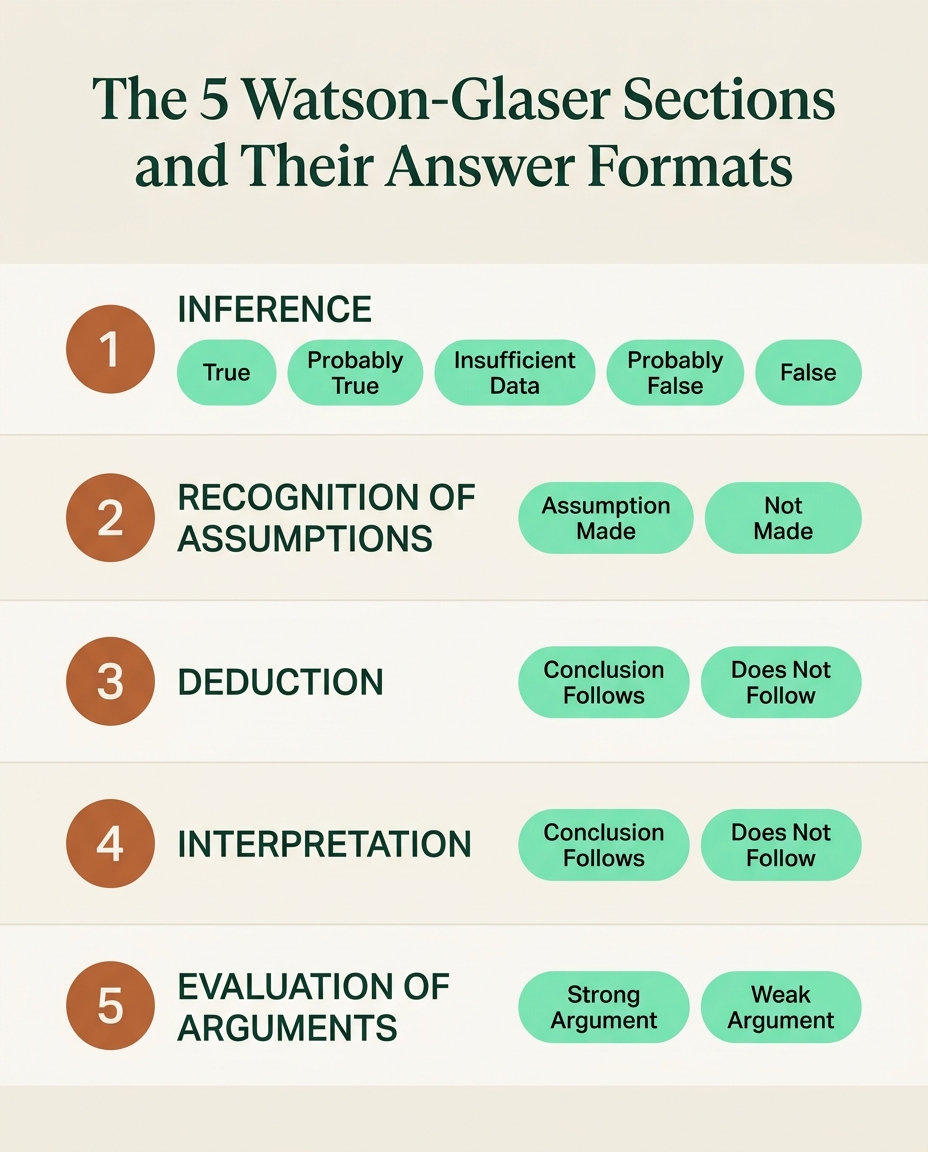
The Watson-Glaser Critical Thinking Appraisal measures how well you reason from evidence across five sections: Inference, Recognition of Assumptions, Deduction, Interpretation, and Evaluation of Arguments. The common form runs 40 multiple-choice questions in about 30 minutes, and each section uses its own answer format, which is exactly why unprepared candidates stumble. This guide explains all five sections with sample questions and worked reasoning, then shows how your score is actually interpreted, because the number that matters is your percentile against a comparison group, not a raw pass mark.
Quick takeaways
- The Watson-Glaser has five sections, and each one has a different answer format you must learn before test day.
- The standard form is 40 questions in roughly 30 minutes, though the employer sets the time and the newer WG-III draws from an item bank.
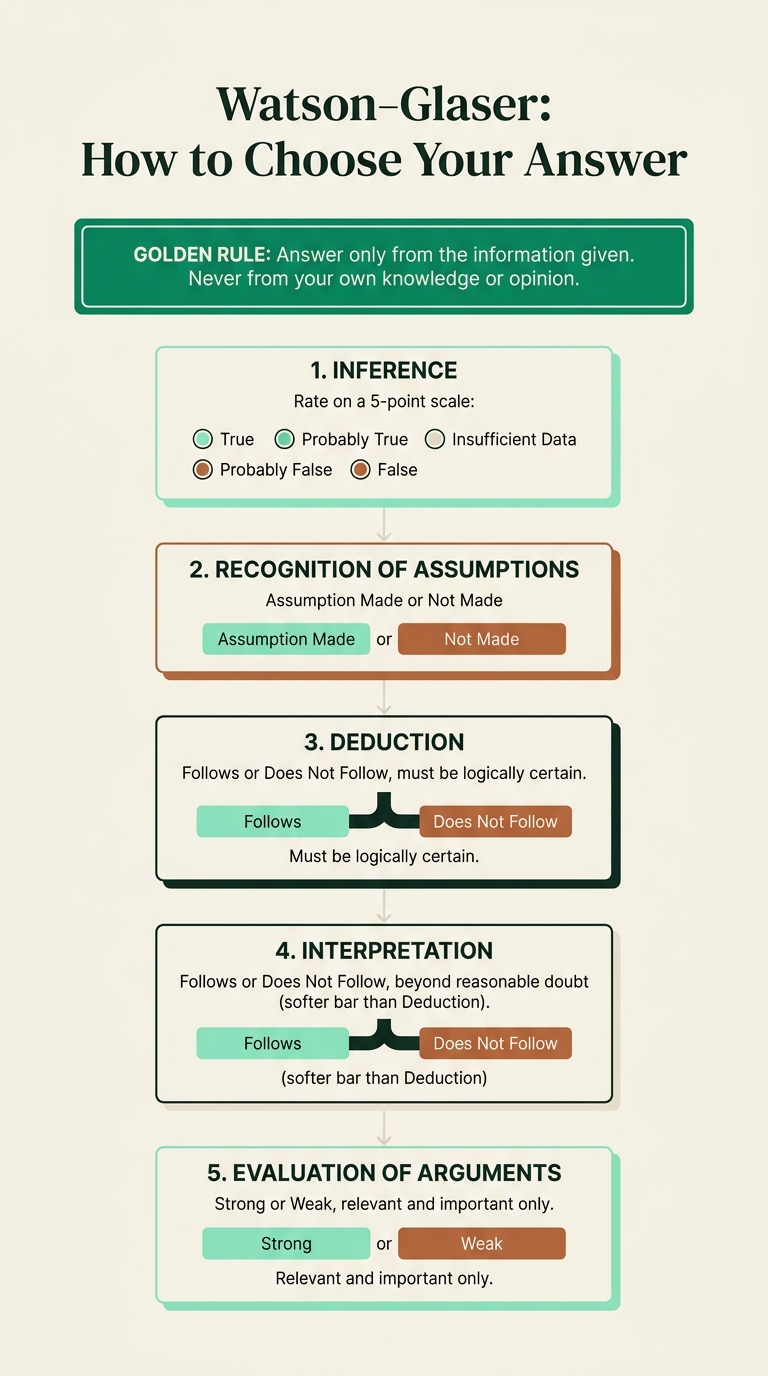
- The golden rule across every section: answer only from the information given, never from your own knowledge or opinion.
- Scores are reported as a percentile against a norm group, so the same raw score can look strong or weak depending on who you are compared to.
- There is no universal passing score. Law firms and other employers set their own bar, often high.
- It is published by Pearson TalentLens (talentlens.com), the authority to cite for section definitions and scoring.
What the Watson-Glaser measures
The Watson-Glaser Critical Thinking Appraisal, often shortened to WGCTA or just Watson-Glaser, is a pre-employment test of critical thinking. Employers use it to predict how well you will analyze information, weigh evidence, and reach sound conclusions under pressure, which is why it is popular for law, consulting, finance, and graduate hiring.
It is published by Pearson TalentLens, and it has one of the longest research pedigrees in the field, tracing back to work by Goodwin Watson and Edward Glaser. Two versions are in use: the WG-II and the newer WG-III. The WG-III is item-banked, meaning questions are drawn from a large pool and randomized, which supports unsupervised remote testing and gives near-instant results. The five sections and the underlying skills are the same across versions.
One point sets this test apart from a general aptitude test. It is not measuring how much you know. It is measuring whether you can reason correctly from the exact information in front of you, even when that information contradicts what you believe to be true in the real world.
The 5 Watson-Glaser sections explained
Here is the part that decides your score. Each section tests a different critical-thinking skill and, crucially, uses a different answer format. Learn the format for each one, because misreading the format is the most common way candidates lose points.
1. Inference
Inference asks you to judge whether a conclusion drawn from a set of facts is warranted, and how confident you can be. You read a short passage, then rate statements on a five-point scale: True, Probably True, Insufficient Data, Probably False, or False.
The trap is the middle option. "Insufficient Data" is the correct answer more often than people expect, because most passages simply do not give enough to prove a statement true or false. Do not fill the gap with an assumption.
Sample flavor: a passage states that a company's revenue rose 10 percent last year while its headcount stayed flat. A statement like "the company became more productive per employee" might be Probably True, while "the company will grow again next year" is Insufficient Data, because nothing in the passage supports a future prediction.
2. Recognition of Assumptions
An assumption is something taken for granted but not stated. This section gives you a statement, then a proposed assumption, and you decide: Assumption Made or Assumption Not Made.
The skill is spotting the unstated leap. If a statement says "we should advertise to increase sales," a proposed assumption that "advertising can reach potential customers" is an Assumption Made, because the plan only works if that is true. An assumption that "our product is the cheapest" is Not Made, because the statement never depends on price.
3. Deduction
Deduction is formal logic. You are given premises, then a conclusion, and you decide whether the conclusion necessarily Follows or Does Not Follow. You must treat the premises as true even if they sound absurd, and rely only on logic.
Sample flavor: "All the machines in Room A are blue. This machine is in Room A." A conclusion that "this machine is blue" Follows. A conclusion that "all blue machines are in Room A" Does Not Follow, because the premises never claimed that. Deduction rewards strict, literal reasoning.
4. Interpretation
Interpretation looks similar to Deduction but uses a softer standard. You read a passage, then decide whether a conclusion follows beyond reasonable doubt. The answer format is again Conclusion Follows or Conclusion Does Not Follow.
The difference from Deduction is the bar. Deduction demands the conclusion be logically certain from the premises. Interpretation asks whether the evidence in the passage makes the conclusion clearly justified. A conclusion can be reasonable yet still Not Follow if the passage leaves real room for doubt.
5. Evaluation of Arguments
Here you judge whether an argument is strong or weak in response to a question. An argument is Strong only if it is both important and directly relevant to the question. Otherwise it is Weak. The format is Strong Argument or Weak Argument.
The common mistake is rating an argument strong because you agree with it. Relevance and importance decide the answer, not your personal opinion. A true but trivial point is a Weak argument; a directly relevant, significant point is a Strong one, even if you dislike the conclusion.
Watson-Glaser sample questions to practice
Use these to feel the format shift between sections. Cover the reasoning, answer, then check yourself.
Inference: A city report notes that public transit ridership fell 15 percent the same year a new remote-work policy took effect at several large employers. Rate: "The remote-work policy caused the entire drop in ridership." The best answer is Probably False, not True. The report shows a correlation in time, not a proven cause, and a claim that one factor explains the entire drop is unlikely when other factors could contribute.
Recognition of Assumptions: Statement: "We should hire more analysts to finish the audit on schedule." Proposed assumption: "The audit is currently behind or at risk of being late." Assumption Made, because the plan only makes sense if the schedule is threatened.
Deduction: Premises: "No members of the finance team have keys to the archive. Dana is a member of the finance team." Conclusion: "Dana does not have a key to the archive." Conclusion Follows.
Evaluation of Arguments: Question: "Should a company require all staff to pass a critical-thinking test before promotion to management?" Argument: "Yes, because managers who reason poorly make costly decisions." Strong, because it is both relevant and important to the question.
Four more from our newest practice test
The samples above are written for this article. These four are real items from Watson-Glaser Practice Test 8, the latest form in our bank, exactly as candidates see them.
1. Inference. A restaurant replaced its paper menu with QR codes linking to an online menu. Over the next two months, table turnover during peak hours rose 11%, and the kitchen reported fewer orders for items that had been removed from the menu.
Proposed inference: The removed items are no longer available.
Answer: Probably True. Fewer orders for removed items fits them being unavailable, but the passage says fewer, not zero, so it stops short of proving it. This True versus Probably True line is where the Inference block takes most of its marks.
2. Recognition of Assumptions. Statement: We should offer scholarships to attract top students to our university. Proposed assumption: The university currently has no students.
Answer: Assumption not made. The aim is to attract top students, which works just as well for a full university. Reject any assumption the statement could live without.
3. Deduction. Premises: Only team members with security clearance can enter the lab. Marco entered the lab. Conclusion: Marco has security clearance.
Answer: Yes, it follows. "Only X can do Y" means doing Y requires X. Marco did Y, so he must have X. Compare it with "all X can do Y", which would not let you conclude anything about Marco.
4. Evaluation of Arguments. Should a company offer paid parental leave beyond the legal minimum? No, because extended leave raises short-term staffing costs and may require temporary hires, which is a real cost to weigh against the benefits.
Answer: Strong argument. You may disagree with the conclusion, and it still counts as strong: it is directly relevant and names a real, important consequence. Rate the argument, not your opinion.
What our practice data says about using a practice test well
We publish anonymised findings from scored practice attempts in the PrepClubs Research series. For the Watson-Glaser, the numbers point to one thing: practise accuracy, not speed.
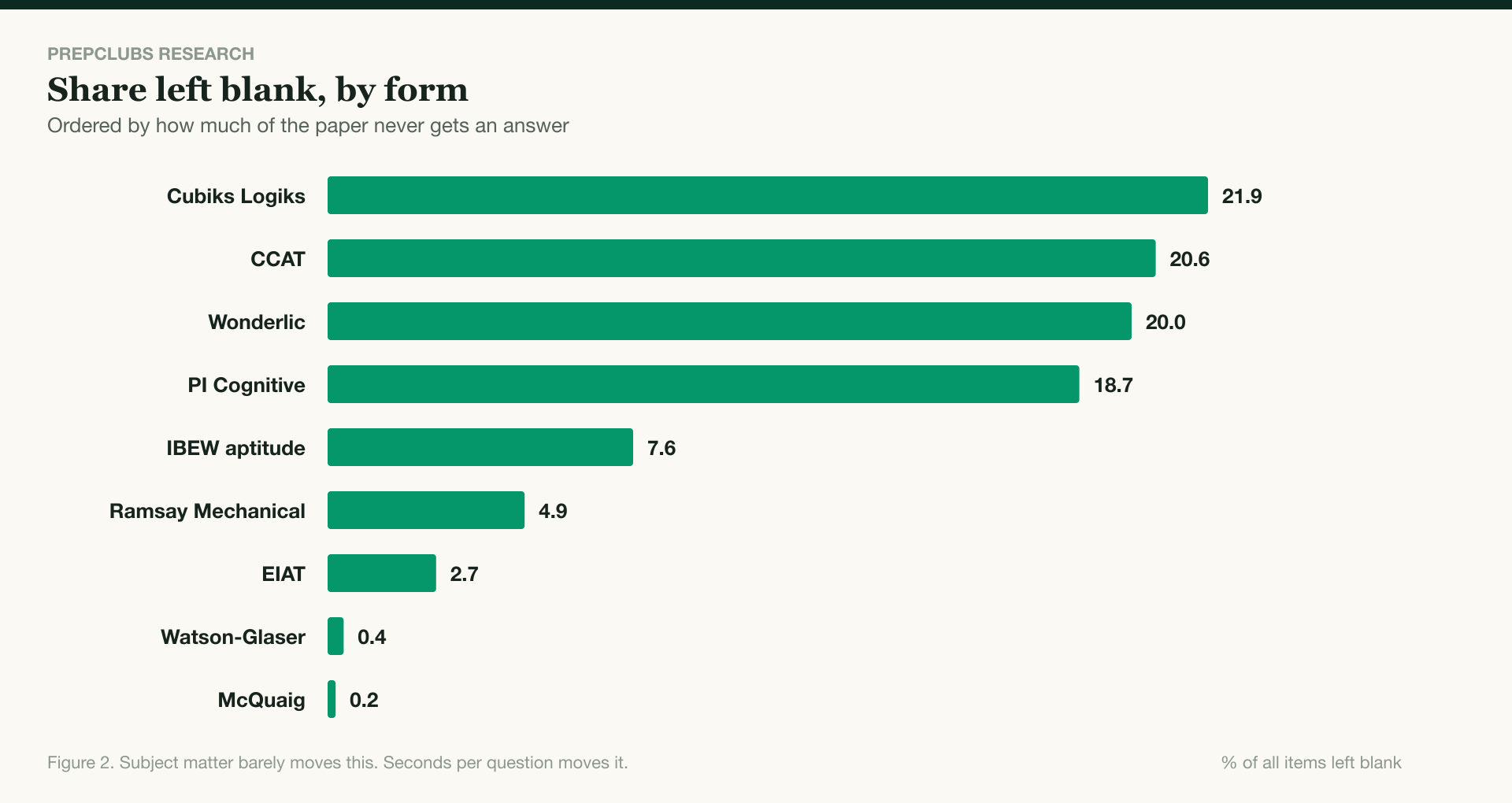
- Almost nobody runs out of time. Only 0.4% of Watson-Glaser items were left blank, the second lowest of the nine forms we measured (How much of a timed aptitude test is never answered). On the CCAT the figure is 20.6%.
- The opening block is the hard one. Accuracy on the first fifth of the paper was 53.1%, then 85% to 91% on the rest (Which aptitude tests are built as a difficulty ramp). On our forms that first fifth is the five-option Inference block. Review your first eight answers before anything else when you mark a practice test.
- A median practice score is 80%. That is 32 out of 40, with the 90th percentile at 37 (What candidates actually score on aptitude practice tests).
How Watson-Glaser scoring actually works
This is where most guides go wrong, so read carefully. Your Watson-Glaser result is not just a raw number out of 40. It is converted into a percentile against a norm group, which is a comparison population such as graduates, or professionals in a specific field.
A percentile tells you the share of that group you scored higher than. If you are in the 80th percentile, you scored higher than 80 percent of the comparison group. The 50th percentile is exactly average. Do not confuse percentile with percentage: scoring 80 percent of questions correct is not the same as landing in the 80th percentile.
The norm group is decisive. The same raw score can place you near the top against a general population and near the middle against a group of experienced lawyers, because the bar shifts with the comparison. That is why there is no single "good score" that applies everywhere.
Pearson TalentLens reports also group the five sections into three broader areas, sometimes called the RED model: Recognize Assumptions, Evaluate Arguments, and Draw Conclusions. The Profile Report shows an overall percentile plus a percentile for each of those three areas, which tells an employer where your reasoning is strongest.
What is a good Watson-Glaser score?
A good score is one that clears the bar your specific employer has set, and that bar is usually a percentile, not a raw mark. Because law firms and professional-services firms use the Watson-Glaser to filter for strong reasoners, their thresholds tend to be high.
As a general guide, and not an official cutoff, competitive candidates for graduate law and analyst roles often aim for the upper percentiles against the relevant norm group. Some employers treat the score as a strict gate; others weigh it alongside your application. Because firms rarely publish their exact thresholds, treat any specific number you see online as an estimate rather than a rule.
The practical takeaway: aim to be clearly above the average for your comparison group, and remember that accuracy plus pace, not raw knowledge, is what moves your percentile.
Who uses the Watson-Glaser and why it is hard
The Watson-Glaser is most associated with law firms, where the ability to reason from evidence is central to the job, and it also appears in consulting, finance, government, and graduate schemes. If you are applying to a firm that values analytical judgment, expect it.
It earns its difficulty in two ways. First, the answer formats are counterintuitive, especially the five-point Inference scale and the Deduction-versus-Interpretation distinction, so a strong general reasoner can still score poorly by misreading what a section is asking. Second, it is timed, and the pressure pushes people toward answering from instinct or prior knowledge instead of strictly from the passage. Practicing the formats until they feel automatic is what removes both problems.
FAQ
Is there a free Watson-Glaser practice test?
Yes. This guide includes free sample questions across all five sections, and PrepClubs offers a free set of practice questions before any purchase. Practicing each section's specific answer format is the most useful preparation, because the formats are what catch people out.
How many questions is the Watson-Glaser?
The common form has 40 multiple-choice questions. The newer WG-III is item-banked, so questions are drawn from a larger pool and can vary, and older or short forms with different counts also exist. Confirm with your employer if the exact structure matters for your test.
How long is the Watson-Glaser test?
It usually takes about 30 minutes, but the employer sets the time limit, and some administrations allow a little longer. Because it is timed, pacing across the five sections matters as much as accuracy.
How are Watson-Glaser scores interpreted?
Your raw score is converted to a percentile against a norm group, which shows the share of that comparison group you outperformed. There is no fixed pass mark; each employer chooses the norm group and its own threshold. This is why the same raw score can read differently for different roles.
What is a good Watson-Glaser score?
A good score clears your employer's bar, usually expressed as a percentile. Firms hiring for analytical roles often set high thresholds, so aim to be clearly above the average for your comparison group. Treat specific cutoff numbers you find online as estimates, since firms rarely disclose them.
How do I prepare for the Watson-Glaser?
Learn the answer format for each of the five sections, then practice under a timer so the format shifts feel automatic. The single most important habit is answering only from the information given, ignoring your own knowledge and opinions, which is the discipline the whole test rewards.
Related on PrepClubs
- The Watson-Glaser format and scoring
- Watson-Glaser pass marks: Magic Circle, Silver Circle, and US BigLaw
- Clifford Chance Watson-Glaser: the 75th-percentile cutoff
- Watson-Glaser practice and prep
- Browse all PrepClubs practice tests
Ready to prepare properly? PrepClubs gives you full-length Watson-Glaser practice tests and section-by-section drills for Inference, Assumptions, Deduction, Interpretation, and Evaluation of Arguments, backed by our Money-back Guarantee. Start practicing for the Watson-Glaser.
Practise for this exam
Watson-Glaser practice tests
Timed practice tests in the real Watson-Glaser format, with a worked explanation for every question, so you learn the method as well as the answer.