Watson-Glaser Pass Marks: What Magic Circle, Silver Circle, and US BigLaw Actually Cut At
There is no universal Watson-Glaser pass mark. Cutoffs are firm-specific percentile bands, reportedly around the 75th to 80th percentile at the Magic Circle. Includes a firm-tier guide and a 7-day prep plan.

Last updated: October 2, 2026
If you are sitting the Watson-Glaser this cycle, the question that actually decides your application is not "what is a good score" but "what does this specific firm cut at." The answer is more knowable than the test prep industry pretends. Magic Circle firms, Silver Circle firms, and US BigLaw all operate on percentile cutoffs that have stayed roughly stable for a decade, and the numbers below are the cutoffs candidates and former graduate recruiters report consistently across forums, university careers services, and prep providers.
Quick takeaways
- There is no published universal Watson-Glaser pass mark. Cutoffs are firm-specific and percentile-based.
- Magic Circle firms are widely reported to cut around the 75th to 80th percentile, so roughly 75 to 80 percent raw is a sensible target.
- Silver Circle and US BigLaw London offices are reported to cut slightly lower, typically around the 70th to 75th percentile.
- Mid-market and regional UK firms are reported to cut around the 60th to 70th percentile.
- The Government Legal Service, Bar Standards Board pupillage routes, and in-house counsel programmes use Watson-Glaser more sparingly and at lower cutoffs.
- The test is graded on percentile rank against a comparison group, not against an absolute mark. Your percentile, not your raw score, is what the firm sees.
How the Watson-Glaser actually decides whether you advance
The Watson-Glaser Critical Thinking Appraisal is a 40-question, 30-minute test in its standard form, with an 80-question, 60-minute long form used by a smaller number of firms. It runs five sections: inferences, recognising assumptions, deductions, interpretation, and evaluation of arguments. Each section uses its own response scale, and a misread scale costs marks across multiple questions in a single section.
The test is published by Pearson TalentLens. Pearson scores your raw answers and converts them to a percentile rank against a comparison group, typically "graduate" or "professional" norms. The firm sees the percentile. They compare it to a cutoff they have set in advance for the role and intake, and either advance or reject you based on that single number.
A small number of firms, Clifford Chance most notably, send candidates a feedback PDF showing their percentile and section-level breakdown. Most firms send a pass or fail email with no score disclosed.
Watson-Glaser cutoffs by firm tier
Five tiers cover almost every Watson-Glaser-using firm you might apply to.
Magic Circle. The five top London-based firms (Allen & Overy, Clifford Chance, Freshfields Bruckhaus Deringer, Linklaters, and Slaughter and May) are reported to set the highest cutoffs, with pass marks commonly said to cluster around the 75th to 80th percentile. Slaughter and May historically did not use the Watson-Glaser at all and instead ran their own assessment, but the rest of the Magic Circle treat the test as a hard pass-or-fail filter. A Watson-Glaser score below the cutoff at any Magic Circle firm ends your application before a human reads your form.
Silver Circle and elite US firms in London. The Silver Circle (Herbert Smith Freehills, Macfarlanes, Travers Smith, Ashurst, Bryan Cave Leighton Paisner) and US BigLaw London offices (Latham & Watkins, Kirkland & Ellis, Skadden, Sullivan & Cromwell, Weil Gotshal & Manges, White & Case) are reported to set cutoffs slightly lower, typically around the 70th to 75th percentile. US firms using their own internal assessments may not use the Watson-Glaser at all, but those that do tend to run cutoffs closer to the Magic Circle than to the mid-market.
International and large mid-market firms. Hogan Lovells, Norton Rose Fulbright, DLA Piper, Baker McKenzie, Bird & Bird, Dentons, CMS, RPC, Eversheds Sutherland, Pinsent Masons. Cutoffs reported in this band are typically 65th to 75th percentile. There is more variability here than at the Magic Circle level: some firms apply a strict percentile cutoff, others use the Watson-Glaser as one input among several at the application sift.
Specialist and regional firms. Burges Salmon, Mills & Reeve, TLT, Hill Dickinson, Kennedys, Bates Wells, HFW. Cutoffs in this band are reported to cluster around the 60th to 70th percentile. The test is more often used as a screen against the bottom of the applicant pool rather than as a precision filter on the top.
Public sector legal employers. The Government Legal Service uses the Watson-Glaser as part of its multi-stage assessment, but the cutoff is generally lower than commercial firms, often around the 60th percentile, and the test is weighted alongside other components rather than treated as a hard filter.
What the percentile cutoffs translate to in raw marks
The raw-to-percentile conversion is not published by Pearson, but the rough mapping based on community-reported scores is consistent enough to be useful.
A raw score around 28 out of 40 (70 percent) typically lands at the 60th to 65th percentile. A raw score around 30 out of 40 (75 percent) typically lands at the 70th to 75th percentile. A raw score around 32 out of 40 (80 percent) typically lands at the 80th percentile. A raw score of 34 or above (85 percent and up) typically clears the Magic Circle bar comfortably. A raw score of 36 or above (90 percent) sits at or near the 90th percentile and clears the cutoffs reported across every firm tier.
Treat the mapping as approximate. Each employer compares you with the norm group it has chosen, so the same raw score can sit at a different percentile at a different firm. What does not change is the marking: a wrong answer costs nothing extra, so a blank is never better than a guess.
Where practising candidates actually land
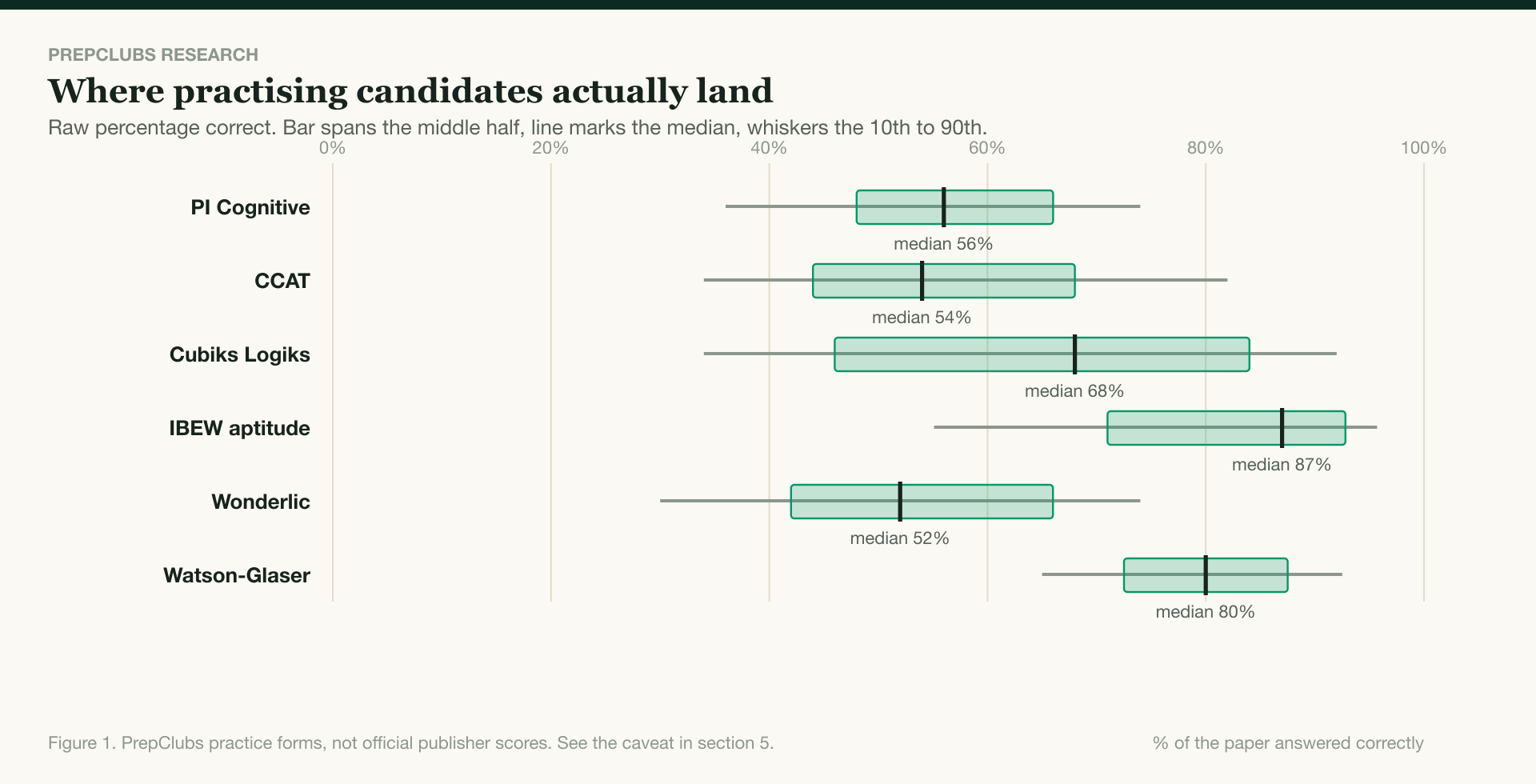
The raw-mark bands above are community reports. We can add a first-party check. Our PrepClubs Research series re-grades every scored attempt on our own Watson-Glaser practice forms, and the distribution lines up closely with the cutoffs firms describe (What candidates actually score on aptitude practice tests).
| Practice percentile | Raw % correct | Out of 40 |
|---|---|---|
| 10th | 65% | 26 |
| 25th | 72.5% | 29 |
| Median | 80% | 32 |
| 75th | 87.5% | 35 |
| 90th | 92.5% | 37 |
Based on 41 analysed practice attempts. These are raw scores on PrepClubs forms written to the published Watson-Glaser format, not Pearson scores, so read them as where practising candidates sit against each other.
Two things follow for anyone chasing a Magic Circle or US BigLaw cutoff:
- The pack is tight. The whole middle half of practising candidates sits inside about three questions (29 to 35 out of 40). One or two avoidable errors move you across a firm's line, which is why the conventions matter more than raw ability.
- The clock is not what stops people. Only 0.4% of Watson-Glaser items were left blank in our data, against about 20% on the CCAT and Wonderlic (How much of a timed aptitude test is never answered). Marks are lost to wrong answers, and the biggest block of them sits at the start: accuracy on the opening fifth of the paper was 53.1%, against 85% to 91% on the rest (Which aptitude tests are built as a difficulty ramp).
Practise the kind of item that decides a cutoff
These four come from Watson-Glaser Practice Test 8, the newest form in our bank. Each one is the type that separates a 32 from a 35.
Question 1 (Inference). A city surveyed residents three months after a new bus rapid transit line opened. 62% of respondents said they used the line at least once a week, and 80% of those users said it shortened their daily commute.
Proposed inference: The line is profitable for the transit authority.
Answer: Insufficient Data. The passage says nothing about fares, costs or revenue. Heavy use feels like it should mean profit, and that feeling is exactly the outside knowledge the test is designed to punish.
Question 2 (Deduction). Premises: All approved contractors are licensed. Some approved contractors are specialists.
Conclusion: All licensed contractors are specialists.
Answer: No. The premises only tell you about approved contractors. There could be licensed contractors who were never approved, and nothing says they are specialists.
Question 3 (Interpretation). Two high schools with similar demographics were compared. The one that adopted later start times posted a 12% lower tardiness rate and a small but statistically significant improvement in average math scores over the following year.
Proposed conclusion: Later start times guarantee higher math scores for any student.
Answer: No. A small average gain across one school does not become a guarantee for every individual. Watch for words like guarantee, always, every and sole cause: they almost always push a conclusion past what the data supports.
Question 4 (Evaluation of Arguments). Should a company adopt mandatory code review for all production changes? No, because some team members prefer to work without oversight.
Answer: Weak argument. It is relevant to the question, but a personal preference is trivial next to a quality-control decision. Strong arguments must be both relevant and important.
The full form, with a worked explanation for every item, is in the Watson-Glaser practice tests on PrepClubs.
Why the Watson-Glaser is harder than candidates expect
The Watson-Glaser does not punish time pressure the way the CCAT or Wonderlic do. Thirty minutes for 40 questions gives you 45 seconds per question, which is generous compared to cognitive screens like the CCAT (18 seconds per question). The difficulty is in the discipline.
The single biggest source of lost marks: candidates use outside knowledge. The test instructs you to reason only from the passage in front of you, even when the passage states something you know to be factually wrong. Candidates who answer based on what they know rather than what the passage says give back marks they did not need to lose. This is the most consistent failure pattern, and it is also the easiest to fix with practice.
The second biggest source: candidates confuse the response scales between sections. Inferences uses a five-point scale (true, probably true, insufficient data, probably false, false). Recognising assumptions uses a binary scale (assumption made, assumption not made). Deductions uses a binary scale (conclusion follows, conclusion does not follow). Switching scales between sections without re-reading the instructions costs marks predictably, and the loss is concentrated in the section the candidate switched into.
The third source: the inferences section requires you to rate "probably true" versus "true" with surgical precision. "True" means the passage entails it. "Probably true" means the passage makes it more likely than not but does not entail it. Candidates who treat these as interchangeable lose marks in the section where the most marks are typically on offer.
How firm-specific the cutoffs really are
Cutoffs vary by firm, but they also vary within a single firm by intake year and by route. Three patterns worth knowing:
A given firm tends to set a higher cutoff for direct training contract applicants than for vacation scheme applicants who have already passed an earlier sift. The cutoff is calibrated to the volume of applications, not to a fixed standard.
A given firm can run different cutoffs for different recruitment cycles depending on application volume. A high-volume year tends to push the cutoff up. A weak year tends to push it down.
Some firms apply the cutoff at a section level rather than the overall test. A candidate scoring 80th percentile overall but 40th percentile on the inferences section can be rejected at a firm that requires balanced section performance, even though the overall score clears the published cutoff. Magic Circle firms in particular look at section balance.
For a Clifford Chance-specific breakdown of the reported 75th percentile cutoff, the application pipeline timing, and section-by-section traps, see Clifford Chance Watson-Glaser: 75th percentile cutoff and practice.
The 7-day Watson-Glaser prep plan
A focused 7 days can make a real difference, and the lift comes from learning the rules of the test, not from learning new content.
Day 1. Take a full-length 40-question timed mock. The point is to surface where your time went and which sections cost you marks. Score by section, not just overall. The section that lost the most marks is your priority for days 2 and 3. If you do not have a form yet, start with a free full-length Watson-Glaser practice test.
Day 2. Drill the inferences section specifically. Practice the "true / probably true / insufficient data / probably false / false" five-point scale at speed. The key skill is calibrating "probably true" against "insufficient data": these are the two answers candidates confuse most often.
Day 3. Drill the recognising assumptions and deductions sections together. These two sections share a logical structure (binary judgement of whether a stated relationship holds) and the same skill transfers between them. The key discipline: assume the passage is true even when you know it is not.
Day 4. Drill the interpretation and evaluation of arguments sections. These reuse a smaller bank of question structures than the other three sections, and pattern recognition lifts your score quickly here.
Day 5. Take a second full-length timed mock. Compare it to Day 1, section by section, to see where the daily drills actually moved your accuracy.
Day 6. Pure error review. Go through every question you got wrong on the Day 5 mock and identify whether the error was a scale confusion, an outside-knowledge intrusion, or a genuine reasoning miss. The first two categories are fixable in minutes. The third is where remaining gain comes from.
Day 7. Rest. Do not learn new material. Sleep eight hours. Take the real test in the first half of your day if you have a choice of timing.
Beyond two weeks of focused prep, returns diminish. The Watson-Glaser has a practical per-candidate ceiling, and most candidates get close to it within a couple of weeks.
Watson-Glaser cutoff lookup table by firm tier
Firms set their own cutoffs and rarely publish them, so read this as the percentile bands candidates and careers services commonly report, not as official thresholds.
| Firm tier | Commonly reported percentile cutoff | Examples |
|---|---|---|
| Magic Circle | 75th to 80th | Allen & Overy, Clifford Chance, Freshfields, Linklaters |
| Silver Circle and elite US London | 70th to 75th | Herbert Smith Freehills, Macfarlanes, Latham, Kirkland |
| International and large mid-market | 65th to 75th | Hogan Lovells, Norton Rose, DLA Piper, Baker McKenzie |
| Specialist and regional UK | 60th to 70th | Burges Salmon, Mills & Reeve, TLT, Bird & Bird |
| Government Legal Service | Around 60th | GLS Trainee Scheme |
How to find out the cutoff for a specific firm
Firms generally do not publish cutoffs, but useful indirect signals:
If the firm runs the Watson-Glaser as the very first step before any human sift, the cutoff is set higher to mass-filter applicants. Magic Circle firms typically operate this way.
If the Watson-Glaser is administered after a paper sift, the cutoff is often lower because the firm has already filtered for fit. US BigLaw London offices and some Silver Circle firms operate this way.
If the firm sends a feedback PDF with your percentile (Clifford Chance is the most reliable example), you can compare your score across applications and gauge cutoffs by which applications advanced.
If you have already taken a Watson-Glaser for one firm in a cycle, your raw performance on the same test format at a second firm should be similar. If you cleared firm A but not firm B, the cutoff at B is higher than at A. This is the most reliable way to triangulate cutoffs without insider information.
What "passing" the Watson-Glaser actually means in practice
There is no universal pass mark. The test does not have a passing score the way a driving test does. What it has is a percentile rank, and your firm compares that percentile to a cutoff they have set.
The defensible target for almost any UK commercial law application is the 80th percentile, roughly 32 correct out of 40. It should clear the cutoffs reported at every Magic Circle firm with a margin, and clear those reported below the Magic Circle comfortably. Hitting the 80th percentile means roughly 80 percent raw on a clean test.
If you are applying outside the Magic Circle, the 70th percentile (around 28 correct) is usually safe. Below the 60th percentile, you are at risk at almost every commercial firm.
How to read your percentile result
If a firm does send you a percentile, here is how to turn it into a decision:
- Compare it to the tier you applied to, not to 100. A 78th percentile is strong for the Magic Circle and comfortable everywhere below it. Percentile is rank against a norm group, not a mark out of 100, so it is not "a C grade."
- Check the section balance if you have it. A strong overall percentile with one weak section, often inferences, can still fail a firm that screens on section balance. If your feedback shows sections, note your weakest one for next time.
- Treat it as a cross-firm baseline. Your percentile on one firm's sitting is a fair predictor of how you will do at another firm on the same format. If you cleared firm A but not firm B, firm B simply sets a higher bar.
- Do not re-sit on a whim. Most firms allow one sitting per cycle and Pearson may carry a result forward, so improve with practice before the next cycle rather than burning an attempt.
If you want the mechanics behind the percentile, including the five sections, the worked examples, and how the raw number converts, read The Watson-Glaser test: format, sections, and score explained.
FAQ
What is a good Watson-Glaser score?
The 80th percentile or higher is competitive at every UK commercial law firm. Raw score of around 32 out of 40 typically lands you at the 80th percentile. Magic Circle firms are reported to cut at the 75th to 80th percentile, so 32 correct gives you a working margin.
What is the Watson-Glaser pass mark for Magic Circle firms?
Magic Circle firms (Allen & Overy, Clifford Chance, Freshfields, Linklaters) are reported to cut at the 75th to 80th percentile. There is no universal raw score, but candidates report that 30 to 32 correct out of 40 is roughly the threshold. Slaughter and May historically uses its own assessment rather than the Watson-Glaser.
How is the Watson-Glaser scored?
Pearson scores your raw answers and converts them to a percentile rank against a comparison group of graduate or professional candidates. Section weighting is not equal across the five sections: inferences and evaluation of arguments tend to carry more weight than deductions and interpretation.
Can I retake the Watson-Glaser?
Most firms allow only one Watson-Glaser sitting per application cycle. If you fail at one firm, you can apply elsewhere in a future cycle, but Pearson maintains a candidate database and your prior result may carry forward depending on the firm.
Is the Watson-Glaser harder than the CCAT?
They test different things. The Watson-Glaser is harder on logical precision, easier on time pressure. The CCAT is the opposite: easier on logical precision, brutal on time pressure. The CCAT gives you 18 seconds per question; the Watson-Glaser gives you 45.
Do all Magic Circle firms use the Watson-Glaser?
Allen & Overy, Clifford Chance, Freshfields, and Linklaters all use the Watson-Glaser at the time of writing. Slaughter and May runs its own assessment process and does not currently use the Watson-Glaser. Always check the current graduate recruitment page of the firm before applying.
What should I do if I score below the cutoff?
Most firms send a pass-or-fail email without revealing the score. If you suspect you are close to the cutoff and the firm is one of the few that publishes feedback (Clifford Chance is the most reliable example), use that data to gauge how much improvement is needed. Otherwise, apply to firms in tiers below your current performance and keep practising for the next cycle.
Related on PrepClubs
- Pillar. Full Watson-Glaser prep guide. Format, scoring, prep plan, FAQs.
- Deep practice. Get the full Watson-Glaser bank. Timed mocks, section-specific drills, and percentile feedback. One-time access, with current pricing on the pricing page. If you do not pass, the Pass Guarantee extends your access by 30 days at no extra cost.
- Compare. How hard is the CCAT, really?. The CCAT difficulty answer for context against the Watson-Glaser.
- Article. What score do you need on the Wonderlic?. Role-by-role cutoffs for the Wonderlic, the closest peer test by format.
- Guide. What is a good cognitive test score?. Per-test benchmarks across CCAT, Wonderlic, PI, SHL, and Watson-Glaser.
Practice on PrepClubs
Practice the Watson-Glaser with the right scales and timing
Full-length 40-question timed mocks plus section-specific drills for inferences, assumptions, deductions, interpretation, and evaluation. One-time access, not a subscription. If you do not pass, the Pass Guarantee extends your access by 30 days at no extra cost.
Practise for this exam
Watson-Glaser practice tests
Timed practice tests in the real Watson-Glaser format, with a worked explanation for every question, so you learn the method as well as the answer.