How Hard Is the CISSP, Really, and Why Technical People Fail It
The CISSP is hard for a specific reason: it rewards the manager's answer, not the technician's. Here is the honest difficulty read, the real exam facts, and why engineers fail it.

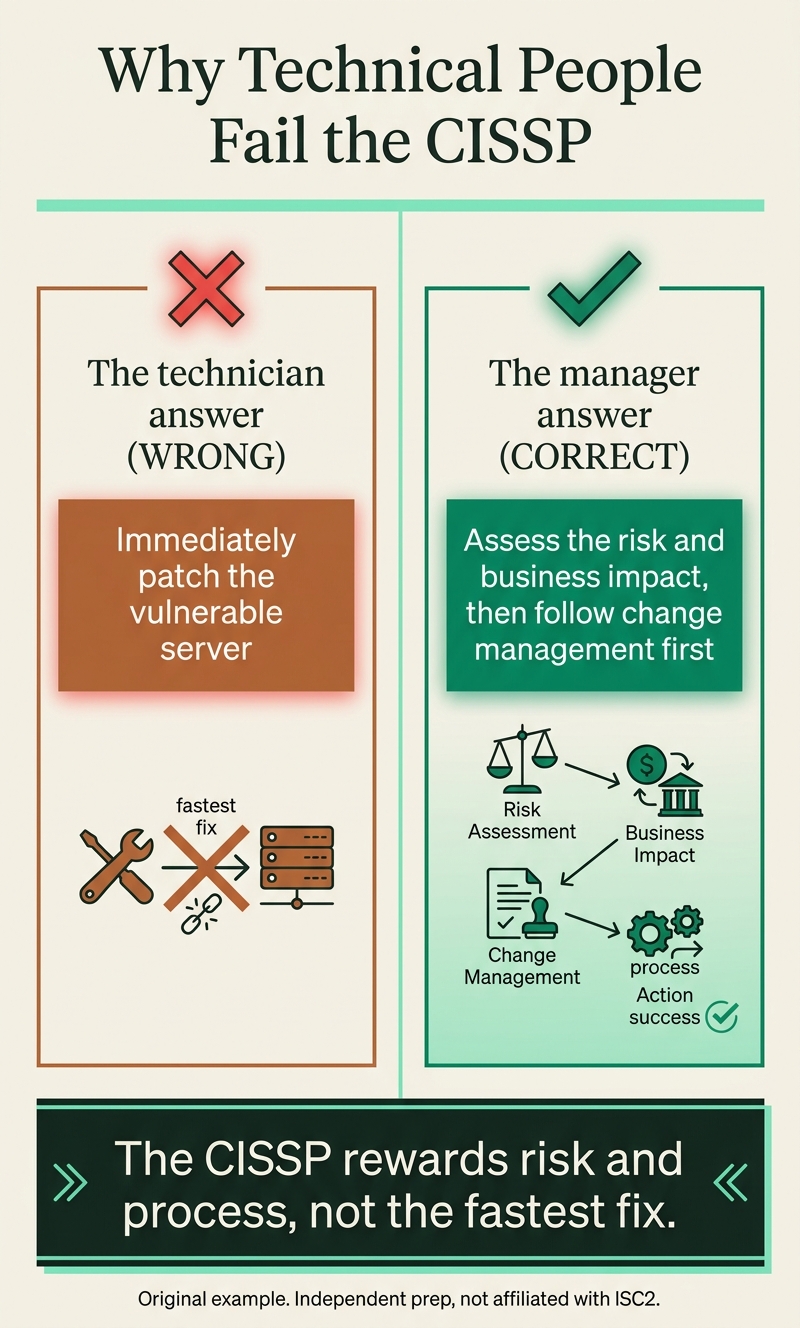
The CISSP is hard, but not for the reason most people assume. It is not hard because the facts are obscure. Most of the material is familiar to anyone who has worked in security for a few years. It is hard because it refuses to reward the technical answer. Over and over, the exam gives you a scenario, offers four answers that are all technically defensible, and asks for the one a security manager would choose. Engineers who have spent a decade fixing things fail it by reflexively picking "fix the problem" when the right answer was "assess the risk first."
If you want an honest difficulty read, here it is: the CISSP is a judgment exam wearing a knowledge-exam costume, delivered in an adaptive format that never lets up. This explains what actually makes it hard, why strong technical people trip on it, and the real exam facts, so you can ignore the outdated "250 questions and a 20 percent pass rate" myths still floating around.
Quick takeaways
- The CISSP is hard mainly because it rewards the manager's answer over the technician's. Multiple answers are often correct; you must pick the best one from a risk and business perspective.
- The format adds pressure: it is a computer adaptive test (CAT) of 100 to 150 items, up to 3 hours, passing at 700 out of 1000, per ISC2. The questions get harder as you do well.
- Technical people fail by choosing the hands-on fix when the exam wanted "assess, document, or escalate first."
- Ignore the "250 questions, 6 hours, 20 percent pass rate" numbers you may still see online. That describes the retired linear exam, not the current CAT.
- PrepClubs' CISSP track is built around scenario questions with rationales that model manager-level reasoning, which is the exact skill the exam tests.
- PrepClubs is independent prep material and is not affiliated with or endorsed by ISC2.
What actually makes the CISSP hard
There are three real sources of difficulty, and none of them is raw memorization.
One: the "think like a manager" framing. The CISSP is written for someone who manages a security program, not someone who racks servers. When it hands you a scenario, the best answer is usually the one that follows sound risk-management process: understand the business impact, weigh the risk, choose the response that protects the organization, not the response that is technically slickest. This is the single biggest adjustment for hands-on candidates.
Two: the breadth. Eight domains, none more than 16 percent of the exam, all fair game. You cannot compensate for a weak domain with a strong one. The "mile wide, inch deep" reputation is accurate, and it means there is no small area you can safely skip.
Three: the adaptive format. The CISSP CAT serves you a harder question when you answer correctly and an easier one when you miss, then estimates your ability from the pattern. It never settles into a comfortable rhythm. Just when you feel like you are doing well, the questions get harder, which is exactly what is supposed to happen. Candidates who do not understand this read the rising difficulty as failure and rattle.
Why technical people fail: a worked example
The clearest way to show the trap is an original example in the exam's style.
Scenario. During a routine review, a security engineer discovers that a production server is running an outdated service with a known critical vulnerability. What should the engineer do first?
| Answer | Verdict |
|---|---|
| A: Immediately patch the service | The technician's reflex. Wrong as a first step. |
| B: Take the server offline until it is fixed | Aggressive and disruptive. Wrong first step. |
| C: Assess the risk and business impact, then follow change management | The manager's answer. Correct. |
| D: Document the finding and move on | Passive. Wrong. |
Almost every strong engineer picks A. It is what you would actually do at 2 a.m. when something is broken. But the CISSP wants C, because the certified professional assesses risk and follows the organization's change-management process before touching production. Patching without assessment could break a dependency, violate a change window, or destroy forensic evidence. The exam is testing whether you think in risk and process, not in fixes. Get this pattern, and a whole category of questions that used to feel like trick questions starts to make sense.
The real exam facts (ignore the outdated ones)
A lot of the fear around the CISSP comes from numbers that are simply wrong now. Here is the current reality versus the retired exam that still gets quoted.
| Current CISSP (CAT) | Retired linear exam (do not use) | |
|---|---|---|
| Questions | 100 to 150 items | 250 questions |
| Time | Up to 3 hours | 6 hours |
| Format | Computer adaptive (CAT) | Fixed linear form |
| Passing score | 700 of 1000 (scaled) | 700 of 1000 (scaled) |
If you read that the CISSP is "250 questions over 6 hours," you are reading about the exam ISC2 retired. The English CISSP moved to CAT years ago, and as of April 15, 2024 all languages worldwide use the CAT format, per ISC2. The current exam is shorter and more efficient, not the marathon its reputation suggests. ISC2 does not publish an official pass rate, so treat any specific "X percent pass" figure you see as an unverified estimate, not fact.
So how hard is it, honestly?
Difficulty depends heavily on who you are.
- A working security manager or GRC professional often finds the framing natural and the content familiar. The main work is filling breadth gaps.
- A strong technical engineer usually knows more than enough content but has to unlearn the fix-it-first reflex. This is the group that most needs scenario practice, not more reading.
- A newer professional faces the eligibility barrier first (five years of experience, or the Associate route) and then the full breadth. This group needs the most study time.
Across all three, the pattern holds: the CISSP is passable, it is not a genius test, and the people who fail usually failed on judgment framing or breadth gaps, not on obscure facts. Both of those are trainable with the right practice.
FAQ
Is the CISSP exam hard?
Yes, but in a specific way. The content is broad rather than deep, and the real difficulty is that it rewards risk-based, manager-level answers over technical fixes. It is passable with the right preparation; it is not a genius test.
Why do technical people fail the CISSP?
Because they pick the hands-on fix when the exam wanted "assess the risk and follow process first." The CISSP tests security-management judgment, so a decade of fixing things can actually work against you until you retrain the instinct.
How many questions is the CISSP, and how long?
A computer adaptive test of 100 to 150 items, up to 3 hours, passing at 700 of 1000, per ISC2. Ignore any source citing 250 questions or 6 hours; that is the retired linear exam.
What is the CISSP pass rate?
ISC2 does not publish an official pass rate, so any specific percentage you see is an estimate. The reliable takeaway is that most failures come from judgment framing and breadth gaps, both of which are fixable with scenario practice.
Can you pass the CISSP in 3 months?
Many candidates do, at roughly 10 to 15 hours a week, if they already have relevant experience. Newer professionals typically need longer. Your diagnostic across the eight domains will tell you how far you actually are.
Is the CISSP harder than Security+?
Yes, considerably. Security+ is entry-level and mostly tests knowledge; the CISSP tests management judgment across eight domains in an adaptive format and requires five years of experience. They sit at different points on the career ladder.
Related on PrepClubs
- The 8 CISSP domains explained: the breadth you have to cover, with 2024 weightings.
- CISSP CAT exam format: how the adaptive format works and what changed.
- CISSP practice questions: why rationale depth beats a bigger dump.
- Security+ practice test: the entry-level cert most people hold before CISSP.
Train the judgment, not just the facts
The CISSP does not fall to more reading. It falls to practice that retrains how you answer, so you spot the qualifier, weigh the risk, and pick the manager's answer under adaptive pressure. That is exactly what PrepClubs' CISSP track is built for: original, scenario-level questions across all eight domains, each with a written rationale that shows why the risk-based answer beats the technical one, plus a free diagnostic to find your weak domains first. It is a one-time purchase with 30 days of access, not a subscription you rent by the year. If you prepare with PrepClubs and do not pass your real test, we extend your access at no extra cost. No fine print. PrepClubs has helped more than 1,600 students prepare for cognitive and certification assessments. Start with the free CISSP diagnostic.
FAQ