How to Study for CompTIA A+ Across Both Cores (Objective-Weighted Plan)
How to study for CompTIA A+ across both cores: weight your hours to the 220-1201 and 220-1202 domain percentages instead of reading a book cover to cover.

The efficient way to study for CompTIA A+ is to treat it as two exams and weight your hours to each core's published domain percentages, instead of reading a study guide cover to cover. The A+ is one certification earned by passing two exams: Core 1 (220-1201) and Core 2 (220-1202), each a maximum of 90 questions in 90 minutes, per CompTIA. Core 1 passes at 675 and Core 2 at 700, both on a 100-to-900 scale. A book gives every topic equal pages; the exam does not give every topic equal weight. This guide is a study method that maps your effort to where the questions actually are.
You have limited weekly hours, so spend them where the exam concentrates its questions. On Core 1 that means hardware and troubleshooting; on Core 2 it means operating systems and security.
Weight your study hours to each core's domain percentages
Quick takeaways
- CompTIA A+ is two exams, 220-1201 (Core 1) and 220-1202 (Core 2), and you must pass both, per CompTIA. Study each on its own weighted plan.
- Each core is a maximum of 90 questions in 90 minutes. Core 1 passes at 675, Core 2 at 700, both on a 100-to-900 scale, per CompTIA.
- On Core 1, hardware (25 percent) and hardware/network troubleshooting (28 percent) carry more than half the exam, so front-load them.
- On Core 2, operating systems (28 percent) and security (28 percent) together are 56 percent of the exam, so they get the most hours.
- Take Core 1 first for most people, since its hardware and networking grounding makes Core 2 easier to absorb.
- Practice the performance-based questions (PBQs) deliberately; they are hands-on tasks, not multiple choice, and they punish reading-only study.
- PrepClubs is independent prep material and is not affiliated with or endorsed by CompTIA.
Study each core as its own exam
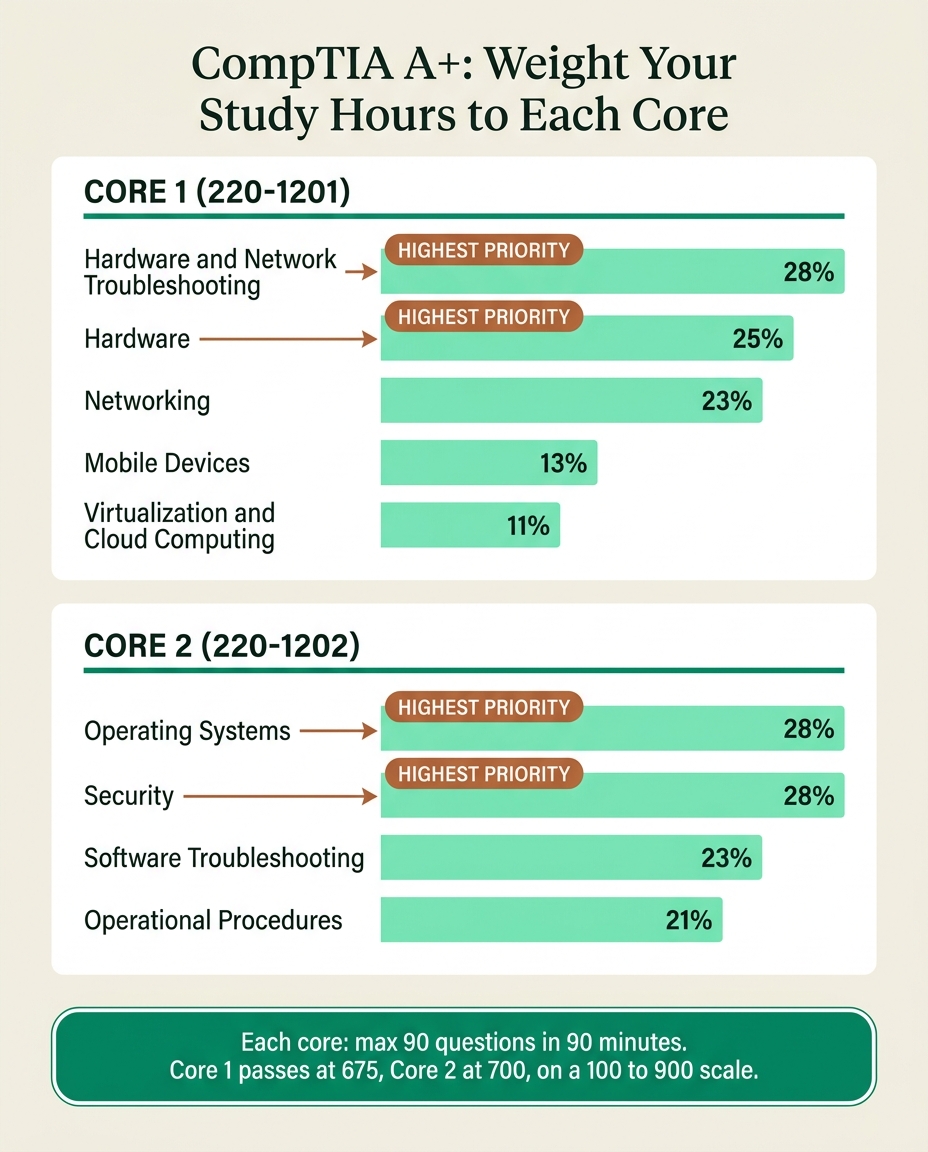
The single biggest mistake is treating A+ as one blob of material. It is two exams with different content and different passing scores, so build two separate weighted plans. Here are the current V15 domain weights for each core, per CompTIA, with where your hours should go.
| Exam | Domain | Weight | Priority |
|---|---|---|---|
| Core 1 (220-1201) | Hardware and Network Troubleshooting | 28% | Highest |
| Core 1 (220-1201) | Hardware | 25% | High |
| Core 1 (220-1201) | Networking | 23% | High |
| Core 1 (220-1201) | Mobile Devices | 13% | Medium |
| Core 1 (220-1201) | Virtualization and Cloud Computing | 11% | Lightest |
| Core 2 (220-1202) | Operating Systems | 28% | Highest |
| Core 2 (220-1202) | Security | 28% | Highest |
| Core 2 (220-1202) | Software Troubleshooting | 23% | High |
| Core 2 (220-1202) | Operational Procedures | 21% | Medium |
The weights are your budget. If you have 60 hours for Core 1, roughly 17 of them belong to troubleshooting and about 7 to virtualization and cloud. The exam tells you where its questions are, so let it decide where your time goes.
Front-load the heaviest domains on each core
On Core 1, hardware and hardware/network troubleshooting together are 53 percent of the exam. Those two are also the most hands-on, so studying them first gives the concepts the longest time to settle and gives you the most practice with the kind of reasoning the PBQs test. Networking at 23 percent comes next, then mobile devices, and virtualization and cloud last.
On Core 2, operating systems and security are 28 percent each, so more than half of Core 2 lives in those two domains. Start there. Software troubleshooting at 23 percent connects naturally to the operating-systems work, and operational procedures at 21 percent (safety, documentation, communication, basic scripting concepts) rounds out the exam.
Take Core 1 first, then Core 2
CompTIA lets you take the two exams in either order, but most people should take Core 1 first. Core 1 is the tangible hardware-and-networking exam, and the mental model you build there (how machines and networks actually work) makes the operating-systems and security material on Core 2 easier to reason about. Passing Core 1 first also gives you a concrete win that carries momentum into the second exam.
Both exams must be from the same version, the current V15 series (220-1201 and 220-1202), per CompTIA. Do not mix a V15 core with a retired 220-1101 or 220-1102, which retired in September 2025.
Budget your weekly hours realistically
Be honest about the hours you actually have. A sustainable rhythm for many people studying while working is 8 to 12 hours per week per core, spread rather than crammed. The total number of weeks depends on how much of the material overlaps with your day-to-day tech experience.
A practical weekly rhythm per core:
- Two focused weekday sessions of about an hour each on the current heaviest domain.
- One longer weekend session for reading plus a set of practice questions and at least one PBQ.
- A rolling review block that revisits earlier domains so they do not fade before exam day.
Two focused cores, one weighted plan each
Schedule Core 2 to start soon after you pass Core 1, while your study habit is still warm. Waiting months between the two exams means relearning material you already covered.
Do not skip the performance-based questions
Both cores include performance-based questions, hands-on tasks where you configure a setting, order a troubleshooting sequence, or match components, not just pick A, B, C, or D. PBQs are where reading-only study falls apart, because you can recognize a definition and still fail to perform the task. Build PBQ-style practice into every weekend session so the format is familiar, not a surprise. On test day the PBQs usually appear first, so getting comfortable with them protects your timing on the rest of the exam.
Confirm the exam facts before you book
Lock in the format before you schedule, per CompTIA: each core is a maximum of 90 questions in 90 minutes, Core 1 passes at 675 and Core 2 at 700, both on a 100-to-900 scale, and you need both passes to earn the credential. Knowing the exact targets keeps your practice honest, since you are aiming for a specific scaled score on each core, not a vague sense of readiness.
FAQ
How should I study for CompTIA A+ efficiently?
Treat it as two exams and weight your hours to each core's domain percentages, per CompTIA. On Core 1, front-load hardware (25 percent) and hardware/network troubleshooting (28 percent). On Core 2, front-load operating systems (28 percent) and security (28 percent). Practice performance-based questions in every session.
How long does it take to study for A+?
It depends on your background, but many people studying while working spend 8 to 12 hours per week per core over a couple of months. Domains that overlap with your current tech experience need fewer hours than unfamiliar ones.
Should I study for Core 1 and Core 2 at the same time?
Most people should study and pass Core 1 first, then move to Core 2 while the study habit is still warm. Core 1's hardware and networking grounding makes the operating-systems and security material on Core 2 easier to absorb.
What is the passing score for each A+ exam?
Core 1 (220-1201) passes at 675 and Core 2 (220-1202) passes at 700, both on a 100-to-900 scale, per CompTIA. You must pass both cores to earn the A+ certification.
How do I study for the A+ performance-based questions?
Practice them hands-on rather than reading about them. PBQs ask you to configure, order, or match, not to recognize a definition, so build PBQ-style tasks into every weekend session. They usually appear first on the exam, so familiarity protects your timing.
Which A+ domains carry the most questions?
On Core 1, hardware/network troubleshooting (28 percent) and hardware (25 percent) are the heaviest. On Core 2, operating systems and security are 28 percent each. Give those domains the most study hours, per CompTIA's published weightings.
Related on PrepClubs
- CompTIA A+ Exam Objectives: Core 1 and Core 2 Domain Breakdown
- A+ Core 1 vs Core 2: What Is on Each Exam and Which to Take First
- CompTIA A+ Practice Test: How to Drill Core 1 and Core 2 to a Pass
A weighted plan tells you where your hours belong; practice under the real format tells you whether they landed. That is how PrepClubs' A+ track is built: a free diagnostic to find your weak domains across both cores, then timed, per-core practice with performance-based questions and a written rationale on every answer, so you rehearse the exact reasoning each exam scores. It is a one-time purchase with 30 days of access, not a subscription. If you prepare with PrepClubs and do not pass your real test, we extend your access at no extra cost. No fine print. PrepClubs has helped more than 1,600 students prepare for cognitive and certification assessments. Start with the free A+ diagnostic.
FAQ