How to Study for CISSP: A Domain-Weighted Plan for Working Professionals
How to study for CISSP: weight your hours to the 8 domains, front-load Security and Risk Management at 16 percent, and think like a manager. A working plan.

The most efficient way to study for CISSP is to weight your hours to the eight domain percentages instead of studying each domain equally. Security and Risk Management is the heaviest at 16 percent, so front-load it. Asset Security and Software Development Security are the lightest at 10 percent each, so they get the fewest hours. The CISSP is a computer adaptive test (CAT) of 100 to 150 questions in up to 3 hours, passing at 700 out of 1000, per (ISC)2, and it rewards a "think like a manager" mindset over the most technical answer. This guide is a study method, not a question tutorial.
For a working professional with limited weekly hours, that difference matters. Spreading effort evenly across all eight domains wastes time on light-weighted material and under-prepares the domains that carry the most exam weight.
Weight your study hours to the domain percentages
Quick takeaways
- Study by domain weight, not evenly. The 2024 outline (effective April 15, 2024) sets eight domains with fixed percentages, per (ISC)2.
- Front-load Security and Risk Management (16 percent), the heaviest domain and the conceptual backbone of the exam.
- Give the lightest hours to Asset Security (10 percent) and Software Development Security (10 percent).
- CISSP rewards a risk-based, business-first mindset. Pick the answer a security manager would, not the most technical one.
- The exam is CAT: 100 to 150 questions in up to 3 hours, passing at 700 out of 1000, per (ISC)2.
- You need 5 years of cumulative paid work experience in 2 or more of the 8 domains, or the Associate of ISC2 path if you lack it.
- PrepClubs is independent prep material and is not affiliated with or endorsed by (ISC)2.
Start with the domain weights
The 2024 CISSP exam outline sets eight domains, each with a fixed percentage of the exam. Your study plan should mirror those percentages. Here is the full breakdown with a suggested share of your total study hours.
| Domain | 2024 weight | Suggested study-hour share |
|---|---|---|
| Security and Risk Management | 16% | Highest, front-loaded |
| Security Architecture and Engineering | 13% | High |
| Communication and Network Security | 13% | High |
| Identity and Access Management (IAM) | 13% | High |
| Security Operations | 13% | High |
| Security Assessment and Testing | 12% | Medium |
| Asset Security | 10% | Lightest |
| Software Development Security | 10% | Lightest |
If you have 100 hours to spend, roughly speaking, about 16 of them belong to Security and Risk Management and about 10 each to Asset Security and Software Development Security. The weights are your budget allocation.
Why front-load Security and Risk Management
Security and Risk Management is the heaviest domain at 16 percent, and it is also the conceptual spine of the exam. It covers governance, risk management concepts, compliance, security policies, and the business-first thinking the rest of the exam leans on. Studying it first is not just about its weight. The risk-based mindset you build here is the same mindset that helps you answer questions in every other domain correctly.
Put it at the start of your schedule so the concepts have the longest time to settle, then let later domains reinforce it.
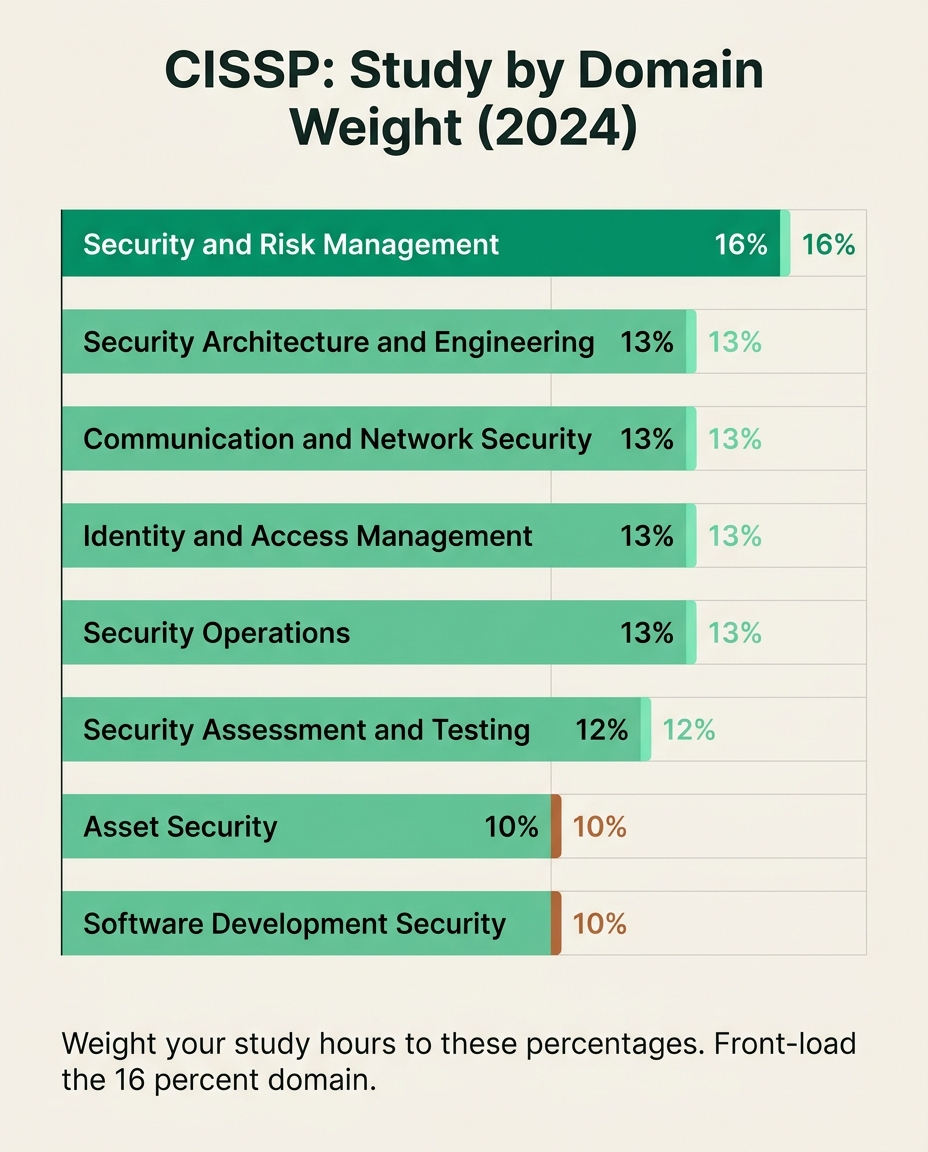
Sequence the eight domains by weight
A weight-first sequence for a working professional looks like this:
- Security and Risk Management (16%) first, to build the mindset and bank the heaviest domain.
- The four 13 percent domains next: Security Architecture and Engineering, Communication and Network Security, IAM, and Security Operations. These are the bulk of the exam, so they get the bulk of your middle weeks.
- Security Assessment and Testing (12%), which connects to the operations and architecture work you just did.
- Asset Security (10%) and Software Development Security (10%) last, the lightest domains, once your foundation is set.
This order is not rigid, but it keeps your heaviest hours on your heaviest domains and lets earlier domains prime later ones.
Budget weekly hours realistically
If you work full time, be honest about how many hours you actually have. A sustainable plan for many working professionals is 8 to 12 study hours per week over several months, rather than cramming. The exact number of weeks depends on your background and how many domains overlap with your day job.
A practical rhythm:
- Two focused weekday sessions of about an hour each, on the current domain.
- One longer weekend session for reading plus a set of practice questions.
- A rolling review block that revisits earlier domains so they do not fade.
Consistency over months beats a short cram
The heaviest domains simply get more weeks in this rhythm; the lightest get one focused pass plus review.
Adopt the "think like a manager" mindset
CISSP is famous for questions where several answers are technically correct but only one is the "best" answer. The exam rewards the risk-based, business-first choice a security manager would make, not the most hands-on technical fix. When you read a question, ask what a manager responsible for the whole program would prioritize: reduce the greatest risk, protect the business objective, follow policy and governance, and only then reach for the technical control.
Practicing this shift is a study activity in itself. As you work through questions, do not just check whether you got it right. Ask why the "best" answer beat the merely-correct ones. That reasoning is what the CAT is measuring.
Practice for the CAT format
The English CISSP is a computer adaptive test: 100 to 150 questions in up to 3 hours, passing at 700 out of 1000, per (ISC)2. Adaptive means the exam adjusts item difficulty based on your answers, and it can end once it has enough evidence about your ability. You cannot go back to change a previous answer.
That format shapes how you should practice:
- Get comfortable committing to an answer and moving on, since you cannot revisit.
- Build endurance for up to 3 hours of sustained decision-making.
- Practice across all eight domains in mixed sets, because the exam does not group by domain.
Confirm you meet the experience requirement
CISSP requires 5 years of cumulative paid work experience in 2 or more of the 8 domains, per (ISC)2. If you do not yet have the experience, you can still sit the exam and become an Associate of ISC2, then earn the certification once you accumulate the required experience within the allowed window. Confirm your eligibility before you book, so your study time leads to a credential you can actually claim.
FAQ
How should I study for CISSP efficiently?
Weight your study hours to the eight domain percentages, per (ISC)2. Front-load Security and Risk Management at 16 percent, give the lightest hours to Asset Security and Software Development Security at 10 percent each, and practice the risk-based "think like a manager" mindset the exam rewards.
How long does it take to study for CISSP?
It varies with your background, but many working professionals study 8 to 12 hours per week over several months rather than cramming. Domains that overlap with your day job need fewer hours than unfamiliar ones.
Which CISSP domain is the most important to study?
Security and Risk Management, the heaviest at 16 percent and the conceptual backbone of the exam. Front-load it, since the risk-based mindset it builds helps you answer questions across all other domains.
What does "think like a manager" mean for CISSP?
Many questions have several technically correct answers, and you must pick the best one. The exam rewards the risk-based, business-first choice a security manager would make (reduce the greatest risk, follow policy, protect the business objective), not the most technical fix.
How is the CISSP exam formatted and scored?
The English exam is a computer adaptive test of 100 to 150 questions in up to 3 hours, passing at 700 out of 1000, per (ISC)2. It adjusts difficulty as you answer and you cannot return to previous questions.
Do I need work experience to take CISSP?
You need 5 years of cumulative paid work experience in 2 or more of the 8 domains, per (ISC)2. If you lack it, you can sit the exam and become an Associate of ISC2, then certify once you meet the experience within the allowed window.
Related on PrepClubs
- The 8 CISSP Domains Explained, With Their 2024 Weightings
- How Hard Is the CISSP, Really?
- The CISSP CAT Exam Format Explained
A weighted plan tells you where your hours should go; practice under the real format tells you whether they worked. That is how PrepClubs' CISSP track is built: a free diagnostic to see your real level across the eight domains, then mixed-domain timed practice with a written rationale on every answer, so you rehearse the "best answer" reasoning the CAT measures. It is a one-time purchase with 30 days of access, not a renewing subscription. If you prepare with PrepClubs and do not pass your real test, we extend your access at no extra cost. No fine print. PrepClubs has helped more than 1,600 students prepare for cognitive and certification assessments. Start with the free CISSP diagnostic.
FAQ