Accounting IT Certifications: 7 That Count for Audit Careers
Accounting IT certifications ranked by payoff: ISACA CISA, the CPA ISC discipline, CIA, CITP and three more. What each proves, what it costs and who it suits.

Accounting IT certifications all answer one question: can you evaluate the systems the numbers live in? The most direct answer is the ISACA CISA, the Certified Information Systems Auditor, and it is the credential hiring managers actually name in IT audit, SOX controls and risk postings. Around it sit six others worth knowing: the CPA with its ISC discipline, the CIA, the AICPA's CITP, and three security-side credentials that are useful but adjacent. This article ranks all seven accounting IT certifications by how directly they pay off in an accounting or audit role, and says plainly what each one does not do.
Quick takeaways
- ISACA CISA is the closest thing to a dedicated IT certification for accountants, and it is the one most IT audit job postings name.
- The CPA is not being replaced. Under the current core-plus-discipline exam, ISC is the technology track inside the CPA itself.
- The CIA belongs to internal audit and risk, not to information systems specifically.
- The AICPA's CITP has a shortcut worth knowing: holding ISACA CISA waives the CITP exam.
- CRISC, CISM and CompTIA Security+ are genuinely useful but sit on the security side of the line, not the accounting side.
- Nothing on this list substitutes for a CPA licence where attest work legally requires one.
First, the name collision nobody warns you about
Search "CISA" and you will get two entirely different things, which is why this article writes ISACA CISA in full.
ISACA CISA is the Certified Information Systems Auditor, a professional credential issued by ISACA, the association formerly known as the Information Systems Audit and Control Association. It is what an accountant or auditor earns.
CISA is also the abbreviation for the Cybersecurity and Infrastructure Security Agency, a United States federal agency. It is a government body. It issues advisories, not credentials for accountants.
They are unrelated. Search engines and AI assistants routinely blend the two, which is how people end up reading federal cybersecurity advisories when they wanted an exam syllabus. When you search, when you write it on a CV, and when you ask a recruiter about it, say "ISACA CISA" or "Certified Information Systems Auditor". The extra word saves a lot of confusion.
The 7 accounting IT certifications, ranked by payoff
1. ISACA CISA (Certified Information Systems Auditor)
What it proves: that you can audit an information system. Not run it, not secure it, audit it. The exam is built around auditor judgment, which is why candidates who know the material still find it hard.
The shape of it: 150 multiple-choice questions over 4 hours, scored on a scaled 200 to 800 range with 450 to pass, per ISACA. Five job practice domains carry the weight: Information Systems Auditing Process (18 percent), Governance and Management of IT (18 percent), IS Acquisition, Development and Implementation (12 percent), IS Operations and Business Resilience (26 percent), and Protection of Information Assets (26 percent). Those last two carry over half the exam between them.
Cost and prerequisites: the exam fee is US$575 for ISACA members and US$760 for non-members. You can sit the exam before you meet the experience requirement, but ISACA will not certify you until you document professional experience in information systems auditing, control or security. Check ISACA's current terms, because substitutions and waivers apply.
The honest catch: the 450 is a scaled score, not 56 percent correct. Candidates who practise toward a percentage target are aiming at a number that does not exist, which the full breakdown of ISACA CISA scoring covers.
2. CPA, with the ISC discipline
What it proves: that you are a licensed accountant, and that you chose the technology track on the way through.
The shape of it: the current CPA Exam is three core sections that everyone sits (Auditing, Financial Accounting and Reporting, and Regulation) plus one discipline chosen from three. ISC, Information Systems and Controls, is the technology option. It covers IT and data governance, information security and confidentiality, testing of controls over business processes, and SOC engagements.
The honest catch: ISC is a section of an exam, not a standalone credential. Nobody hires "an ISC". It is the right choice if you are already pursuing the CPA and want the technology grounding baked in, and it is not a route into IT audit on its own.
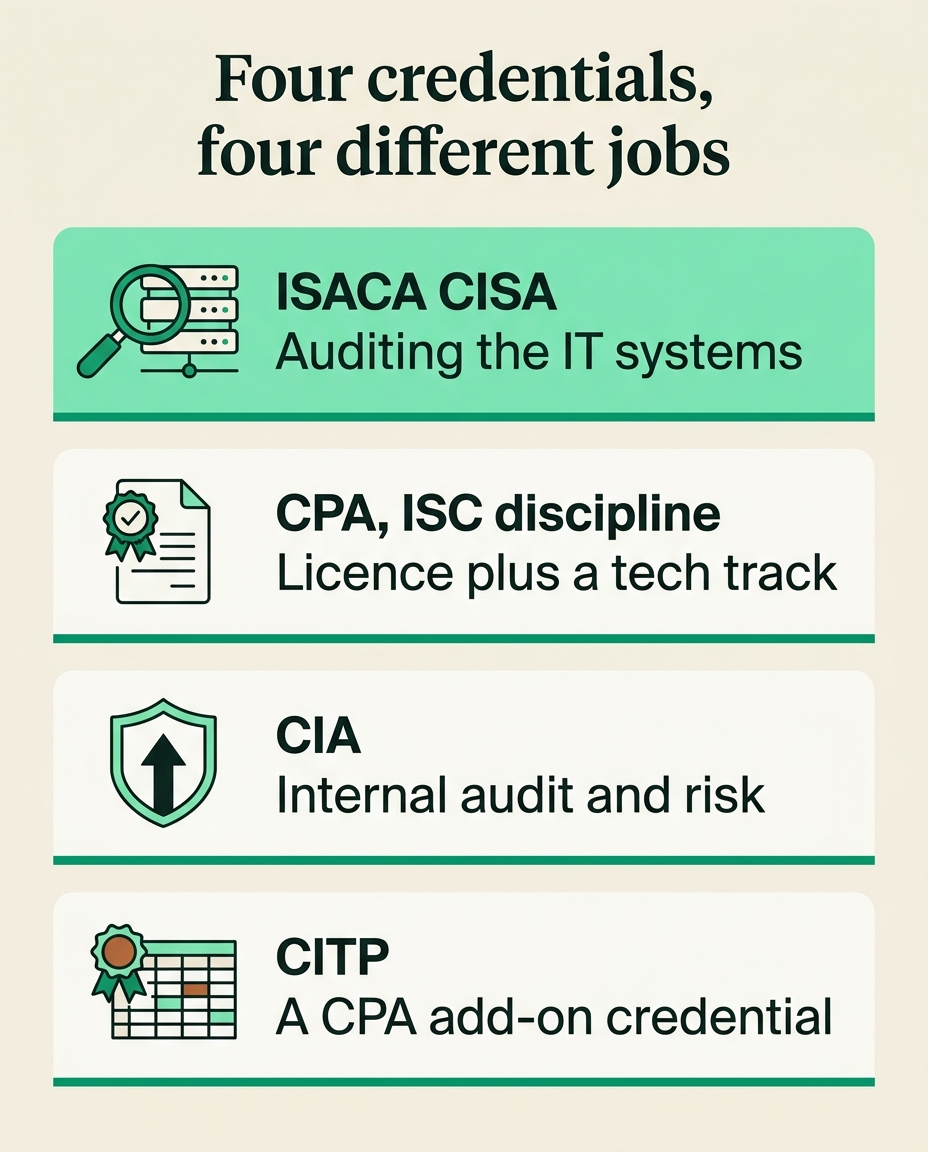
3. CIA (Certified Internal Auditor)
What it proves: that you can run an internal audit function: governance, risk management, control frameworks and the audit engagement itself.
The shape of it: three parts, issued by The Institute of Internal Auditors. Each part is scored on a scaled 250 to 750 range with 600 to pass.
The honest catch: the CIA is an internal audit credential with IT as one component, where ISACA CISA is an IT credential with audit as the frame. If your role is systems-first, the CIA is the wrong end of the telescope. If your role is process-first, it is the right one. Plenty of senior auditors hold both.
4. CITP (Certified Information Technology Professional)
What it proves: that you are a CPA with demonstrated technology expertise, across data management and analysis, IT governance, IT risk and controls, and SOC reporting.
The shape of it: issued by the AICPA. You need AICPA membership, an unrevoked CPA certificate, at least 1,000 hours of relevant business experience in the preceding five years, and the CITP exam. Recertification runs on 20 hours a year of CPD in CITP topics.
The shortcut worth knowing: the CITP exam is waived if you already hold ISACA CISA. If you are a CPA heading into technology work, passing one exam can put two credentials after your name.
The honest catch: it is gated behind a CPA certificate. If you are not on that path, this one is simply not available to you.
5. CRISC (Certified in Risk and Information Systems Control)
What it proves: that you can identify and manage IT risk and design the controls that answer it. Also ISACA, and it pairs naturally with SOX and enterprise risk work.
The honest catch: it is a risk credential, not an audit one. Most people who want CRISC want ISACA CISA first, because the auditing frame is what accounting employers screen for.
6. CompTIA Security+
What it proves: a working baseline in information security. Vendor-neutral, entry-level, and the most common first security certification anywhere.
The honest catch: it is not an accounting credential in any sense. Its value to an accountant is literacy: understanding what the security team means when they describe a control. Useful, cheap and fast, but it will not move you into IT audit on its own.
7. CISM (Certified Information Security Manager)
What it proves: that you can manage an information security programme. Also ISACA, and clearly senior.
The honest catch: a security leadership credential. It suits an accountant who has already crossed fully into a security or risk role, and it is the wrong first pick for anyone still working in audit or reporting.
The comparison in one table
| Credential | Issuer | Best fit | Prerequisite |
|---|---|---|---|
| ISACA CISA | ISACA | IT audit, SOX controls, systems risk | Documented IS audit experience to certify |
| CPA, ISC discipline | AICPA and state boards | Licensed accountants wanting a tech track | Full CPA pathway |
| CIA | The IIA | Internal audit and enterprise risk | Education and experience per The IIA |
| CITP | AICPA | CPAs specialising in technology | Unrevoked CPA certificate |
| CRISC | ISACA | IT risk and control design | Experience per ISACA |
| Security+ | CompTIA | Security literacy, career changers | None |
| CISM | ISACA | Security programme management | Experience per ISACA |
How to pick, in about a minute
- You are in audit and want to move toward systems. ISACA CISA. It is the term recruiters search on, and it is the one this whole category orbits.
- You are already a CPA and want technology credibility. ISACA CISA first, then claim CITP with the exam waiver. Two credentials, one exam.
- You are mid-CPA and choosing a discipline. ISC, if technology work is where you want to land. It is not a substitute for ISACA CISA later.
- You sit in internal audit and are staying there. CIA, with CRISC if your work is risk-heavy.
- You are changing careers into security entirely. Security+ first, CISM much later. Neither is an accounting credential.
- You are starting out, with no degree and no accounting background. Security+ is the only one of the seven with no degree or experience prerequisite, so it is the realistic first step. ISACA CISA, the CIA and the CITP all gate certification behind documented experience, and the CPA behind an education pathway.
What these credentials will not do for you
Being straight about this matters more than another bullet list of benefits.
None of these replaces a CPA licence where attest work legally requires one. A credential is not a licence, and no amount of IT audit expertise lets you sign something a licence is required to sign.
None of them is a shortcut past experience. ISACA, The IIA and the AICPA all gate certification behind documented work, so passing the exam is a milestone rather than the finish line.
And none of them turns an accountant into an engineer. ISACA CISA proves you can evaluate whether a system's controls work. It does not claim you can build the system, and pretending otherwise in an interview is a fast way to lose one.
None of them is free, either, despite how often "free accounting IT certifications" gets searched. Exam fees run from the low hundreds for Security+ up to US$575 or US$760 for ISACA CISA, before training materials or membership dues. What is genuinely free is the practice: take a free diagnostic to find your weak domains before you commit to an exam fee.
FAQ
What is an IT accountant?
Not a formal job title so much as a description of accountants whose work sits on the systems side: IT auditors, SOX controls testers, ERP and financial-systems specialists, and risk professionals who assess technology controls. The credential most associated with that work is ISACA CISA.
Is ISACA CISA the same as the government CISA agency?
No. ISACA CISA is the Certified Information Systems Auditor credential from ISACA. The Cybersecurity and Infrastructure Security Agency is a United States federal agency that shares the abbreviation and does not issue credentials for accountants. Always write or say "ISACA CISA" to keep them apart.
Are accounting IT certifications worth it?
They are worth it when they match a job you actually want, and not otherwise. ISACA CISA is the clearest case, because IT audit and controls postings name it directly, which is a specific signal rather than general polish. A credential with no matching role in your plan is an expense with a renewal schedule attached.
Can a CPA make $200,000 a year?
Some do, but it is a function of role and seniority rather than of any certificate. People at that level are typically partners in public accounting, senior finance leaders such as controllers and CFOs, or specialists in high-demand advisory work. It is not typical mid-career pay, and no certification on this list produces it on its own. For published wage distributions rather than anecdotes, check the US Bureau of Labor Statistics.
Can you make $500,000 a year as an accountant?
It happens, and almost always in one of two places: equity partnership in a public accounting firm, or a senior executive finance role at a large company. Both take many years and rest on ownership or leadership scope, not on credentials. Treat any page that attaches a figure like that to a specific certification as marketing rather than data.
Which comes first, the CPA or ISACA CISA?
If you are on the CPA pathway, finish it. The licence opens doors no certification does. If you are not on that pathway, or you are already licensed, ISACA CISA is the most direct next step for systems and audit work, and it also waives the CITP exam if you later want that credential too.
Can I sit the ISACA CISA exam before I have the experience?
Yes. ISACA lets you take the exam first and apply for certification once you can document the required experience. Many candidates sit it while still accumulating the years, which is worth knowing if you are early in your career and want the exam behind you.
Should a CPA candidate choose the ISC discipline?
Choose it if technology, controls and SOC work is where you want your career to go. It covers IT and data governance, information security, and testing controls over business processes. If your intended path is tax or reporting, one of the other disciplines fits better and you can always add ISACA CISA later.
Related on PrepClubs
- Is the ISACA CISA worth it?
- ISACA CISA practice questions: what to pay and why auditor judgment matters
- Free ISACA CISA practice test
- ISACA CISA practice track
- CISSP practice track
Ready to sit the one that counts?
If ISACA CISA is the credential on your list, the exam rewards auditor judgment rather than recall, so the practice has to teach reasoning and not definitions. The PrepClubs ISACA CISA track is 1,525 original scenario questions across 11 tests, 10 full-length timed mocks plus a free diagnostic you can take before paying anything, with every domain weighted the way ISACA weights it and a written rationale on each item. It is $99 as a one-time payment with 30 days of access, not a subscription that renews on you. If you prepare with PrepClubs and do not pass your real test, we extend your access at no extra cost. No fine print, no satisfaction-guarantee hedge. PrepClubs has helped more than 1,600 students prepare for cognitive and certification assessments. Get ISACA CISA access.
PrepClubs writes original practice questions and is not affiliated with, endorsed by or partnered with ISACA, the AICPA, The Institute of Internal Auditors or CompTIA.