Free CCAT Practice Test 2026: 50 Questions in 15 Minutes, Timed
A free CCAT practice test only helps if you treat it like the real exam. Here is what a real CCAT practice test contains, four worked sample questions across math, verbal, logical, and spatial reasoning, plus a raw-to-pe

Take a free, timed CCAT practice test. Run a full 50-question, 15-minute Criteria Cognitive Aptitude Test set on PrepClubs, scored the moment you finish, then use the walkthroughs and percentile bands below to see exactly where you stand against employer cutoffs. Start the free CCAT practice test.
The honest answer is that most candidates who download a free CCAT practice test the night before fail by 20 raw-score points. Not because the test is unfair, but because they used the practice the wrong way. The Criteria Cognitive Aptitude Test gives you 50 questions in 15 minutes. That is 18 seconds per question if you split it evenly, and the items get harder as you go. A practice test only helps if you treat it like the real one: full timer, no calculator, no Googling halfway through. This article shows you what a real CCAT practice test contains, walks through four sample questions across the four categories, and gives you a way to score yourself against the same percentile bands employers like Vista Equity and Crossover use to filter candidates.
Quick takeaways
- The CCAT is 50 questions in 15 minutes. The standardization sample mean is 24.2 with a standard deviation of 8.58, so a raw score of 24 puts you at the median.
- A raw score of 31 maps to roughly the 80th percentile and is the informal "passing" threshold most employers anchor to.
- Vista Equity Partners portfolio companies and Crossover roles typically cut at 35 to 42 raw, depending on level. A raw 40 puts you in the top 1 to 2 percent.
- The 50 questions split roughly: 17 to 18 math, 17 verbal, 11 to 12 spatial, and 3 to 5 logical reasoning items.
- Very few candidates finish all 50 items. The CCAT is designed so the last 10 items are hard enough that a top performer answers most but not all.
- A free practice test is only useful if you take it under exam conditions and score yourself against the published bands. Reading the answer key after a few questions is the most common practice-test mistake.
What a real CCAT practice test contains
A practice test that mimics the real CCAT has to match three things: the question count, the timer, and the mix of question types. Many free practice tests floating around contain 20 to 30 questions, which feels like a sample but does not train the timing instinct that decides the score. The real CCAT runs the timer down to zero whether you are on question 12 or question 45, and you cannot go back.
Question type ratios from the Criteria Corp official format and confirmed by every published score breakdown:
- Math and numerical reasoning, including number series, word problems with ratios and percentages, and basic algebra. About 17 to 18 items.
- Verbal reasoning, including analogies (the SALMON is to FISH pattern), antonyms, sentence completion, and reading comprehension snippets. About 17 items.
- Spatial reasoning, including pattern completion grids, paper folding, and rotation. About 11 to 12 items.
- Logical reasoning, including syllogism-style "assume the statements are true" items. About 3 to 5 items.
A practice test missing any of these categories is not a CCAT practice test, it is a generic cognitive sampler. The Crossover and Vista screening windows lean on the math and spatial sections, because those are the items most candidates lose under time pressure.
The chart below shows the rough difficulty arc of the real test, with how many seconds per item you have if you want to leave 60 seconds of buffer at the end.

Walk through four sample CCAT questions
The four worked examples below sit in the middle of the difficulty range. Try each one with a stopwatch before you read the explanation. If you cannot solve any of them in under 25 seconds, the bottleneck is recognition speed, not knowledge.
For 10 worked samples across all four CCAT sections (verbal, math, logic, spatial) with the rule for each, see CCAT Sample Questions: 10 Real Examples Walked Through.
Four real questions from our newest CCAT practice test
The walkthroughs above explain the method. These four are real items from CCAT Practice Test 15, the newest form in our bank, with the answer and the reasoning. Give yourself 18 seconds each.
Question 4 of 50 (spatial). Which shape completes the sequence?
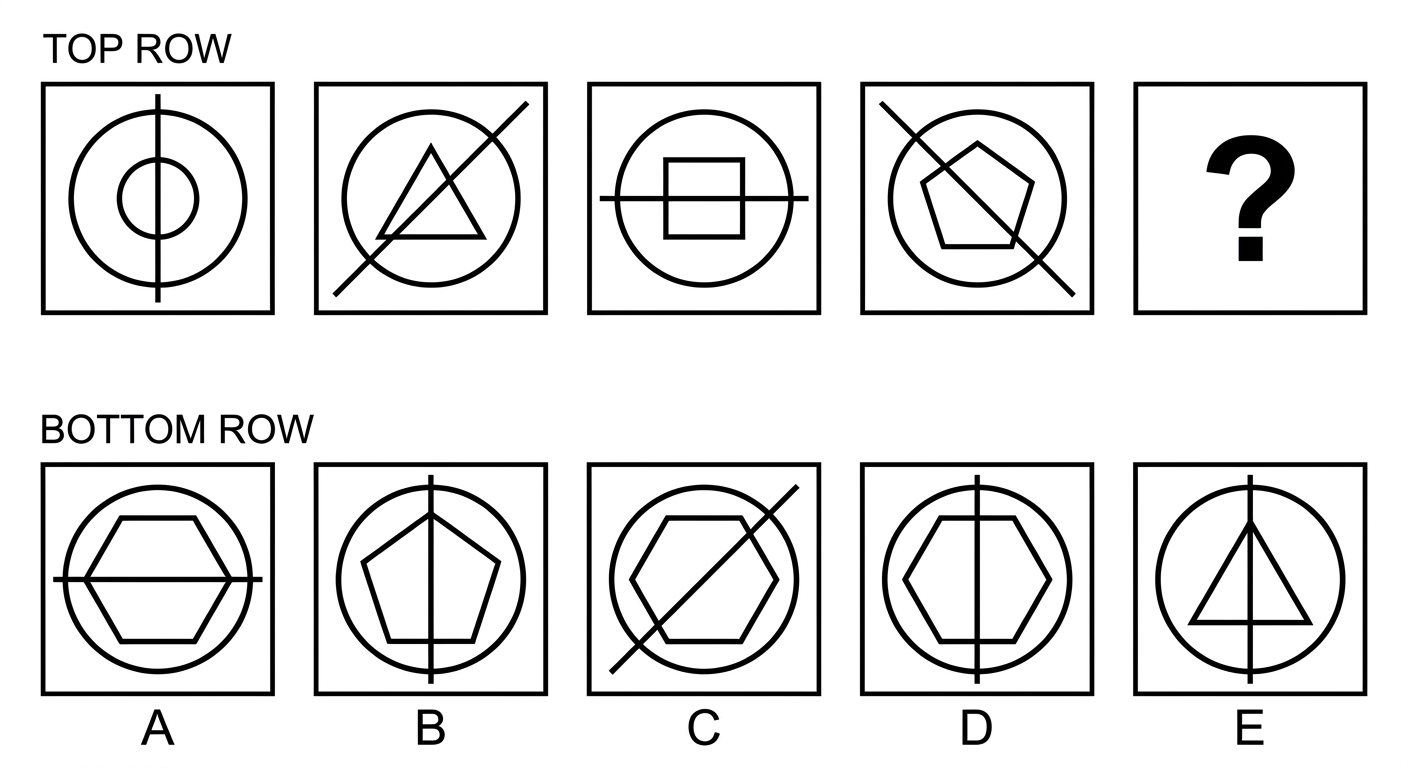
Answer: D. Two things change together. The inner shape gains a side each step (circle, triangle, square, pentagon), so the fifth is a hexagon. The line turns a step clockwise each time (upright, leaning right, flat, leaning left), so it comes back to upright. Only D is a hexagon with an upright line. A has the right shape but a flat line, and B has the right line but a pentagon.
Question 26 of 50 (math). An item costs $84 including 5% tax. What was the pre-tax price?
A) $76 B) $78 C) $79 D) $80 E) $82
Answer: D) $80. The $84 is 105% of the price, so divide by 1.05. The trap is to take 5% off $84, which gives $79.80 and pulls you toward C.
Question 31 of 50 (logic). Four siblings, Ann, Bob, Cal and Dee, are aged 5, 8, 11 and 14, not in that order. Bob is the oldest. Cal is the youngest. Ann is older than Dee. How old is Dee?
A) 8 B) 5 C) 11 D) 14 E) Cannot determine
Answer: A) 8. Bob is 14 and Cal is 5, which leaves 8 and 11 for Ann and Dee. Ann is older, so Dee is 8.
Question 43 of 50 (letter series). What comes next: A, C, F, J, O, ?
A) R B) S C) T D) U E) V
Answer: D) U. The gaps grow by one each time: skip 1 letter, then 2, then 3, then 4. Skipping 5 letters after O (P, Q, R, S, T) lands on U.
How practising candidates actually use the 15 minutes
Our PrepClubs Research series re-grades every scored CCAT practice attempt. Across 189 analysed attempts, three numbers explain most of the gap between a first practice score and a target score:
- About a fifth of the paper is never answered. Candidates left 20.6% of all CCAT items blank, rising to 60.6% of the final ten questions (How much of a timed aptitude test is never answered). Because there is no penalty for a wrong answer, guessing those blanks is worth about 2 raw points on its own.
- The paper is a ramp. Among attempts that answered every item, accuracy was 81.7% on the first ten questions and 45.3% on the last ten (Which aptitude tests are built as a difficulty ramp). A practice test that felt easy for ten minutes is not evidence of a good score.
- The median practice score is 27 out of 50. The middle half of practising candidates scored between 22 and 34, and the 90th percentile was 41 (What candidates actually score on aptitude practice tests). These are raw scores on PrepClubs practice forms, not official Criteria scores, but they tell you where you stand against people preparing for the same test.
Sample CCAT math question
A delivery driver receives 8 packages per hour during her shift. How many packages does she handle over a 12-hour double shift?
A. 80 B. 84 C. 88 D. 92 E. 96
Show answer and explanation
Correct answer: E (96)
12 hours times 8 packages per hour equals 96 packages. Notice the trap: the test is checking whether you read "per hour" and "12-hour shift" correctly, not whether you can multiply. Candidates who scan the question for the most prominent number and multiply by the most prominent other number often pick 88, which is the kind of distractor the CCAT inserts to catch skimmers.
Sample CCAT verbal analogy
OAK is to TREE as….
A. SCALPEL is to TOOL B. NITROGEN is to ATOM C. SEDAN is to TRUCK D. PLANT is to OAK E. VELOCITY is to RUN
Show answer and explanation
Correct answer: A (SCALPEL is to TOOL)
The relationship is specific-to-general. An OAK is a specific kind of TREE. A SCALPEL is a specific kind of TOOL. Option D reverses the direction. Option C compares two siblings (sedan and truck are both vehicles, not a specific-and-general pair). The CCAT verbal section rewards you for naming the relationship in your head before scanning the options, not for picking the option that sounds vaguely related.
Sample CCAT logical reasoning question
Assume the first two statements are true.
Is the final statement true, false, or uncertain based on the information provided?
Statement 1: Priya solely had the fastest race time in the meet.
Statement 2: Marcus had a slower race time than Priya.
Final statement: Marcus did not have the fastest race time.
A. True B. False C. Uncertain
Show answer and explanation
Correct answer: A (True)
The word "solely" in Statement 1 is the lock. If Priya solely had the fastest time, nobody else tied or beat her. Marcus, having a slower time than Priya, cannot have had the fastest time either. The CCAT logical items are usually solvable in 10 to 15 seconds once you spot the operative word. Don't overthink them.
Sample CCAT spatial reasoning question
Spatial reasoning items on the CCAT show a pattern of figures with one missing slot, marked by a question mark. Your job is to pick the option that completes the pattern.
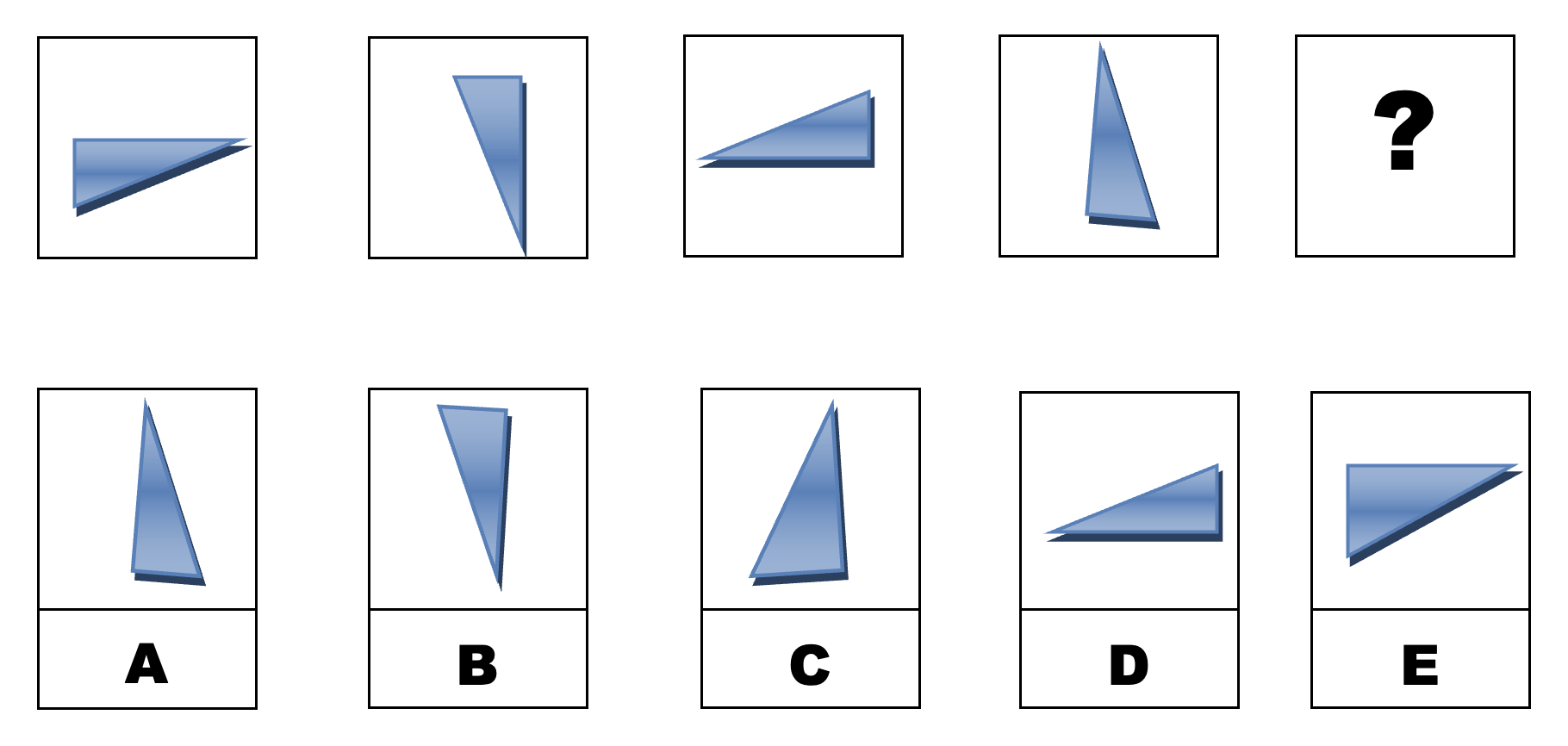
These appear roughly 5 to 7 times on a typical CCAT and are best approached by identifying the rule (rotation, reflection, sequence) before scanning the options. The rule on most of them is simpler than candidates assume, but the time pressure makes pattern recognition slower than usual. We deliberately do not reveal the answer here. Work through a few of these in our full CCAT practice test bundle with worked solutions for every item, so you can build the rule-spotting reflex.
CCAT score bands and what each one means at hiring time
After you finish your practice test, scoring it correctly is the second half of the work. The published Criteria Corp norms convert raw score to percentile against the standardization sample. The table below summarizes the bands most candidates need, plus the role-level cutoffs that show up most often in our CCAT cutoffs analysis of 30+ confirmed employers.
| Raw score (out of 50) | Approximate percentile | What it signals at hiring |
|---|---|---|
| 16 to 20 | 20th to 35th | Below typical screening threshold. Service and entry-level positions only. |
| 21 to 25 | 36th to 55th | Median band. Acceptable for many sales and operations roles, weak for analytical roles. |
| 26 to 30 | 56th to 75th | Solid for most administrative and customer-facing analyst roles. |
| 31 to 35 | 76th to 90th | The informal "pass" zone. Threshold for most management trainee programs and Crossover engineering screens. |
| 36 to 40 | 91st to 98th | Vista Equity portfolio companies and senior consulting screens. Comfortable margin for technical roles. |
| 41 to 50 | 99th+ | Exceptional. Very few candidates reach this band even after multiple retakes. |
The infographic below visualizes the same data as a vertical bar chart so you can see how steep the curve is between the 75th and 90th percentile.

If you scored in the 21 to 25 raw band on your first practice, that is the median. Most candidates can move 6 to 10 raw points with two weeks of focused practice. Moving from 30 to 40 is much harder, and usually requires drilling on the spatial section specifically because that is where time bleeds out fastest.
The 7-day plan to use your CCAT practice test right
A practice test taken once and forgotten is wasted. The plan below maps how to extract the most signal from each practice attempt across a week.
Day 1: Take a full 50-question practice under timed conditions. No pauses, no calculator, no looking up. Score it honestly and note your raw and approximate percentile.
Day 2: Review only the questions you got wrong. For each one, write a one-line note: was the failure speed, knowledge, or recognition? Most candidates discover 70 percent of their misses come from speed and recognition, not knowledge.
Day 3: Drill the weakest category for 30 minutes. If your math section is the bottleneck, focus on number series and ratio word problems. If spatial is the bottleneck, drill paper-folding and rotation patterns.
Day 4: Half-length practice (25 questions, 7.5 minutes). The goal is to keep the timing instinct sharp without burning out.
Day 5: Drill the second-weakest category for 30 minutes.
Day 6: Full 50-question practice again. Compare to Day 1.
Day 7: Rest. Stress eats raw score. Going into the real test sleep-deprived costs 3 to 5 raw points.
This is the version of the plan we use for paid prep on PrepClubs, condensed. The CCAT honest-difficulty walkthrough covers the deeper reasoning for why the spatial section is so often the bottleneck.
For the day-by-day version of this plan with drill volumes and per-day target raw scores, see the full CCAT 7-day prep plan.
Mistakes that ruin your CCAT practice score
Three habits show up in candidates who plateau below their target.
The first is reading the answer key while taking the test. The practice is meaningless if you peek. Treat it like a real screen.
The second is skipping the verbal section in prep because it "feels easy." Verbal looks lighter than math but the analogies and reading comprehension items are dense, and candidates who skim them lose 4 to 6 raw points to careless picks.
The third is overpracticing one source. The CCAT publisher does not release all 50 official items, so most practice tests are reconstructions. Drilling the same 200 items repeatedly trains your memory of the test, not your reasoning. The fix is to rotate sources every other day so you do not pattern-match on specific items.
For the full raw-to-percentile lookup with role-specific Vista Equity cutoffs, see CCAT score explained: bands, percentile, and cutoffs by role.
FAQ
Is there an official CCAT practice test?
Criteria Corp publishes a small set of sample questions on the official site, but does not release a full 50-question practice version. Every full-length practice test online is a reconstruction. The reconstructions vary in quality. A good reconstruction matches the time limit, question count, and category ratios. The reconstructions linked from competitor prep sites that hide the timer or sneak in a calculator are not useful.
How many CCAT practice tests should I take before the real one?
Two full-length practice tests plus four to six section drills is the sweet spot for most candidates. More than four full tests starts to feel like memorization rather than reasoning, and candidates report worse outcomes when they over-train. The compound effect comes from spacing the tests at least 48 hours apart, with review and drill sessions in between.
Can I use a calculator on a CCAT practice test?
You should not, because you cannot use one on the real CCAT. The math section is designed to be solvable without a calculator if your mental arithmetic is sharp. Practicing with a calculator gives you a score that does not transfer to the real test environment.
What is a good score on a CCAT practice test?
A raw 31 on a well-built practice test puts you in the same zone as the 80th percentile on the real CCAT, which is the informal "passing" threshold most employers anchor to. For Vista Equity portfolio companies and Crossover roles, aim for raw 35 to 42 to have margin. For a generic operations role, raw 24 to 28 is often enough. The honest target depends on the employer.
Does the CCAT get harder as you go?
Yes. The first 10 to 15 items are calibrated to feel approachable. Items 25 through 40 are the meat. Items 41 to 50 are designed so that top performers answer most but not all of them, which is how the test discriminates the 95th percentile from the 99th. The pacing trap is rushing the early items to "save time," because every minute saved on items you would have answered correctly anyway costs you on the hard items where time matters.
How long should I prepare for the CCAT?
Five to seven days for most candidates is enough to move from a cold-start score to a defensible target. Less than three days rarely moves the needle. More than two weeks shows diminishing returns once you have covered the four categories and taken two full practice tests. The deeper prep playbook is in the cluster pillar at /tests/ccat.
Will I get my CCAT score afterwards?
The CCAT raw score is reported to the employer, not to you. Some employers share it during feedback, most do not. The percentile band is what matters for hiring decisions, and most candidates can infer their band from how many items they completed and how confident they felt on the late items. The PrepClubs cognitive-test scoring guide covers how to interpret different employer scoring conventions across CCAT, Wonderlic, and PI Cognitive.
Related on PrepClubs
- Pillar. The CCAT test page. Score bands, format, employer cutoffs, and practice access in one place.
- Deep practice. Full CCAT practice with worked solutions. One-time payment. Money-back Guarantee.
- Difficulty. How Hard Is the CCAT, Really?. The honest answer about where candidates lose points.
- Companies. Companies That Use the CCAT. Vista Equity portfolio and 30+ confirmed employers.
- Guide. What Is a Good Cognitive Test Score?. Per-test benchmarks across CCAT, Wonderlic, PI Cognitive, and more.
Practice on PrepClubs
Full-length CCAT practice with the same 15-minute timer the real test uses.
The PrepClubs CCAT bundle gives you 10 full-length 50-question practice tests, every item with a worked solution, plus category-specific drill sets for math, verbal, spatial, and logical reasoning. Built for the Vista Equity and Crossover cutoff levels. One-time payment. Backed by our Money-back Guarantee. Current pricing is on the pricing page.
Practise for this exam
CCAT practice tests
Timed practice tests in the real CCAT format, with a worked explanation for every question, so you learn the method as well as the answer.