The SHL Test in 2026: Verify G+, OPQ, Numerical, and Verbal
What the SHL test actually is in 2026: the adaptive Verify G+ General Ability test, the OPQ personality questionnaire, and the numerical and verbal reasoning sections. How each is formatted, timed, and scored, where you

"The SHL test" is rarely one test. SHL is the company behind a suite of assessments, and when an employer says they are sending you "the SHL test," they usually mean some combination of the Verify G+ cognitive test and the OPQ personality questionnaire, often with a numerical or verbal module on top. Knowing which piece you are facing changes everything about how you prepare, because one is a timed, adaptive reasoning test you can train for, and another is an untimed personality inventory you mostly should not try to game. This page lays out each part as it works in 2026: the format, the timing, the scoring, and where in a hiring process you tend to meet it.
Quick takeaways
- "The SHL test" usually means the Verify G+ General Ability cognitive test, the OPQ personality questionnaire, or both, sometimes with a standalone numerical or verbal module.
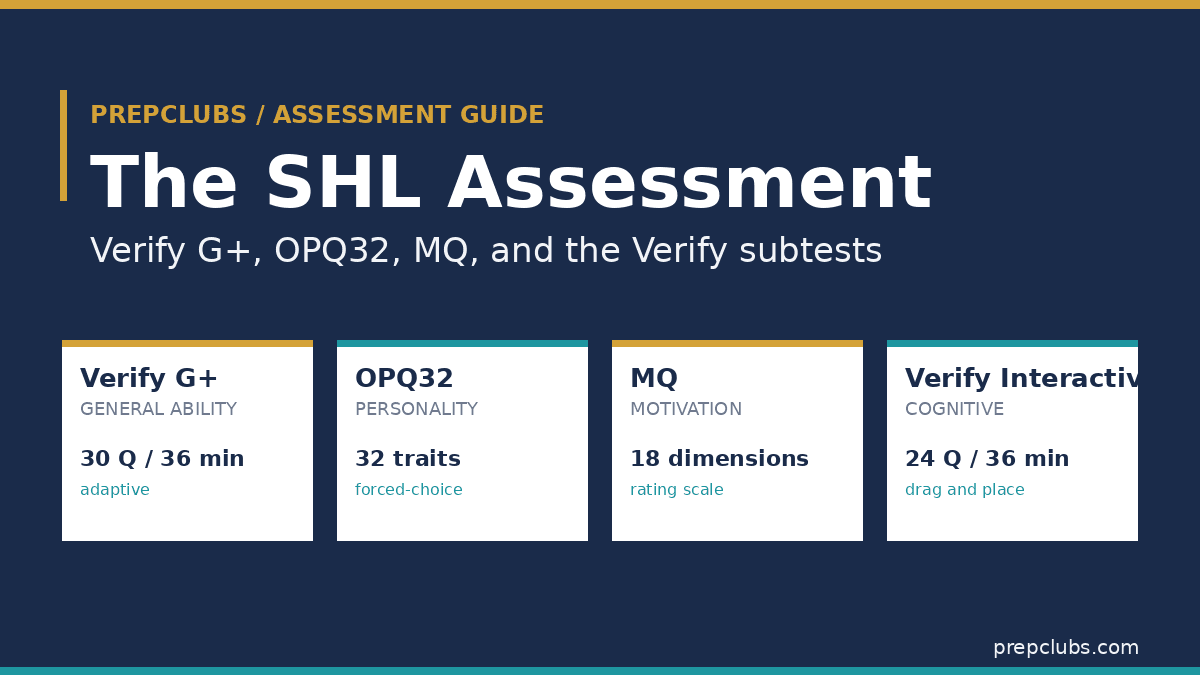
- Verify G+ is adaptive and timed: 30 questions in the multiple-choice version or 24 in the Interactive version, both with a 36-minute limit.
- The cognitive sections are numerical, inductive, deductive, and verbal reasoning. General Ability blends them; modular subtests isolate one each.
- Cognitive results are reported as a percentile or sten against a comparison group, not as a raw mark, because the test adapts.
- The OPQ is not timed and has no right answers; it profiles work style across roughly 30 traits and is read for fit, not pass or fail.
- There is no universal pass mark on the cognitive side. The cutoff is set per role, and competitive roles often screen around the 50th to 70th percentile or higher.
What the SHL test actually is
SHL does not sell a single product called "the SHL test." It licenses a library of assessments to employers, who pick a combination for each role. For a fuller tour of the suite and how the pieces fit, read SHL Assessment: All the Tests Explained. In practice, three things account for the overwhelming majority of what candidates are sent.
The first is Verify G+, the General Ability cognitive test, which is the part most people mean when they talk about "passing" the SHL test. The second is the OPQ, a personality questionnaire that produces a profile rather than a score. The third is a standalone reasoning module, usually numerical or verbal, that an employer adds when the role leans heavily on one skill. The cognitive pieces are gradeable and trainable; the personality piece is not gradeable in the same way. That distinction is the single most useful thing to hold in your head.

Verify G+ General Ability: format and timing
Verify G+ is the flagship cognitive test, and it is adaptive, which means the difficulty of each question adjusts to how you have answered so far. Get items right and the test serves harder ones; miss them and it eases off. Your final score reflects the difficulty of what you handled, not a simple count of correct answers.
There are two versions. The multiple-choice version runs 30 questions; the Interactive version, which uses drag-and-drop and other on-screen formats designed to be harder to coach, runs 24. Both share a 36-minute limit. That works out to a little over a minute per question, but the adaptive design means you cannot flag a hard item and circle back the way you would on a fixed-form paper test. The decision is in the moment: commit and move. For the full pillar breakdown of format, scoring, and prep paths, see the SHL Verify G+ General Ability overview.
For the deeper breakdown of Verify G+ specifically (the per-section question split, the score-band-to-employer-tier table, and a 5-day prep plan calibrated to 72-second pacing), see SHL General Ability Test: Format and Cutoffs.
The four reasoning sections
General Ability blends four reasoning types into one combined score, while the modular Verify subtests isolate one each. Knowing what each section rewards is what turns blind practice into useful practice. We give one worked sample for each in SHL Practice Tests: Free Walkthroughs by Section.
Numerical reasoning gives you a chart or table and asks a calculation, usually a percentage, ratio, or rate; it rewards reading the right figures fast and skipping the steps that do not matter. Inductive reasoning shows a sequence of shapes or numbers and asks what comes next; it rewards finding the single underlying rule rather than testing many. Deductive reasoning gives you statements and a conclusion and asks whether the conclusion necessarily follows; it rewards strict logic over plausibility. Verbal reasoning gives you a passage and a statement to mark True, False, or Cannot say based only on the passage; it rewards disciplined reading and ignoring outside knowledge.
OPQ: the personality questionnaire
The OPQ, or Occupational Personality Questionnaire, is the part of the SHL test that trips people up because they treat it like an exam. It is not timed, there are no right or wrong answers, and it profiles your work style across roughly 30 traits, grouped into how you relate to people, your thinking style, and how you handle feelings and pressure. Employers read it for fit against a role, not as a pass-fail gate.
The temptation is to answer as the "ideal" candidate, but the OPQ is built with forced-choice formats and consistency checks that make heavy gaming visible and counterproductive. The better approach is to answer honestly and consistently, having read the role first so you understand which of your genuine traits are most relevant. Trying to be all things at once tends to produce a flat, internally contradictory profile that helps no one.
How the SHL test is scored
On the cognitive side, your result is not a raw count out of 30. Because Verify is adaptive, the score reflects the difficulty of the items you answered correctly, and it is reported as a percentile or a sten against a comparison group. A percentile of 70 means you outperformed 70 percent of that norm group. There is no universal pass mark; the cutoff is set per role, and competitive graduate and commercial roles often screen around the 50th to 70th percentile, with the most selective employers higher. For how that compares across tests, see what is a good cognitive test score.
The infographic below summarizes the components, their formats, and how each is scored.

The OPQ is scored differently: it produces a trait profile, sometimes summarized against a competency model the employer cares about, but it is not a percentile you pass or fail. Two candidates with very different profiles can both be a strong fit for different roles.
Timing and pacing: what the 36 minutes demands
The 36-minute cognitive limit, spread across 24 to 30 questions, gives you roughly a minute to ninety seconds per item, but the adaptive structure changes how you should spend it. A slow correct answer and a fast correct answer score the same, while a question you never reach scores nothing, so the worst outcome is stalling on one awkward item and running out of clock before easier points later.
The most common pacing mistake is over-investing in a single numerical question with a fiddly chart. If the figures are not yielding in about a minute, take your best estimate and move on. Inductive and verbal items are usually quicker, so banking those keeps your average on track. Practising with the clock running, not off, is the only way to make that instinct automatic.
Where you will meet the SHL test
The SHL test usually appears early, as a screen after your application and before any interview, which is why so much hangs on it: a low cognitive percentile can end an application before a human reads your CV closely. Large graduate schemes, banks, consultancies, and many commercial and tech employers use it at volume. The OPQ tends to come slightly later or alongside the cognitive test, and its results often feed into a structured interview rather than acting as a hard gate.
How to prepare
Prepare the two halves differently. For the cognitive side, practise timed and by section, and review why each answer is correct rather than just checking it. Identify your weakest reasoning type, usually numerical under time pressure, and drill it until the setup is automatic, then do full-length timed sets so the per-question pace feels normal. For full-length, adaptive-style practice with worked walkthroughs for every item, work through our SHL General Ability practice.
For the OPQ, the preparation is reading, not drilling: understand the role, reflect on your genuine work style, and answer honestly and consistently. If you are weighing SHL against another cognitive test you may face, CCAT vs SHL General Ability lays out how the two differ in format and difficulty.
FAQ
What is the SHL test?
It is not one test but a suite. In practice "the SHL test" usually means the Verify G+ General Ability cognitive test, the OPQ personality questionnaire, or both, sometimes with a standalone numerical or verbal reasoning module added for the role.
How long is the SHL test?
The Verify G+ cognitive test has a 36-minute limit, with 30 questions in the multiple-choice version or 24 in the Interactive version. The OPQ is not timed and typically takes 25 to 45 minutes to complete thoughtfully.
Is the SHL test hard?
The cognitive test is demanding mainly because of pace and the adaptive difficulty, not because any single question is exotic. Timed, by-section practice with review is what makes it manageable. The OPQ is not hard in the same sense, since it has no right answers.
How is the SHL test scored?
The cognitive test is scored as a percentile or sten against a comparison group, not as a raw mark, because it adapts. There is no universal pass mark; the cutoff is set per role. The OPQ produces a trait profile rather than a pass-fail score.
What is a good SHL score?
There is no fixed number, but competitive graduate and commercial roles often screen around the 50th to 70th percentile, and the most selective employers higher. Because the cutoff is set per role, the practical target is to land above the band your specific employer uses.
Can you practise for the SHL test?
Yes, for the cognitive parts. Timed, by-section practice with worked review reliably improves both speed and accuracy. The OPQ cannot be practised in the same way; the right preparation there is honest, consistent answering informed by the role.
What is the difference between Verify G+ and the OPQ?
Verify G+ is a timed, adaptive cognitive test that produces a percentile you can be screened on. The OPQ is an untimed personality questionnaire that produces a work-style profile read for fit, not a pass-fail score.
Is the SHL test multiple choice?
The multiple-choice version of Verify G+ is. The Interactive version uses drag-and-drop and other on-screen response formats designed to be harder to coach, and it has fewer questions, 24 against 30, within the same 36-minute limit.
Related on PrepClubs
-
Pillar. SHL Verify G+ General Ability overview and prep. The full pillar page with format, scoring, and prep paths.
-
Suite. SHL Assessment: All the Tests Explained (Verify G+, OPQ, MQ). What each test in the SHL suite is and how it is scored.
-
Practice. SHL Practice Tests: Free Walkthroughs by Section. One worked sample for each Verify reasoning section.
-
Compare. CCAT vs SHL General Ability. How the two cognitive tests differ in format and difficulty.
-
Guide. What is a good cognitive test score: per-test benchmarks. Cross-test benchmarks including SHL, CCAT, Wonderlic, and Watson-Glaser.
-
All sections. SHL Psychometric Test: All Sections Explained. The three pillars of the SHL battery, cognitive, personality, and situational judgement, with how each is scored and which combinations employers use.
Practice on PrepClubs
Full-length SHL Verify practice, timed and by section.
The cognitive half of the SHL test is the part you can train, and a handful of explained questions beats a hundred rushed ones. Our SHL practice runs numerical, inductive, deductive, and verbal items at the real adaptive timing, with a worked walkthrough for every question so you learn the method, not just the answer. $49 one time. Pass Guarantee.
FAQ